

Constantly Tired Despite Getting Enough Sleep: What Is Really Behind It
Do you feel constantly tired despite getting enough sleep? The causes are often far more complex than a single bad night and usually lie deep beneath the surface. Often, invisible factors such as undetected nutrient deficiencies or hormonal imbalances gradually drain your body's energy.
Understanding the Mystery of Constant Tiredness

Do you wake up in the morning feeling as though you have been up all night? Although the clock confirms that you got eight hours of sleep, you struggle through the day exhausted. If this feeling sounds familiar, you are definitely not alone. Many people suffer from this unexplained exhaustion, which drifts through everyday life like a thick fog and noticeably diminishes their quality of life.
This phenomenon is more than just a temporary energy slump. It is a clear signal from your body that something is out of balance. The reasons are often invisible and cannot simply be remedied by another hour of sleep. Imagine your body as a finely tuned orchestra—if just one instrument is out of tune, the entire symphony sounds off.
Why More Sleep Isn't Always the Solution
The simple assumption that tiredness is always due to lack of sleep often falls short. In reality, the causes may be hidden deep within your biochemistry. Instead of merely fighting the symptoms, for example with the next cup of coffee, it is crucial to identify the true roots of the problem.
Possible invisible energy drains include:
- Nutrient deficiencies: A deficiency in important vitamins and minerals such as iron, vitamin B12, or vitamin D can effectively bring your body's energy production to a standstill.
- Hormonal fluctuations: Your thyroid, stress hormones, or sex hormones can become imbalanced and lead to persistent exhaustion.
- Disrupted sleep quality: You may spend enough time in bed, but unnoticed issues such as pauses in breathing during the night or poor sleep architecture prevent the restorative deep-sleep phase.
- Silent inflammation: Undetected food intolerances can trigger chronic inflammatory processes in the body that constantly drain your energy.
With mybody®, you gain in-depth insights into your women’s health—from hormones and nutrients to your metabolism. This helps you understand what your body really needs to feel comfortable, balanced, and healthy in everyday life.
Here is a brief overview that can help you find some initial clues.
Quick overview of possible causes of fatigue
Find out which invisible factors could be draining your energy despite getting enough sleep.
| Possible cause | Typical symptoms | Suitable mybody-x test |
|---|---|---|
| Nutrient deficiency | Paleness, concentration problems, susceptibility to infections | Nutrient test |
| Hormonal imbalance | Mood swings, menstrual cycle problems, unexplained weight gain | Hormone test |
| Underactive thyroid | Feeling cold, hair loss, depressed mood, dry skin | Thyroid test |
| Disrupted gut flora/intolerances | Digestive problems, bloating, skin problems | Food intolerance test |
| Sleep apnea | Loud snoring, pauses in breathing, headaches in the morning | Medical evaluation (sleep laboratory) |
This table provides an initial guide. For an accurate diagnosis, it is important to investigate the individual causes.
A widespread problem in Germany
The figures confirm that this feeling of exhaustion is anything but rare. According to the Robert Koch Institute’s “Health in Germany—Current” (GEDA) study, around 29.7% of adults suffer from at least mild to moderate fatigue. Young adults and women are particularly affected. To better understand the complex phenomenon of tiredness despite getting enough sleep, further perspectives may be helpful.
Instead of continuing to grope in the dark and resigning yourself to the fatigue, you can now take action. Targeted at-home self-tests—whether for nutrients, hormones, or intolerances—give you the opportunity to get to the bottom of these invisible causes. They provide valuable data directly from your body and help you regain your energy in a targeted way.
Identify your internal energy drains
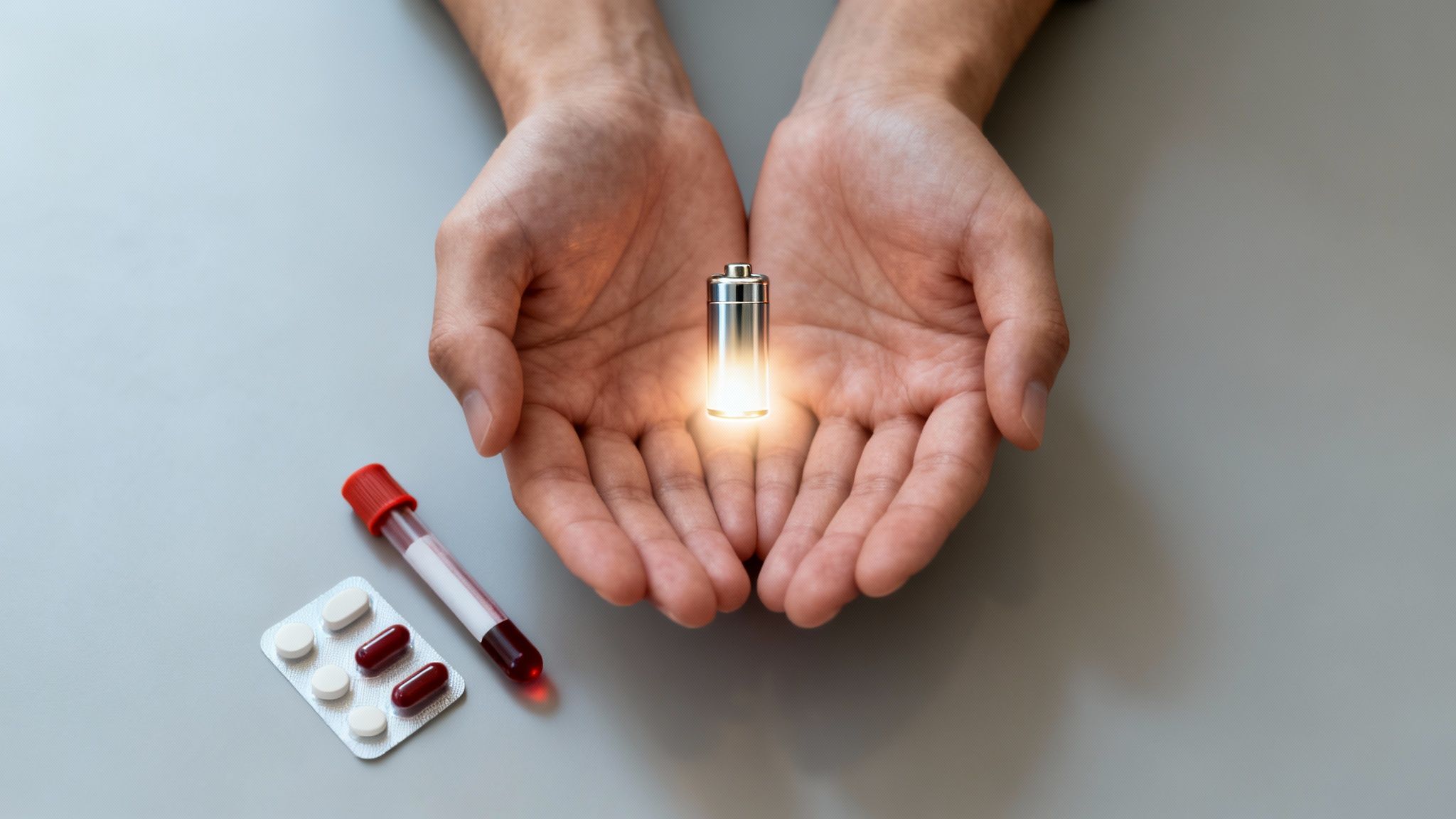
You get enough sleep, eat sensibly, but still feel like you’re on autopilot every day? If you’re constantly tired despite an apparently healthy lifestyle, the answer is often hidden deeper—in your body’s biochemistry. Simply imagine your body as a highly advanced power plant.
This power plant requires very specific raw materials to generate energy smoothly. If these essential building blocks are missing, production runs at reduced capacity. The result is that inexplicable, debilitating exhaustion that drags you through the day. Well-intentioned advice like “just get more sleep” completely misses the heart of the problem.
Instead, we need to deliberately look for the invisible energy thieves that are sabotaging your system from within. Only when you know exactly which “raw materials” your power plant is missing can you take targeted action and regain your energy.
Nutrient deficiencies: the invisible handbrake
One of the most common causes of persistent fatigue is a deficiency of essential nutrients. Imagine wanting to start a fire but having only damp wood and no matches—the best you can hope for is a weak glow. That’s exactly what happens in your cells when essential vitamins and minerals are missing.
Three of the most important players in energy metabolism are:
- Iron: This mineral is the key player in oxygen transport. Without enough iron, too little oxygen reaches your cells, directly slowing energy production. You feel sluggish and unfocused and become short of breath even with the slightest exertion.
- Vitamin B12: As a cofactor, it is involved in countless metabolic processes, including blood formation and energy production in the mitochondria—the small power plants of your cells. A deficiency often manifests as deep, debilitating fatigue.
- Vitamin D: The “sunshine vitamin” is important not only for your bones and immune system but also directly affects muscle function and your energy levels. Especially during the darker months, a deficiency can lead to pronounced daytime fatigue.
A nutrient deficiency often develops gradually and goes unnoticed for a long time. If you want to understand more precisely how certain deficiencies can slow down your energy, you’ll find deeper insights in our article on Nutrient deficiencies causing fatigue and lack of energy. A simple blood test, such as the mybody-x nutrient test, can quickly provide clarity and show you where you need to replenish your stores.
Thyroid and hormones: the control center of your energy
Your thyroid is essentially the accelerator pedal of your metabolism. It produces hormones that affect almost every cell in your body and set the pace at which your system runs. Even a mild underactive thyroid (hypothyroidism) can cause your metabolism to work at a snail’s pace.
Imagine a car that can only drive in first gear—it uses a lot of power but barely moves forward. That’s how your body feels when thyroid hormones are lacking: You’re constantly tired, feel cold easily, and may even gain weight for no apparent reason.
But the thyroid is not the only factor that plays a central role. The entire hormonal system is a finely balanced network. Above all, the stress hormone cortisol has a direct connection to your energy levels. Chronically elevated cortisol levels caused by ongoing stress can literally exhaust your adrenal glands and completely disrupt your natural day-night rhythm.
This often leads to a vicious cycle: You cannot unwind in the evening, sleep poorly, and wake up feeling battered because your cortisol levels have fallen out of balance.
The mybody-x approach: your path to clarity
The guesswork is over. Instead of merely making assumptions, you can use mybody-x’s targeted self-tests to collect concrete data about your body. A nutrient test precisely reveals whether you are lacking important vitamins or minerals such as iron or vitamin B12.
Especially for women, whose menstrual cycle and hormone balance are closely linked to their energy levels, our analyses provide valuable insights. A hormone test can show you whether your thyroid is functioning optimally or whether your cortisol levels are balanced. With these insights, you receive a clear roadmap for identifying the true causes of your fatigue and restoring your energy in a targeted, data-driven way.
When exhaustion becomes an illness: ME/CFS
Sometimes, feeling constantly tired despite getting enough sleep is more than just a persistent energy slump. It can be the first subtle sign of a serious and complex illness that is unfortunately still often misunderstood: myalgic encephalomyelitis, better known as chronic fatigue syndrome, or ME/CFS for short.
This illness goes far beyond what we know as normal exhaustion. ME/CFS is a severe neuroimmune disease that often turns the lives of those affected upside down. Imagine that your energy reserves are not merely empty—it is as if your body’s battery were defective and simply could no longer recharge properly, no matter how long you rest.
What distinguishes ME/CFS from normal fatigue
The all-important difference between “normal” severe fatigue and ME/CFS lies in one very specific core symptom: so-called Post-Exertional Malaise (PEM). It sounds complicated, but essentially means that the person’s condition deteriorates drastically—and, above all, for a prolonged period—even after the slightest physical or mental exertion.
A small activity that healthy people take completely for granted—a short walk, a phone call, or reading an email—can trigger a severe relapse in people with ME/CFS. This “crash” can last for hours, days, or even weeks and feels as though the body is shutting down completely.
With ME/CFS, exhaustion is not merely a feeling but a pathological condition in which even the slightest exertion can lead to systemic overload. It is as if your body ran a marathon after every step.
Other typical symptoms that may occur include:
- Unrefreshing sleep: Despite spending a long time in bed, people wake up feeling as though they have not slept a wink.
- Cognitive impairment: Often described as “brain fog.” This manifests as problems with concentration, finding words, and memory.
- Pain: Muscle, joint, and nerve pain are widespread and often migratory.
- Circulatory problems: Dizziness and a racing heart, especially when standing up, are also common.
The importance of early evaluation
Diagnosing ME/CFS is complex and requires carefully ruling out other conditions that can cause very similar symptoms. This is precisely where taking responsibility for your own health becomes so important. A mybody-x self-test cannot, of course, diagnose ME/CFS, but it is an incredibly valuable tool on the path to greater clarity.
By checking and ruling out possible causes such as a severe nutrient deficiency, an underactive thyroid, or hormonal imbalances with a nutrient or hormone test, you create an important foundation for your conversation with your doctor. You come equipped with concrete data and can investigate much more specifically. In our guide, we explore in detail the various causes of chronic fatigue that need to be distinguished.
Unfortunately, the disease is no longer rare. Current estimates from the ME/CFS Research Foundation put the number of people affected in Germany at 650,000—a massive increase compared with the approximately 250,000 people before the COVID-19 pandemic. The National Association of Statutory Health Insurance Physicians even reported 620,000 treatment cases in 2023. Learn more about the latest data and facts on mecfs.de.
So if you suspect that your exhaustion goes beyond normal levels—and especially if you notice this worsening of your condition after exertion—medical evaluation is essential. A test from mybody-x gives you an important piece of the puzzle to take charge of your health and find the right path forward.
Why the quality of your sleep matters more than the duration
Eight hours on the clock are one thing; eight hours of restorative sleep are something completely different. If you feel constantly tired despite getting enough sleep, the problem is often not the duration but the quality of your nighttime recovery. Many people spend enough time in bed but do not go through the crucial sleep phases that are essential for the recovery of body and mind.
Imagine your sleep as a journey through different landscapes. Each night, you pass through several cycles of light, deep, and REM sleep (dream sleep). Each of these phases serves a unique and indispensable function for your health.
The crucial role of deep sleep
Deep sleep in particular is the foundation of your physical recovery. The most important repair and regeneration processes take place during this phase: Your immune system is strengthened, cells are renewed, growth hormones are released, and your brain organizes and stores the day's information.
If this phase is repeatedly disrupted or shortened, you wake up feeling completely exhausted in the morning—regardless of how long you were in bed. It is as if you took your car to a repair shop, but the mechanics were constantly interrupted while working. In the end, the car has been there all night, but is still not roadworthy the next morning.
Hidden factors that rob you of sleep
Often, invisible disturbances deprive you of this important deep-sleep phase without you consciously realizing it. They work in the background and sabotage your nighttime recovery.
The most common include:
- Nighttime stress caused by cortisol: If your stress hormone cortisol does not decrease as intended in the evening but remains elevated, your body cannot switch to relaxation mode. The result is restless, shallow sleep and frequent waking.
- Disrupted melatonin production: The sleep hormone melatonin regulates your sleep-wake cycle. Blue light from screens in the evening or an irregular sleep schedule can inhibit its production, making it harder to fall asleep and disrupting sleep architecture.
- Unnoticed pauses in breathing (sleep apnea): Short, unnoticed pauses in breathing during the night cause tiny arousal responses that pull you out of deep sleep. You do not remember them in the morning, but your body was unable to regenerate.
- Nutrient imbalances: Certain nutrients are essential for healthy sleep. A deficiency in magnesium, for example, can cause muscle tension and nervousness, preventing deep, restful sleep.
The problem is widespread: The Stada Health Report 2023 reveals that 36% of Germans sleep poorly at night. Women are particularly affected (42% compared with 30% of men). This problem is increasing, as reported by the Barmer health insurance fund: The proportion of people with sleep disorders rose by a full 36% from 2012 to 2022. Read more about these concerning developments on ptaheute.de.
How your hormone and nutrient status affects your sleep quality
Your body is a complex system in which everything is interconnected. An imbalance in one area can directly affect your sleep quality. Hormones such as cortisol and melatonin must work in a precise rhythm so that you become tired in the evening and can sleep deeply at night.
At the same time, minerals such as magnesium and certain vitamins are crucial for nerve function and the production of sleep-related neurotransmitters. A deficiency can keep your body in a state of latent tension, thereby blocking restorative sleep phases. Even your genetic predisposition may play a role. If you would like to learn more about how sleep and genes are connected, you can find further information with us.
This is exactly where the mybody-x tests can provide valuable support. Instead of groping in the dark, you can specifically check your hormone and nutrient levels. A hormone test can show whether your cortisol levels have become unbalanced, while a nutrient test reveals whether you are lacking important sleep-promoting minerals such as magnesium. With these data-based insights, you can identify the true causes of your restless nights and specifically improve your sleep quality from within.
Find your personal path to more energy
Stop guessing why you feel constantly tired despite getting enough sleep. It is time to address the problem at its root and finally gain clarity. This section is your practical guide to making data-driven decisions about your health and taking targeted action where it matters most.
Instead of generic advice that may not work for you, the solution lies in listening closely to what your body is really trying to tell you. The most precise method is scientifically validated analysis of your blood values. These provide a clear picture of what is really happening behind the scenes of your metabolism.
This decision tree shows the very first step: an honest assessment of your sleep as the starting point for all further considerations.

The graphic makes it clear: Even if you feel that you have slept well, the causes of your fatigue may lie much deeper and require more detailed investigation.
Your body tells its story—we help you listen
Your blood is like an open book about your health. It contains valuable information about your nutrient levels, hormone status, and possible hidden burdens. With mybody-x self-tests, you can now easily read and understand this book from the comfort of your home. This helps you discover the specific causes that are draining your energy.
We focus on three key areas that are particularly often behind persistent fatigue:
- The nutrient test: Your first and most important step. It analyzes essential vitamins and minerals such as iron, vitamin B12, and vitamin D. A deficiency in these areas is one of the most common—and easiest to correct—causes of exhaustion.
- The hormone test: Hormones are the conductors of your energy balance. This test provides insight into the function of your thyroid, the stress hormone cortisol, and other important messengers. These insights are particularly valuable for women seeking to understand cycle-related or hormonal fatigue.
- The intolerance test: Sometimes unnoticed reactions to certain foods put a strain on your body. These can trigger low-grade inflammation that constantly drains your energy. The test helps you identify these hidden energy thieves in your diet.
With mybody®, you gain in-depth insights into your women's health—from hormones and nutrients to your metabolism. This helps you understand what your body really needs to feel comfortable, balanced, and healthy in everyday life. Discover more insights into women's health on mybody-x.com.
Which mybody-x test is right for you?
Use this overview to quickly find the right test and get to the bottom of the causes of your tiredness.
| Your symptoms | Possible cause | Recommended test |
|---|---|---|
| Constant tiredness, pale skin, difficulty concentrating, hair loss | Iron deficiency, vitamin B12 or vitamin D deficiency | Nutrient test |
| Exhaustion, weight fluctuations, low mood, sleep disorders | Underactive thyroid, cortisol imbalance, hormonal imbalance | Hormone test |
| Digestive problems, bloating, skin blemishes, tiredness after eating | Unrecognized food intolerances that trigger silent inflammation | Food intolerance test |
These tests are your starting point for moving from guessing to knowing. This allows you to make targeted changes in the right places.
From insight to action in simple steps
The path to more energy doesn't have to be complicated. We've designed the process so that you can easily and conveniently integrate it into your everyday life. You remain fully in control and receive scientifically sound results you can rely on.
And it's that simple:
- Order your test: Choose the test that best matches your symptoms. It will be delivered discreetly to your home.
- Collect your sample: Follow the simple, illustrated instructions to conveniently and painlessly collect your sample at home (a few drops of blood from your fingertip). Everything you need is included in the kit.
- Send it to the lab: Pack your sample in the enclosed return envelope and send it free of charge to our certified partner laboratory in Germany.
- Understand your results: After just a few days, you'll receive your results in an easy-to-understand report. We'll translate the "medical jargon" for you and clearly show you where your levels stand.
- Implement specific recommendations: And most importantly: You won't be left on your own. You'll receive specific, personalized recommendations for action regarding nutrition and lifestyle, so you can take action immediately and replenish your energy reserves.
This approach puts you back in control. Instead of wasting time and money on methods that may not work for you, you invest directly in investigating the causes. This helps you find your own personal path back to greater vitality and joy in life.
Take charge of your energy again
Feeling constantly tired even though you’ve actually slept enough isn’t a fate you simply have to accept. It’s an important signal from your body—a quiet cry for help that deserves your full attention. As you’ve learned in this article, the causes are often complex and hidden deep beneath the surface. They range from invisible nutrient deficiencies and hormonal imbalances to sleep quality that looks good only on paper.
The solution isn’t to cover up the symptoms with yet another cup of coffee, but to understand the true reasons for your exhaustion. That’s exactly where your journey back to greater vitality begins. It’s about actively taking responsibility for your energy and well-being.
Your first step toward greater clarity
We want to encourage you to take this first, decisive step. Instead of remaining in the fog of uncertainty, a mybody-x test can give you the clarity you need to make targeted and effective changes.
Our scientifically based analyses provide data-driven insights directly from your body. You’ll see in black and white which nutrients you’re lacking, whether your hormones are balanced, or what else may be out of order. These insights are like a compass that points you toward the right steps to take.
With mybody®, you gain in-depth insights into your women’s health—from hormones and nutrients to your metabolism. This helps you understand what your body really needs to feel comfortable, balanced, and healthy in everyday life.
Don’t rely on mere assumptions any longer—rely on facts. Take the opportunity to regain control and address the causes of your fatigue in a targeted way. Find out what your body really needs and take charge of your energy again. It’s time to feel fit, alert, and full of joie de vivre again.
Your questions, our answers: everything about fatigue and self-tests
Here you’ll find answers to the most frequently asked questions about persistent fatigue and how a self-test can finally give you clarity. Short and to the point, so you know exactly what to expect and can confidently take the next steps.
How quickly will I get my results?
As soon as your sample arrives at our laboratory, everything happens very quickly. The analysis usually takes just a few business days. We will notify you immediately by email as soon as your personal results report is available online. This gives you the clarity you need for your journey toward more energy, without delay.
Can I trust the test results?
Absolutely. We work exclusively with certified German partner laboratories that operate according to the strictest ISO standards. The analytical methods are state of the art. You can therefore rely fully on the accuracy and reliability of your results.
Does a self-test replace a visit to the doctor?
Our tests are an incredibly valuable tool for understanding your body better and uncovering hidden causes of your fatigue. However, they are not a substitute for a medical diagnosis or treatment.
They are perfect for collecting reliable data that enables you to have a much more targeted conversation with your doctor or therapist. If you suffer from severe or persistent symptoms, seeking medical evaluation is always the right and most important course of action.
And what do I do with the results then?
We won't leave you alone with your results—we promise. Every report is prepared so that you can understand it immediately, even without any medical knowledge.
We translate your laboratory results for you and provide specific, personalized recommendations for your diet and lifestyle. This way, you know exactly what you can adjust to regain your energy.
Which test is best for me?
If you feel constantly tired despite getting enough sleep, the nutrient test is usually the best first step. A deficiency is one of the most common causes of unexplained exhaustion.
If women also experience cycle problems or mood swings, the hormone test is a very useful addition. If accompanied by digestive issues such as bloating or discomfort, the intolerance test can provide crucial insights.
These targeted analyses take you from simply guessing to taking targeted action. They give you back control and show you your personal path to greater well-being and vitality.
Take your health into your own hands. With mybody x Gesundheit, you get the scientifically sound insights you need to understand the causes of your fatigue and take targeted action. Discover the right test for you now at https://mybody-x.com.



Share now:
Building up gut flora: How long does it really take?
Food intolerance self-test: How you can finally gain clarity