
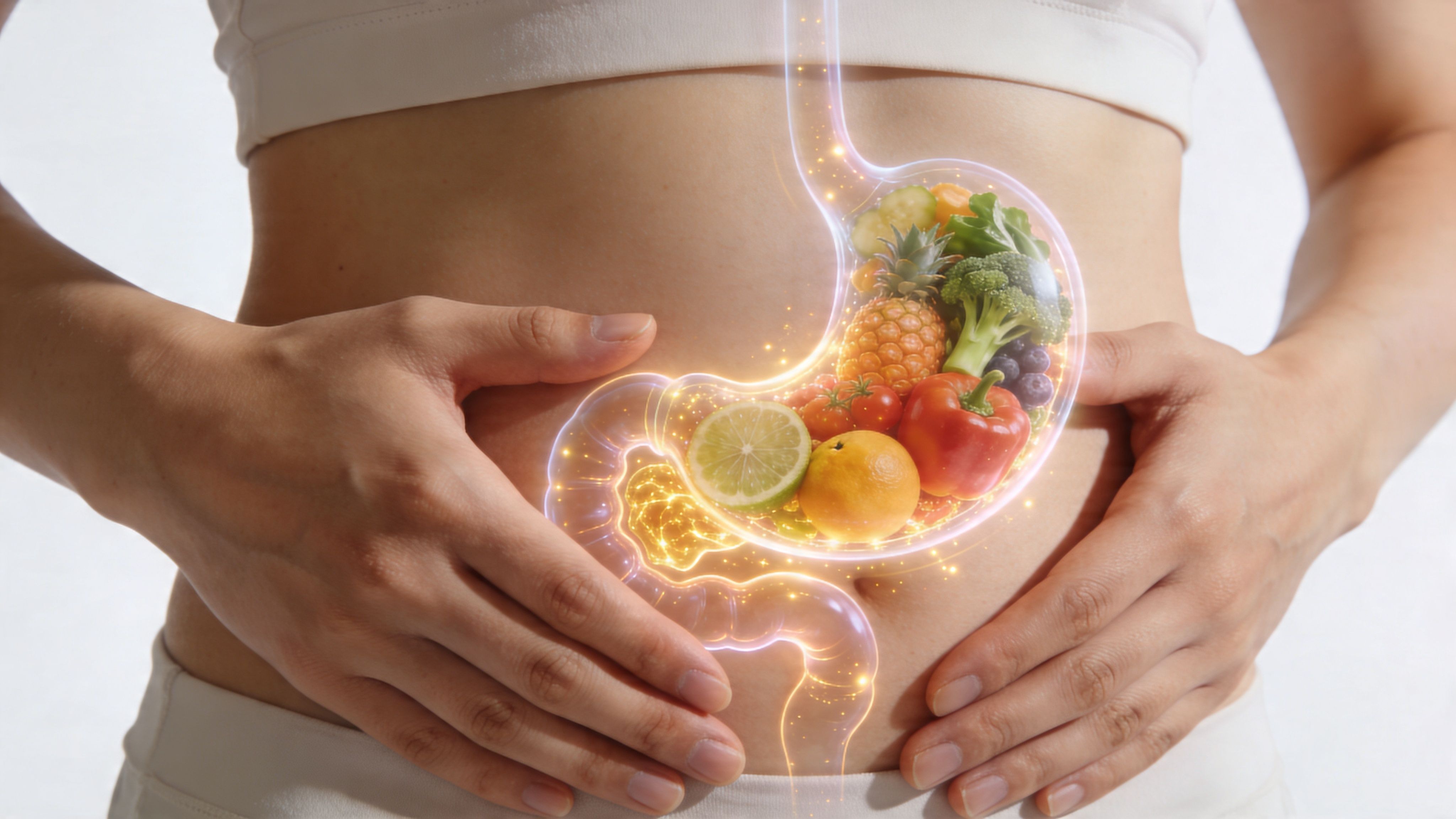
Stomach Digestion: Your Guide to a Healthy Gut
You eat quite normally. And yet your abdomen feels tight. Perhaps it burns after eating all the way up to your throat; perhaps you feel full quickly, bloated, or strangely tired. It often seems like a minor everyday problem. But if your gut regularly sends you signals, there is usually more behind it than “you ate something wrong.”
That is precisely why it is worth looking at stomach digestion in more than a superficial way. Your stomach does not work in isolation. It is connected to your intestines, your microbiome, your nutrient supply, and even your eating rhythm. When something gets out of sync in one place, you often feel it in your gut first.
Many people then try the obvious things. Less coffee. A bland diet. Herbal tea. Eating more slowly. These things can help. But if symptoms keep returning, you need more than general tips. You need an understandable picture of what is happening in your body and how to recognize where the underlying cause might lie.
Why Your Gut Feeling Is More Than Just a Feeling
Digestive problems are not a fringe issue. A representative survey found that 7 out of 10 people in Germany (69 percent) occasionally suffer from gastrointestinal complaints, with common symptoms such as heartburn, stomach pain, and nausea, as described in the ABDA press release on gastrointestinal complaints.
This matters because many people downplay their symptoms. They tell themselves that bloating, pressure after eating, or acid reflux are simply part of life. They are not. Your body sends you signals, and these signals are often surprisingly logical when you interpret them correctly.
What Your Gut Is Trying to Tell You
Your gut is not an adversary. It is more like a signaling system.
If your stomach feels heavy after eating, this may indicate that the meal is not being processed properly. If it burns, acid may be reaching somewhere it does not belong. If you feel nauseous or get full quickly, this may point to a problem with movement, irritation, or the composition of the food.
Many people confuse symptom and cause. The symptom is what you feel. The cause often lies deeper.
Your gut feeling is often not a vague impression, but a bodily response with a pattern.
Why Looking Away Rarely Helps
Recurring symptoms quickly become a habit. Then you adapt instead of asking why. You avoid certain foods, eat less, or live with a vague sense of discomfort.
A different approach is more helpful:
- Observe the timing. Does the problem occur immediately after eating or only later?
- Pay attention to the type of symptom. Burning, pressure, cramps, nausea, and bloating do not necessarily mean the same thing.
- Take accompanying signs seriously. Fatigue, loss of appetite, or the feeling that food is “sitting heavily” provide additional clues.
When you take these signals seriously, frustration turns into something very useful: orientation. And that is exactly what you need to better understand your digestive system.
Your stomach as a high-performance engine
Your stomach works like a high-performance engine. It has to receive food, mix it, prepare it chemically, and pass it on at the right pace. None of this happens by chance; it follows a finely coordinated sequence.
Over the course of an average lifetime, the digestive system processes around 30 tons of food and 50,000 liters of liquid. The stomach also produces 2 to 3 liters of highly acidic gastric juice every day, as described in the Stern article about the stomach and intestines.

The starting process in the stomach
As soon as you eat, processes do not begin only in your abdomen. Chewing, smelling, and tasting already prepare the body. The stomach, so to speak, switches to standby.
Then it takes on three main tasks:
-
Storage
It initially takes in the meal. This is important so that everything does not rush into the intestines unchecked.
-
Mixing
Its muscles knead the food contents. You can think of it as a combination of a blender and a kneading machine.
-
Acidification
Gastric juice breaks down food and creates an environment in which the next steps of digestion can be prepared.
Why acid is not a flaw
Many people hear “stomach acid” and immediately think of something bad. Yet it is fundamentally useful. It is part of a functioning system.
It helps break down food and prepares the food contents for the intestines. Acid only becomes problematic when it rises into the esophagus or when there is too little of it and the preliminary work in the stomach remains incomplete.
Key takeaway: Not every stomach complaint means too much acid. Sometimes the coordination of the entire system is also off.
The transition into the intestines
At some point, the stomach passes the food contents on in portions. This timing is crucial. Too quickly can be uncomfortable. Too slowly can be as well.
The intestines then take care of the fine-tuning. Nutrients are absorbed there, and the remaining digestion is completed. For you, that means: If you want to understand your stomach, you should never consider it in isolation. Digestion in the stomach is teamwork between the stomach, intestines, enzymes, nerves, and eating habits.
When the engine sputters: Common stomach complaints
Some symptoms feel very distinct. A burning sensation behind the breastbone. A hard pressure in the upper abdomen. The feeling that the food has been sitting in your stomach for hours. Others are harder to identify. Mild nausea, early satiety, or an uncomfortable feeling of fullness even though you have not eaten much.
With signals like these, it helps to look under the hood. Not with technical jargon, but with clear patterns.
Heartburn and acid reflux
This is where stomach acid reaches areas that are not designed to handle it. The stomach lining is protected against acid. The esophagus is not protected in the same way. That is why it burns.
It is typical for symptoms to become noticeable after large meals, when lying down, or during stressful periods. This does not automatically mean that your stomach is working “too hard.” It may also be that the valve between the esophagus and stomach is not closing properly or that pressure in the abdominal cavity is playing a role.
Bloating and stomach pressure
It often feels as though your stomach is already full after just a few bites. Or as though the meal is sitting like a stone in your upper abdomen.
If you want to take a deeper look at this pattern, the article on stomach pressure and bloating covers typical triggers and practical everyday tips.
These symptoms can occur when the stomach moves food onward only slowly, when a meal is difficult to digest, or when other factors such as nutrient status and digestive rhythm also play a role.
When the stomach is running with the handbrake on
Around 12 to 15 percent of the German population experience symptoms resembling delayed gastric emptying. In addition to organic causes, nutrient deficiencies and hormonal factors can slow gastric peristalsis by up to 50 percent, as Techniker Krankenkasse summarizes in its information on digestion.
That explains why some people experience discomfort despite eating a “healthy diet.” The food is not the whole problem. The engine simply does not rev up smoothly.
Nausea and a sensitive stomach
Nausea is often a protective signal. It indicates that the body is not processing something well, wants to ward something off, or that digestion is currently overwhelmed.
It can occur after fatty foods, when rushed, with irritation of the stomach lining, or as part of generally sensitive digestion. It is important to pay attention to the pattern rather than just treating the individual symptom.
Common stomach complaints and possible clues
| Symptom | Possible causes | Which test can provide clarity? |
|---|---|---|
| Heartburn | Irritation caused by rising acid, unfavorable meals, impaired stomach function | Home self-test for the gastrointestinal area, supplemented by an intolerance test depending on the question |
| Feeling of fullness | slow stomach emptying, difficult-to-digest meals, impaired digestive coordination | Nutrient test, hormone test, gastrointestinal self-test |
| Nausea after eating | sensitive stomach lining, intolerances, digestive stress | Intolerance test, gastrointestinal self-test |
| Bloating with upper abdominal pressure | impaired connection between the stomach and intestines, microbiome imbalance | Microbiome test, nutrient test |
| Fatigue after meals | inadequate nutrient intake, strain on digestion, individual reactions to food | Nutrient test, intolerance test |
Looking for the why beyond the symptoms
Many people initially change the obvious things. Eating less fatty food, drinking less coffee, and having fewer late meals. That is sensible. But sometimes the symptoms persist anyway. Then it is worth looking at the less obvious contributors.

The microbiome also affects the stomach
In Germany, around 20 to 30 percent of adults suffer from functional digestive disorders such as irritable bowel syndrome, which are often attributed to an imbalance in the microbiome. A probiotic adjustment based on microbiome analyses can improve digestive efficiency by 25 to 40 percent, as described in the AOK article on digestion.
This is particularly interesting because many people only think about the stomach when they have digestive complaints. In fact, your intestinal environment often influences how calm or irritated your entire digestion feels. When the microbiome becomes unbalanced, this can manifest as bloating, intolerance, a feeling of pressure, or diffuse discomfort after eating.
Intolerance, irritation, infection
Not every reaction to food is immediately clear. Some people tolerate certain foods poorly without recognizing the pattern right away. Others struggle with recurring irritation of the stomach lining.
The issue of germs in the stomach also comes up repeatedly with persistent symptoms. If you would like to learn more, the article about Helicobacter pylori provides a good overview of when this germ may play a role.
Recurring symptoms are often not a sign of a lack of discipline, but of a lack of clarity about the cause.
Nutrients as an Overlooked Factor
The stomach needs more than suitable meals. The entire digestive system depends on an adequate supply of nutrients. When the body lacks certain building blocks, digestion may feel slower, more sensitive, or more unsettled.
This shows why treating symptoms alone often does not go far enough. If you only try to suppress burning, pressure, or nausea, you can easily overlook the real question: What is throwing the system out of balance?
Clarity Instead of Guesswork: When a Test Is Useful
If symptoms occur rarely, simple adjustments in daily life are often enough. If they return, change, or persist despite your efforts, guessing is impractical in the long run. Then you want to know whether intolerances, nutrient deficiencies, hormonal influences, or an issue with the microbiome are behind them.

When Guesswork Is No Longer Enough
A test is especially useful if you identify with one of these points:
- Symptoms without a clear pattern. You cannot say for sure which food or situation triggers the problem.
- Food makes you feel more tired than energized. In that case, it is worth looking at nutrients and individual reactions.
- Your stomach remains sensitive despite good habits. This suggests looking deeper instead of simply continuing to try things.
- You have several symptoms at the same time. For example, bloating, pressure, skin issues, or fatigue.
Which test answers which question
In people over sixty, reduced stomach acid production is suspected in 20 to 30 percent. This can reduce protein digestion by up to 50 percent and lead to nutrient deficiencies. Specific tests can provide clarity, as described in this article on stomach function and stomach acid.
This offers a practical benefit:
- Intolerance test is suitable if you regularly notice symptoms after eating certain foods but cannot identify the trigger with certainty.
- Nutrient test is helpful if you also experience fatigue, poor recovery, or vague drops in performance.
- Hormone test may be useful if your symptoms fluctuate significantly and you feel that your routine, stress, or hormonal changes may be involved.
- Home self-test for the stomach and gut is suitable if you want to gain clarity systematically from home.
Anyone looking for such an overview can find an explanation of various options at online stomach and gut test. One option in this area is mybody x Gesundheit, offering self-tests for blood, the gut microbiome, and other concerns, depending on whether the focus is on intolerances, nutrient status, or the gut flora.
Practical rule: The more nonspecific your symptoms are, the more helpful structured data is than constantly coming up with new assumptions.
Your plan for a calm stomach
Not every change has to be radical. For stomach and digestive health, small, consistent steps often work better than strict prohibitions. What matters is reducing the strain on your stomach while also supporting your gut in a meaningful way.

Creating a calm environment while eating
Your stomach works better when it does not have to digest food amid the rush.
- Eat at a steady pace, not in a rush. Food that is chewed thoroughly is easier for the stomach to process.
- Pay attention to your portion size. If you often feel overly full, somewhat smaller meals are often more comfortable than infrequent large ones.
- Stay focused on your meal for a moment. Working, scrolling, or eating while standing distracts from the process.
Avoid further irritating the stomach
If your stomach is sensitive, try simple ways to ease the strain instead of blanket prohibitions.
Warm, relatively simple meals are often perceived as more pleasant than very heavy, greasy, or extremely spicy foods. Eating very late can also feel uncomfortable if you are already prone to pressure or burning sensations.
A calm stomach does not require a perfect diet. It often needs better timing, more suitable portions, and greater attention to your body’s reactions.
Keep beneficial gut bacteria in mind
Digestion does not end in the stomach. That’s why it’s worth considering what benefits your gut.
- Feed variety. Different plant-based foods add variety to your plate and support a more stable digestive experience.
- Observe reactions carefully. If you increase your fiber intake, do so gradually. Changes that happen too quickly can temporarily overwhelm your stomach.
- Regularity helps. A consistent eating rhythm gives the digestive system guidance.
Record your body’s signals instead of guessing
A brief log can be surprisingly helpful. Nothing complicated. Simply record what you ate, how you felt afterward, and when symptoms occur.
These questions are particularly useful:
- When does the symptom begin?
- Where exactly do you feel it?
- How long does it last?
- What was different that day compared with usual?
This makes it easier to recognize whether the issue concerns the stomach itself, certain foods, or the connection with stress, sleep, and your daily rhythm.
Conclusion: Take control of your health
Your stomach is not a temperamental organ. It works according to clear principles. When digestion in the stomach is not running smoothly, your body usually lets you know fairly early that something needs attention.
It’s important not to see symptoms merely as a disturbance, but as a clue. Burning, pressure, nausea, early fullness, or bloating often reveal something about how your stomach, intestines, and nutrient supply interact. That is precisely where the difference lies between temporarily suppressing symptoms and genuinely understanding them.
You don’t have to try everything on suspicion. People who take their body’s signals seriously, observe patterns, and use appropriate analyses when needed make clearer decisions. This often saves time, frustration, and unnecessary detours.
So your gut feeling is more than just a feeling. It’s a starting signal. Listen to it, get specific, and give your body the support that really suits you.
If you want to do more than simply interpret your symptoms and instead assess them on a sounder basis, take a look at mybody x Gesundheit. There you’ll find at-home self-tests covering the gut microbiome, nutrients, intolerances, and other health questions that can help you turn assumptions into concrete next steps.


Share now:
How long is the intestine? Numbers, facts & health tips
Leaky Gut Glutamine: Your Guide to Healing the Gut