
How long is the intestine? Facts, figures & health tips
You may be sitting on the sofa after eating, with your abdomen feeling a little tight, wondering: How long is the intestine, anyway? The question sounds simple at first. But as soon as you explore it, you find yourself in the middle of one of the most fascinating systems in your body.
Your intestine is not simply a tube through which food passes. It is a finely tuned organ that absorbs nutrients, reclaims water, works together with billions of microorganisms, and is therefore much more closely connected to your everyday life than many people think. When your digestion is running smoothly, you often do not notice it at all. When it gets out of balance, you do.
A journey inside your body
Many people only start thinking about their intestines when symptoms appear. Perhaps you know this too. Sometimes you feel heavy after eating, sometimes your abdomen is bloated, and sometimes everything seems sluggish. That is when this very basic question often arises: how long is the intestine, and what actually happens over several meters inside my abdomen?
The answer is fascinating because it helps you better understand your body. Your intestine is not a minor organ, but a long, folded, highly active passage through which an enormous amount happens in a short time. Food is broken down, nutrients are absorbed, water is regulated, and in the end only what your body no longer needs remains.
Why this question is about more than anatomy
If you see your intestine merely as a digestive tube, you are missing the essential point. Its shape and structure are directly related to its function. The better you understand how this system is organized, the easier it becomes to recognize why digestion, energy, and overall well-being influence one another.
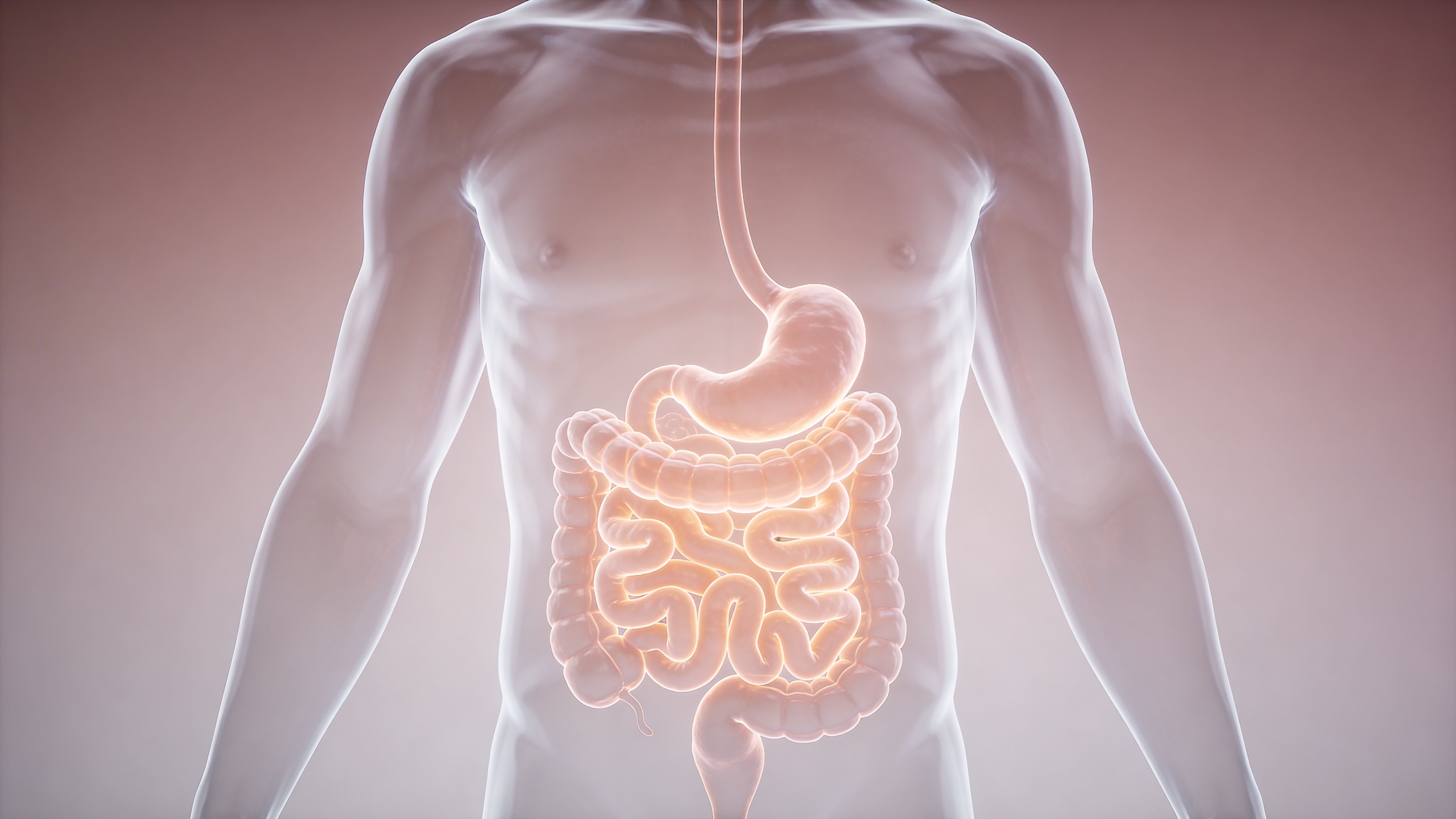
A good place to start is by looking at the structure of the intestine. It quickly becomes clear that individual sections perform very different jobs.
Everyday rule: Not every abdominal complaint immediately means something serious. But recurring signals deserve attention because they often indicate that your digestive system needs support.
Many people also confuse length with size. A long intestine does not automatically mean a “better” intestine. What matters is how well it works. That is why it is worth looking not only at the number of meters, but also at its function.
Your digestive system in detail: small intestine and large intestine
Put simply, the intestine consists of two main sections. Small intestine and large intestine. Both lie close together, but work very differently.
According to the AOK information on the anatomy, structure, and function of the intestine, the human intestine in adults is approximately 4 to 6.5 meters long, with the small intestine measuring 3 to 5 meters and the large intestine measuring 1 to 1.5 meters. The same source also describes the impressive intestinal surface area of approximately 32 square meters, created by folds in the mucous membrane and intestinal villi.
The small intestine handles the fine work
The small intestine is the section where most digestion and nutrient absorption take place. You can think of it as a long absorption route. This is where the building blocks that your body can actually use are filtered out of your food.
This area includes the duodenum, jejunum, and ileum. Each section helps break food down further and make it usable.
The large intestine takes care of organization and recovery
The large intestine is shorter, but by no means less important. Its main tasks are to reclaim water and form stool. What was not absorbed in the small intestine is processed further here.
This is a good point at which many readers pause. “Large intestine” sounds bigger, but it is not longer. It is called that because it is wider, not because it has more meters.
Why the large surface area is so important
The number of meters alone does not explain why the intestine is so efficient. The real trick lies in the interior. The mucous membrane is not smooth like a garden hose but heavily folded. It also contains intestinal villi, tiny projections.
This creates a huge contact area. You can think of it like a piece of fabric that has been folded extensively. From the outside, everything looks compact. Inside, much more surface area is created, allowing absorption to take place.
| Intestinal section | Main function | Reference |
|---|---|---|
| Small intestine | Absorb nutrients | long and highly specialized |
| Large intestine | Absorb water, form stool | shorter, but functionally central |
The better this inner surface works, the more smoothly your body can extract from food what it needs for energy, regeneration, and everyday life.
Why intestinal length differs from person to person
Many people look for a single number and want to know what is “normal.” This is exactly where confusion often arises. There is no perfect standard length for the intestine that is the same for everyone.
Even the stated range shows that natural differences exist. That is completely normal. Bodies are not mass-produced. They follow a basic blueprint, but each person has their own anatomical characteristics.
Height and predisposition both play a role
A larger person also tends to have more internal length available than a smaller person. Genetic predisposition also plays a role. Some differences simply arise because that is how your body is built.
That does not mean, however, that a longer intestine would automatically be more efficient. What remains decisive is how well the individual sections work together. Two people can have different intestinal lengths and still both feel completely healthy.
Function matters more than the exact figure
Many health questions become unnecessarily complicated because people look for an ideal figure. When it comes to the intestine, this search is usually of little help. A much more useful question is: Does your digestive system function well in your everyday life?
A few practical points of reference are more helpful than fixating on measurements in meters:
- Your gut feeling matters: Do you regularly feel well after eating, or often feel weighed down?
- Your reaction to foods is relevant: Do you tolerate many foods well, or are there noticeable patterns?
- Your energy level also tells a story: When digestion and absorption are not working smoothly, you often feel it not only in your abdomen.
A broad normal range is nothing unusual in anatomy. With the intestine, individuality is more the rule than the exception.
That is why it is worth not comparing your own body with generalized figures found online. The more useful question is almost always: What exactly is my body showing me?
The importance of intestinal length for your health
As long as the intestine performs its functions well, you hardly need to consciously notice its length in everyday life. Things look different when parts of the intestine are missing, for example after an operation, or when a section can no longer perform its work properly. Then an anatomical question suddenly becomes an issue affecting your daily well-being.

When absorption area is missing
The small intestine in particular is responsible for absorbing nutrients. If less functional length is available here, the body can no longer extract what it needs from food as efficiently. It is then not just a matter of digestion, but also of nourishment.
Possible consequences may include:
- Everyday fatigue: The body does not always receive everything it needs for energy in the best possible way.
- Digestive issues: Bowel movements, bloating, or a general feeling of discomfort may change.
- Signs of deficiency: The skin, performance, or resilience may suffer as a result.
Structure and function go hand in hand
This is the point at which many people begin to see the topic differently. The question “how long is the intestine” is not merely an anatomical fact. It leads directly to considering how much functional surface area is available to your body and how well that surface works.
An intestine can be anatomically present but functionally out of balance. The measurements may be right, yet everyday performance still does not feel good.
What you can pay attention to in daily life
You do not have to be a medical professional to take changes seriously. Instead, observe recurring patterns rather than isolated exceptions.
| Observation | What they may mean |
|---|---|
| Recurring bloating | Digestion is not running entirely smoothly |
| Unexplained exhaustion | Absorption and nourishment deserve a closer look |
| Changing digestion | The gut may be sensitive to diet or stress |
If symptoms keep coming back, that is not a sign of weakness. It is often simply the way your body asks for attention.
That is precisely why it makes sense not only to push symptoms aside, but also to understand the causes better.
More Than Just Length: The Microbiome in Your Gut
The length of your intestine provides the stage. But another system also determines what happens on that stage. Your microbiome. This refers to the community of microorganisms that lives in your intestine and is involved in many processes.
Why the microbiome is so crucial
Many people first associate gut health with constipation, diarrhea, or bloating. That is too narrow a view. A balanced microbiome affects how well your gut handles food, how stable your abdomen feels, and how resilient your entire system seems.
When this balance is disrupted, very different symptoms can occur. Sometimes they are clearly felt in the abdomen. Sometimes they are more diffuse, for example in the form of intolerances, fatigue, or the feeling that the body is not properly balanced.
Anyone who wants to explore the topic further will find a good overview in the article What Is the Microbiome.
Length is fixed, but the microbiome can be influenced
This is where the practical difference lies. You cannot simply change your basic anatomical structure. Your microbiome, on the other hand, responds to your daily life. Diet, stress, sleep, exercise, and medication can leave their mark.
That is good news. Because it means that you are not helpless when it comes to functional gut health.
A helpful way of thinking:
- The length of the intestine is the infrastructure: It sets the framework.
- The microbiome is the ongoing operation: This is where it is determined how well many things actually function.
- Your daily life plays a role: What you do regularly shapes this inner ecosystem.
What readers often misunderstand
Some people hope for a single explanation for all their symptoms. In reality, the gut is more like a sensitive interplay of factors. Its length alone does not explain why a food agrees with you or not. The microbiome often provides the missing piece of the puzzle.
It's not the number of meters alone that makes your gut strong, but the interplay of the mucous membrane, digestive function, and microbial balance.
So if you only ask how long your gut is, you get an interesting number. If you ask how well your gut works, you come much closer to understanding your health.
How to find out what your gut really needs
Many people get stuck at the point where they understand how fascinating the gut's structure is but don't know what to do with that knowledge. That's exactly when curiosity becomes a practical question: What does my gut personally need?
A sensible answer almost always begins with observation. Don't guess; identify patterns. Which foods make you feel good? When does your stomach react sensitively? Are there periods of greater stress when your digestion also becomes unsettled?
From gut feeling to a clearer assessment
If you only assess your symptoms roughly, you can quickly end up with general advice. More fiber, less sugar, more rest. This may help, but it may not be exactly right for your body.
You gain more clarity when you take a closer look at your gut. A good introduction to the topic can be found in this article about the gut test.
Three sensible next steps
-
Note your symptoms
Write down when your stomach feels calm and when it doesn't. Even simple notes can reveal patterns. -
Don't just look at symptoms
Energy levels, how your skin feels, how manageable everyday life is, and your tolerance can also provide clues. -
Check specifically instead of wondering indefinitely
Anyone who wants to understand their gut better often benefits from a structured analysis rather than constantly changing dietary experiments.
The most important point is ultimately simple. Your gut is not an abstract organ from a biology textbook. It influences how you feel after eating, how steadily your digestion functions, and how well your body copes with stress.
If you want to do more than simply guess about your digestive system and instead understand it better, a suitable self-test from mybody x Gesundheit could be a useful next step. The range includes gut microbiome analyses as well as other at-home health self-tests, helping you assess symptoms more precisely and receive personalized guidance for everyday life.



Share now:
Always having intestinal problems? Find your solution now!
Stomach and Digestion: Your Guide to a Healthy Gut