
Understanding skin aging and taking proactive action
Wrinkles are not the first thing that happens. Skin aging is a gradual process that begins in our twenties—long before we discover the first fine lines in the mirror. Essentially, our body’s natural renewal processes gradually shift into a lower gear. We then notice this in the structure and elasticity of our skin. It is a fascinating interplay between what is in our genes and what life brings.
What is skin aging really?
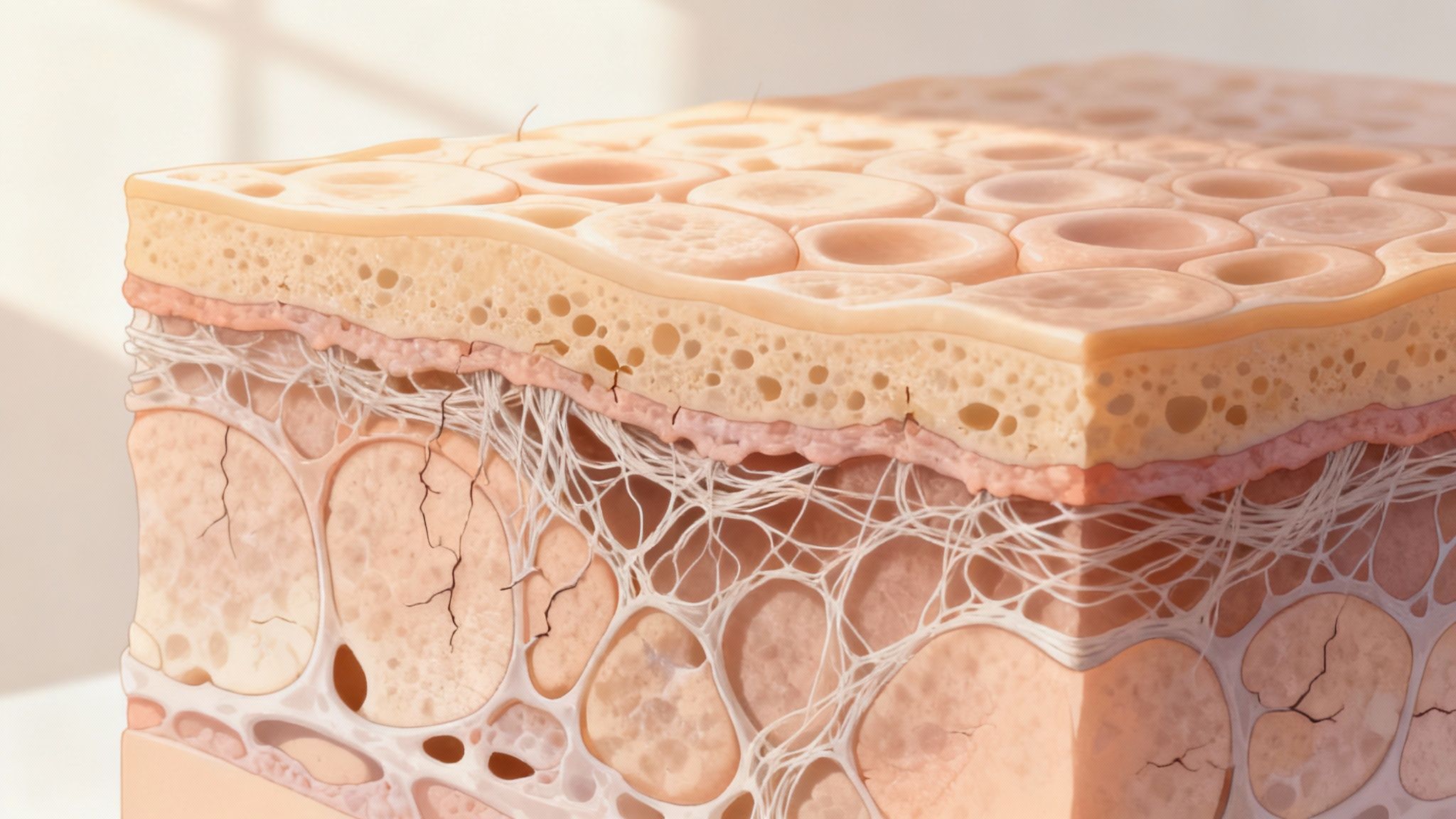
Imagine your skin as a finely woven, elastic net. When we are young, this net is dense, strong, and full of supportive fibers. Over time, the mesh loosens and the tissue becomes more yielding. That is exactly what happens at the cellular level as our skin ages.
It is about so much more than wrinkles. Skin aging is a profound biological process that affects every single layer. Starting in our mid-20s, production of the key building blocks for firm, youthful-looking skin begins to decline.
The invisible changes beneath the surface
The aging process begins in the deeper layers of the skin, long before we can see it. Essentially, three things happen there:
- Collagen breakdown: Collagen is the protein that gives your skin its firm structural framework. Production begins to decline by about 1% per year from the age of 20. The result? Skin loses firmness, and the first fine lines begin to appear.
- Elastin loss: Elastin is responsible for skin elasticity. It allows your skin to immediately smooth out again after you smile. As its production also declines, we gradually notice a significant loss of elasticity.
- Slower cell renewal: When we are young, the top layer of our skin, the epidermis, renews itself about every 28 days. This cycle becomes increasingly sluggish with age. This can lead to a duller complexion and uneven skin texture.
At the same time, our skin’s natural protective barrier becomes more permeable. It can no longer retain moisture as effectively and is more vulnerable to external aggressors such as UV radiation and pollution.
Your genes may set a general direction, but your lifestyle and environment have the final say in how quickly the signs of aging become visible. The great thing is that you have the power to influence it.
When genetics meets lifestyle
The speed and extent to which our skin ages are determined to some degree by our DNA. This “intrinsic” aging is, so to speak, your personal roadmap. Some people naturally have a more robust collagen structure, while others are more prone to dry skin. The mybody®x Skincare DNA Metabolism Test can show you exactly where your genetic strengths and weaknesses lie.
The much greater factor, however, is “extrinsic” aging—everything that comes from outside. Your lifestyle and environmental influences play the main role here. These factors can even control the activity of your genes, a field of research known as epigenetics. If you want to understand more precisely how your daily habits can influence your genetic predisposition, read our detailed article about what epigenetics is.
Knowing your biological foundations can give you a head start. Instead of simply reacting to visible signs, you can support your skin in a targeted way, preserve its health, and actively help shape the aging process. It is about taking control and making conscious choices for your skin.
The two drivers of your skin aging
Your skin aging is not determined by a single factor, but driven by two different yet closely interconnected forces. The best way to picture it is like a house: There is the blueprint that determines the basic structure—that is your genes. Then there is the weather, which acts on the façade over decades. Together, they ultimately determine the condition of the building.
It is much the same with your skin. We distinguish between internal, so-called programmed aging and external influences that can significantly accelerate—or slow down—this process.
Intrinsic skin aging: your genetic roadmap
Intrinsic, or internal, skin aging is your very own genetic roadmap. It is encoded in your DNA and sets the basic pace at which your cells renew themselves, your hormone balance changes, and important structural proteins such as collagen are broken down.
This biological process is completely natural and cannot be stopped. Over time, it causes the skin to become thinner, drier, and less elastic. Although we cannot stop this internal mechanism, we can support it optimally through a healthy, mindful lifestyle.
The demographic shift in Germany highlights how important this topic is. In 2023, around 18.7 million people aged 65 or older lived in Germany—equivalent to approximately 22.5% of the total population. Given the increasing life expectancy, it is all the more important to take proactive control of your skin health. You can find more information about this development in Statista’s data: Learn more about the age structure in Germany on de.statista.com.
Extrinsic skin aging: the power of your habits
This is where the far greater and more decisive influence on your skin’s appearance comes into play. Extrinsic, or external, aging is the sum of all the environmental influences and lifestyle factors you are exposed to over the course of your life.
It is responsible for most of the visible signs of skin aging that we often perceive as "premature." These factors generate oxidative stress in the form of free radicals—aggressive molecules that act like tiny attackers, damaging your collagen and elastin fibers and massively accelerating the aging process.
Your genes may determine when the aging process begins biologically, but your lifestyle determines how quickly and how severely it becomes visible.
To show you exactly what happens in the body, this infographic visualizes the natural decline of important building blocks in your skin.
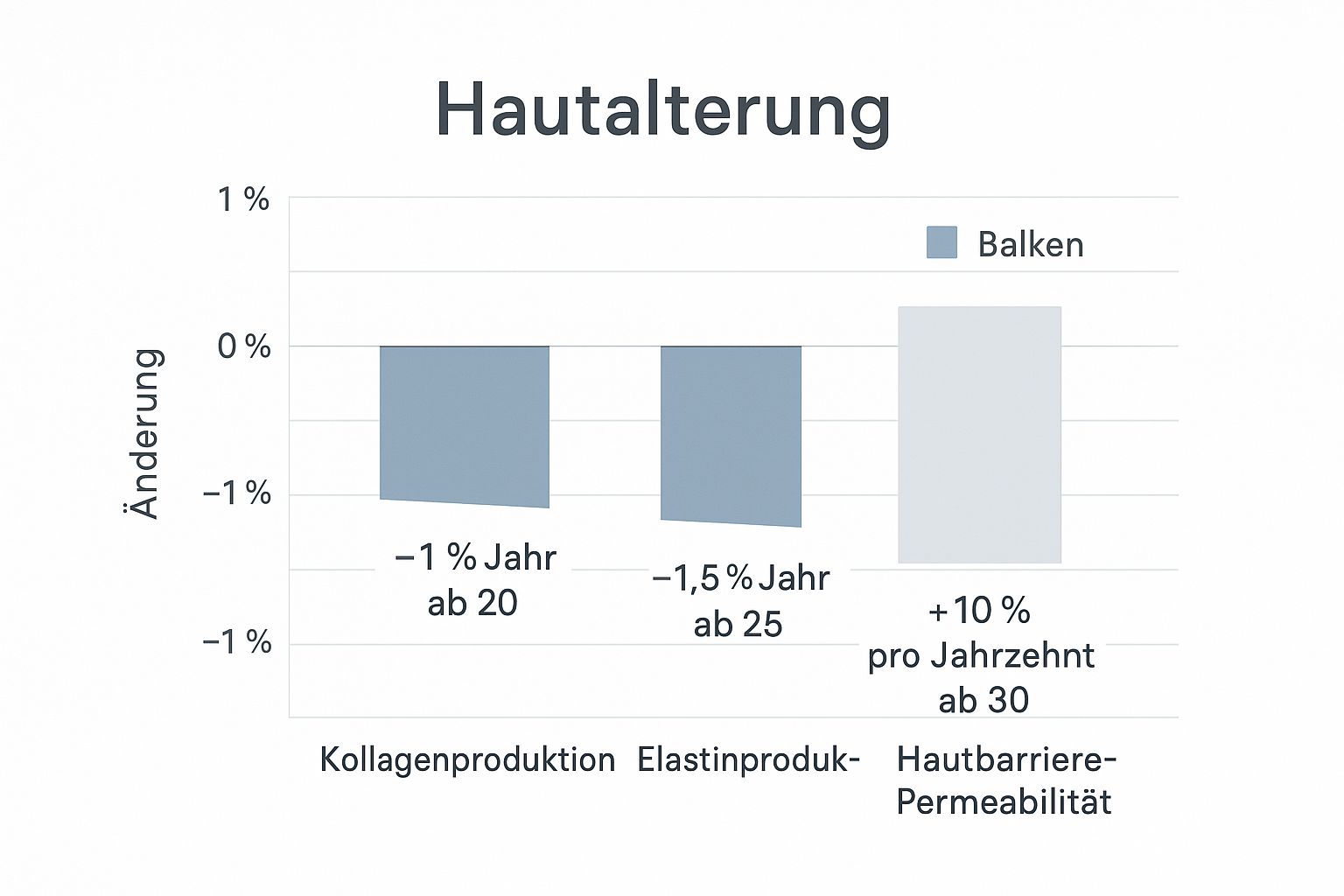
The graphic makes it clear: the breakdown of collagen and elastin begins as early as young adulthood, while the skin barrier’s important protective function increasingly declines over time.
Intrinsic vs. extrinsic skin aging compared directly
To make the differences more tangible, we have compared the two processes directly here. This way, you can see at a glance which factors you can influence yourself and where nature sets the rules.
| Characteristic | Intrinsic skin aging (genetically determined) | Extrinsic skin aging (environmentally induced) |
|---|---|---|
| Main cause | Genetic predisposition and natural biological processes. | UV radiation, smoking, diet, stress, air pollution. |
| Visible signs | Fine lines, thinner and drier skin, general loss of elasticity. | Deep wrinkles, pigmentation spots, uneven skin tone, leathery skin texture. |
| Modifiability | Barely influenceable, but it can be positively supported by a healthy lifestyle. | Strongly influenced by sun protection, diet, and mindful lifestyle choices. |
| Beginning | A gradual process that begins as early as your 20s. | Begins with the first exposure to harmful factors. |
This knowledge is the first and most important step toward taking control of your skin's appearance. While you cannot change your genetic code, it is entirely up to you to manage the external factors. Your genes give you a predisposition, but your daily choices shape your skin's appearance. If you want to understand in even greater depth how your genes influence healthy aging, we recommend our related article: Read more about how your genes influence healthy aging.
Ultimately, this insight is precisely what makes a proactive approach possible: Instead of merely reacting to changes, you can specifically protect and strengthen your skin before the signs of aging become visible. The key is knowing your own personal weaknesses. This is exactly where the mybody®x Skincare DNA Metabolism Test comes in, showing you what you should pay particular attention to based on your genetic predisposition.
Understanding your skin's foundation
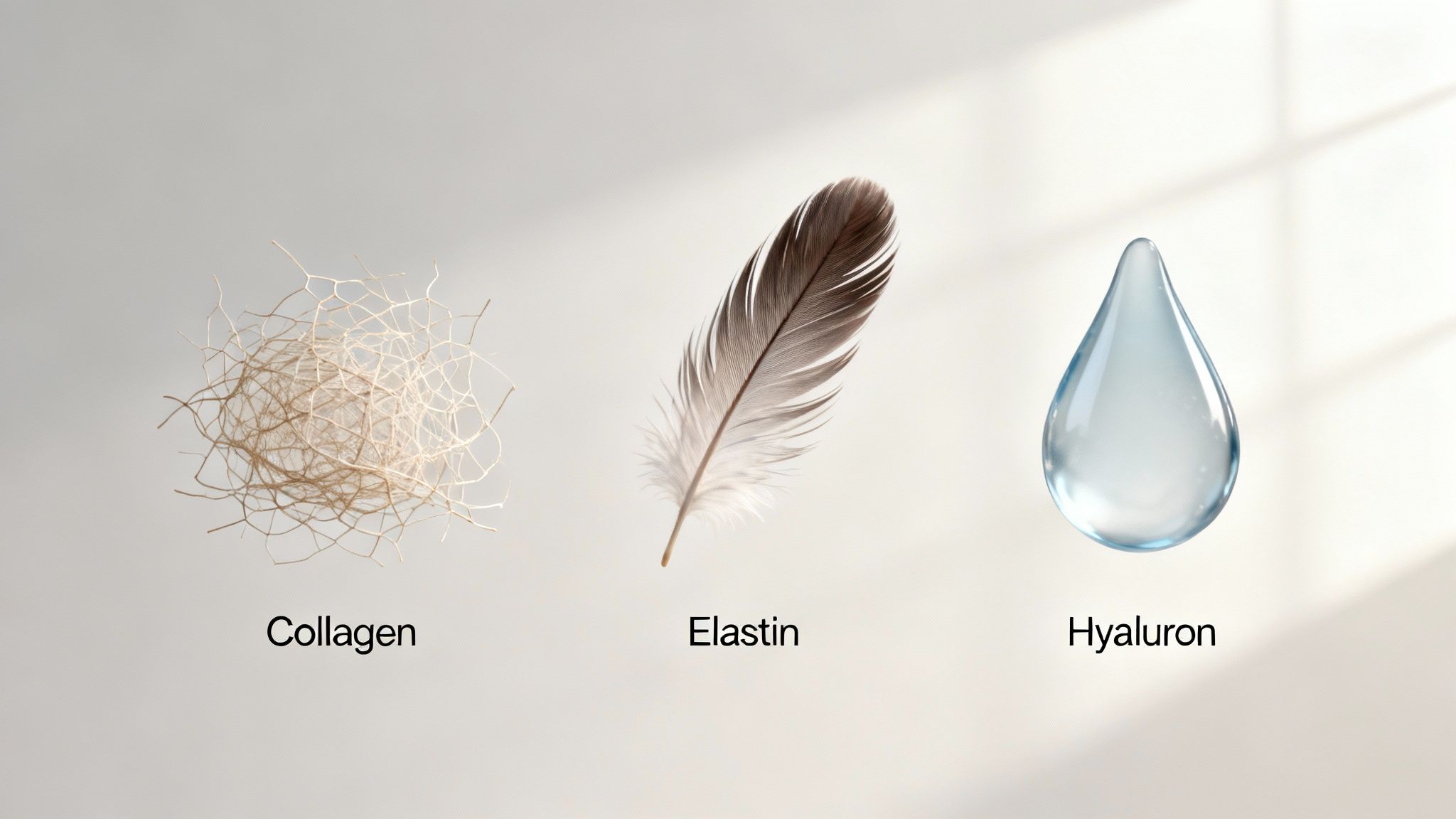
To truly understand skin aging, we need to look beneath the surface. That is exactly where, in the deeper layers of the skin, three silent heroes work tirelessly to keep your skin firm, smooth, and plump. The best way to imagine it is as a cleverly designed house built on a stable foundation.
This foundation consists of three key building blocks. Once we understand their roles, it immediately becomes clear why wrinkles and sagging skin develop when their production declines.
The three pillars of your skin structure
Each of these building blocks has its own important role. Only by working together do they provide firmness, flexibility, and a healthy glow.
-
Collagen – the stable framework: Think of collagen as the steel framework of a building. It is the most abundant protein in the body and forms a dense network of fibers that gives your skin structure and support. Without this framework, everything would collapse in on itself.
-
Elastin—the elastic springs: Elastin is essentially the rubber in this framework. These fibers are extremely stretchable and ensure that your skin immediately returns to its original shape after every movement—whether smiling or frowning. They are the guarantee of firmness.
-
Hyaluronic acid—the moisture reservoir: Hyaluronic acid acts like a tiny sponge that can bind enormous amounts of water—one thousand times its own weight. This plumps your skin from within, makes it look full, and supplies it with moisture.
This trio is perfectly coordinated to keep your skin smooth and resilient. Unfortunately, this balance does not last forever.
Why the foundation crumbles over time
Both the natural aging process and external influences such as UV radiation cause the small “factories” in the skin, known as fibroblasts, to become tired over time. They slow down their work and produce less and less collagen, elastin, and hyaluronic acid.
It is a gradual process with visible consequences. Less collagen means less firmness—the skin sags. A lack of elastin causes expression lines to eventually become permanently etched into the skin. And when hyaluronic acid diminishes, the skin loses volume and moisture, leading to dryness and a dull complexion.
Essentially, it’s quite simple: Your skin loses more structure than it can rebuild. This imbalance is at the core of visible skin aging.
Supply building blocks and specifically stimulate production
The good news is that you can influence this process. Your body needs certain nutrients to stimulate the production of these important building blocks. Vitamin C, for example, is essential for collagen production—without it, it simply cannot happen. Amino acids such as glycine and proline are the direct building blocks for new collagen fibers.
But this is precisely the crux of the matter: Every body is different. Your genes help determine how quickly your collagen breaks down and how well you can use certain nutrients for your skin. So instead of groping in the dark, you can start right here.
A targeted analysis can reveal your personal weaknesses. The mybody®x Skincare DNA Metabolism Test reveals how your genes influence the condition of your skin. Among other things, it analyzes your genetic predisposition to collagen breakdown and shows you which nutrients and active ingredients are particularly important for you to specifically strengthen the foundation of your skin. This way, your skincare strategy is based on knowledge, not guesswork.
Your personal blueprint for healthy skin
Have you ever wondered why that expensive cream works wonders for your friend, while you barely notice a difference in your own skin? The answer is as individual as you are—it lies deep within your DNA. Your genes are, in a sense, the invisible architect of your skin and play a major role in determining how your skin ages.
They determine how quickly your body breaks down collagen, how well your natural shield against UV radiation works, and how efficiently your skin can retain valuable moisture. We all have a completely different genetic starting point.
No more skincare roulette
Instead of continuing to feel in the dark and trying countless products on a whim, you can finally gain clarity through targeted analysis. It’s about transforming your skincare routine from a guessing game into a knowledge-based, truly effective strategy. This is exactly where modern science comes in, giving you the right tools to take control.
This is where the mybody®x Skincare DNA Metabolism Test comes in. This simple at-home test is like a personal roadmap for your skin health. It decodes the genetic information that is crucial to your skin’s appearance, giving you the foundation for a skincare routine that truly suits you.
The test examines a whole range of genetic markers associated with the key factors of skin aging. Here’s exactly what that means:
As you can see, this is not a blanket assessment. It is a detailed analysis that shows you exactly where your skin needs genetically determined support.
Insights that transform your skincare
When you know your genetic predispositions, you can finally proactively adapt your skincare routine and lifestyle. The test provides clear answers to the questions that really matter:
- Collagen breakdown: Are you naturally prone to faster breakdown of your collagen structure? If so, active ingredients such as vitamin C or peptides are especially important for you to stimulate new production.
- Antioxidant capacity: How well can your skin defend itself against free radicals? A lower value means you can particularly benefit from a diet and skincare routine rich in antioxidants such as vitamin E.
- Moisture retention: How well can your skin retain moisture? If your genes indicate a slight weakness in this area, moisturizing ingredients such as hyaluronic acid are essential for you.
With this personalized information, you can choose exactly the active ingredients and nutrients your skin really needs—and simply leave out the rest.
Imagine no longer spending money on products that aren’t suitable for your skin type. Instead, you invest specifically in what demonstrably supports your skin—based on your own genetics.
This approach goes far beyond general skincare tips. It’s a strategy based on your very own biological blueprint. You’ll get to know your skin on an entirely new level and finally understand why it is the way it is. To learn more about how such a test works and what insights it can provide, see our detailed article on the importance of a DNA test for your skin health.
With this knowledge, you can make informed decisions and give your skin exactly what it may be losing a little faster due to your genetic predisposition. It’s the most direct path to healthy, resilient skin—today and in the future.
Practical strategies for healthy skin
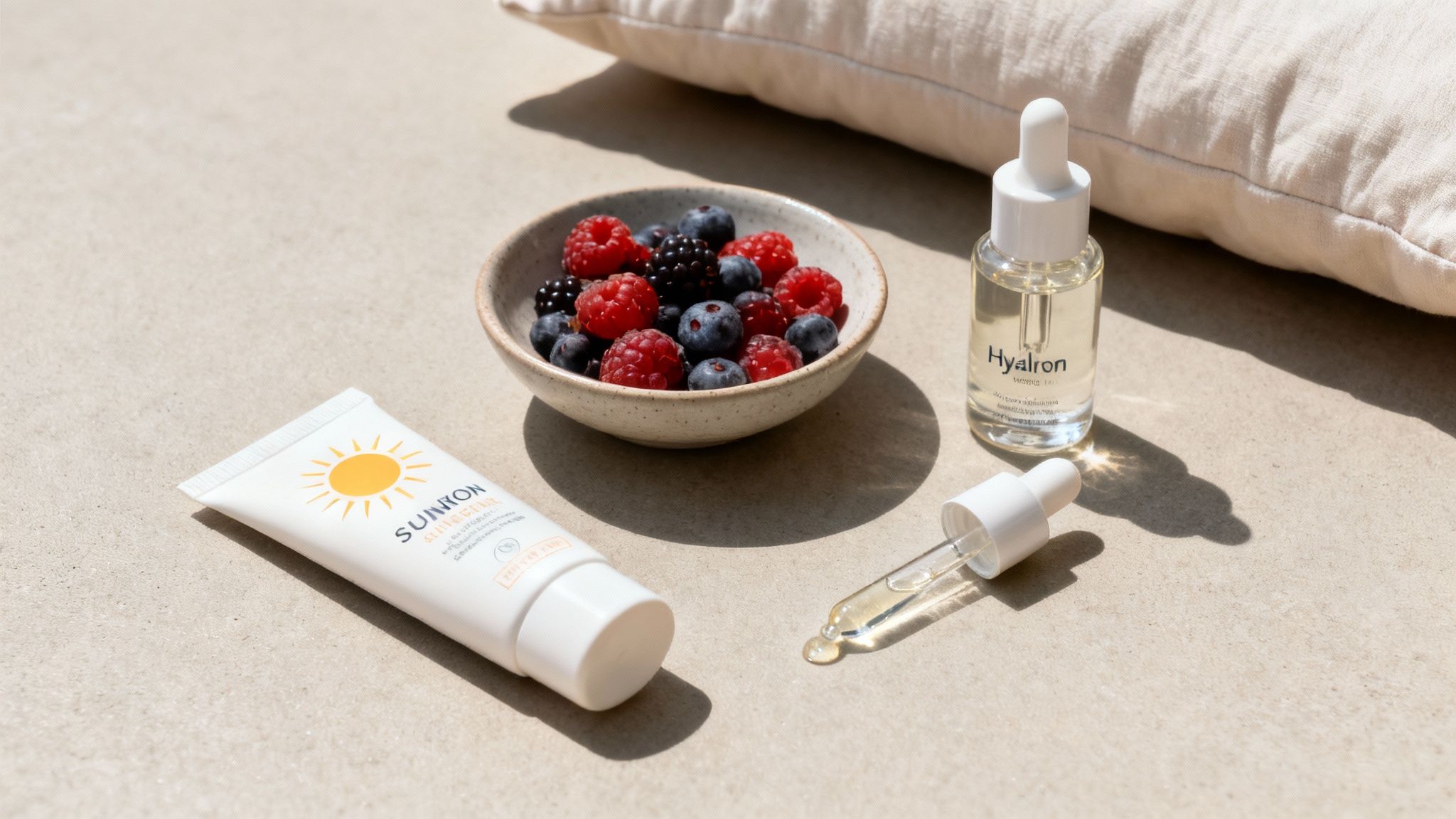
Now that we’ve explored the biological background of skin aging, it’s time to get practical. Knowledge alone doesn’t bring about change—it’s the small, daily habits that ultimately have the greatest impact. Here, we’ll give you four very concrete pillars that can help actively slow down external skin aging.
It’s not just about knowing what helps, but also understanding why it works. That’s the only way to build a routine on a solid foundation and stick with it over the long term. Think of each of these pillars as a powerful tool for healthy, resilient skin.
Pillar 1: Consistent sun protection as the foundation
If there were only one thing you could do for your skin, it would be this: Wear sunscreen every single day. UV radiation is the absolute main cause of externally induced skin aging. It is responsible for up to 80% of visible signs such as wrinkles, sagging skin, and pigmentation spots.
Sunscreen is no longer just for vacations; it’s a daily necessity. UVA rays in particular, which penetrate deep into the skin and attack the collagen framework, are present all year round—even on cloudy days.
A broad-spectrum sunscreen with at least 30 is the simplest and most effective form of prevention. This protects you not only from wrinkles but also from skin cancer.
Pillar 2: A diet rich in antioxidants
Your skin is under constant attack from free radicals—aggressive molecules caused by UV light, air pollution, and stress. Antioxidants are like your internal bodyguards: They neutralize these troublemakers before they can cause damage.
A diet rich in colorful fruits and vegetables supplies your body with a whole army of these little helpers. Think berries, dark leafy greens, nuts, and intensely flavored spices. They’re packed with vitamins such as vitamins C and E, which not only protect but also play an important role in collagen production. If you want to get started with specific choices, you’ll find a practical list of antioxidant-rich foods in our guide.
Your diet is skincare from within. What you eat provides the building blocks your skin needs to repair and protect itself.
Pillar 3: A smart skincare routine
Alongside external protection and inner nourishment, a targeted skincare routine can make all the difference. But remember: less is often more. It’s not about layering dozens of products, but about finding the right active ingredients for your skin.
- Vitamin C: A powerhouse among antioxidants. It protects the skin from environmental influences and plays an important role in collagen production. Perfect for your morning routine!
- Hyaluronic acid: A true moisture magnet. Hyaluronic acid binds water in the skin, plumps it from within, and gives it a full, fresh appearance.
- Retinoids (vitamin A): The gold standard in anti-aging. They stimulate cell renewal, boost collagen production, and can visibly smooth and refine the appearance of the skin.
Incidentally, demand for such products also depends heavily on where you live in Germany. In rural areas, especially in the north and east, the proportion of older people is particularly high. In some districts of Thuringia, Saxony, and Saxony-Anhalt, people aged 65 and over make up around 30% of the population—which naturally creates very different demand for skincare.
Pillar 4: Lifestyle and regeneration
The final, but often underestimated, factor is you. Chronic stress floods the body with the hormone cortisol, which can actually accelerate collagen breakdown. Good sleep, on the other hand, is the most important regeneration phase for your skin. While you sleep, repair processes operate at full speed.
A mindful approach to stress—whether through exercise or relaxation techniques—and consistently getting seven to eight hours of sleep per night are therefore not merely wellness tips. They are essential building blocks for skin that stays healthy and vibrant for a long time.
Your questions about skin aging—answered briefly and concisely
After delving deep into the world of skin aging, you probably still have a few questions on your mind. To wrap up, we have summarized the key points for you—briefly, concisely, and straight to the point—so you have clear guidance for your everyday life.
Can skin aging really be stopped?
To be completely honest? No. We cannot completely stop the natural biological process of skin aging. It is part of life. The good news, however, is that we can significantly slow it down and have far more influence than most people think.
Extrinsic skin aging in particular, driven by sunlight, environmental toxins, and our lifestyle, is largely within our own control. Consistent sun protection, a nutrient-rich diet, and smart skincare can preserve the health and appearance of your skin for years to come. So it is not about stopping aging, but about aging healthily and consciously.
Your goal should not be to desperately look young, but to keep your skin as healthy, resilient, and vibrant as possible at every age.
This is exactly where a DNA analysis gives you a decisive knowledge advantage. The mybody®x Skincare DNA Stoffwechsel Test deciphers where your skin needs special genetically determined support and helps you tailor your personal strategy to it perfectly.
Which vitamins are most important for the skin?
Although a whole range of vitamins are important for our skin, there are three absolute superstars. They are the power players in skincare, whether from within through your diet or from the outside through your skincare routine.
-
Vitamin C: A true all-rounder. As a powerful antioxidant, it neutralizes free radicals that damage your cells. At the same time, it is essential for building new collagen. Without vitamin C, there is no stable, firm skin structure.
-
Vitamin A: In skincare, you probably know it as retinol or retinal. It stimulates cell renewal, boosts collagen production, and can visibly smooth and refine your complexion.
-
Vitamin E: This vitamin is the bodyguard of your cell membranes. It protects them from oxidative stress, strengthens the skin barrier, locks in moisture, and helps the skin regenerate.
The best foundation for nourishing your skin from within remains a balanced, colorful diet.
When does anti-aging skincare make sense?
The answer is quite simple: as early as possible. Prevention really is the key here. From the mid-20s, the body's own collagen production gradually begins to decline. That is exactly the perfect time to start a protective routine.
By far the most important and effective anti-aging measure is daily sun protection. It is the undisputed foundation and your best insurance against premature skin aging. Combined with a good moisturizer and antioxidant protection, such as vitamin C, it gives you an excellent foundation for every age.
More intensive active ingredients, such as highly concentrated retinoids, usually become relevant from the late 20s or early 30s. However, the exact timing always depends on your individual skin condition and genetic predisposition.
Does drinking plenty of water really help reduce wrinkles?
Yes and no. Water is absolutely essential for a healthy body and well-hydrated skin. If you drink enough, your skin is hydrated from within, looks plumper, and fine dehydration lines may be temporarily reduced. Your skin simply looks fresher.
Water alone cannot combat deeper, structural wrinkles caused by the breakdown of collagen and elastin in the dermis. This requires other measures, such as consistent sun protection and active ingredients that stimulate collagen production.
So consider drinking enough water an important building block of a healthy lifestyle and an absolute foundation for hydrated skin—but not the only miracle cure for the signs of aging.
Are you ready to put your skincare on a scientific footing and finally understand what your skin really needs? The mybody®x Skincare DNA Metabolism Test analyzes your genetic predispositions and provides you with a personalized roadmap to healthy, resilient skin. Discover your individual skincare strategy now.



Share now:
Glycemic Index Table for Your Everyday Life
Lose weight with oatmeal: Here's how it really works