
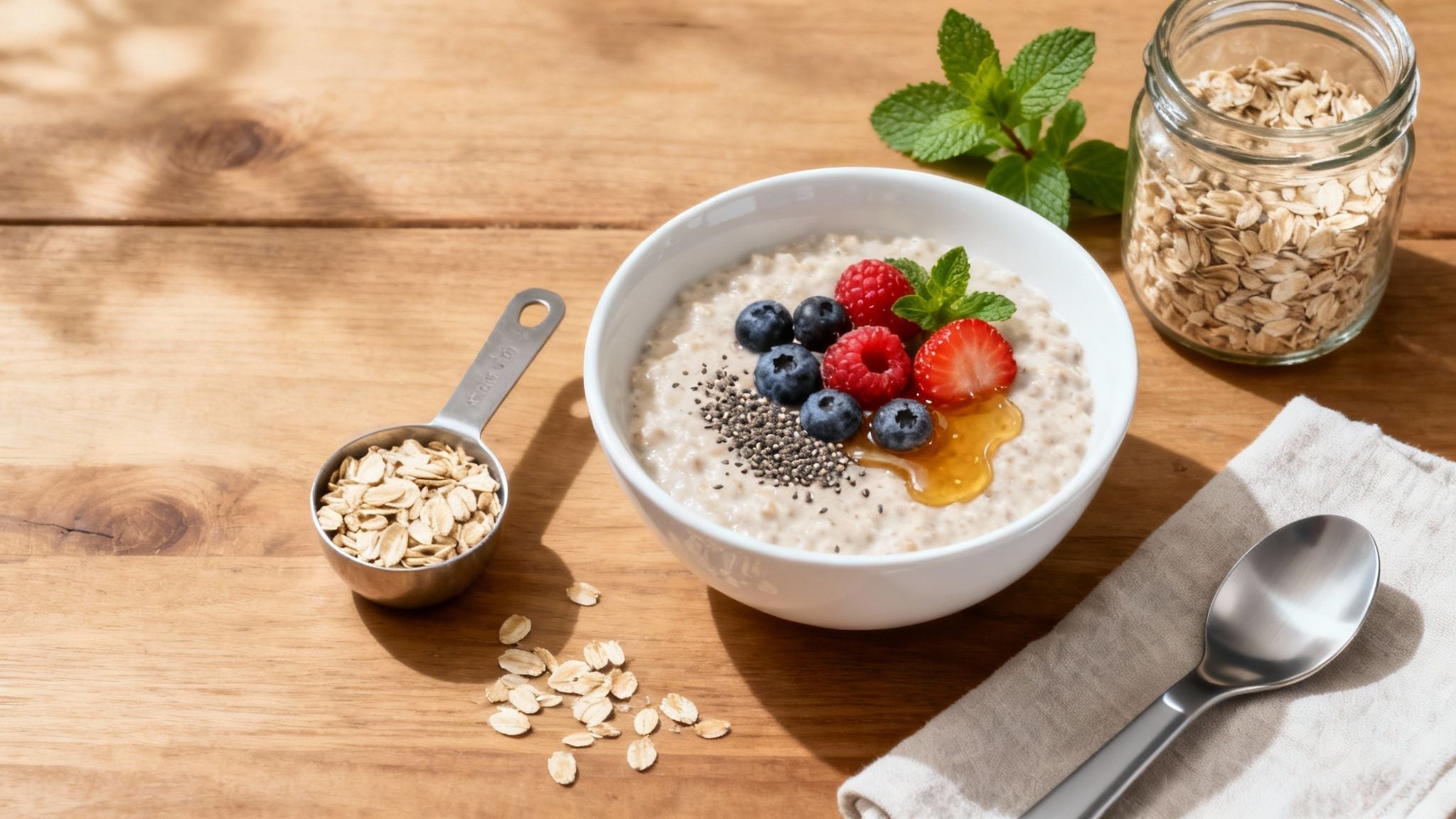
Losing weight with oats: How it really works
Yes, losing weight with oats really does work. Not because they are a miracle cure, but because they cleverly support you in achieving your goals. They are a kind of strategic tool for managing how you feel in your body—they provide long-lasting satiety, stabilize your blood sugar, and help you outsmart cravings.
Why oats really help with weight loss
You may be wondering how such a simple food can make a real difference on the scales, right? The answer is not a magical formula but its powerful nutritional composition. Oats are a true powerhouse that supports your body on several levels at once.
Just imagine starting your day with a meal that is not only delicious but also keeps you full and satisfied until lunchtime. That is exactly what oats do. They prevent the typical mid-morning slump that might otherwise tempt you to reach for unhealthy snacks.
The science behind feeling full
Let’s take a look at the facts. A serving of 100 grams of oats provides around 354 calories, 13 grams of protein, 60 grams of carbohydrates, and a substantial 10 grams of fiber. It is precisely this combination that ensures your body releases energy slowly and steadily. If you want to take a deeper look at the nutritional values, you can find more information at DoktorABC.
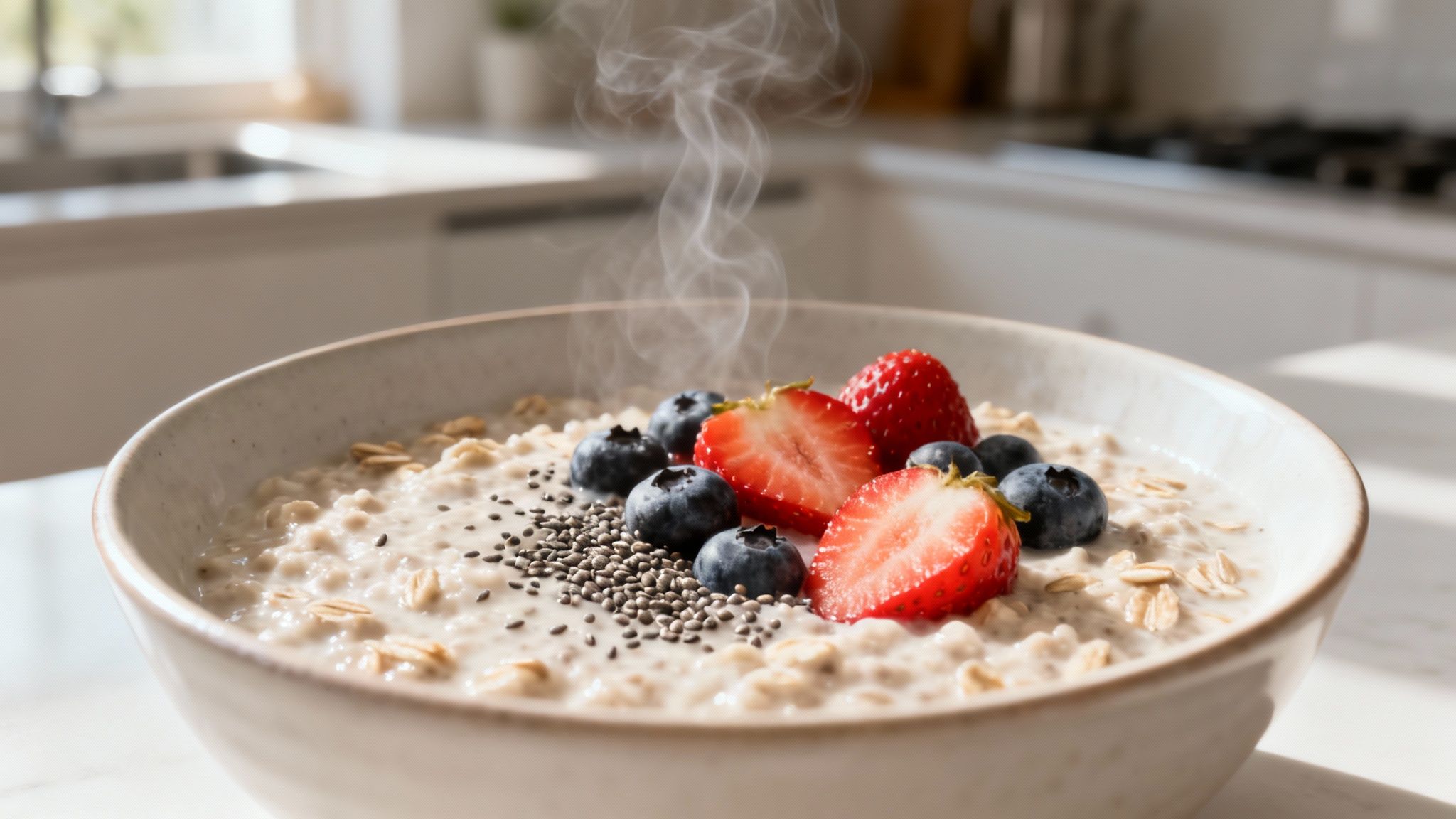
But the real hero here is a soluble fiber called beta-glucan. This substance has an ingenious property: In the stomach, it forms a kind of gel that noticeably slows gastric emptying.
What does this mean for you specifically?
- Long-lasting satiety: You feel pleasantly full for hours without feeling bloated.
- Stable blood sugar levels: The energy from carbohydrates is released into the bloodstream only slowly.
- No binge cravings: Stable blood sugar is the best weapon against dreaded cravings.
Beta-glucan is essentially your personal, natural appetite suppressant. It makes it much easier to stay in a calorie deficit without constantly having to fight hunger. And that is exactly the key to sustainable success.
Nutritional values of oats and their effects
To make the whole thing more tangible, I’ve put together a small overview for you. This table shows the key nutrients in oats per 100 g and explains how each one supports you in reaching your weight goals.
| Nutrient | Amount per 100 g | Your advantage when losing weight |
|---|---|---|
| Fiber (beta-glucan) | 10 g | Promote a long-lasting feeling of fullness and stabilize blood sugar levels. |
| Plant-based protein | 13 g | Support muscle retention during a dietary change and boost the metabolism. |
| Complex carbohydrates | 60 g | Provide energy slowly and steadily, preventing dips in performance. |
| Magnesium | 130 mg | Important for muscle function and energy metabolism. |
| Iron | 5.8 mg | Essential for transporting oxygen in the blood—for more energy in everyday life. |
As you can see, it’s about much more than simply filling your stomach. You’re providing your body with everything it needs to stay capable and perform at its best.
More than just a filling food
But oats can do more than simply fill you up. The plant-based protein they contain is extremely important for protecting your muscles—because muscles burn calories. The complex carbohydrates, in turn, fuel your brain and muscles, helping you stay fit throughout the day.
As an added bonus, you also get a valuable dose of micronutrients such as magnesium, iron, and zinc, which are needed for countless processes in the body. So you’re not only doing something for your figure—you’re also strengthening your overall well-being. Oats are therefore the perfect foundation for a healthy, mindful change in your diet.
Practical ways to incorporate oats into your daily routine
Theory is one thing, but how do you actually incorporate oats sensibly into your everyday life without getting bored? The good news: It’s not about following a strict diet, but about finding a flexible, smart routine that works for you.
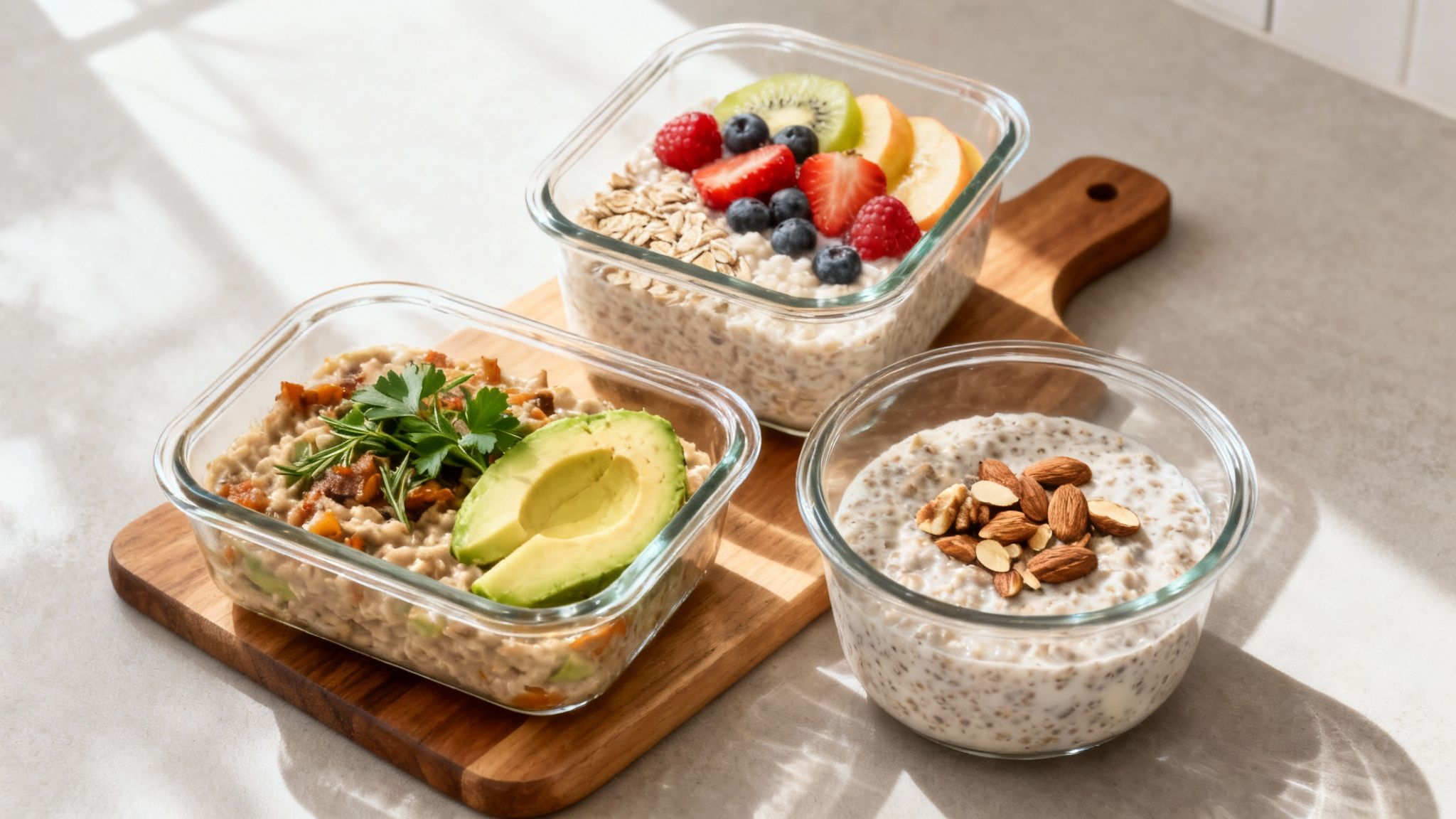
Forget rigid plans. Simply think of the following ideas as a kind of building-block system. Pick what works for you and design your meals cleverly—and above all, make them filling. This is how losing weight with oats becomes something that fits naturally into your lifestyle.
Your sample daily plan with oats
A good day often starts with stable blood sugar levels and a feeling of being truly full. Oats are the perfect foundation for this—but they can do so much more than just breakfast.
Morning (around 7:00 a.m.) The power breakfast Let’s start with a classic porridge. Cook about 40–50 grams of rolled oats with water or unsweetened plant-based milk. What matters now are the toppings: Instead of sugar or syrup, use a handful of berries (fresh or frozen), a spoonful of flaxseeds for healthy fats, and a pinch of cinnamon, which may support metabolism.
Lunch (around 12:30 p.m.) The savory, filling meal Yes, you read that right: Oats also work wonderfully in savory dishes. Use them to make vegetable soup creamier, or shape them into healthy patties. My tip: Mix 30 grams of rolled oats with an egg, some grated vegetables such as zucchini or carrots, and fresh herbs. Fry the mixture in olive oil until golden brown and serve with a large salad—done.
The afternoon (around 4:00 p.m.) The smart snack When the afternoon energy slump hits, forget the cookies. A few spoonfuls of Greek yogurt with 1–2 tablespoons of oats and a small handful of nuts provide valuable protein and fiber. That will easily keep you going until dinner. Need more inspiration? Here you’ll find our delicious and healthy snack recipes.
A small but effective tip: Prepare your oats as “overnight oats” the evening before. This saves you time in the morning and lets you start the day stress-free—your nervous system will thank you.
Portion control and the right partners
Success when losing weight with oats comes down to two things: the right portion size and the right accompaniments.
A standard serving is about 40 to 60 grams (when dry). Anything more can quickly become a calorie bomb, especially when sugary toppings are added.
Here are a few ingredients that enhance your oat meal—and some you’d better avoid:
-
Top partners for your oats:
- Berries: They provide antioxidants and vitamins with very few calories.
- Nuts and seeds (in moderation): Chia seeds, flaxseeds, or a few almonds provide healthy fats and additional protein.
- Unsweetened protein powder: A scoop of it in your porridge enhances the feeling of fullness and helps maintain your muscles.
- Spices: Cinnamon, cardamom, or turmeric add flavor without calories and can stimulate the metabolism.
-
Beware of these calorie traps:
- Ready-made muesli and granola: These often contain a lot of hidden sugar and unhealthy fats.
- Dried fruit: It is heavily sweetened and has a high calorie density.
- Agave syrup and honey: Although they sound natural, they consist almost entirely of sugar.
If you follow these simple rules, you will turn oatmeal into a true ally on your journey. You will stay full for longer, provide your body with important nutrients, and save unnecessary calories along the way.
The oatmeal diet: An honest assessment
The so-called “oatmeal diet” has been circulating online for some time. It is often promoted as a miracle solution for rapid weight loss. But before you rush into it full of enthusiasm, let’s take an honest, no-nonsense look at the whole thing. Because what sounds great at first usually has a major catch.
Most of these radical diet approaches are essentially about one thing: drastically reducing calorie intake. The principle is quickly explained: You eat around 250 grams of oatmeal a day, which pushes total energy intake down to a meager 1,000 to 1,300 kilocalories. Clearly, the weight loss is primarily caused by this extreme calorie deficit.
Although the complex carbohydrates and high protein content keep blood sugar levels stable and help prevent cravings, the plain oatmeal method offers no real long-term advantage over other calorie-reduced diets. A critical look at reports such as the one on Utopia.de confirms this.
Short-term success vs. long-term risks
Of course you lose weight when you eat so little. Your body taps into its reserves, and the number on the scale drops quickly. That can be incredibly motivating at first, no question.
But this extreme lack of variety is toxic to your health. A diet consisting almost entirely of a single food inevitably leads to nutrient deficiencies. Important vitamins, minerals, and healthy fats from vegetables, fruit, and other protein sources are completely missing.
A crash diet is like a sprint—you make rapid progress, but you cannot keep it up for long. A balanced diet, on the other hand, is a marathon that gets you to your goal sustainably and healthily.
The following infographic sums up the dilemma: Calorie intake is at rock bottom, while the risk of the dreaded yo-yo effect goes through the roof.
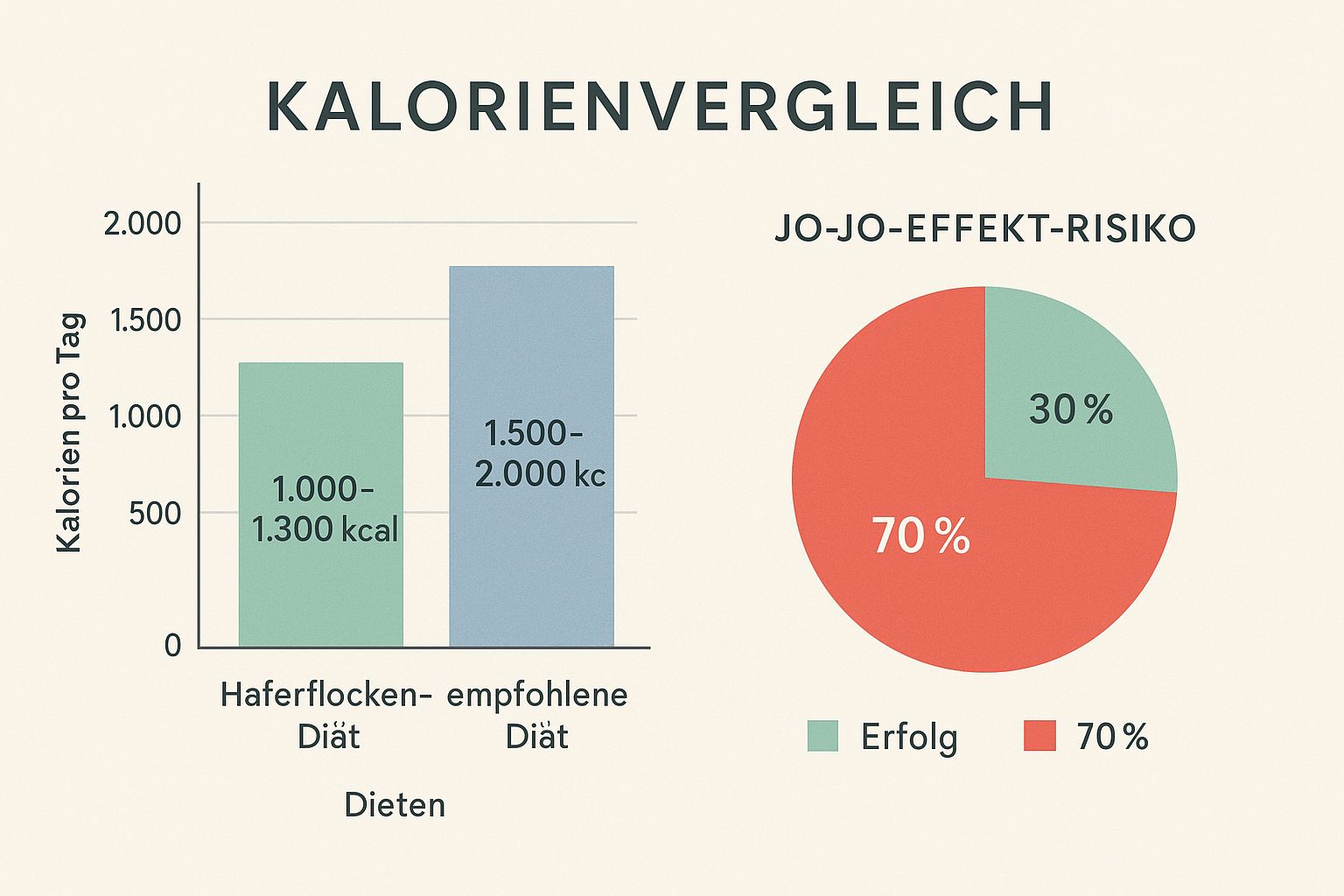
The data show unequivocally that quick success comes at a high price. As soon as you start eating normally again, your body switches into panic mode and stores even more reserves for fear of the next “famine.” The weight returns in no time—often even more than before.
The smart way to use oats
Instead of following a radical diet, you should see oats for what they really are: an incredibly valuable building block for a balanced diet. They are the perfect way to keep you full and satisfied, but they should never be your only food.
- Incorporate, don't replace: Use a serving of oats to make one meal of the day healthy and filling—the breakfast is ideal for this.
- Combine wisely: Always supplement your oats with protein (yogurt, quark), healthy fats (nuts, seeds), and vitamins (fresh fruit).
- Listen to your body: Learn to recognize your fullness signals again instead of clinging to rigid calorie targets.
This approach is much more sustainable and leads to long-term success without pushing your body to its limits. If you want to learn more about how to lose weight healthily, you'll find many more practical tips in our guide. It's about doing something good for your body, not punishing it.
Choosing the right oats and toppings
When losing weight with oatmeal, the devil is often in the details. Not all oats are the same, and not every topping truly brings you closer to your goal. The selection on supermarket shelves can quickly become overwhelming, but don't worry: With the right knowledge, you'll always make the best choice from now on.
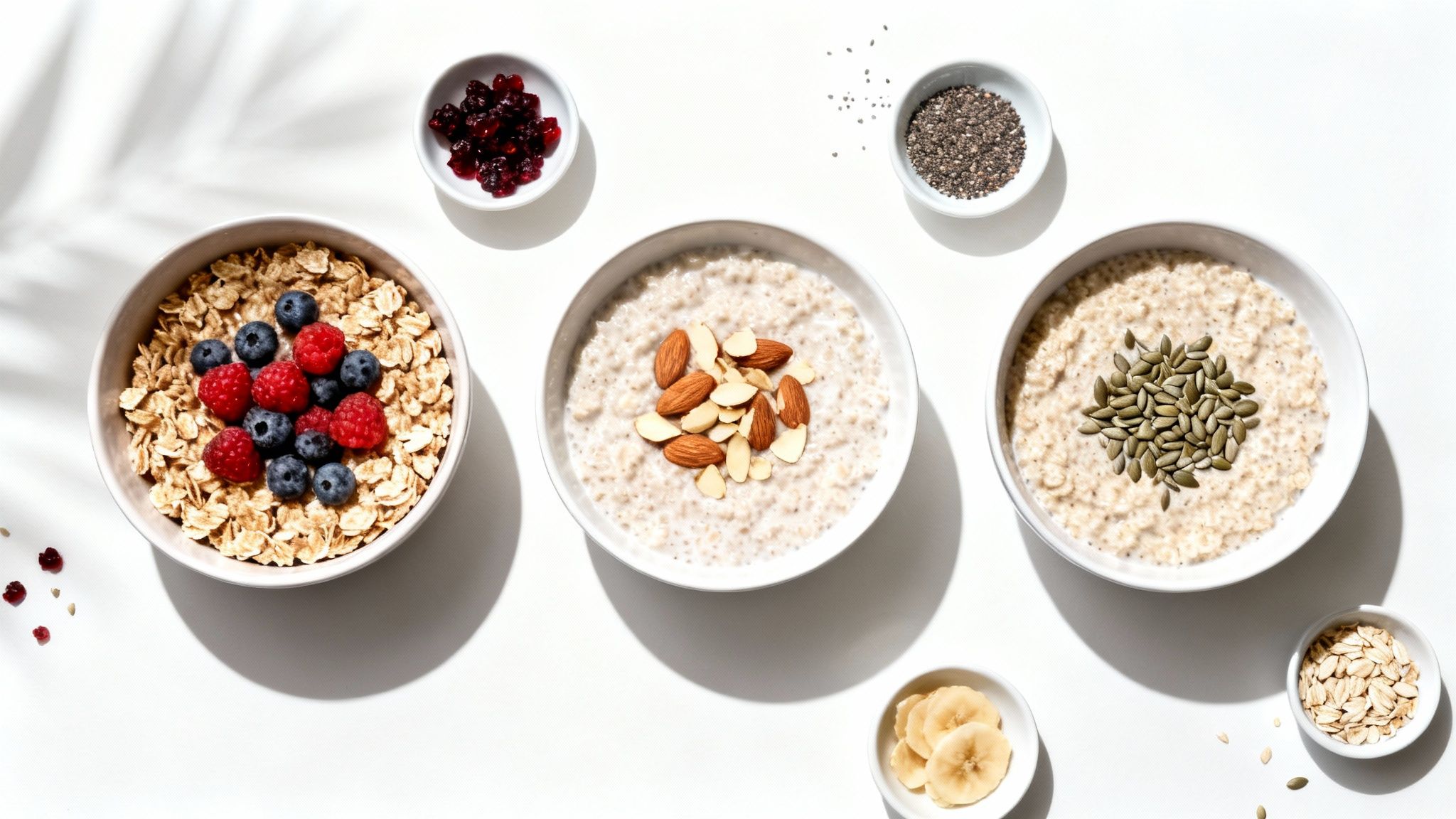
Think of your oats simply as the foundation of a house. They provide solid, long-lasting energy. The toppings are what you build on top—either a strong, healthy building or a shaky hut made of sugar and empty calories.
Steel-cut, rolled, or instant oats: Which is the best choice?
The good news first: Regardless of which variety you choose, they all come from the whole oat grain and are therefore fundamentally a good choice. The crucial difference lies in the processing. This affects how quickly your body digests the flakes and, more importantly, how long they keep you full.
- Hearty rolled oats (large flakes): When it comes to long-lasting satiety, they are the clear winners. Here, the whole grain is simply flattened. Your body therefore has to work harder to break it down, resulting in wonderfully stable blood sugar levels.
- Fine rolled oats (small flakes): Here, the grains are chopped before rolling. The result? They swell faster and become creamier. However, they are also digested a little faster than the hearty variety. A good compromise when you need to get going quickly in the morning.
- Quick-cooking oats: They are rolled from oat flour and dissolve almost completely in liquid. Ideal for baby food, but rather unsuitable for weight loss. They cause blood sugar to rise more quickly and keep you full for significantly less time.
For maximum satiety and a blood sugar level that carries you through the morning, hearty rolled oats are your best choice. They provide fiber in its most natural form and give your metabolism plenty to work on.
The art of smart toppings
Now we come to the crucial part—the part that determines the success or failure of your oatmeal breakfast. Even the best hearty oats are useless if you drown them under a mountain of sugar. The goal is to enhance your meal with valuable nutrients, not stuff it full of empty calories.
To make the decision easier in everyday life, I put together a quick overview.
Smart vs. less smart toppings for your oatmeal
A comparison of toppings to help you make nutrient-rich, calorie-conscious choices for your breakfast.
| Smart choice (Supports weight loss) | Less smart choice (May slow weight loss) |
|---|---|
| Fresh or frozen berries: Rich in antioxidants, vitamins, and fiber with minimal calories. | Dried fruit (dates, raisins): High concentrations of fructose and calories. |
| Flaxseeds, chia seeds, hemp seeds: Provide valuable omega-3 fatty acids, protein, and additional fiber. | Sweetened nut-nougat spreads: Pure sugar and fat bombs without any significant nutrients. |
| A small handful of nuts/almonds: Healthy fats and plant-based protein that also help keep you full. | Ready-made granola or crunchy muesli: Usually contain huge amounts of hidden sugar, fat, and empty calories. |
| Cinnamon or unsweetened cacao nibs: Add flavor without calories and may stimulate the metabolism. | Agave syrup, honey, maple syrup: They consist almost exclusively of sugar and cause blood sugar to spike. |
As you can see, by consciously choosing your toppings, you can transform a simple bowl of oats into a true nutrient booster that brings you much closer to your goals.
If you would like to explore the topic in more depth, our guide explains in much greater detail whether oats are healthy and what you should consider when choosing and preparing them.
Oat days as a targeted reset for your metabolism
Have you ever heard of “oat days” and wondered what they are all about? The concept may sound unusual at first, but it originally comes from diabetes therapy. However, it can also be a valuable, short-term boost for healthy people—think of it as a reset button for your metabolism.
The idea is to eat almost nothing but oats for a very short time, usually two to three days. The primary goal here is not rapid weight loss, but improving your insulin sensitivity.
What happens in the body during oat days?
Imagine that, due to an unbalanced diet, your body has somewhat forgotten how to respond efficiently to the hormone insulin. This often leads to fluctuating blood sugar levels, which in turn promotes cravings and slows down fat burning. Sounds familiar, right?
This is exactly where oat days come in. By providing a substantial amount of the fiber beta-glucan and drastically reducing your intake of fat and sugar, you give your system the opportunity to recalibrate. Your cells become more sensitive to insulin again.
In concrete terms, this means for you:
- Your blood sugar level stabilizes.
- Your body can process carbohydrates more effectively again.
- You create the perfect foundation for more effective fat burning.
It is important to note: Oat days are not a conventional diet. They are a short-term, targeted measure to get your metabolism back on track and prepare it optimally for a healthy dietary change.
A clear guide to carrying it out safely
If you want to try this reset, a structured plan is essential. It’s not about starving yourself, but about sending your body the right signals.
A typical oat day consists of three main meals. Each meal consists of 75 grams of oats, prepared with around 500 ml of water or unsweetened tea. This brings you to a total of approximately 1,000 kilocalories per day.
A few small, light side dishes are allowed to add a little variety:
- A splash of lemon juice or a pinch of cinnamon for flavor.
- A small handful of berries (approx. 50 g) per meal.
- Fresh herbs and calorie-free vegetables such as cucumber or leafy greens.
Studies have shown that oat days like these can significantly lower blood glucose levels in people with type 2 diabetes. For healthy people, the benefit lies in short-term calorie restriction and giving the metabolism a break. However, experts warn against viewing this as a long-term solution. If you’d like to explore the scientific background in more depth, you can find information from the German Diabetes Association.
The starting point for long-term change
After the two to three oat days comes the crucial part: not falling back into old patterns. See these days as the perfect starting point for a sustainable change in diet. Your body is now optimally prepared, and you’ll notice that healthy foods have a better effect and keep you feeling full for longer.
To maintain this momentum, it’s important to keep your metabolism active over the long term. In our guide, we show you which foods stimulate your metabolism and how to incorporate them cleverly into your daily routine. This is how you turn a short reset into long-term success.
Frequently asked questions about losing weight with oats
Even if you already know quite a bit about losing weight with oats, everyday life often brings up detailed questions. That’s perfectly normal, because every body is different. Here, I answer the most common questions we keep receiving so you can get started with a clear plan and complete confidence.
Are oats in the evening a good idea?
Yes, contrary to many myths, oats can also be a smart choice in the evening. A smaller portion, around 25 to 30 grams, may even help you fall asleep. This is due to the amino acid tryptophan, a precursor to the sleep hormone melatonin.
However, preparation is important here: It is best not to combine the oats with sugary fruits. Instead, opt for a pinch of cinnamon or a few almonds. This helps keep your blood sugar levels stable and provides your body with valuable nutrients overnight without slowing down fat burning.
How many grams of oats per day are optimal for weight loss?
There is no one-size-fits-all answer, as the ideal amount always depends on your personal calorie needs. However, a good rule of thumb is 40 to 60 grams (dry weight) per day.
This portion provides enough fiber to keep you full for a long time without exceeding your calorie budget. Remember: more is not automatically better. Oats are a valuable part of your diet, but they are not the only food. Variety is key to getting all the nutrients you need.
The goal should be to replace or enhance one meal—usually breakfast—with oats. This allows you to make the most of their satiating effect to start the day and effectively prevent cravings during the morning.
Are oats suitable for everyone?
Basically, yes—for most people, oats are extremely healthy and well tolerated. However, there are a few exceptions you should know about:
- Celiac disease: If you have a gluten intolerance, you must make sure to choose certified gluten-free oats. Regular oats can easily come into contact with gluten-containing grains during processing.
- Histamine intolerance: Some people with severe histamine intolerance are sensitive to oats. In this case, it is advisable to start slowly with small amounts and see how your body reacts.
- Fructose malabsorption: If you have a fructose intolerance, you should avoid sugar-rich toppings such as bananas or dried fruit. Better alternatives include berries, nuts, or seeds.
When in doubt, always listen to your body. It sends you the best signals about what is good for it. With these answers, you are now ideally equipped to use oats cleverly and effectively to achieve your goals.
Do you want to know exactly which foods work best for you instead of merely guessing? At mybody-x.com, we analyze your individual metabolism and create a nutrition plan based on scientific data that is truly tailored to you. Discover how your body works and reach your goals faster and more sustainably. Find out now which metabolic test is right for you.


Share now:
Understand skin aging and take proactive action
Low-Carb Diet: Your Simple Guide to Getting Started