
Diet for irritable bowel syndrome: what the guideline recommends and what it does not
The essentials at a glance
There is no diet that suits everyone with irritable bowel syndrome. The German clinical guideline says this explicitly. Two approaches are supported by evidence: soluble fiber and a time-limited, professionally supervised reduction of certain carbohydrates. Both affect symptoms. Neither makes irritable bowel syndrome disappear.
This article lays out the recommendations from the nutrition chapter of the S3 guideline individually and states for each what it applies to and where it explicitly advises caution. Every statement includes the institution and year. Where the guideline makes no statement, neither does this article.
You will first learn what lies behind the diagnosis and why there is no single diet. This is followed by the signs that warrant an appointment before any dietary change, a comparison of the three evidence-based approaches, chapters on fiber, FODMAP reduction, and dietary supplements, the practical process of a supervised dietary change, and its limitations.
What to expect in this article
1. What irritable bowel syndrome is and what food can change about it
2. Why there is no one-size-fits-all diet for irritable bowel syndrome
3. When food is not the first step
4. Three approaches that are all called diet for irritable bowel syndrome
5. Soluble fiber: the most clearly established lever
6. FODMAP reduction and its three phases
7. Probiotics and dietary supplements: what is supported by evidence
8. What food-related tests can contribute
9. What a supervised dietary change looks like in practice
10. What a gut flora analysis shows in this context
11. Who can benefit from a supervised dietary change
12. Limitations: what diet cannot do for irritable bowel syndrome
13. What ultimately matters when it comes to eating
Frequently asked questions
Sources
What irritable bowel syndrome is and what food can change about it
People who search for information about diet for irritable bowel syndrome are rarely looking for a definition. They are looking for a list: what I can eat, what I should leave out. That exact list does not exist, and the reason is already contained in the diagnosis.
Irritable bowel syndrome is a diagnosis of exclusion. It describes a pattern of symptoms, not a single dysfunction that can be measured and then eliminated through diet. The S3 guideline on irritable bowel syndrome from DGVS and DGNM (version 2.0, June 2021) ties the diagnosis to three points, all of which must be met together.
The first point concerns duration: chronic symptoms must be present that, according to the guideline, last or recur for more than three months and are related to the bowel. The second point concerns the impact of the symptoms on everyday life: according to the guideline, they should be severe enough to significantly impair quality of life.
The third point is where dietary questions are decided. It reads verbatim: “The prerequisite is that there are no changes characteristic of other disease patterns that are likely responsible for these symptoms.” (Statement 1-1, DGVS and DGNM, 2021)
Key message
Irritable bowel syndrome is diagnosed by excluding other diseases. A dietary change therefore only comes into play once this evaluation has already taken place.
How common the symptom pattern actually is
The guideline gives two very different figures, and the gap between them is itself informative. Worldwide, the S3 guideline on irritable bowel syndrome estimates the prevalence at 11.2 percent, with a range of 9.8 to 12.8 percent (DGVS and DGNM, 2021).
For Germany, the same guideline cites an analysis of billing data. Routine coding data from a large German health insurance fund showed an administrative prevalence of 1.34 percent and an incidence of 0.34 percent per year (DGVS and DGNM, 2021). The gap between eleven percent and just over one percent shows how many people affected by these symptoms never appear in billing data.
Women are affected more often. The guideline reports a pooled odds ratio of 1.46 and describes women as outnumbering men by two to one in the second and third decades of life (DGVS and DGNM, 2021).
Why the symptom pattern determines the dietary question
One point determines almost everything that follows, yet advice guides rarely distinguish it clearly: Which symptom is predominant for you? The guideline does not formulate its dietary recommendations for irritable bowel syndrome as a whole, but for individual symptom patterns.
Recommendation 5-6 explicitly refers to adults “with irritable bowel syndrome and predominantly constipation-related symptoms,” meaning constipation is the main issue. Recommendation 5-7 separately refers to patients “of the diarrhea type,” for whom diarrhea is predominant. The FODMAP recommendation in Recommendation 5-9c is also linked to a particular symptom pattern.
Anyone who skips this classification applies a measure formulated for a different symptom pattern. This is the most common reason why a dietary change achieves nothing, even when it has been implemented correctly.
What diet can actually do in this context
Food is the only stimulus the gut receives several times a day and that you control yourself. That is why diet is an obvious starting point for irritable bowel syndrome, and why the guideline gives it its own chapter.
What it says there is nevertheless more sober than the abundance of advice might suggest. A dietary pattern can influence symptoms. It does not treat a disease, it does not eliminate a set of symptoms, and the guideline does not state anything else at any point.
Why there is no single diet for irritable bowel syndrome
The guideline’s nutrition chapter begins with a sentence that rules out any universal list. It reads: “No uniform dietary recommendations can be made for all patients with irritable bowel syndrome.” (Recommendation 5-1, DGVS and DGNM, 2021)
This sentence is not a fallback. It describes a finding: The same meal triggers different symptoms in two affected people, and which foods play a role in an individual case cannot be determined in advance.
This leads to the chapter’s second statement, which challenges the widespread practice of eliminating foods as a precaution. The wording is: “Broad elimination recommendations without evidence of clinical effectiveness should be avoided.” (Recommendation 5-3, DGVS and DGNM, 2021)
Documented source
“Longer-term elimination diets should only be attempted when individual food intolerances have been confirmed and under the guidance and supervision of a nutrition medicine or nutritional therapy professional.”
German Society for Gastroenterology, Digestive and Metabolic Diseases (DGVS) and German Society for Neurogastroenterology and Motility (DGNM)
Update to the S3 Guideline on Irritable Bowel Syndrome, version 2.0, AWMF registry number 021/016, Recommendation 5-2, June 2021
Two conditions that are regularly missing from dietary guides
This recommendation contains two conditions, both of which are often overlooked in dietary guides. The first is confirmed evidence of an individual intolerance. The second is professional advice and monitoring during the elimination phase.
Without the first condition, someone may eliminate foods that play no role at all. Without the second, no one remains to check whether the diet that is left is still adequate. The guideline has a separate, very brief sentence on this: “Malnutrition should be avoided or treated.” (Recommendation 5-4, DGVS and DGNM, 2021)
The fact that this recommendation was needed at all says something about common practice. A meal plan from which food group after food group disappears over the course of months eventually becomes a problem in its own right—regardless of whether the abdominal symptoms have improved.
What can be said about prevention
A question regularly comes up in consultations: Can irritable bowel syndrome be prevented through the right diet? The guideline answers it clearly and directly: “No dietary recommendations can be made for the prevention of irritable bowel syndrome.” (Recommendation 5-5, DGVS and DGNM, 2021)
When food is not the first step
Before any dietary change begins, the question is whether the symptoms are actually part of irritable bowel syndrome. The third criterion of the guideline definition requires exactly that: there must be no changes characteristic of other clinical conditions.
Blood in the stool belongs in a medical practice. Unintentional weight loss belongs in a medical practice. Fever belongs in a medical practice. Symptoms that wake you from sleep belong in a medical practice.
These four signs are not a reason for an elimination phase and not a reason to place an order. They are a reason to make an appointment. Anyone who notices them should not run a test or start a diet, but make an appointment.
Three approaches, all called nutrition for irritable bowel syndrome
The term nutrition for irritable bowel syndrome encompasses three approaches that differ considerably in purpose, duration, and effort. The following overview compares them using the same criteria, together with what the guideline says about each.
| Criterion | Guided basic nutrition | Soluble fiber | Low-FODMAP in three phases |
|---|---|---|---|
| Wording of the guideline | “Accompanying medical nutritional counseling should be recommended.” | “Soluble fiber should be preferred.” (Recommendation 5-6) | “For constipation as the dominant symptom, a low-FODMAP diet … may be recommended” (Recommendation 5-9c) |
| Purpose | The basis for every subsequent step. Clarifies what is being eaten before considering what should be eliminated. | Primarily for predominantly constipation-related symptoms. According to Recommendation 5-7, it is also possible for the diarrhea-predominant type. | Reduction of certain short-chain carbohydrates to identify individual triggers. |
| Duration | Designed to be permanent. It is the normal state, not the exception. | Can be continued indefinitely because nothing is removed; something is added. | Limited in time. The guideline describes three phases: elimination, finding tolerance, and long-term nutrition. |
| Professional guidance | Explicitly recommended. The wording refers to medical nutritional counseling. | No separate specification in the wording of Recommendations 5-6 and 5-7. | Necessary because phases two and three involve the actual work and will be skipped without guidance. |
| Known risk | Low. Nothing is omitted that would need to be replaced. | The wording of the recommendations says nothing about the quantity. That question belongs in the consultation. | Persisting in phase one risks narrowing the diet. Recommendation 5-4 addresses malnutrition. |
A fourth variant often appears in practice and is deliberately absent from this table: blanket abstinence after a test result. It has no place in the guideline because Recommendation 5-3 explicitly seeks to avoid far-reaching abstinence recommendations without evidence of effectiveness.
Soluble fiber: the clearest lever
Of all dietary measures, this one is formulated most clearly. The guideline states: “In adults with irritable bowel syndrome and predominantly constipation-related symptoms, fiber should be used for treatment. Soluble fiber should be preferred.” (Recommendation 5-6, DGVS and DGNM, 2021)
There is a separate, more cautiously worded statement for the other major symptom type: “Therapy with soluble fiber can also be used in patients with diarrhea-predominant irritable bowel syndrome.” (Recommendation 5-7, DGVS and DGNM, 2021) The difference between “should” and “can” is not merely stylistic; it reflects the strength of the recommendation.
What distinguishes soluble from insoluble fiber in the intestine
The distinction is not a minor detail for specialists; it is the core of the recommendation. According to the Federal Centre for Nutrition, soluble fiber forms gels and is fermented in the intestine by bacteria, meaning it is broken down.
According to the same source, insoluble fiber is “not fermented or only incompletely fermented” and increases stool volume. For a sensitive intestine, this is a noticeable difference, and it explains why the guideline indicates a preference rather than specifying a total amount.
The gap between the guideline and reality
The German Nutrition Society recommends at least 30 grams of fiber per day for adults aged 19 and over (DGE, reference values, as of 2021). This is not an irritable bowel syndrome recommendation, but the general guideline for the population.
In fact, women consume an average of 18 grams and men 19 grams of fiber per day (Federal Centre for Nutrition, accessed in August 2026). That means there is a gap of around ten grams per day between the guideline and reality.
The wording of recommendations 5-6 and 5-7 does not specify an amount specifically for irritable bowel syndrome. That is why there is no amount given here either. How much soluble fiber is appropriate in a particular case, and in what form, is precisely the question for which the guideline recommends accompanying nutritional counseling.
Chapter at a glance
The S3 guideline on irritable bowel syndrome (DGVS and DGNM, 2021) recommends fiber for predominantly constipation-related symptoms, with soluble fiber preferred. It can also be used for the diarrhea-predominant type, although the wording is weaker. The recommendations do not specify a daily amount for irritable bowel syndrome; the general DGE guideline is at least 30 grams per day for adults. Soluble fiber differs from insoluble fiber in that it forms gels and is fermented in the intestine.
FODMAP reduction and its three phases
FODMAP is an abbreviation for a group of short-chain carbohydrates and polyhydric alcohols that are poorly absorbed in the small intestine and fermented by bacteria in the large intestine. The term therefore describes not an ingredient but a property that applies to many different foods.
The abbreviation stands for fermentable oligosaccharides, disaccharides, monosaccharides, and polyols. These four groups include substances found in many different foods, from wheat products and certain fruits and vegetables to lactose and sugar substitutes. Therefore, FODMAP reduction cannot be pinned down to a handful of ingredients.
That is precisely where its effort and, at the same time, its risk lie. Anyone who wants to avoid the groups completely cuts across the entire meal plan, including foods that do not cause symptoms at all in an individual case. For this reason, the guideline links reduction to a procedure, not to a list.
FODMAP reduction appears in the guideline with remarkable precision. The wording names not only the intervention but also its structure: “For constipation as the predominant symptom, a low-FODMAP diet (in 3 phases: elimination, finding tolerance levels, long-term diet) may be recommended” (Recommendation 5-9c, DGVS and DGNM, 2021).
The parenthetical phrase is the most important part of this sentence. In the guideline, FODMAP reduction is a three-part procedure with a beginning and an end. It is not a long-term diet, nor was it ever intended to be one.
The three phases in the wording of the guideline
Elimination
The intake of the carbohydrates in question is significantly reduced for a limited period. This phase is the best known and also the shortest of the three. Anyone who stops here has abandoned the procedure, not completed it.
Finding tolerance levels
The groups previously reduced are reintroduced individually and in an organized manner to determine what actually triggers symptoms and what was merely eliminated along with the rest. This phase provides the actual information.
Long-term diet
The result of the second phase is a long-term diet that is as minimally restrictive as possible. The goal is the broadest possible diet, not the narrowest.
Why guidance is not merely a formality here
The guideline places a specific recommendation alongside nutritional therapy: “Accompanying medical nutritional counseling should be recommended.” (DGVS and DGNM, 2021) With FODMAP reduction, that is the difference between a procedure and a restriction.
Phases two and three are difficult to follow without guidance because they require patience and a system, whereas phase one often produces quick results. This is precisely what creates the most common pattern: the elimination phase remains, reintroduction is skipped, and the meal plan becomes increasingly restrictive over the course of months.
This is where the brief Recommendation 5-4 on malnutrition, already quoted above, comes in. It is the reason why FODMAP reduction belongs in professional hands and not in an app list.
Probiotics and dietary supplements: what is supported by evidence
Few topics in irritable bowel syndrome are advertised as intensively as the capsule supposedly meant to restore the gut to normal. The guideline’s nutrition chapter remains remarkably brief here: “No recommendation can be made for dietary supplements in the treatment of irritable bowel syndrome.” (Recommendation 5-8, DGVS and DGNM, 2021)
This is not a warning, but a statement about the available evidence. It means that the evidence for this product group does not support a recommendation in either direction.
The guideline discusses probiotics elsewhere, namely in the section on the microbiome in therapy. In essence, according to the S3 Guideline on Irritable Bowel Syndrome (DGVS and DGNM, 2021), selected probiotics should be used in the treatment of irritable bowel syndrome. The word “selected” carries the sentence, because this does not constitute a general recommendation for probiotics.
In everyday life, this means two things. First, deciding which preparation is suitable for which form of symptoms is a professional matter, not one to be decided at the shelf. Second, no capsule replaces working on the daily diet addressed in Recommendations 5-1 to 5-9.
Why advertising claims and guideline wording diverge
Dietary supplements are foods, not medicines. What may be stated on a package is therefore determined by approved health claims, not by what a clinical guideline says about treating a set of symptoms.
This creates the impression that there is a wide range of treatments for irritable bowel syndrome with proven benefits. In fact, Recommendation 5-8 describes the evidence soberly: No recommendation can be made for dietary supplements in the treatment of irritable bowel syndrome.
Anyone who still wants to try something should treat it like an elimination phase: one thing at a time, over a set period, with a note about what has changed. Without this structure, the question of what worked and what happened at the same time remains unanswered.
What testing around food can contribute
Many people affected come to the topic of nutrition through a test, rather than the other way around. A result promises a shortcut: a list of foods to avoid without having to observe anything yourself. That shortcut does not exist.
There is a clear professional consensus on tests for food-specific immunoglobulin G, or IgG, and it belongs here: allergy societies do not recommend IgG tests for diagnosing food intolerances. Elevated IgG levels indicate contact with a food, not necessarily an intolerance.
The S3 guideline on irritable bowel syndrome also does not recommend testing for food-specific IgG in this clinical picture. At most, such a finding may provide clues about which foods to observe first during a professionally supervised elimination phase. It does not establish anything, which is why this article contains no product offer for it.
Where diagnostic testing has a clear role
Two other conditions are regularly considered when people have abdominal symptoms and are investigated differently. Celiac disease is diagnosed through a medically ordered evaluation, not through an elimination phase. Eliminating gluten beforehand makes the subsequent evaluation more difficult.
For lactose intolerance, the hydrogen breath test, also called the H2 breath test, is the medical standard. An antibody finding in the blood does not answer this question because it involves an enzyme deficiency, not an antibody reaction.
What helps in both cases and with irritable bowel syndrome is unremarkable: a food and symptom diary kept over several weeks. It provides precisely the individual clues that Recommendation 5-2 requires as documented evidence before a longer-term elimination diet.
What a useful food diary contains
A diary that only lists foods helps no one. It becomes useful when it also records the time, the symptom and its severity, along with bowel movements and everything else that shaped the day.
The reason is the time delay. Symptoms often occur hours after a meal, and without times it is impossible to reconstruct later which meal could have been responsible. Without this association, every suspicion remains just a feeling.
Four weeks is a good period because it also captures fluctuations unrelated to food. Anyone who subsequently reviews their journal with a nutrition professional has the foundation required by all three approaches discussed in this article.
How a guided dietary change works in practice
Several months lie between making the decision and establishing a sustainable long-term diet. This is not a sign of an ineffective approach, but the price of leaving as few foods as possible excluded in the end.
Assessment comes first
The diagnosis is one of exclusion. Without this step, any dietary change begins with an unverified assumption.
Write it down first, then eliminate it
Keep a diet and symptom diary for several weeks. Without a baseline, it is not possible to attribute any subsequent change.
Get advice
The guideline recommends accompanying medical nutritional counseling. It determines which approach is suitable for your symptoms.
Reintroduce and keep a record
Finding your tolerance determines the outcome. In the end, the long-term diet should remain as varied as possible.
The goal is the broadest possible diet, not the narrowest possible one.
This article puts the guideline situation into context. If you are instead looking for a step-by-step guide for everyday life, you can find it in our article Irritable bowel diet in six steps. Which test answers which question when you have digestive symptoms is explained in Gut test for home use. You can look up which types of bacteria appear in a report and what they mean in the Gut encyclopedia.
What a gut flora analysis shows in this context
mybody®x (MYBODY Lab GmbH) offers a description of the gut flora from a stool sample. Before the card appears, the most important limitation belongs at the front, not at the end.
In essence, according to the S3 guideline on irritable bowel syndrome (DGVS and DGNM, 2021), analyzing the commensal gut microbiota is not intended for diagnosing irritable bowel syndrome. Such a finding therefore does not answer whether irritable bowel syndrome is present, nor does it identify the cause of your symptoms.
Its purpose is narrower and more honest: describing the current state and serving as a comparison point if you are already changing your diet over several months. The price is as of August 27, 2026.
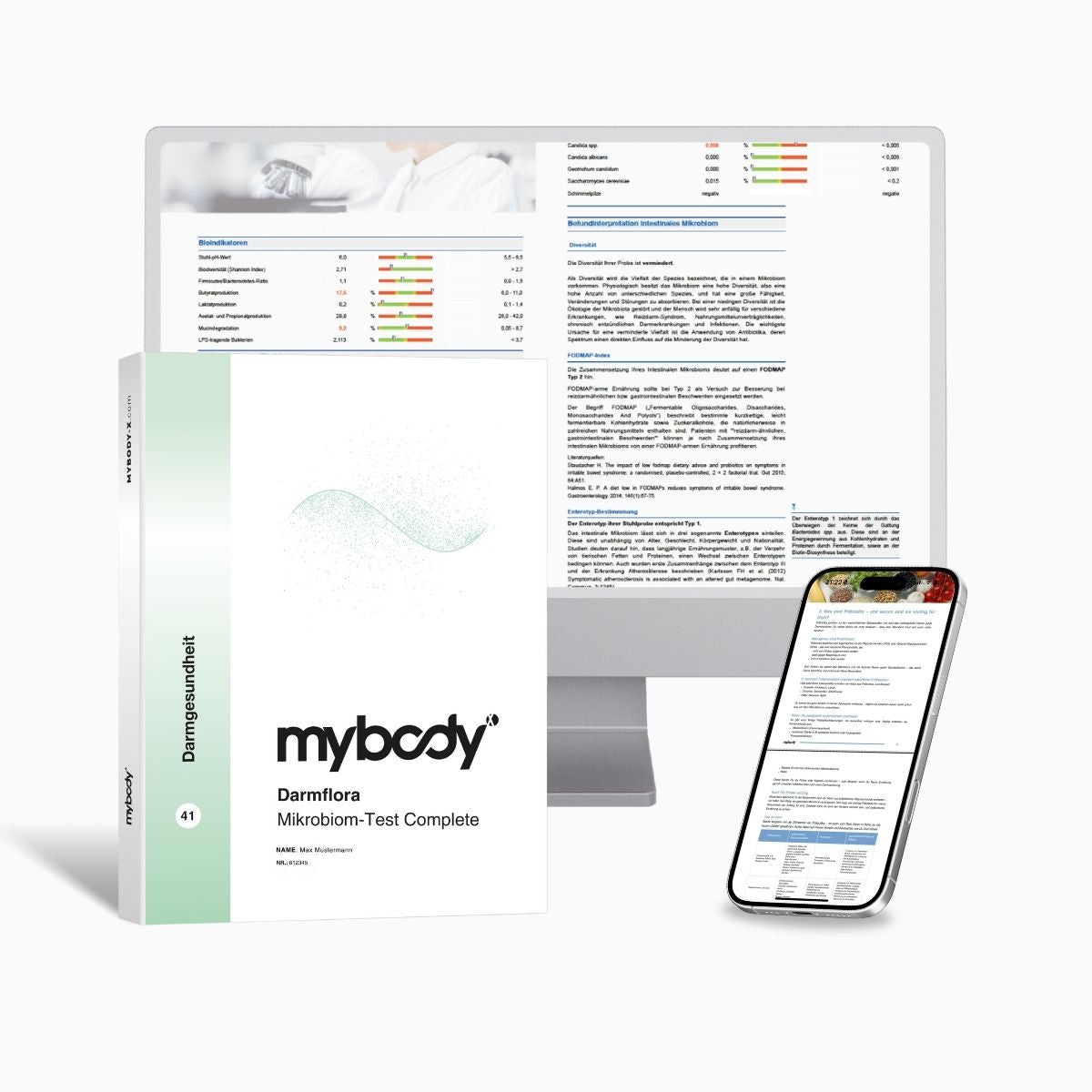
Gut test from a stool sample
Complete gut microbiome test | Complete
Using DNA sequencing, it records more than 1,500 types of gut bacteria and describes their composition. What the test does not do: It does not assess irritable bowel syndrome, identify the cause of abdominal symptoms, or provide a nutrition plan that replaces professional advice. The product page lists nutrition, digestion, and everyday routines as its areas of application and explicitly states that it does not provide a medical assessment.
Laboratory analysis 5–10 business days after sample receipt
Product page information without location, accessed 27 August 2026
There is deliberately no offer or link here for tests for food-specific IgG. An article that cites the professional assessment and offers the corresponding product alongside it undermines its own statement.
When a test result serves as a useful baseline
A description of the gut flora is most useful when you tie it to a specific point in time. A single result describes a state. Two results taken months apart describe a change, and change is what matters in a dietary intervention.
The testing interval for gut tests therefore follows a different logic than for a DNA test. The gut flora changes over the course of weeks, which is why a follow-up test after around three months is customary. A DNA analysis, by contrast, remains the same for life and is performed once.
Even with two test results, the limitation stated above still applies. A change in composition says nothing about whether your symptoms have improved. Your diary, not your lab report, answers that question.
Who benefits from guided dietary changes
A structured dietary change takes time, attention, and usually money. Whether this effort is worthwhile depends less on the severity of your symptoms than on where you are right now.
Worthwhile for you if …
you have undergone medical evaluation and other causes have been ruled out.
your symptoms have persisted for months and so far you have only eliminated individual foods on suspicion.
you are prepared to keep records for several weeks and actually follow through with reintroducing foods.
Probably not if …
one of the warning signs from chapter three applies to you. Then you need a medical appointment, not a dietary change.
you have or have had an eating disorder. Structured elimination phases can cause harm rather than help in this situation.
you are hoping for a fixed list of forbidden foods. The guideline does not provide one, and this article does not either.
Limitations: what diet cannot do for irritable bowel syndrome
The clearest boundary comes at the beginning of any honest assessment. Changing your diet can affect symptoms. It does not make irritable bowel syndrome disappear, and none of the recommendations cited claims that it does.
The second boundary concerns transferability. Since recommendation 5-1 states that there are no uniform dietary recommendations for all those affected, every food list on the internet is, at best, a hypothesis about another person.
The third boundary concerns time. A FODMAP reduction is designed in three phases, and the second and third phases take weeks to months. Anyone who stops after two weeks of elimination has learned nothing and nevertheless lost something.
The fourth boundary concerns test results. A description of the gut flora does not attribute symptoms, and an IgG result does not establish an intolerance. At most, either can be the beginning of an observation professionally guided by someone qualified.
Key message
A dietary pattern can influence symptoms of irritable bowel syndrome. It does not cure anything, and the S3 guideline does not state otherwise anywhere.
What ultimately matters when eating
A short sequence can be derived from the nine recommendations in one specialist chapter, and it is unremarkable. Assessment before dietary change. Writing things down before eliminating foods. Guidance before starting an approach. Reintroduction before perseverance.
What becomes apparent in this sequence is stated in none of the recommendations and yet follows from all of them: The guideline is more concerned with the process than with the foods. It does not tell you what belongs on your plate. It tells you how to find out what belongs on yours.
The specific next step is therefore smaller than most people expect. Get a notebook and write down what you eat and how you feel afterward for four weeks. This notebook is your ticket into any of the three approaches because it provides the individual information required by recommendation 5-2.
It all began with the search for a list saying what you should eliminate. That is precisely why it is worth taking the detour via the booklet: In the end, there is a list, but it is yours, and it is shorter than the one from the internet.
If you are unsure which of the three approaches suits the form of your symptoms: The consultation costs nothing, and it will not try to sell you anything.
Frequently asked questions
Which diet is right for irritable bowel syndrome?
There is no diet that suits everyone. The 2021 S3 guideline on irritable bowel syndrome from the DGVS and DGNM states in recommendation 5-1 that uniform dietary recommendations cannot be made for all those affected. Specifically, it outlines three approaches: a guided basic diet with medical dietary counseling, the preferred use of soluble fiber, and a three-phase low-FODMAP reduction. Which one is suitable depends on the form of your symptoms and should be determined with professional guidance.
How long does a FODMAP reduction take?
It is designed as a process with an endpoint, not as a permanent diet. In Recommendation 5-9c, the guideline describes three phases: elimination, tolerance finding, and long-term diet. Elimination is the shortest phase, reintroduction provides the actual information, and the end result is a lasting diet that excludes as little as possible. The wording of the recommendation does not specify a number of weeks; the duration is determined by the accompanying nutritional counseling.
Do fiber really help with IBS?
For predominantly constipation-related symptoms, soluble fiber should be used according to Recommendation 5-6 of the S3 guideline (DGVS and DGNM, 2021), with soluble fiber preferred. For the diarrhea-predominant type, it may also be used according to Recommendation 5-7, but the wording is weaker. Neither recommendation specifies a daily amount specifically for IBS. The general guideline of the German Nutrition Society is at least 30 grams per day for adults aged 19 and over (DGE, as of 2021).
When should abdominal symptoms be checked by a doctor?
Blood in the stool, unintentional weight loss, fever, and symptoms that wake you at night belong in a doctor's office. IBS is diagnosed by ruling out other conditions: According to Statement 1-1 of the S3 guideline (DGVS and DGNM, 2021), there must be no changes characteristic of other conditions that are likely responsible for the symptoms. If you notice any of these signs, do not take a test or start a diet—make an appointment.
Can a test show which foods trigger my IBS?
No. Allergy specialist societies do not recommend IgG tests for diagnosing food intolerances. Elevated IgG levels indicate contact with a food, not necessarily an intolerance. An analysis of the gut flora is also not intended for assessing irritable bowel syndrome. What reveals individual triggers is a food and symptom diary kept over several weeks and evaluated with a nutrition professional.
Next step
If you want to document your current status
The Complete gut microbiome test | Complete describes the composition of your gut flora from a stool sample. It does not assess irritable bowel syndrome and does not replace nutritional counseling. If you only want to look up what individual types of bacteria mean, you can continue without a test.
Complete gut microbiome test | Complete Gut glossary without a testRead more
You might also be interested in
The practical side: how to implement the three approaches in everyday life once the classification is clear.
In case the question of the right test comes before the question of nutrition.
For reference on which bacterial species and markers may appear in a report and what they mean.
Sources
- German Society for Gastroenterology, Digestive and Metabolic Diseases (DGVS) and German Society for Neurogastroenterology and Motility (DGNM): Update to the S3 guideline on irritable bowel syndrome, version 2.0, June 2021, AWMF register number 021/016, chapter “Nutrition in the treatment of irritable bowel syndrome” – dgvs.de
- DGVS and DGNM: Update to the S3 guideline on irritable bowel syndrome, full text in the AWMF register, status February 2022 (definition and epidemiology) – register.awmf.org
- German Nutrition Society (DGE): Reference values for nutrient intake, fiber, 2021 edition – dge.de
- Federal Center for Nutrition (BZfE): Fiber, accessed on 08/28/2026 – bzfe.de
The recommendations quoted verbatim as 5-1 to 5-9c, as well as the recommendation for accompanying medical nutritional counseling, are taken from [1]; the paraphrased information on selected probiotics and microbial analysis also comes from that source. Statement 1-1 with the definition, as well as the information on frequency, odds ratio, and sex ratio, comes from [2]. The guideline value of at least 30 grams of fiber per day comes from [3]. The average intake of 18 and 19 grams per day, as well as the description of soluble and insoluble fiber, comes from [4]. The information on IgG tests reflects the assessment of the allergy specialist societies. Information on price, scope of testing, sample type, and laboratory comes from the mybody®x product pages, accessed on 08/27/2026; processing times follow the central specification for gut tests. All sources were accessed and reviewed on 08/28/2026.

mybody®x Editorial & Expert Team
Nutritional science Microbiome and gut science Guideline development Laboratory diagnostics
This article was created by the mybody®x editorial and expert team. The team brings together nutritional science, microbiome and gut science, and the interpretation of findings. Contributors are listed on the authors page.
Published on 07/09/2025 · Last updated on 08/27/2026
The content is intended for general information and does not replace medical advice, diagnosis, or treatment. The recommendations provided reflect the status of the S3 guideline on irritable bowel syndrome from June 2021; the decisive factors are the medical assessment in each individual case and the applicable guidelines.




Share now:
Testosterone – Effects, Symptoms & Tests for Men
Healthy eating for weight loss – how to make it easy