
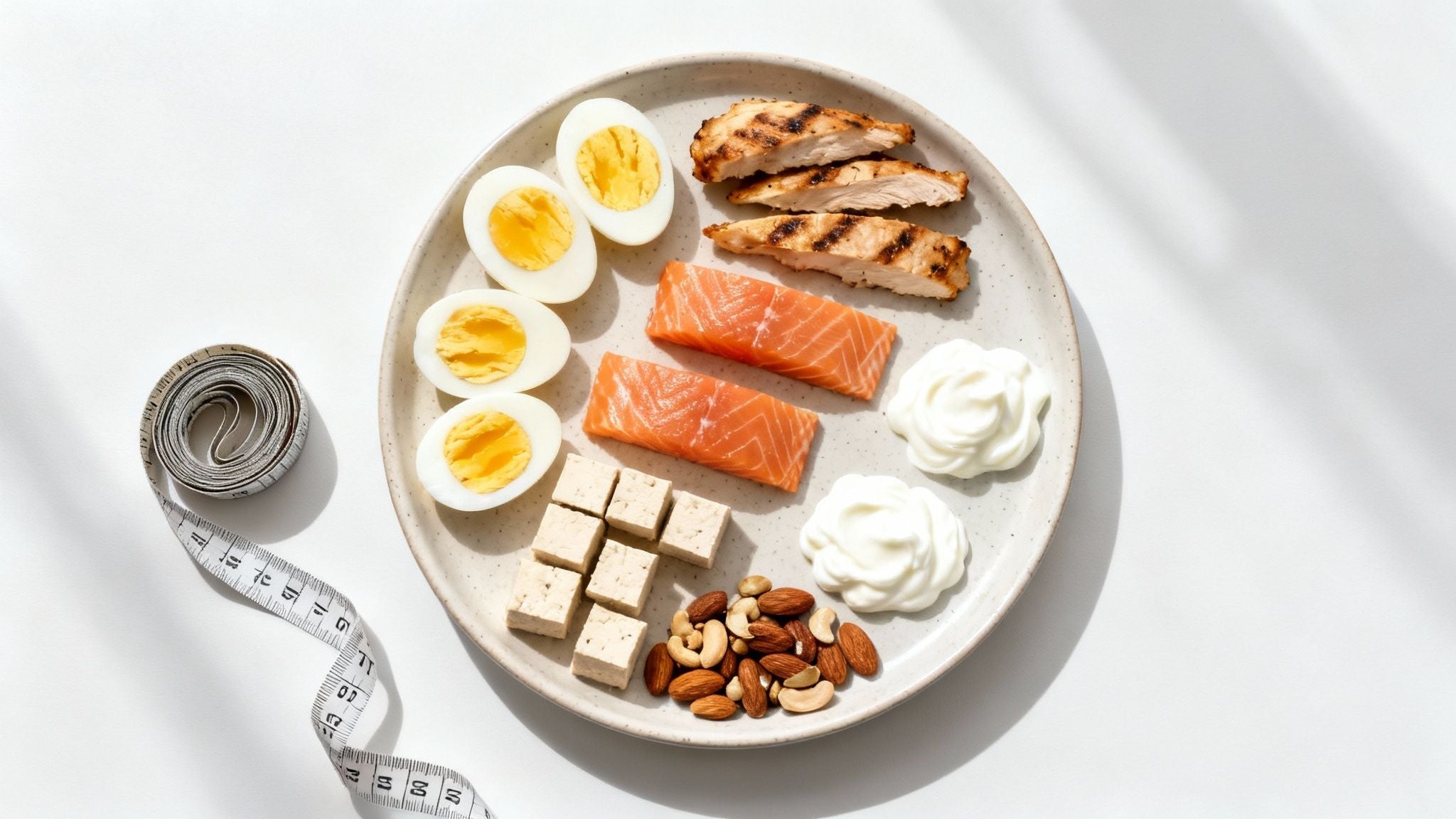
Your exact daily protein requirement: Find out what your body really needs
How much protein you really need per day is probably one of the most frequently asked questions in nutritional counseling. The short answer, as so often, is: It depends. Many people cite the figure 0.8 grams of protein per kilogram of body weight. But honestly? That is only a general starting point and is not enough for most of us. Your true requirement is as individual as you are—and the most precise answer can be found in your DNA.
Understanding your daily protein requirements
Your body is not a machine that operates rigidly according to a formula. Your personal protein requirement is a highly dynamic matter that constantly adapts to your life. Think of it as fuel for your car: A compact car leisurely cruising through the city has very different fuel consumption from a sports car racing around a track.
The same applies to your body. Your age, sex, health status, and above all, how active you are determine how much of this important building material you actually need.
Activity as an influencing factor
The biggest factor affecting your protein requirements is your physical activity. Someone who spends most of the day at a desk has fundamentally different needs from someone who regularly laces up their sports shoes.
- Low activity: Your body primarily needs protein for basic repair and maintenance processes. Here, the baseline value of 0.8 g/kg is often sufficient.
- Moderate activity: If you train several times a week, whether jogging, cycling, or doing light strength training, your requirements increase. Your muscles practically cry out for more building blocks for recovery.
- High activity: Ambitious athletes working toward building muscle or achieving real performance gains have the highest requirements. Protein is the decisive factor here for repair, growth, and performance.
The following graphic clearly illustrates how sharply your daily protein requirement per day rises with your activity level.
So you can see: Your requirements can easily more than double when you get off the couch and choose a more active lifestyle. Yet even these figures are only rough guidelines.
Important note: These figures are good averages. However, the truly optimal amount for you may still differ. One factor is often completely overlooked: your individual genetics.
While general calculators and tables provide excellent guidance, the most precise answer to your personal needs lies in your genes. A metabolism test from mybody-x.com can show you exactly how your body processes protein and whether you naturally have a higher or lower requirement. That's the difference between making a good guess and having real knowledge.
Why Protein Is the Foundation of Your Body

Imagine your body as a house. For this house to stand securely, it needs a solid foundation, load-bearing walls, and a roof that can withstand any weather. That is exactly what proteins, also known as dietary protein, are for your body: They are the universal building blocks for pretty much everything that goes on inside you.
Without enough bricks—that is, proteins—no stable house can be built. Every process, from cell renewal and oxygen transport in the blood to defending against pathogens, depends on a steady supply of these essential macronutrients. Proteins are much more than just “muscle food.”
The Many Functions of Protein
Proteins are true all-rounders and take on roles that go far beyond simply building muscle. They keep your body's complex system running.
- Repair and growth: They are, in a sense, the mortar holding your tissues together. After an injury or an intense workout, they repair damaged cells and build new ones.
- Structural support: Proteins such as collagen and keratin give your skin, hair, and nails their strength and structure. Without them, everything would look rather limp.
- Hormone and enzyme production: Many hormones that regulate important bodily functions, as well as enzymes that get your metabolism going, are made of proteins.
- Strong immune system: Your antibodies, which fight viruses and bacteria, are nothing more than specialized proteins. A deficiency therefore directly weakens your immune defenses.
This fundamental importance shows why meeting your daily protein requirement is crucial for every one of us—whether you're a fitness enthusiast or an office worker. If you want to take a deeper look at your health and build a strong physical foundation, you'll find more valuable information on the nlc homepage.
More Than Just Building Material
In addition to serving as building blocks, proteins have another crucial benefit that is especially valuable for weight management and overall well-being: They keep you feeling full for longer.
Compared with carbohydrates and fats, the body requires more energy to digest protein. This process, known as diet-induced thermogenesis, boosts your metabolism and helps you feel full and satisfied for longer.
In plain terms, this means that a protein-rich meal can help curb cravings and make it easier to manage your calorie intake. Getting enough protein is therefore important not only for your health, but also for your energy levels and how you feel in your body day to day.
How to Calculate Your Personal Protein Requirement
Now that we’ve looked at the general recommendations, it’s time to make things personal. Forget rough estimates—it’s time to find out what your body really needs. The basis for this is a simple but incredibly effective formula that uses your own body weight as its starting point.
The basic calculation is incredibly simple: You multiply your body weight in kilograms by a factor that suits your lifestyle and goals. This gives you a clear number to use as your daily guide.
The Formula in Real Life
To make this more tangible, let’s look at three completely different people. You’ll immediately see how widely individual requirements can vary, even though the basic formula is always the same.
-
Example 1: The Office Worker (35 years old, 70 kg)
Her daily life revolves around a desk, and she rarely engages in strenuous physical activity. Her goal: to stay healthy and maintain her weight. Here, a factor of 0.8 g to 1.0 g per kilogram of body weight is a great starting point.- Calculation: 70 kg x 0.9 g/kg = 63 g of protein per day.
-
Example 2: The Recreational Runner (45 years old, 80 kg)
He trains three to four times a week for his next half marathon. Recovery and protecting his muscles are his top priorities. A factor of 1.2 g to 1.4 g is exactly right here.- Calculation: 80 kg x 1.3 g/kg = 104 g of protein per day.
-
Example 3: The Active Senior Woman (68 years old, 65 kg)
She wants to maintain her muscle strength, goes for regular walks, and does light gymnastics. Since the body needs more support to stay fit as we age, we use 1.0 g to 1.2 g here.- Calculation: 65 kg x 1.1 g/kg = 71.5 g of protein per day.
These examples make one thing crystal clear: A blanket recommendation is hardly ever truly suitable for anyone. Official bodies such as the German Nutrition Society (DGE) do give adults a guideline of 0.8 grams per kilogram of body weight. However, for people aged 65 and over, this value is increased to 1.0 gram to counteract the natural loss of muscle with age.
What Else Affects Your Calculation
Your weight and level of physical activity are the most important pillars of the calculation—but they are not the only ones. There are a few other factors that can increase your protein needs and require a small adjustment to the formula.
Always remember: Your body is not a rigid structure. What is right for you today may look completely different six months from now if your life or goals change.
Keep these points in mind when calculating your needs:
- Age: The older we get, the more protein the body needs to put a stop to muscle loss (sarcopenia).
- Health status: When you are recovering from an illness or injury, your body is working at full speed. Repair processes require more building blocks—and therefore more protein.
- Special phases of life: During pregnancy and breastfeeding, requirements are significantly higher. After all, it is not only the mother who needs to be nourished, but also the growing baby.
All these formulas and factors give you a damn good estimate. But what if you want to do it not just well, but perfectly? The key to ultimate precision lies in your DNA. While calculators are always based on estimates, a metabolic test from mybody-x.com can tell you exactly how your body processes protein. You will find out whether you naturally need more or less—a discovery that takes your diet to an entirely new level. Learn more in our article about how personalized nutrition based on your DNA works.
Protein needs over the course of life
Your daily protein requirement is anything but a fixed figure set in stone. Rather, it reflects your life—it changes with you, your goals, and your everyday routine. This becomes particularly noticeable as we get older.
While young adults often do well with a baseline amount, the body changes as we age. Metabolism becomes somewhat slower and, more importantly, it naturally begins to break down muscle mass. This process, also called sarcopenia, is the main reason why protein suddenly becomes a much more pressing issue as we get older.
Why seniors need more protein
From around age 65, the body switches, so to speak, into a different mode. It becomes less efficient at using the protein from food. This means it needs more of it to achieve the same effect and maintain muscle. That is exactly the goal—to actively counteract muscle loss in order to preserve strength, mobility, and your independence for as long as possible.
A protein-rich diet in old age is therefore not a nice option but a genuine necessity. It is the foundation for:
- Maintaining muscle mass: Strong muscles are the best protection against falls and the key to staying mobile.
- Strong bones: Proteins are a fundamental component of the bone matrix and are therefore indispensable for bone health.
- A strong immune system: The body's defenses also depend on an adequate protein supply to remain effective.
Experts agree: Protein requirements increase significantly with age. An increase of up to 50 % compared with younger years to sustainably maintain quality of life.
Specific figures for the second half of life
The growing importance of protein in old age has long been recognized in the scientific community as well. Professional organizations such as the European Society for Clinical Nutrition and Metabolism (ESPEN) recommend a daily intake of 1.0 to 1.5 grams of protein per kilogram of body weight for seniors.
For a 75-kilogram senior, this means specifically that they should consume between 75 and 112.5 grams of protein daily to help prevent muscle loss.
This conscious adjustment is a crucial building block for a long, healthy, and independent life. If you would like to explore in greater depth how nutrition can specifically contribute to a longer life, you will find valuable insights in our guide to longevity nutrition.
Especially when your appetite may decrease somewhat with age, deliberately choosing protein-rich foods becomes all the more important. While these guidelines provide excellent orientation, the most precise answer lies in your genetics. A metabolism test from mybody-x.com can show you precisely how your body processes protein and whether your personal requirements may naturally be even higher. This allows you to tailor your diet not only to your age but directly to your genetic blueprint.
Protein as fuel for sports and exercise

When you exercise regularly, you essentially shift your body into a higher gear. You challenge your muscles, tendons, and ligaments—and that is exactly what makes you stronger and more enduring. But every training session also leaves tiny microtears in the muscle tissue. To repair them and rebuild stronger than before, your body needs one thing above all: more building material in the form of protein.
Imagine your muscles as a construction site. After a hard day’s work (your workout), the construction workers (proteins) must arrive to repair the damage and reinforce the building. If the workers are missing, the entire construction project stagnates. Your daily protein requirement therefore increases directly with your level of physical activity, because protein is the key to recovery and improved performance.
Strength training versus endurance training
For a long time, the myth persisted that only bodybuilders needed huge amounts of protein. But that has long been outdated. Clearly, strength athletes have particularly high requirements to build new muscle mass. But endurance athletes also depend on increased intake to stay fit.
- Strength athletes (goal: muscle growth): Here, protein clearly serves as a building block for hypertrophy, meaning the growth of muscle fibers. The body needs a protein surplus to build new tissue in the first place.
- Endurance athletes (goal: recovery): When running, cycling, or swimming, the focus is less on significant muscle gain. Much more important is the rapid repair of stressed muscles and the preservation of existing muscle mass. A good protein supply helps protect against muscle loss during prolonged exertion.
The protein requirements of physically active people are significantly higher than the general recommendations of the DGE. Depending on the type and intensity of exercise, international professional organizations recommend an intake of 1.2 to 2.0 grams per kilogram of body weight per day. For a 70-kilogram person, that means between 84 and 140 grams of protein per day—this is the only way to truly ensure muscle growth, recovery, and protection against muscle loss.
Practical tips for sports nutrition
Optimizing your protein intake is not rocket science. What really matters is timing and quality to get the most out of your training.
The meal after training is particularly important. During the first one to two hours after exercise, your body is extremely receptive to nutrients. A protein-rich snack or shake can significantly speed up recovery.
A low-fat quark with fruit, a chicken breast fillet with vegetables, or a high-quality protein shake are ideal options after exercise. But did you know that your genetics also play a decisive role in how effectively you build muscle? In our article, you’ll learn how a DNA test for muscle building can optimize your training.
While these guidelines provide an excellent foundation, the most precise answer to your personal needs lies in your genetic makeup. A metabolic test from mybody-x.com can show you whether you may have a genetically higher protein requirement, allowing you to reach your athletic goals even more efficiently.
Discover your exact protein requirement in your DNA
All those formulas and guidelines are great for roughly narrowing down your daily protein requirements. But let’s be honest: They only scratch the surface because they are based on averages. The truly precise answer lies much deeper—in your own personal genetic blueprint.
Your DNA is essentially the instruction manual for your body. It determines how efficiently your cells process proteins, how quickly you build muscle, and how high your individual need for this building block really is. Imagine this: Two people with the same weight and identical training plans can have completely different protein requirements solely because of their genes.
From estimation to knowledge
This is exactly where we bridge the gap between general recommendations and a diet that is truly tailored to you. Instead of guessing, you can know for sure. A metabolic test, such as the one from mybody-x.com, specifically analyzes the genes responsible for your protein and nutrient metabolism.
Imagine holding a report that tells you in black and white whether you naturally have a higher or lower protein requirement than average. This is no longer a vision of the future, but the key to getting the most out of your diet.
The result is a clear, practical recommendation tailored specifically to you. You’ll learn which nutrient distribution is optimal for your body, helping you reach your health and fitness goals faster and, above all, more sustainably.
This takes you out of the world of estimates and into the realm of precise, scientifically based facts. You give your body exactly what it needs according to its own genetic makeup. If you want to understand how far-reaching these insights can be, read our guide on how a DNA test for nutrition can transform your entire approach. This is the ultimate step toward tailoring your diet perfectly to you.
Frequently asked questions about protein requirements
Great, you’re almost there! To wrap things up, we’ll answer a few more questions we keep receiving about daily protein requirements. This will help clear up any final uncertainties so you can get fully started.
Can you eat too much protein?
In theory, yes, but for healthy people it is rarely an issue in everyday life. Extremely high intake over a very long period could put strain on the kidneys. As long as you follow the usual recommendations for your activity level (up to 2.0 g/kg), you are absolutely on the safe side and benefit from all the advantages.
A small tip: Just make sure you drink enough. That supports your kidneys in their work either way.
Does protein make you fat?
A clear no. Protein alone does not make you fat—in the end, your overall calorie balance is what matters. In fact, the opposite is often true: A high-protein diet can even help you lose weight. Why? Because it boosts your metabolism and keeps you feeling full for a long time. That is the best weapon against cravings.
You will only gain weight if you consistently eat more calories than you burn. It makes no difference whether those calories come from protein, fat, or carbohydrates.
Which foods are the best sources of protein?
The best strategy is a colorful mix of animal-based and plant-based sources. This ensures that your body gets the full spectrum of essential amino acids.
- Top animal-based sources: Lean meat such as chicken or turkey, fish (salmon and tuna are great), eggs, and dairy products such as low-fat quark or Greek yogurt.
- Strong plant-based sources: Legumes such as lentils and chickpeas, tofu, tempeh, as well as nuts, seeds, and the pseudocereal quinoa.
When you cleverly combine different protein sources, you increase what is known as biological value. Put simply, this means your body can use the protein you consume even more efficiently to build its own structures, such as muscle.
Is protein intake different for men and women?
The basic requirement per kilogram of body weight does not depend on gender, but on your body composition and activity level. Since men have more muscle mass on average, their absolute requirement in grams is often higher. However, the relative formula (grams per kilogram) is a great guideline for everyone.
Are you ready to stop guessing and finally see in black and white what your body really needs? The mybody-x metabolism test analyzes your genes and gives you an exact blueprint for your optimal diet. Find out exactly how much protein you personally need and reach your goals faster than ever before.
Discover your personalized metabolism test now at mybody-x.com



Share now:
Stop glycation and slow skin aging
VO₂max value: Improve your endurance and performance