
Finally understand sleep disorders during menopause
Do you lie awake at night wondering why you just can't find peace? You're not alone. Sleep disturbances during menopause are extremely common and often have clear physical causes that go far beyond everyday stress. So it's no coincidence that your sleep is completely out of whack right now.
Why your sleep suffers during menopause
During menopause, your body undergoes a profound hormonal shift. Imagine your body as a finely tuned orchestra, in which the hormones estrogen and progesterone have been the main conductors. When their levels suddenly drop, many processes become disrupted – and your sleep-wake cycle is often the first casualty.
These changes are not imaginary, but a tangible biological reality. Many women feel completely exhausted during the day, while at night they lie awake for hours, their thoughts racing endlessly. This is not only frustrating, but also incredibly draining.
Hormonal imbalance as the main cause
Hormonal fluctuations themselves likely play the biggest role in this nightly drama. The drop in progesterone , also known as a natural "calming hormone," is particularly noticeable. Normally, it has a relaxing and sleep-inducing effect. When progesterone levels fall, this calming effect disappears, which can lead to inner restlessness and troublesome sleep disturbances.
At the same time, the falling estrogen level interferes with the regulation of your body temperature. The result is the dreaded hot flashes and night sweats that abruptly jolt you out of deep sleep. But that's not all:
- Changes in sleep architecture: The crucial deep sleep phases become shorter. Your sleep becomes lighter overall and is interrupted more frequently.
- Increased susceptibility to stress: The body may release more of the stress hormone cortisol, which further sabotages falling asleep.
- Psychological stress: Persistent lack of sleep quickly leads to mood swings, irritability and anxiety, which in turn disrupt sleep – a classic vicious cycle.
Sleep disturbances during menopause are a widespread problem in Germany. Studies show that up to 60 percent of postmenopausal women are affected, compared to only 16 to 24 percent of the general population. Learn more about the background at pharmazeutische-zeitung.de .
More than just tiredness
The consequences of sleep deprivation go far beyond the feeling of tiredness. Your physical and mental performance suffers, your immune system is weakened, and the risk of metabolic disorders can increase.
The stress hormone cortisol plays a particularly crucial role here. A persistently elevated level can not only ruin your sleep but also negatively impact many other health processes. If you'd like to learn more, read our article on the symptoms of high cortisol levels in women .
Understanding these connections is the first and most important step to regaining control. It's not about simply accepting the situation, but about knowing the causes and taking targeted countermeasures.
How hormones affect your nighttime rest
Do you often feel like the main character in a bad movie at night, unable to find peace? Unfortunately, your hormones are in charge. To understand why your sleep is so frequently disrupted during menopause, we need to take a look behind the scenes – at the hormonal orchestra in your body, which suddenly starts playing a completely new melody.
The two most important instruments in this orchestra are estrogen and progesterone . When their levels drop, it triggers a chain reaction that ends directly in your bedroom.
The role of the calming hormone progesterone
Think of progesterone as a gentle lullaby for your nervous system. It's often called nature's "calming hormone" because it has relaxing, anxiety-reducing, and sleep-inducing effects. But during perimenopause, it's often one of the first hormones whose production declines.
The result? A noticeable inner restlessness and tension. You lie in bed at night, actually exhausted, but your mind is racing incessantly. This feeling of being constantly on edge and simply unable to switch off is a direct consequence of the lack of the calming signal from progesterone.
Estrogen deficiency and nighttime hot flashes
At the same time, estrogen levels also gradually decline, which has a different, but no less disruptive, effect. Estrogen is, among other things, responsible for finely tuning the body's thermostat in the brain. If its levels drop, this delicate balance is completely disrupted.
Your body suddenly interprets normal room temperatures as overheating and activates an emergency program: the dreaded hot flashes and night sweats. These sudden waves of heat inevitably jolt you awake, often leaving you drenched in sweat with a racing heart. You're not alone: between 40 and 60 percent of menopausal women struggle with these hormonally related sleep problems. You can read more about the underlying causes, for example, at tena.de.
The following infographic shows you at a glance how it all fits together – from the hormones to the symptoms to the sleepless nights.
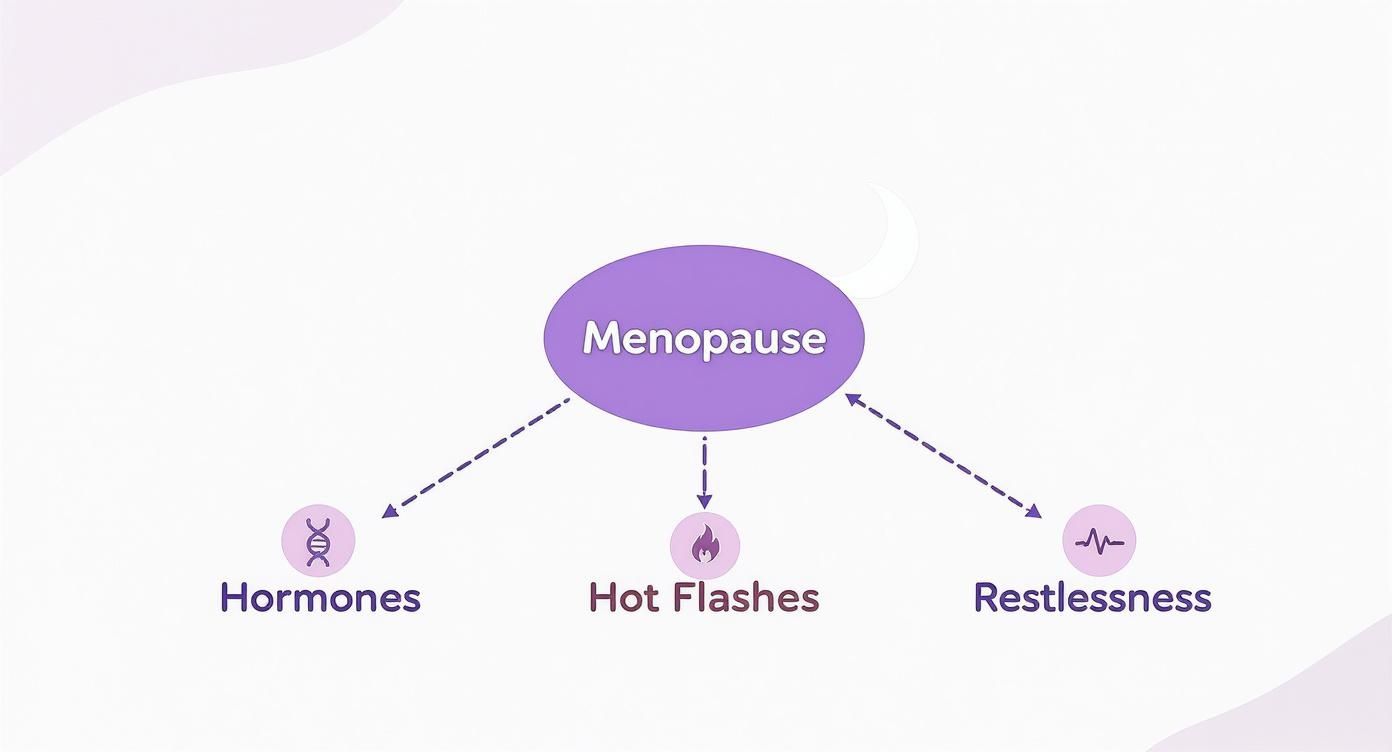
It is clear: Hormonal imbalance is the central domino that triggers a whole series of symptoms that rob you of sleep.
It's important to understand this: your sleep problems during menopause are not imaginary. They have a real, tangible physical cause, which lies in your hormonal balance.
Every woman experiences these changes differently, as the hormonal interplay is highly individual. A test can be incredibly helpful in gaining clarity about your personal status. You can learn more about how to have your hormone levels checked in our detailed article on hormone testing for women . This knowledge is the first and most important step towards regaining control and taking targeted steps for more restful nights.
Correctly interpreting typical signs and symptoms
If you're having trouble sleeping during menopause, that's rarely the only problem. Most of the time, a sleepless night is just the tip of the iceberg – one piece of a larger puzzle of symptoms that are really throwing your body out of whack. To find the right solution, you need to learn to understand your body's language.
Many women don't experience just one type of sleep problem, but a colorful mix of different patterns. It's extremely important to interpret these signs correctly so you don't simply dismiss them as everyday stress.
More than just bad sleep
Sleep disturbances during menopause can feel very different for everyone. Perhaps one or more of these scenarios will sound familiar:
- Trouble falling asleep: You lie awake for hours, even though you're exhausted. Your thoughts race and you just can't find peace.
- Sleep disturbances: You wake up in the middle of the night – often drenched in sweat from a hot flash – and then simply cannot fall back asleep.
- Early morning awakening: Suddenly you are wide awake at four or five o'clock in the morning, long before the alarm clock rings, but you still feel completely exhausted.
These nighttime struggles are often closely linked to other symptoms that also plague you during the day. Heart palpitations, sudden anxiety, or an inexplicable inner restlessness can be direct companions. Mood swings, from deep sadness to intense irritability, are also common and almost always related to hormonal imbalances. You can read more about the specific signs in our article on the symptoms of estrogen deficiency .
Many of these symptoms are mistakenly diagnosed as burnout or a simple stress reaction. But the cause lies deeper – in the hormonal changes in your body.
A phenomenon affecting millions of women
And you're definitely not alone. Around 9 million women in Germany are currently going through menopause . A study shows that 31 percent of them suffer from sleep disorders, often accompanied by hot flashes and mood swings. The frequent misdiagnosis as burnout then often leads to treatment that doesn't address the root cause. You can read more about this in these study results on menopause .
That's precisely why it's so important to correctly identify the symptoms. Only when you know the true causes can you take targeted and effective steps for better sleep and greater well-being. The next step is to discover your own personal rhythm in order to regain control.
Discover your personal sleep rhythm
You've already tried countless tips for sleep problems during menopause , but nothing seems to provide lasting relief? That doesn't surprise me. Standard solutions often overlook the most important factor: your own personal biology. Every body is different, and this is especially true when it comes to sleep. Instead of continuing to grope in the dark, you could take a look at your internal blueprint – your DNA.
A general piece of advice like "Just go to bed at 10 p.m." might work for some, but be completely wrong for you. The reason lies in your genes. They determine your chronotype —whether you're naturally a "lark" (early bird) or more of an "owl" (night owl). Forcing yourself into a rhythm that goes against your internal clock can actually worsen your sleep problems.

Your genes as a guide to better sleep
A DNA metabolic analysis goes much deeper than general recommendations. It deciphers how your body is genetically programmed and finally gives you concrete, personalized answers to the truly important questions:
- How much sleep do you personally need? Do you really need the often-cited eight hours? Or do you perhaps need less – or even more – due to genetics?
- When is your ideal bedtime? The analysis shows you your optimal time window for falling asleep and waking up, according to your innate chronotype.
- How quickly does your body metabolize caffeine? Some people can still drink an espresso in the evening and sleep like a baby, while others are already up all night after their midday coffee. Your genes reveal which group you belong to.
This knowledge can be a real game-changer. It gives you the power to structure your daily life so that it finally aligns with your biological predisposition.
Instead of clinging to rigid rules that don't work for you, you learn to listen to your body's signals – based on scientific facts about yourself.
Knowledge as a weapon against sleepless nights
With the results of a genetic analysis in hand, you can make targeted adjustments to the right factors. You'll learn when the best time is for your last meal or when you should consciously wind down in the evening to allow your body a gentle transition into sleep.
A DNA metabolic analysis from mybody-x.com provides precisely these personalized insights. It's your tool to understand the true causes of your sleep problems from the ground up and to develop a sustainable strategy for restful nights. A strategy perfectly tailored to you and your unique genetics.
Practical strategies for restful nights
You now know why your sleep is so erratic during menopause. Great, that's the first and most important step! But knowledge alone won't guarantee you restful nights. Now it's time to take action and regain control.
Think of the following tips like a toolbox. You don't have to implement everything at once. Just pick what feels right for you and start giving your body clear signals: It's time to rest.
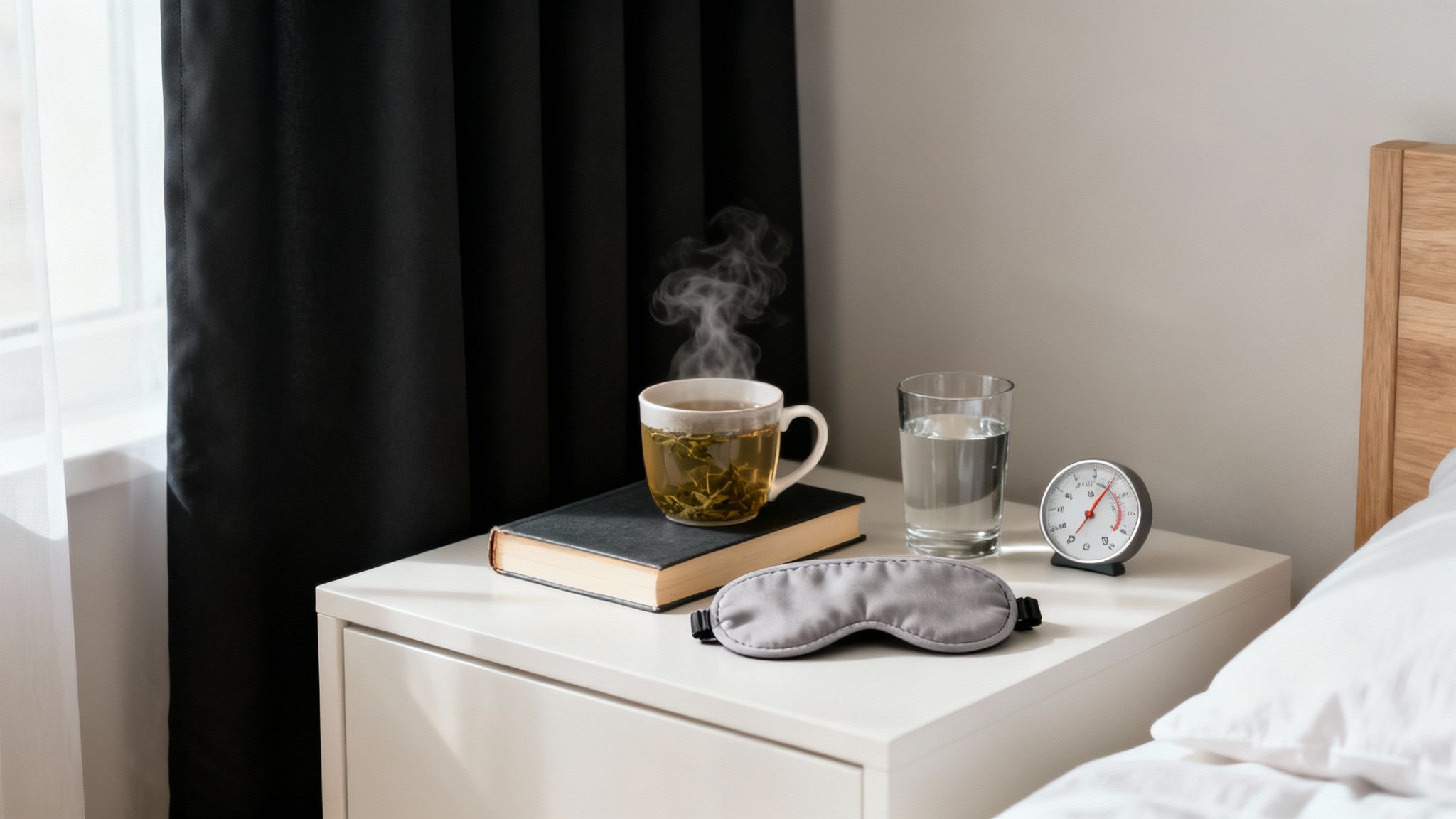
Your sleep-promoting evening routine
A good evening routine is your anchor in the hormonal chaos. Even small, conscious actions can make a huge difference. It's not about turning your life upside down overnight. Rather, you create a relaxing sequence of habits that signal to your body and mind: The day is over, time to wind down.
Here are a few proven building blocks for your own personal routine:
- Turn off screens: This is probably the hardest, but also the most important point. Switch off your TV, smartphone, and tablet at least an hour before going to bed. The blue light from these devices is a real melatonin killer and keeps you artificially awake.
- Soft light: Dim the lights in your home. Replace harsh overhead lights with a small table lamp emitting warm light. This signals to your brain that the active phase of the day is ending.
- A warm bath or shower: It sounds simple, but it's highly effective. After getting out of the tub, a warm bath slightly lowers your core body temperature. This drop is a strong signal for the body to switch into sleep mode.
- Tea instead of wine: A glass of wine in the evening might feel relaxing, but alcohol sabotages your sleep. While it may help you fall asleep, it severely disrupts the important deep sleep phases in the second half of the night. Opt instead for calming herbal teas such as valerian, lemon balm, or hops.
Your evening routine is like a gentle landing strip for your body. Every step helps you glide safely and peacefully into sleep, instead of experiencing a nighttime crash landing.
To make it easier for you to get started, I've put together a simple checklist. Think of it as inspiration that you can adapt to your own rhythm.
Checklist for your evening routine
| Time (approx.) | activity | Why it helps |
|---|---|---|
| 8:30 p.m. | Final check of emails/messages, then turn off all screens. | Reduces blue light exposure and prevents the suppression of the sleep hormone melatonin. |
| 8:45 PM | Dim the lights, prepare a cup of herbal tea. | It signals to the brain the transition from the active day to the rest phase. |
| 9:00 PM | Take a warm bath or read a book (not a thrilling mystery!). | It lowers body temperature after bathing and promotes mental relaxation. |
| 9:30 PM | Perform a short relaxation exercise such as the 4-7-8 breathing technique. | It activates the parasympathetic nervous system, which is responsible for rest and recovery. |
| 9:45 PM | Go to bed, perhaps write a few pages in a gratitude journal. | It focuses attention on positive thoughts and helps to stop the mental merry-go-round. |
This structure is just a suggestion. Find out what works best for you and stick with it – your body will thank you with better sleep.
The power of proper nutrition and relaxation
What you eat in the evening and how you wind down also directly affect your sleep quality. A heavy, greasy pizza or a large portion of ice cream late at night? Not a good idea. Your digestion then has to work overtime, which can keep you awake.
Opt for light foods rich in tryptophan . This is an amino acid your body needs to produce the sleep hormone melatonin. Good sources include a small bowl of oatmeal, a banana, or a handful of walnuts.
The biggest problem for many women, however, is the never-ending cycle of thoughts. It starts almost as soon as you lie down in bed. Simple relaxation techniques are invaluable in this regard. One of the most effective and quickest methods is the 4-7-8 breathing technique :
- Breathe in calmly through your nose and count to four in your head.
- Hold your breath and count to seven .
- Then exhale slowly and completely through your mouth while counting to eight .
- Repeat this cycle three to four times.
This simple exercise is like a switch for your nervous system. It activates your rest-and-digest system (the parasympathetic nervous system) and helps you get out of your head and into your body. Just try it – you'll be surprised how quickly it works.
When you should seek professional help
Sometimes, even the best tips and routines just don't work. Sleep disturbances during menopause can be persistent. If you notice that sleepless nights are dominating your daily life, you're just dragging yourself through the day, and your zest for life is dwindling, that's a clear warning sign.
Seeking professional support is not a sign of weakness, but of strength. It's about finally finding the right tools for your specific situation. Going to the doctor is an important and absolutely necessary step when the burden becomes too much.
Clear signs that a doctor's visit is necessary.
When do you reach the point where you should consider a medical check-up? Listen to your body. If one or more of these points apply to you over a longer period, it's time to take action:
- Persistent sleep problems: You have been lying awake almost every night for weeks, unable to fall asleep or constantly waking up.
- Extreme daytime fatigue: Your performance at work or in everyday life is extremely low. You have trouble concentrating, are constantly exhausted, or easily irritable.
- Additional symptoms: In addition to sleep problems, you may be plagued by severe heart palpitations, nighttime panic attacks, or depressive moods.
- No improvement in sight: You've tried everything – from sleep hygiene to relaxation exercises – but nothing really works.
What happens at the doctor's office? Diagnostics and treatment options.
A doctor's visit has a clear goal: to finally uncover the causes of your symptoms. It all begins with a detailed consultation in which your medical history and current symptoms are discussed in detail. Based on this, there are various ways to get to the bottom of the problem.
The first step is often a blood test. This checks your hormone levels (estrogen, progesterone, thyroid hormones) and important nutrients. This quickly clarifies whether there is a significant hormonal imbalance or deficiency.
Would you like to gain a better overview of your situation beforehand? A targeted symptom check can help you find out which test is right for you and provide valuable initial insights.
Depending on the diagnosis, various treatment options are available. The spectrum is broad and ranges from herbal remedies and bioidentical hormone therapy to specific medications that regulate the sleep-wake cycle. Sometimes, a referral to a sleep lab is also advisable to rule out other causes such as sleep apnea.
The most important thing is that you feel safe and understood. Don't hesitate to seek this help – you deserve to regain your quality of life and restful nights.
Your most pressing questions, answered briefly
Do you have questions about your sleep problems during menopause and are looking for quick, clear answers? You'll find them here.
Are menopause and sleeplessness really the cause of my sleepless nights?
Yes, absolutely. Imagine your body has two built-in sedatives: estrogen and progesterone. During menopause, both decline. Progesterone, which normally promotes relaxation, is suddenly lacking – resulting in that nervous restlessness that keeps you from falling asleep. At the same time, the estrogen deficiency disrupts your body's natural temperature regulation, giving you those dreaded nighttime hot flashes.
What helps immediately when I wake up in the night?
Are you lying awake, your thoughts racing, and sleep seems impossible? Try the simple yet extremely effective 4-7-8 breathing technique . Inhale through your nose for four seconds, hold your breath for seven seconds, and then exhale slowly and audibly through your mouth for eight seconds. This signals to your nervous system: "Everything is okay, time to relax." This will help you break the cycle of racing thoughts and fall back asleep more easily.
When should I see a doctor about my sleep problems?
If you've barely been able to sleep for weeks, feel completely exhausted during the day, and perhaps even experience heart palpitations or a depressed mood, it's time to seek professional help. A visit to the doctor, ideally including an analysis of your hormone levels, will provide clarity. This way, you'll see in black and white where the causes lie and can take targeted steps.
What you absolutely need to know: You're not alone, and you don't have to go through this alone. Your sleep problems aren't in your head; they have real physical causes. And the best part: There are effective ways to get your restful nights back.
How do I find out which sleep rhythm really suits me?
Standard tips like "Go to bed at 10 p.m." often don't work because everyone has a different internal clock—their genetically determined chronotype. Are you a "lark" who's alert in the morning, or an "owl" who thrives in the evening? A DNA metabolic analysis can tell you exactly that. It reveals not only your chronotype but also your unique sleep needs. With this knowledge, you can finally adapt your daily routine to your body—the best foundation for deep, restful sleep.
Are you ready to take back control of your sleep and understand your body on a deeper level? The mybody-x.com DNA metabolic analysis gives you the scientifically sound roadmap for your individual rhythm. Discover what your body truly needs and say goodbye to sleepless nights.



Share:
Your exact daily protein requirements: Find out what your body really needs.
VO₂max value: Increase your endurance and performance