
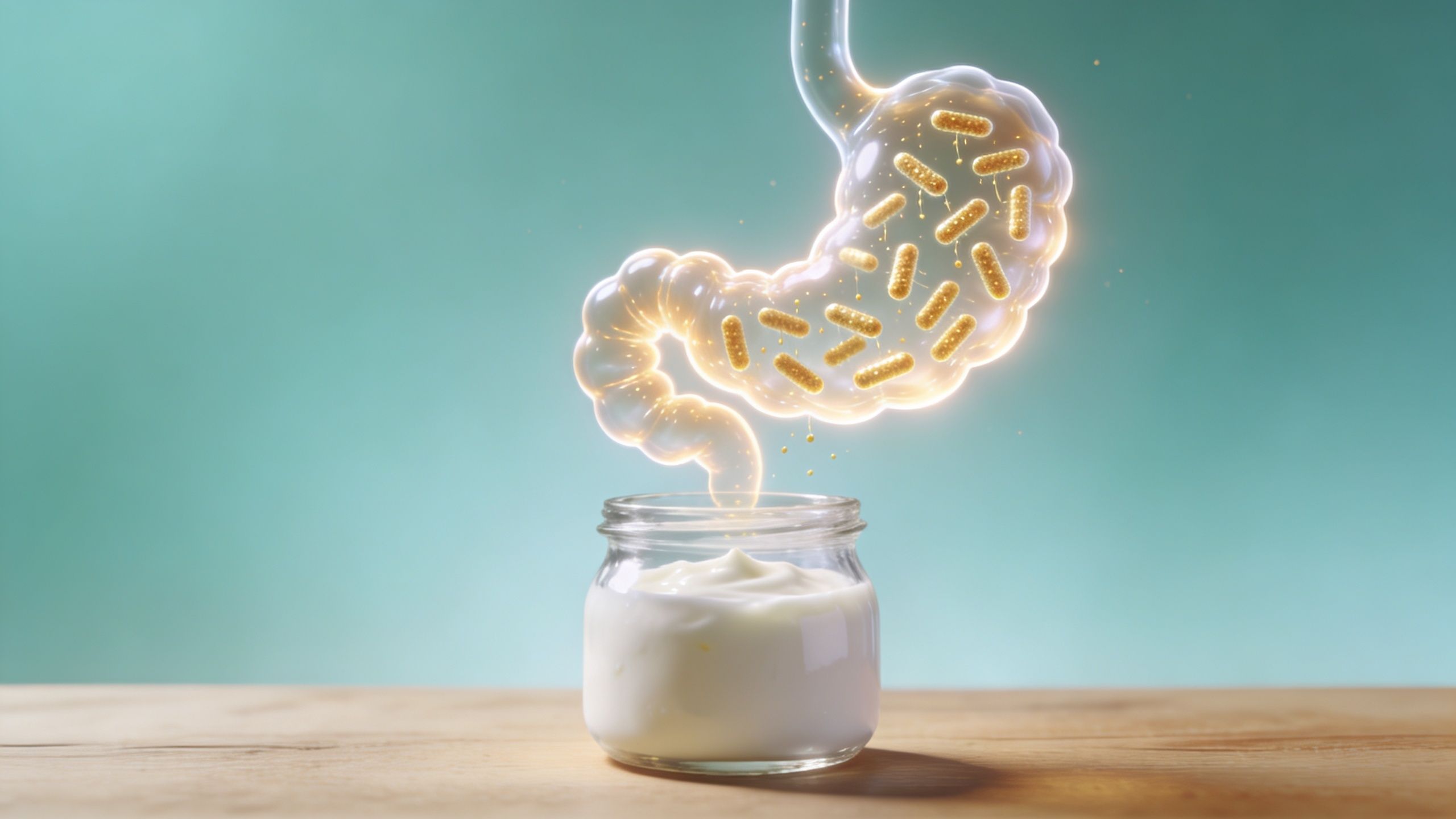
Bifidobacteria: Your key to gut health
You pay attention to your diet. Maybe you try more fiber, less sugar, a different yogurt, or perhaps a supplement. And yet that feeling remains that your gut is following its own agenda. Sometimes it bloats after an ordinary meal, sometimes digestion is sluggish, and sometimes you feel somewhat drained even though you’re doing many things right.
That’s exactly where many people start wondering. Is it gluten, dairy, stress, too little sleep, hormones, or “poor digestion”? Often, it isn’t one obvious cause but an interplay of factors. And right in the middle are tiny gut inhabitants that are surprisingly rarely discussed in concrete terms: bifidobacteria.
These bacteria are among the best-known “good” gut bacteria. They’re not a wellness buzzword, but a genuine building block of your gut microbiome. When they’re present in a healthy balance, they may be relevant to digestion, the gut barrier, and your overall well-being. When they’re underrepresented, self-optimization quickly becomes a gamble.
Do you often feel unwell and not know why?
Maybe you know a day like this: coffee in the morning, what should be a healthy lunch, and yet a distended stomach in the evening. Or you wake up already feeling exhausted for no clear reason. Not sick enough to set off alarm bells. But not really fit either.
What’s frustrating isn’t just the symptom itself. It’s the uncertainty. You can sense that something isn’t quite right, but you don’t get a clear answer. So you start cutting things out, trying something new, and testing nutrition tips from podcasts or social media. Sometimes it gets better briefly, then it doesn’t again.
When healthy habits aren’t enough
Many people start struggling right here. They eat more mindfully than before and still experience:
- bloating after ordinary meals
- changing digestion, sluggish at times and sensitive at others
- a vague energy slump that can’t be explained by lack of sleep alone
- the feeling of reacting sensitively to many things
That doesn’t mean you’re doing anything wrong. Quite the opposite. You’re probably already on the right track; you just need a more precise map.
You don’t have to convince your body. You first have to learn to read it better.
Why bifidobacteria are so often overlooked
Bifidobacteria work quietly. You don’t notice them directly like caffeine or sugar. They’re more like a good support team in your gut. When they’re well represented, many things run more smoothly. When they’re lacking or out of balance, you often notice only the effects, not the cause.
This is one reason people remain stuck in trial and error for a long time. They optimize foods, meal times, and routines without knowing what their personal microbiome actually looks like right now.
A common misconception
Many people think: “If I eat yogurt occasionally or take a probiotic, things should be fine.” That may help. But it may also completely miss your actual needs. Not every gut needs the same thing.
Especially when symptoms are nonspecific, self-observation only goes so far. It is a good starting point. But it does not replace data. That is precisely why it is worth viewing bifidobacteria not merely as a nice health detail, but as a possible key to finally making sense of what your gut is telling you.
What are bifidobacteria, and where do they come from?
Bifidobacteria are beneficial gut bacteria that live in your large intestine. You can think of them as diligent gardeners. They help ensure that the plants you want grow in your gut rather than weeds. They do not operate alone, but they are among the groups most often associated with a stable gut environment.

If you want to build a solid basic understanding of your gut flora, this overview of gut bacteria and their function can also help.
What makes them so special in the gut
Bifidobacteria are among the early and important inhabitants of the gut. They do not simply help “with digestion” in a general sense. They are part of a complex ecosystem. When this ecosystem is stable, your gut can process food more effectively, protect its lining, and remain balanced with other bacteria.
The garden analogy works well because it makes one thing easy to understand: it is rarely about a single bacterium. It is about the conditions in the system as a whole. Bifidobacteria are often an indication of how favorable this environment currently is.
They often accompany us right from the very beginning
One particularly fascinating aspect is their origin. During vaginal birth, bifidobacteria are transferred directly from the mother's vaginal secretions to the newborn. Since around 3 in 10 children in Germany are born by C-section, they miss this contact, which can lead to significantly lower colonization with bifidobacteria and greater susceptibility to certain pathogens, as Aptaclub's article on bifidobacteria in babies explains.
This is relevant because many people think that gut flora only becomes an issue in adulthood. In fact, this story begins very early. Initial colonization can help shape how the gut environment develops. Later, diet, medication, stress, and lifestyle are added.
Important to know: Your current gut flora is not a fixed destiny. But early patterns can explain why some people react more sensitively than others.
Where readers often get confused
Two things are often confused:
| Term | Simply explained |
|---|---|
| Bifidobacteria | The bacteria themselves |
| Microbiome | The entirety of all microorganisms in the gut |
So you should not only ask, “Do I have bifidobacteria?” A more useful question is often: “How strongly are they represented in my gut, and what kind of environment do they live in?”
This is exactly where general health knowledge becomes personal. And that is the moment when your gut no longer has to be just a mystery.
The superpowers of bifidobacteria for your health
Bifidobacteria are not simply “there too.” They have real jobs in the gut. If you want to understand why so many people are taking a more targeted approach to optimizing their gut health, it is worth looking at what these bacteria actually do.

More than just digestion
Many people associate gut bacteria only with bowel movements or bloating. That falls short. Bifidobacteria are more like good team leaders in a sensitive system. They support conditions under which your gut can function stably.
These areas in particular are included:
-
Regulating the digestive environment
They help ensure that food components are processed in a favorable environment in the gut. -
Supporting the gut barrier
A strong gut barrier is important so that your gut does not become unnecessarily permeable. -
Defending their place in the gut
Beneficial bacteria compete with less desirable microbes for nutrients and adhesion sites.
Why they are so competitive
A fascinating scientific point is their metabolism. Bifidobacteria use a unique metabolic pathway, the bifidum pathway, which enables 25% higher energy yield per sugar molecule than in many other bacteria. This metabolic efficiency helps them displace pathogenic microbes when competing for nutrients and adhesion sites in the gut, as described in the overview of Bifidobacterium on Wikipedia.
It sounds technical, but it’s easy to imagine in everyday life. If two teams work in the same room and one gains more energy from the same amount of material, that team is usually faster, more stable, and more enduring. That’s exactly how you can think of the advantage of bifidobacteria in the gut.
Three areas of health where they are particularly relevant
Digestion
When your gut seems sluggish, sensitive, or easily overwhelmed, it’s often not just the food that matters, but also the bacterial environment in which that food is processed.
Protective function
Your intestinal lining is not a passive wall. It’s more like an active boundary. Bifidobacteria help keep things orderly there and give unwanted intruders fewer opportunities.
Everyday well-being
Many people don’t notice the effects as a “wow effect,” but as something much more valuable: less chaos. Less bloating. Less unpredictability. More of a feeling that the gut is working with you again instead of constantly getting in the way.
A healthy gut often feels unremarkable. That’s exactly the goal.
Why this information alone isn’t enough
Here’s the crucial point: Even if the functions of bifidobacteria are well understood, that still says nothing about what things look like for you personally. You can eat very healthily and still have an unfavorable microbial profile. Or you may have just a few specific weaknesses that can be addressed in a targeted way.
That’s why knowledge is important, but measurement is what makes knowledge practical in everyday life. Otherwise, you’re optimizing based on guesswork.
Your gut feeling doesn’t lie – Typical signs of an imbalance
Not every gut sends the same signals. For some, it’s classic bloating. For others, it’s more like sluggishness, vague intolerance, or that annoying feeling that eating has suddenly become a chore. The symptoms look different, but they can all be consistent with a microbiome that is no longer properly balanced.

Four patterns many people recognize themselves in
The persistent bloated belly
You don’t eat anything extreme, yet you quickly feel bloated. It’s not always painful, but it’s constantly there. Often, this leads to cutting out more and more foods, even though the real problem may lie deeper.
The sluggish gut
Digestion is slow, irregular, or feels “sluggish.” This is particularly interesting because there is specific data on individual strains. In controlled studies, the Bifidobacterium strain B. animalis DN-173 010 reduced intestinal transit time by up to 40% in a dose-dependent manner in patients with constipation, as reported by Ärzte Zeitung on bifidobacteria and transit time.
This does not mean that every sluggish gut needs this particular strain. But it clearly shows that certain bifidobacteria can measurably affect digestion.
The sensitive gut
You don't tolerate food terribly badly, but your gut reacts unusually often. Today something agrees with you, tomorrow it doesn't. The suspicion quickly falls on individual foods alone. In reality, an unstable gut environment could also be behind it, making it harder to buffer normal stimuli.
The gut–mouth connection
Some people notice not only gut issues but also unpleasant breath despite good dental care. In that case, it is worth taking a holistic view. If this topic concerns you as well, you can find helpful information about treating bad breath in Bad Neuenahr from Dr. Matthias Willamowski & colleagues. This makes sense because the oral cavity and digestion are not completely separate worlds.
Why self-assessment alone has limited value
Many people try to decipher patterns like these using notes on their phones. That's not wrong. But it has limitations:
-
Symptoms are nonspecific
Bloating can indicate too little, too much, or the wrong type of intestinal activity. -
Food reactions can be misleading
The same food can affect you differently on two days. -
The real signal remains invisible
You feel the effects, but not the bacterial cause.
If your gut regularly sends you signals, you're not imagining it. It just isn't a diagnosis yet.
The most important reassurance
You don't have to force yourself into a type. These profiles are only useful for recognition. Symptoms alone cannot reliably show whether bifidobacteria actually play a role for you. That's exactly why your gut feeling is valuable but incomplete. It shows you that you should take a closer look—not what exactly is going on.
Feed your beneficial gut bacteria in a targeted and effective way
If you want to support bifidobacteria, you need to understand two terms that are often confused: probiotics and prebiotics. Probiotics are live microorganisms. Prebiotics are their food. Many people focus only on one and forget the other.

If you want to adapt your diet in a practical way, you can also find a good starting point here: building a healthy gut flora through diet.
What bifidobacteria really like
Specific prebiotic fibers such as inulin, pectin, and galacto-oligosaccharides are considered bifidogenic factors because they specifically promote the growth and activity of bifidobacteria in the colon. This has been shown to strengthen the intestinal barrier and mucosal immunity, according to Bioprophyl’s assessment of bifidobacteria.
Put simply: Good bacteria need the right food. Otherwise, it’s a bit like buying seeds without preparing the soil.
Foods that often make sense in everyday life
You don’t need to collect exotic powders for this. It often comes down to simple, regular basics:
-
Whole-grain products
They provide fiber that often supports your microbiome better than highly processed carbohydrates. -
Legumes
For many gut bacteria, lentils, beans, and chickpeas are valuable food. If you react sensitively, start with small amounts. -
Apples and bananas
Practical for everyday life, uncomplicated, and easy for many people to incorporate. -
Inulin-containing foods
This includes, for example, certain types of vegetables that may be beneficial as prebiotics.
How to proceed wisely instead of radically
Many people make the mistake of going from almost no fiber straight to a lot of it. This can put additional stress on a sensitive gut at first. A gradual approach is better.
A sensible approach often looks like this:
-
Don’t change everything at once
Otherwise, you won’t know what helped in the end. -
Increase amounts slowly
Especially if you tend to experience bloating. -
Observe, but don’t overinterpret
A single day doesn’t tell you much.
Practical rule: Don’t optimize as much as possible; stabilize in a targeted way.
And what about probiotics?
Probiotic products or supplements may be worth considering. But they are not automatically the answer. A suitable strain may be beneficial, while an unsuitable one may do little for you. That is why the order matters: understand first, then supplement.
This is where a microbiome test comes in. An offering such as the mybody x Gesundheit microbiome test uses a stool sample and can show which groups of bacteria are present or missing. That is often the difference between “I’ll just try something” and “I’ll take targeted action.”
Others are already optimizing their gut based on data. You do not have to chase after them. But you can save yourself unnecessary detours.
Guess or know? Why a test makes the difference
You are on the right track if you are focusing on your diet, gut microbiome, and bifidobacteria. Really. The problem is not your effort. The problem is the uncertainty that remains when you build only on assumptions.
Because, honestly, without measuring, you do not know whether you are addressing the right problem. You only know that you hope you are right.
Why self-optimization often stalls
Eating healthily is sensible. Increasing your fiber intake can be sensible. Taking a probiotic can be sensible. But these are all general measures. They do not tell you whether your microbiome actually contains few bifidobacteria, whether other bacterial groups are unusual, or whether your gut needs more support with its barrier, diversity, or digestive function.
This is exactly where guessing ends and knowledge begins.
| Without a test | With a test |
|---|---|
| You suspect connections | You see your individual profile |
| You try multiple approaches | You can prioritize more effectively |
| You only assess symptoms | You supplement symptoms with data |
Especially interesting for vague symptoms
There are connections between the gut microbiome and other areas of well-being, but in everyday life it often remains unclear what is truly relevant to an individual. Although connections between a lack of bifidobacteria and metabolic or mental health are being discussed, concrete data for the individual are often lacking. A microbiome test can reveal whether dysbiosis correlates with an individual’s tryptophan metabolism, a precursor to serotonin, and thus provides a data-driven approach to optimizing well-being, as explained by Praxisklinik’s information page on bifidobacteria.
This matters because many people consider fatigue, lack of motivation, or a vague sense of restlessness only in isolation. Sometimes it is worth taking a broader view.
When a test makes particular sense
Taking a test does not mean that “something serious” must be wrong. It is often simply the sensible next step when you no longer want to go around in circles.
This is especially true if you recognize yourself in one of these points:
-
You have already tried quite a few things
You adjusted your diet and eliminated foods, but never identified a clear pattern. -
You want to optimize with intention rather than at random
Not another trend, but a decision based on your profile. -
You want to save time
Trial and error costs energy, discipline, and often money.
If you want to see how such an analysis generally works, this overview of gut testing and what its results mean can help.
Others are already optimizing their gut more systematically. Not perfectly, but more precisely.
The reliable answer does not lie in guesswork
Self-observation is valuable. Diet is important. But you can only get a reliable answer about your current bifidobacteria status through a microbiome gut test. If you want clarity instead of more guesswork, this is the most straightforward step you can take independently.
Frequently asked questions about bifidobacteria
Is probiotic yogurt from the supermarket enough?
It can be part of your diet. But it does not tell you whether your gut specifically needs these bacteria or whether they can establish themselves well in your gut at all. Foods can provide support, but they do not replace an individual analysis.
Can I tell for myself whether I am lacking bifidobacteria?
Only to a limited extent. Bloating, sluggish digestion, or a sensitive stomach may be consistent with this, but they do not have to be. Symptoms provide clues, but not a definitive identification.
Are prebiotics more important than probiotics?
Not automatically. Both can be useful. Prebiotics provide food for the beneficial bacteria already present. Probiotics introduce specific strains from outside. Which is more suitable for you depends on your microbiome.
How quickly will I notice a change from dietary adjustments?
It varies from person to person. Some people notice differences in their digestion fairly quickly, while others need patience. The important thing is not to overinterpret every short-term change. A test helps you assess progress more meaningfully.
Can you benefit from a microbiome test even without symptoms?
Yes, especially if you take a preventive approach. Many health-conscious people do not want to wait until something clearly goes wrong before taking action. They want to understand their bodies better and make more targeted adjustments.
If you no longer want to guess but want to understand your gut based on data, a microbiome test is the most logical next step. At mybody x Gesundheit, you’ll find the Microbiome Leaky Gut Test as well as the complete overview of gut health and microbiome analyses. This allows you to test easily from home, shorten trial and error, and tailor your next steps more precisely to your body.



Share now:
Gut microbiome test: Your guide to gut health
Understanding Antioxidants: Your Guide to Healthy Eating