

Bloating before your period: when it is cycle-related
The essentials at a glance
An abdomen that swells in the days before menstruation has a temporal fingerprint: it develops after ovulation and is gone by the end of menstruation at the latest. This precise time window distinguishes cycle-related bloating from everything else. Checking it costs nothing, and it determines the next step.
This article describes what produces the increased girth during the second half of the cycle, which four patterns may be behind it, and which figures German institutions cite. Wherever a figure is documented, it is given here with the institution and year. Where no figure is available, that is stated as well.
First, you will read how progesterone and estrogen affect the intestines and fluid balance, followed by the signs that warrant a visit to a medical practice. Next come a comparison of the four patterns, the crucial time window, prevalence, the role of the intestines, and the evidence from studies. The final section covers everyday life, abdominal swelling that persists outside the cycle, two ways of measuring it, and their limitations.
What to expect in this article
1. Why the abdomen grows during the second half of the cycle
2. When your abdominal swelling is no longer cycle-related
3. Four patterns behind bloating around the period
4. The time window when everything is decided
5. How common the individual patterns are
6. What happens in the intestines when hormone levels shift
7. What examinations show about cycle-related abdominal symptoms
8. Four steps that actually affect abdominal girth
9. When the abdominal swelling also persists outside the cycle
10. What you can have measured at home for this pattern
11. Limitations: what a measurement cannot clarify here
12. Who may benefit from a measurement—and who may not
13. What matters in the end
Frequently asked questions
Sources
Why the abdomen grows during the second half of the cycle
The increased girth that develops in the days before menstruation is not fat tissue. Fat changes over weeks and months, not within a few days. The additional volume that appears during this short period is gas in the intestines, intestinal contents, or fluid in the tissues.
The second half of the cycle is called the luteal phase. It begins with ovulation and ends with menstruation. During this phase, progesterone levels rise. This hormone is produced by the corpus luteum in the ovaries and prepares the body for a possible pregnancy.
The Institute for Quality and Efficiency in Health Care (IQWiG) classifies symptoms during this phase as part of premenstrual syndrome and explicitly includes water retention and digestive problems (2022). Both can increase abdominal girth without any change in diet.
Key message
Cycle-related bloating develops during the second half of the cycle from gas, intestinal contents, and fluid in the tissues. It is not explained by how much you have eaten, but by changes in the speed of digestion and fluid balance.
Progesterone and the speed of intestinal transit
Progesterone acts on smooth muscle. This muscle is found in the uterus, but it also forms the intestinal wall. When these muscles work less vigorously, the contents move forward more slowly.
Slower transit has two visible effects. The large intestine remains more heavily filled for longer, and the bacteria in the gut have more time to produce gas from undigested carbohydrates. Together, both increase the volume in the abdominal cavity.
This also explains why many women’s symptoms ease on the first day of bleeding. As progesterone levels fall, bowel movements return to their usual pace, and the accumulated contents start moving again.
Fluid in the tissues: why your weight fluctuates too
The second route involves fluid balance. The IQWiG (2022) counts water retention among the physical symptoms of premenstrual syndrome. It rarely appears first in the abdomen, but rather in the fingers, ankles, or breasts.
This is a useful distinction for you. A belly that swells along with tender breasts and tighter rings follows a different mechanism from one that becomes distended after eating and goes down again at night. One is fluid; the other is gas.
Anyone who records both will have an answer after two cycles to the question of which of the two factors is actually worth working on. Without this record, it remains a matter of trial and error.
When your belly is no longer related to your cycle
Before looking at causes and practical everyday measures, it is worth comparing your symptoms with the following list. If any of these points apply to you, the next step is an appointment at a medical or gynecological practice—not searching for the right tea.
Two statements from the institute support this list. For irritable bowel syndrome, the IQWiG identifies significant weight loss, blood in the stool, fever, or paleness as signs of another intestinal disease (2023). Regarding period pain, the same institute states that very severe or worsening pain should be medically evaluated because endometriosis, fibroids, or polyps may be behind it (2023).
These signs warrant a medical appointment
Blood in the stool
light or dark, once or repeatedly—always have it checked (IQWiG, 2023)
Significant unintentional weight loss
along with fever or noticeable paleness, a sign of another intestinal disease (IQWiG, 2023)
Very severe or worsening period pain
Pain that keeps you from your daily activities for days or becomes worse from one cycle to the next (IQWiG, 2023)
Abdominal distension that remains after the bleeding
when the abdomen no longer goes down, but remains the same size for weeks or slowly increases
Pain during bowel movements or urination around the time of bleeding
The IQWiG lists it as a possible symptom of endometriosis (2024)
Bleeding outside the menstrual period
Bleeding between periods or a clearly changed bleeding intensity should be assessed gynecologically
This list is neither a diagnosis nor reassurance. It is a sorting aid: it separates what you can observe yourself from what someone needs to examine.
Four patterns behind bloating around the period
A bloated abdomen around the time of bleeding is not a single disease entity. Four patterns are possible, and they differ less in how they feel than in their timing and the way they are evaluated. The table compares them according to the same four criteria.
| Criterion | Premenstrual syndrome | Irritable bowel syndrome, cyclically aggravated | Endometriosis | Intolerance |
|---|---|---|---|---|
| When the bloating occurs | After ovulation, in the second half of the cycle (IQWiG, 2022) | Throughout the month, more severe around the time of bleeding | Usually together with the pain, often worsening over the years | After certain meals, regardless of the day of the cycle |
| Disappears when the bleeding ends | Yes, by then at the latest (IQWiG, 2022) | No, there is an underlying burden | Not reliably | No, it depends on food, not the date |
| How it is evaluated | Symptom diary over at least two cycles, medical consultation | Medical evaluation to rule out other conditions | Gynecological examination, possibly laparoscopy | Hydrogen breath test, blood test if celiac disease is suspected |
| What a home test contributes | A snapshot of cycle hormones, not an explanation for the bloating | A baseline value for the composition of the gut microbiome | Nothing—it is detected through imaging procedures | Nothing that replaces the breath test |
The second line carries the most weight. Whether the bloating completely disappears when the bleeding ends distinguishes the first pattern from the other three. This observation costs you nothing more than two notes a month.
The time window that determines everything
Premenstrual syndrome has one characteristic that distinguishes it from almost all other explanations: It is strictly tied to a specific time. IQWiG explicitly describes this connection in its patient information.
Documented source
“When menstrual bleeding begins and a new cycle starts, the PMS symptoms subside again. They have completely disappeared by the end of the bleeding at the latest and can only reappear after the next ovulation.”
Institute for Quality and Efficiency in Health Care (IQWiG)
Premenstrual syndrome (PMS), as of 2022
This sentence can be turned into a criterion that requires no examination. If your abdomen is still tense two days after the bleeding ends, premenstrual syndrome is unlikely to be the sole explanation.
This is neither reassurance nor a warning. It is a way to sort things out: it tells you whether to keep looking at the cycle or at digestion.
Why two cycles are the minimum
A single cycle is not enough for observation. Cycles differ in length and progression, and a month with a cold, a trip, or an unusual diet can create patterns that have nothing to do with hormones.
Two consecutive cycles are the minimum needed to identify a recurring pattern. Three are better. Only four things are recorded: the day of the cycle, abdominal circumference in the morning, abdominal circumference in the evening, and whether swelling has occurred in the fingers or ankles.
This record has a second benefit that is often underestimated. It significantly shortens the conversation at the medical practice because it answers a question that is routinely asked first: Exactly when do the symptoms occur?
How common the individual patterns are
German institutions report prevalence figures for three of the four patterns. These figures do not say which pattern applies to you. They say how likely it is that you are not alone in experiencing this pattern.
Prevalence in numbers
20–40 %
of girls and women have several more pronounced PMS symptoms that noticeably affect daily life
2×
women have irritable bowel syndrome twice as often as men; women are more likely to have constipation, while men are more likely to have diarrhea
up to 10%
of women of reproductive age have endometriosis, according to studies
Source: Institute for Quality and Efficiency in Health Care (IQWiG); Premenstrual syndrome, 2022 edition; irritable bowel syndrome, 2023 edition; endometriosis, 2024 edition
The smaller group that is rarely discussed
Alongside the larger group with noticeable symptoms, there is a smaller group that is affected much more severely. In approximately 3 to 8 percent of all girls and women, the symptoms are so severe that they significantly interfere with daily life (IQWiG, 2022). When psychological symptoms are pronounced, experts refer to premenstrual dysphoric disorder.
Anyone who recognizes themselves in this group is poorly served by trying a dietary approach. This belongs in a medical practice, because treatment options exist that no everyday adjustment can replace.
Why endometriosis is diagnosed so late
IQWiG notes that it often takes years to identify endometriosis as the cause of symptoms (2024). One reason is that severe period pain is long considered something that simply comes with menstruation.
According to the same source, symptoms also include problems and pain when urinating and having a bowel movement. This exact combination of abdominal symptoms and cycle-related issues initially leads many people to suspect a digestive problem, even though the appropriate point of contact is a gynecological practice.
By the way, perimenopause and cycle irregularities are not something you simply have to endure. The same applies here: symptoms that dictate your daily life for months deserve to be assessed, not normalized.
What happens in the gut when hormones fluctuate
Up to this point, the focus has been on hormones. In this story, the gut is not a passive tube but the place where the volume actually develops. Gas forms where bacteria break down food components that were not absorbed in the small intestine.
These components include certain carbohydrates and dietary fibers. They are not harmful; quite the opposite. They are the nutritional basis for a large part of the gut microbiome. When transit slows down, only the time available for breakdown becomes longer.
This leads to a point that surprises many people: If you greatly increase your fiber intake in the second half of the cycle to do something about bloating, you initially increase the volume in the intestine even further. The benefit for the gut microbiome remains, but the sensation gets worse for a few days.
What is established—and what is not—about estrogen and gut bacteria
Guide articles often state that the gut microbiome regulates estrogen levels. The connection between gut bacteria and the breakdown of estrogens is in fact being studied and described in research. However, the reviewed institutional sources do not provide a substantiated figure for how strong this influence is in an individual person.
That is why there is no percentage here. What can be said is that the composition of the gut microbiome differs considerably between people, and it is one reason why the same meal produces different amounts of gas in two women. You can look up which bacterial species and markers may appear in a report in the Gut Encyclopedia.
The objection is justified: If no figure is available for this, why is the chapter here at all? Because the claim is widespread online, and a text that silently overlooks it fails to put it into context. More precisely, the question is not whether the connection exists, but what conclusions you can draw from it.
Constipation as the underestimated contributor to abdominal girth
The IQWiG notes that, in irritable bowel syndrome, women are more likely to experience constipation and men diarrhea (2023). In the second half of the cycle, this tendency coincides with an already slowed transit.
A full colon needs space, and that space is limited in the abdominal cavity. Some of the girth perceived as bloating is therefore simply contents. That is why some women’s abdomen changes within a few hours of the first day of bleeding.
What studies on abdominal symptoms during the cycle show
In addition to the information provided by the institutes, there are studies that have directly recorded gastrointestinal symptoms throughout the cycle. One of them is well documented and provides figures that support the picture from the previous chapters.
Bernstein, Graff, Avery, Palatnick, Parnerowski, and Targownik surveyed 156 healthy premenopausal women in Canada and published the analysis in BMC Women's Health (2014). Abdominal pain was reported by 58 percent of participants before menstruation and 55 percent during menstruation.
The difference is clearer among women with a history of painful periods. In this group, 73 percent reported abdominal pain before menstruation, compared with 42 percent of the remaining participants. During menstruation, the figures were 73 percent versus 34 percent.
The same study reports diarrhea in 24 percent before menstruation and 28 percent during menstruation, and constipation in a range of 10 to 15 percent. According to the authors, a bloated feeling was the most frequently reported additional gastrointestinal complaint; no separate percentage is provided for it in the reviewed summary, so none is stated here.
What these figures mean for you—and what they do not
The study describes healthy women. That is its value: It shows that gastrointestinal symptoms around menstruation are common even without an illness. Observing them in yourself does not constitute a medical finding.
At the same time, the study shows an association between painful periods and abdominal symptoms. If you have both, you have one more reason to discuss the connection with a healthcare professional rather than treating them separately.
One limitation should be noted: The figures are based on self-reports from 156 people in one country. They describe an approximate level, not a rule that applies to every woman.
Chapter at a glance
Abdominal symptoms around menstruation are also common among healthy women: In a survey of 156 premenopausal women, 58 percent reported abdominal pain before menstruation and 55 percent during menstruation (Bernstein et al., BMC Women's Health, 2014). Among women with painful periods, the figure was 73 percent. A bloated feeling was the most frequently reported additional complaint, without a separate percentage in the reviewed summary.
Four steps that actually influence circumference
So far, this has been about causes and numbers. Now it is about the order in which you proceed with yourself. The following four steps prepare you for a conversation in a medical practice; they do not replace it.
Record the cycle day and circumference
For two cycles: cycle day, waist circumference in the morning and evening. Four numbers a day, nothing more.
Record your meals without making changes
Observe first, then change. If you change things first, you won't know afterward what worked.
Change one thing at a time
Gradually increase fiber, exercise on the critical days, and monitor salt. One at a time.
Taking your records to the conversation
Two cycles of data shorten the medical history and make the next examination more targeted.
Why movement on exactly these days matters
Physical activity stimulates bowel movements. If transit is already slower in the second half of the cycle, that is the period when a walk has a greater effect than in the first half.
This is not a major change, but a shift. The days when you feel least like exercising are the days when it makes the biggest difference. The effect can be checked in the same record you started with.
What remains of reducing water retention and detoxifying
Those who want to reduce water retention or detoxify mean something real: they feel heavy, tense, and uncomfortable. The need is legitimate. However, these terms promise a process for which no supporting evidence was found in the institutional sources reviewed here.
The less exciting approach is the one supported by evidence: check the time window, compare the warning signs, change one thing at a time, and record the change. It sounds like less than what a cleanse promises. It is the only thing that can still be verified afterward.
When the bloating persists outside the cycle
Some readers will discover while recording their measurements that the circumference does not follow the cycle at all. It is larger in the evening than in the morning, but it does not care which day of the cycle it is. In that case, this is the wrong article.
There is a separate classification for this case: Bloated Belly Like Pregnant addresses circumference that occurs independently of the cycle or remains throughout the entire month. This article deals exclusively with the cycle-related pattern. The distinction is intentional because the two lead to different next steps.
Whether the circumference disappears completely when the bleeding ends distinguishes the first pattern from the other three.
There is a third case: the cycle itself changes. If the intervals between periods become irregular, the flow changes, or hot flashes and sleep problems appear, the question shifts. It is no longer about a single cycle, but about a transitional phase.
This, too, is not something you simply have to put up with. However, it is a different question from the one about a bloated belly, and it is answered using different measurements.
What you can have measured at home for this pattern
If your record shows a recurring pattern after two cycles, two paths lead forward: one involving cycle hormones, the other involving the composition of the gut flora. mybody®x (MYBODY Lab GmbH) offers a test for each, with the sample collected at home.
A caveat applies to both and should not get lost in either product description: neither measures your waist circumference, and neither explains why it fluctuates. They provide readings that you can bring to a conversation together with your record. Nothing more—and that is also the claim being made.
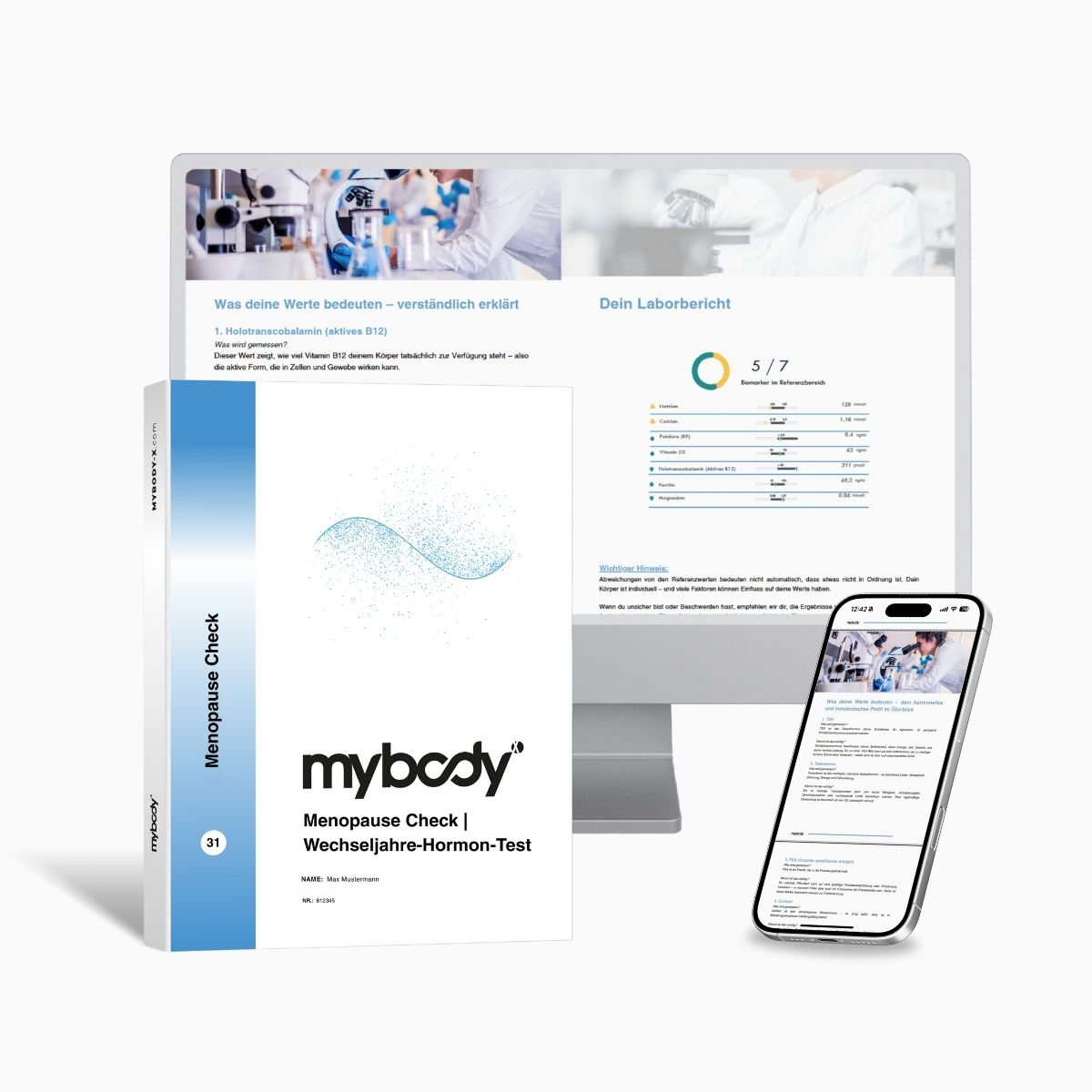
Blood test from capillary blood
Menopause Check | Menopause Hormone Test
Eight values from one blood sample: progesterone, estradiol, FSH, LH, testosterone, DHEA-S, SHBG, and TSH. According to the product page, no other test in the range includes progesterone. What the test does not do: It does not explain bloating or measure anything related to digestion. The product page is tailored to menopause and contains no section on abdominal circumference or bloating. It expressly notes that estradiol, progesterone, FSH, and LH fluctuate significantly throughout the cycle—if you still have a cycle, the cycle day must be recorded; otherwise, the result is difficult to interpret.
Laboratory analysis 3–5 business days after receipt of the sample
accessed 27 August 2026
One point to consider when interpreting this test: It measures a single point in time, not a progression. Cycle hormones fluctuate significantly from day to day, so a single value describes precisely the moment when the sample was taken. Without the recorded cycle day, it is difficult to interpret.
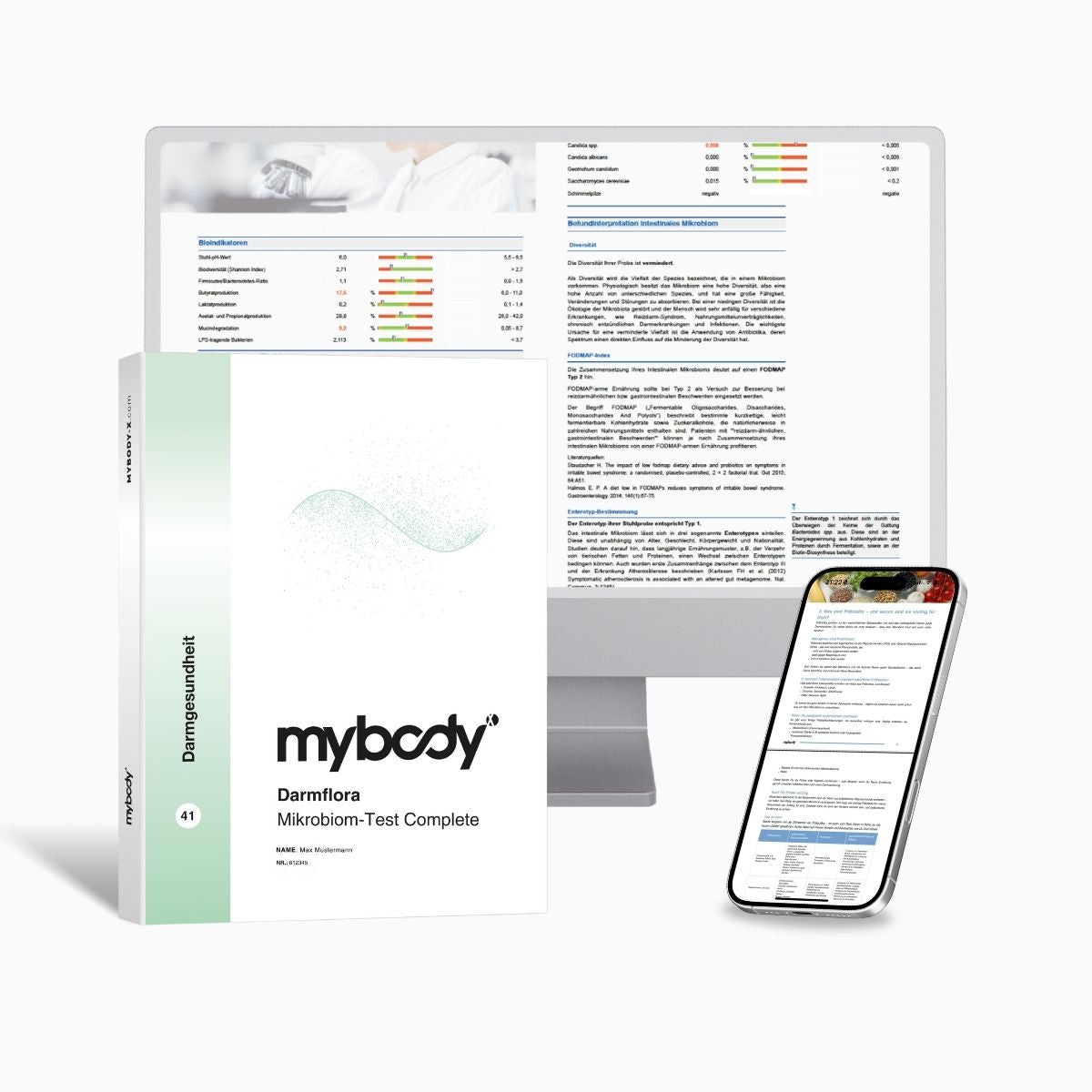
Gut test from a stool sample
Gut Microbiome Test | Complete
Uses DNA sequencing to record more than 1,500 bacterial species in the gut flora and classify its composition. What the test does not do: The product page lists diet and digestion as areas of application, but contains no section on bloating, the menstrual cycle, or periods. It does not identify a cause of your symptoms, replace either a hydrogen breath test for lactose intolerance or a celiac disease evaluation, and, according to its own information, does not provide a medical assessment.
Laboratory analysis 5–10 business days after receipt of the sample
Product-page information without location, accessed 27 August 2026
Which of the two pathways fits is determined by your record, not by this paragraph. If your circumference fluctuates closely with the day of your cycle and breast tenderness and water retention also occur, the cycle-related explanation is more likely. If it fluctuates with meals and throughout the entire month, the digestive explanation is more likely.
Limitations: what a measurement does not clarify here
No blood or stool test captures abdominal circumference. The symptom at issue here is an observation of yourself over several days, and no single laboratory value can replace it.
The second limitation concerns attribution. A hormone level outside the reference range or an unusual composition of the gut flora describes a state. The result does not say whether this exact state is causing your abdominal circumference.
The third limitation is the most important. Endometriosis is diagnosed through a gynecological examination and imaging, not through markers in blood or stool. The same applies to fibroids and other changes in the pelvis. Anyone with severe or increasing period pain cannot avoid seeing a doctor.
And a fourth limitation, for your own sake: A hormone level without the cycle day is difficult to interpret, and reference ranges depend on the laboratory, the method, and age. The information on your own report is always authoritative, not the numbers from an article.
None of this is an argument against taking a measurement. It is an argument against expecting a number to replace your own observation.
Who should consider a measurement—and who should not
Useful for you if …
you have recorded two cycles and see a recurring pattern that you want to support with measurements during your appointment.
your cycle has become more irregular and you want to know the levels of progesterone, estradiol, FSH, and LH on a specific cycle day.
your abdominal circumference fluctuates more with meals than with the cycle day and you are looking for a baseline value for your gut flora.
you are planning a dietary change and want to track the progress with a measurement beforehand and a follow-up measurement.
Probably not if …
you notice one of the signs from Chapter 2 in yourself. In that case, making an appointment is the right order of events, not taking the test.
your period pain is very severe or is increasing from cycle to cycle. No blood or stool sample can clarify this suspicion.
you have not written anything down yet. A measurement without the cycle day and without a record over time is difficult to interpret.
you are looking for an answer to the question of lactose intolerance. The hydrogen breath test is the medical standard for this.
What matters in the end
If you take away one action from this article, let it be this: For two cycles, note the cycle day next to the date and measure your abdominal circumference in the morning and evening. That is four numbers a day and takes less than two minutes.
The reason is unremarkable, yet it supports everything else. If the circumference disappears when the bleeding ends, it follows the cycle, and the relevant levers are movement, fiber, and talking about premenstrual syndrome. If it remains, it follows something else, and the search continues in another direction.
There is a third possible outcome that is rarely written about. Sometimes the record shows that your abdominal circumference does fluctuate, but much less than it feels. That is also a result, and it is not a bad one: it shifts the question from your abdomen to the feeling with which you look at it.
At the beginning was the question of why the abdomen swells before a period. The most useful answer is not the one about the cause, but the one about the timing. When it appears and when it goes away says more than any list of home remedies. And you write that answer down yourself.
Frequently asked questions
Why is my abdomen bloated before my period?
Because two things come together in the second half of the cycle. Progesterone acts on smooth muscle, which also includes the intestinal wall, slowing transit so that more gas and intestinal contents need space. Water retention is another factor, which IQWiG (2022) counts among the physical symptoms of premenstrual syndrome. Both increase abdominal circumference without any change in diet.
How long does a bloated abdomen last during your period?
With premenstrual syndrome, the timeframe is narrowly defined. Symptoms occur after ovulation and subside when bleeding begins; according to IQWiG (2022), they have completely disappeared by the end of the bleeding at the latest and may not recur until after the next ovulation. If your abdomen remains distended beyond that point, premenstrual syndrome alone is unlikely to be the explanation.
When should I have a bloated abdomen around my period medically evaluated?
If there is blood in the stool, significant unintentional weight loss, fever, or noticeable paleness. According to IQWiG (2023), these signs indicate a different bowel disease from irritable bowel syndrome. Other reasons include very severe or worsening period pain, pain during bowel movements or urination around the time of bleeding, bleeding between periods, and a circumference that does not decrease again after the bleeding. In all these cases, making an appointment is the right order of action, not taking a self-test.
Can a hormone test explain why my abdomen swells?
No. The Menopause Check measures eight values from capillary blood, including progesterone, estradiol, FSH, and LH. It therefore describes a point in the cycle, not the cause of an enlarged abdomen. The product page contains no section on bloating or abdominal circumference, and it notes that these values fluctuate considerably throughout the cycle. Without a recorded cycle day, such a result is difficult to interpret.
Is abdominal discomfort around your period normal?
They are common. In a survey of 156 healthy premenopausal women, 58 percent reported abdominal pain before bleeding and 55 percent during bleeding (Bernstein et al., BMC Women's Health, 2014). However, common does not mean that every manifestation should be tolerated: around 20 to 40 percent of all girls and women experience several more pronounced PMS symptoms, and for 3 to 8 percent they significantly interfere with daily life (IQWiG, 2022). Once symptoms reach this threshold, the issue should be discussed.
Next step
Write it down first, then measure
If your two cycles reveal a pattern linked to specific cycle days, the Menopause Check provides hormone levels for the day you recorded. If the pattern appears to be more closely related to meals, the Microbiome Test provides a baseline for your gut flora. Neither replaces medical evaluation.
Menopause Check Gut Microbiome Test | CompleteRead more
You might also be interested in
In case your abdominal circumference occurs regardless of the day of your cycle or persists throughout the entire month.
The classification of a bacterium in the stomach when pressure and a feeling of fullness in the upper abdomen are the main symptoms.
For reference: which types of bacteria and markers appear in the test report and what they mean.
Sources
- Institute for Quality and Efficiency in Health Care (IQWiG): Premenstrual syndrome (PMS) (as of 2022) – gesundheitsinformation.de
- Institute for Quality and Efficiency in Health Care (IQWiG): Irritable bowel syndrome (as of 2023) – gesundheitsinformation.de
- Institute for Quality and Efficiency in Health Care (IQWiG): Menstrual pain (as of 2023) – gesundheitsinformation.de
- Institute for Quality and Efficiency in Health Care (IQWiG): Endometriosis (as of 2024) – gesundheitsinformation.de
The verbatim quote regarding the time window for PMS symptoms, the information on water retention and digestive problems, and the figures of 20 to 40 percent and 3 to 8 percent come from source [1]. The warning signs of weight loss, blood in the stool, fever, and pallor, the note that irritable bowel syndrome is twice as common in women, and the distribution of constipation and diarrhea are based on [2]. The advice that very severe or worsening menstrual pain should be medically evaluated comes from [3]. The information on endometriosis—up to 10 percent of women of reproductive age, the years-long delay before diagnosis, and discomfort during urination and bowel movements—comes from [4]. The percentages for abdominal pain, diarrhea, and constipation over the course of the cycle come from a survey by Bernstein, Graff, Avery, Palatnick, Parnerowski, and Targownik in BMC Women's Health (2014); it is attributed in the main text with the authorship, journal, and year and is therefore not included in this list. Information on prices, markers, sample type, and laboratory comes from the mybody®x product pages, accessed on 27.08.2026; processing times follow the central specifications for blood and gut tests. All sources were accessed and reviewed on 27.08.2026.

mybody®x editorial & expert team
Women’s health Laboratory diagnostics Microbiome and gut science Blood analysis interpretation
This article was created by the mybody®x editorial and expert team. The team combines laboratory diagnostics, blood analysis interpretation, and microbiome and gut science. Those who contribute to it are listed on the authors page.
Published on 25.01.2026 · Last updated on 27.08.2026
The content is for general information and does not replace medical advice, diagnosis, or treatment. Reference ranges depend on the laboratory, method, and age—the information on your test report is always authoritative.




Share now:
The most important vitamins for women: A comprehensive guide to your health
Pimples during your period – understand the causes and take targeted action