

Magnesium for nerves as a protective shield against stress and anxiety
Do you often feel overstimulated, restless, or as if there's a constant buzzing on your nerves? Think of magnesium as the level-headed gatekeeper of your nerve cells . In a world full of stimuli, this gatekeeper decides who gets in and who has to stay out. If this mineral is lacking, the doors are wide open, and stress signals flood your system. The result: inner tension and the feeling of constantly being "on edge."
How magnesium protects your nerves from stress

In our hectic daily lives, many of us are familiar with the feeling of being overstimulated. But what exactly happens in your body during this time? Your nervous system is an extremely complex communication network that constantly sends and receives signals. To prevent this system from becoming overloaded, it needs regulators that ensure balance and the necessary breaks.
This is precisely where magnesium comes into play. It's not some esoteric miracle cure, but rather a biochemical shield for your inner balance. It acts as a natural antagonist to calcium, a mineral responsible for the excitation of nerve cells.
Magnesium occupies specific receptors on nerve cells, thus blocking the excessive influx of calcium. The result: The nerves become less easily excitable, and your entire system can relax.
This mechanism is absolutely crucial for your resilience in everyday life. It helps you react more calmly to stress, promotes concentration, and is an important prerequisite for restful sleep.
A widespread deficit
Unfortunately, a deficiency in this important mineral is not uncommon. Did you know that in Germany, around 26 percent of women and 29 percent of men don't get enough magnesium? According to the National Nutrition Survey II, the average intake is often below the recommendations of the German Nutrition Society (DGE). You can find more interesting insights on this topic at lebensmittelverband.de .
This deficiency can severely disrupt the delicate balance of your nervous system. Without the "gatekeeper," stress hormones like cortisol can more easily bind and exert their stimulating effects. This leads to chronic tension, which can manifest in various symptoms.
Signs of a possible undersupply are varied and often nonspecific:
- Inner restlessness and nervousness: A feeling as if you simply can't switch off.
- Increased irritability: Small things upset you more quickly than usual.
- Sleep problems: Difficulty falling asleep or staying asleep.
- Muscle tension: Especially in the neck and shoulder area.
Stress itself is also a real magnesium thief. During demanding periods, your body excretes more magnesium, which further increases your need. If you'd like to learn more about how to manage your stress levels, read our article on measuring cortisol at home . It's therefore crucial to keep an eye on your magnesium levels to sustainably strengthen your nervous system.
Understanding the Biochemistry of Rest

To understand why magnesium plays such a key role for nerves , we need to take a look behind the scenes – right into your cells. But don't worry, this won't be a dry biology lesson. Simply imagine your nervous system as a highly complex control panel with countless dials and switches. Magnesium is the sensitive technician here, ensuring that these dials don't overspeed.
Magnesium exerts its calming effect through three ingenious mechanisms that work together perfectly to keep your system in balance.
The dimmer for your nerve cells
The first and perhaps most important mechanism involves a specific receptor on your nerve cells, the so-called NMDA receptor . You can think of it like a volume control for nerve signals. Normally, a magnesium ion sits in this receptor like a small plug, keeping it blocked.
This is a good thing, because it prevents the nerve cell from becoming overstimulated by the constant influx of calcium. However, if magnesium is lacking, this "plug" is gone. The receptor becomes hypersensitive, and even the slightest stimuli can trigger a violent reaction – like a volume control that jumps to maximum volume at the slightest touch. The result: inner restlessness, irritability, and the feeling of being constantly on edge.
Magnesium acts here almost as a natural "calcium channel blocker". It ensures that nerves only fire when truly necessary and protects them from constant excitation.
This mechanism isn't just abstract; it has very concrete effects. Think of a stressful meeting: Without sufficient magnesium, the signals of stress and pressure could overwhelm your nerves, leaving you feeling drained and unable to concentrate. With adequate magnesium levels, your nerves remain calmer, and you can think more clearly. To understand precisely how magnesium affects your nerves, it's helpful to know the basic anatomy of the nervous system .
Your body's own relaxation aid
The second mechanism revolves around a neurotransmitter in the brain called GABA (gamma-aminobutyric acid). GABA is the most important inhibitory neurotransmitter in your central nervous system. Put simply, GABA is the brake on your brain. It slows down nerve activity and promotes relaxation and calmness.
Magnesium plays a crucial role in the production and function of GABA. It binds to GABA receptors and enhances their calming effect. Adequate magnesium levels therefore help your body to effectively utilize its own natural relaxant.
This effect is particularly important for restful sleep. If your thoughts are racing in the evening and you just can't relax, a deficiency in GABA – and therefore also in magnesium – could be playing a role.
Controlling stress hormones
Finally, magnesium directly influences the regulation of your stress axis. When stressed, your body releases hormones like adrenaline and cortisol . These put you into a "fight-or-flight" mode, which is useful in the short term, but becomes an enormous strain on your nervous system if stress is prolonged.
Magnesium helps to dampen the release of these stress hormones. It calms the hypothalamic-pituitary-adrenal axis (HPA axis), the control center of your stress response.
- It reduces cortisol release: Magnesium helps regulate the production of cortisol in the adrenal gland, contributing to a feeling of calmness.
- It reduces adrenaline sensitivity: It makes your cells less susceptible to the stimulating effect of adrenaline.
In summary, magnesium acts like a multifunctional buffer. It reduces the overexcitability of your nerves, strengthens the body's natural relaxation mechanism, and lowers the production of stress hormones. These three effects make it an indispensable mineral when it comes to maintaining control over your nervous system and facing everyday stress with greater inner peace.
Interpreting your body's signals correctly
Your body is a master of communication – it's constantly sending you signals. The trick is to interpret them correctly before a quiet whisper becomes a loud cry for help. Especially when it comes to a magnesium deficiency affecting nerves and muscles, the signs are often subtle and creep into your daily life unnoticed.
Perhaps you know the feeling of being irritable for no reason, or you notice that your concentration just isn't cooperating anymore. Does your eyelid sometimes twitch uncontrollably, or does a nasty leg cramp jolt you awake at night? This isn't your imagination. These are concrete signs from your body that it's missing a crucial element for its inner balance.
Magnesium deficiency manifests itself on various levels, which are closely intertwined. To help you better understand these connections, we have divided the most common symptoms into three key areas.
Neurological signs of overstimulated nerves
When your nervous system is out of sync, you often notice it first in your mental and emotional state. As we've seen, magnesium acts like a protective shield for your nerve cells. Without it, they are virtually defenseless and react hypersensitively to even the slightest stimulus.
Typical neurological symptoms include:
- Inner restlessness and nervousness: A constant feeling of tension, as if you just can't find the "off switch".
- Increased irritability: Little things get on your nerves faster than usual, your patience threshold is extremely low.
- Concentration problems: You easily get distracted, can hardly focus on a task and quickly feel mentally exhausted.
- Hypersensitivity to noise and light: Everyday noises or bright light suddenly feel unpleasant or even painful.
These symptoms arise because, without enough magnesium, the nerve cells constantly "fire" and literally flood your brain with a flood of signals.
Muscular tension and cramps
The connection between magnesium and your muscles is direct and unambiguous. Imagine it like this: While calcium is responsible for muscle contraction, magnesium ensures the much-needed relaxation. If this counterpart is missing, the muscle simply remains tense.
This often manifests itself through:
- Muscle twitching: The involuntary twitching of the eyelid is particularly common and well-known.
- Neck and shoulder tension: A persistent, painful condition that often leads to headaches.
- Calf cramps: Sudden, stabbing cramps that often strike in the middle of the night or after exertion.
These muscular signals are a crystal-clear indicator that the delicate balance between tension and relaxation is disrupted.
Magnesium acts as a natural muscle relaxant. A deficiency leads to increased muscle excitability, which manifests as cramps and tension.
Psychological consequences of a deficiency
The effects of a magnesium deficiency often extend far beyond physical symptoms and can severely impact your mental health. Because magnesium supports the production of the calming neurotransmitter GABA and simultaneously reduces the release of stress hormones, a deficiency can have serious consequences.
This includes:
- Sleep disorders: You have difficulty falling asleep or wake up constantly during the night because your nervous system cannot rest.
- Anxiety and panic attacks: A deficiency can increase the tendency towards anxiety, as the natural buffering function against stress is lacking.
- Depressive moods: A chronic deficiency can noticeably negatively affect mood and lead to lack of motivation and despondency.
Precisely because these symptoms are so varied, they are often not directly associated with a nutrient deficiency. To give you a quick overview, we have summarized the most important signs in a checklist.
Checklist of possible signs of magnesium deficiency
This table will help you quickly identify the most common nervous, muscular, and psychological symptoms of a magnesium deficiency.
| Area | Typical symptoms | What it could mean |
|---|---|---|
| Nerves & Psyche | Inner restlessness, irritability, difficulty concentrating, anxiety, sleep disturbances | The nervous system is overstimulated because the calming effect of magnesium is lacking. |
| muscles | Muscle twitching (e.g., around the eye), calf cramps, neck and shoulder tension | The balance between muscle tension and relaxation is disrupted. |
| General well-being | Exhaustion, headaches, hypersensitivity to noise and light, depressive moods | The stress axis is overactive, and the body lacks an important regulator for energy and rest. |
If you notice several of these signs, it might be worth taking a closer look. In our more detailed article, you can learn much more about the various symptoms of magnesium deficiency . So it's worth paying close attention and taking your body's signals seriously.
Improve your magnesium supply in a targeted way
You've recognized your body's signals and now want to take action? Excellent! Replenishing your magnesium stores isn't rocket science, but it does require a little know-how. It's about knowing the right sources and understanding how your body can best absorb this mineral.
The first and most important step always involves a conscious diet. After all, your body is designed to draw nutrients from natural foods. Fortunately, nature has gifted us with a wealth of magnesium-rich powerhouses that you can easily incorporate into your daily routine.
Magnesium on the plate
A magnesium-conscious diet is varied and delicious. It's not about deprivation, but about cleverly combining the right foods. Here are some of the best sources of magnesium:
- Seeds and nuts: Pumpkin seeds are the undisputed champions, closely followed by almonds, cashews, and sunflower seeds. A small handful as a snack or in muesli already makes a huge difference.
- Whole grain products: Swap white flour products for whole grain bread, oatmeal, or quinoa. These not only provide magnesium but also valuable fiber that benefits your digestion.
- Green leafy vegetables: Spinach, chard, and kale are true nutritional powerhouses. They provide you not only with magnesium, but also with many other important vitamins.
- Legumes: Lentils, chickpeas and black beans are excellent plant-based sources of magnesium and protein.
But to be honest: Sometimes diet alone isn't enough. During certain phases of life or under particular stress, your needs can increase so much that it becomes really difficult to meet them through food alone.
When supplements are useful
Taking magnesium supplements can be a very useful addition if certain factors increase your need for it. This is often the case with:
- Chronic stress: As you now know, stress is a real magnesium thief. Your body uses significantly more of it during stressful periods.
- Intense exercise: You lose minerals through sweating, including magnesium. At the same time, your muscles need more of it for regeneration.
- Certain diseases: Gastrointestinal diseases, for example, can impair the absorption of magnesium from food.
If you decide to take a supplement, you face an important question: Which form of magnesium is right for you?
The following graphic serves as a simple decision tree to visualize the most common symptoms of a possible deficiency and to classify the need.
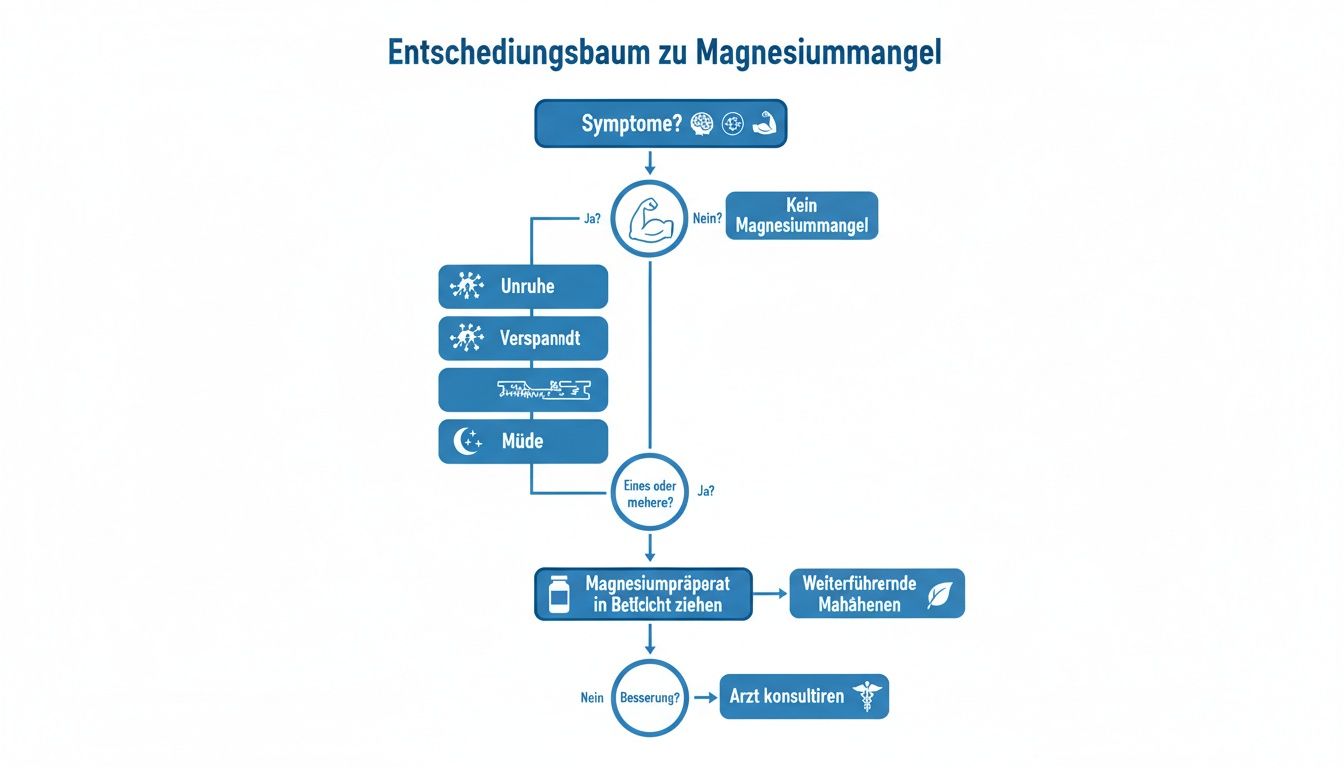
The infographic shows you at a glance how symptoms such as restlessness, tension or fatigue can be interpreted as initial indications and point the way to the next steps.
Choose the right form of magnesium
Not all magnesium is created equal. The crucial difference lies in what's called bioavailability . This term describes how well your body can absorb a particular magnesium compound and transport it to where it's needed. For example, inexpensive magnesium oxide has very low bioavailability, while organic compounds like citrate or glycinate are absorbed much more effectively.
Choosing the right form of magnesium is crucial for its effectiveness. It depends on your individual needs – whether you want to calm your nerves, relax your muscles, or simply replenish your stores.
To make your choice easier, we have compiled the most common types and their specific advantages in a clear table for you.
Comparison of magnesium forms
Find out which magnesium compound is best suited for your goals, such as calming your nerves, relaxing your muscles, or improving tolerability.
| Magnesium form | Bioavailability | Especially suitable for |
|---|---|---|
| Magnesium citrate | High | Fast absorption, good for muscle relaxation and can help with constipation. |
| Magnesium glycinate | Very high | Excellent for the nervous system, it has a calming effect and is very well tolerated. |
| Magnesium malate | High | Supports energy metabolism, ideal for tiredness and exhaustion. |
| Magnesium oxide | Small amount | It is inexpensive, but often has a laxative effect and is poorly absorbed. |
As you can see, there's a suitable form of magnesium for almost every need. Magnesium glycinate is often considered the best choice when the primary goal is to strengthen the nerves and improve sleep quality. This is because the bound amino acid glycine itself has calming properties – a clever double whammy.
By optimizing your diet and specifically choosing the right form of magnesium when needed, you lay the foundation for a resilient nervous system and more inner peace.
Why testing your magnesium levels is a good idea
Inner restlessness, constant tension, or restless nights – does this sound familiar? Such symptoms are often your body's way of telling you that something is missing. They can be a clear indication of a magnesium deficiency, which is essential for nerve function , but not exclusively. Stress or other nutritional deficiencies can also trigger very similar symptoms. Relying solely on guesswork is therefore often like groping in the dark.
Only a targeted test will give you the certainty you need. It provides you with solid data that allows you to make informed decisions about your health. Instead of blindly trying out random products, you gain clarity and can optimize your care in a targeted and effective way.
More than just the value in the blood serum
When you have your magnesium levels checked by a doctor, they usually analyze your blood serum. The problem with this is that serum is essentially just the "transport fluid" in your blood. The magnesium level there only accounts for about 1% of your body's total magnesium and reveals very little about how well your cells are actually supplied.
Your body is a master at keeping serum levels stable. If a deficiency threatens, it simply draws on the large reserves in your bones and muscles. Therefore, a normal serum level can give a false sense of security, while your cells are already depleted.
Crucial for a truly meaningful analysis is the magnesium level in whole blood, more precisely in the red blood cells (erythrocytes). This intracellular value reflects the actual magnesium level in your cells and is therefore considered the gold standard for reliably detecting a deficiency.
Easily test your magnesium levels from home
This is precisely where the nutrient tests from mybody-x.com come in. We want to provide you with a simple and precise method to conveniently measure your magnesium levels from home – right where it really matters: in whole blood.
Imagine being able to gain clarity about your nutrient levels without waiting endlessly for a doctor's appointment or spending time in a waiting room. Our self-tests make this possible. With a simple prick of your finger, you collect a few drops of blood – uncomplicated, quick, and virtually painless.
The advantages are obvious:
- Convenience: You do the test when and where it suits you best.
- Precision: Your sample will be analyzed in a German specialist laboratory certified according to ISO standards, guaranteeing the highest accuracy.
- Clarity: You will not receive an incomprehensible lab report, but a detailed and clearly presented results report.
This report not only shows you your exact magnesium level, but also gives you personalized recommendations. You'll learn specifically how to optimize your levels through your diet and, if needed, targeted supplements. This provides you with a clear roadmap to actively take control of your mental well-being and overall health. If you'd like to learn more about which other nutrients you can test, you'll find all the information in our Vitamin and Mineral Testing Guide.
A test is therefore the first and most important step to moving from mere guesswork to targeted action. It gives you back control and creates the basis for a sustainable improvement in your health.
Take your nerve strength to the next level: From knowledge to action
Well done! You've made it this far and now know exactly what a crucial role magnesium plays for your nerves and inner peace. Let's summarize the key points again so you can start a more relaxed life with clarity and energy.
You've come to understand that magnesium is so much more than just a simple remedy for leg cramps. It's the foundation for a strong nervous system – your personal shield against the constant overstimulation of everyday life. Think of it as the calm manager of your nerve cells: it dampens stress signals, activates the body's own relaxation mechanism (GABA), and keeps the release of stress hormones in check.
Your body is speaking – now you understand it.
You've learned to correctly interpret your body's subtle signals. Inner restlessness, difficulty concentrating, muscle twitching, or poor sleep – all of these can be cries for help, indicating depleted magnesium stores. You now know the best food sources and how to specifically improve your intake with the right supplements, such as magnesium glycinate.
But all this knowledge is only half the battle. The truly decisive step, the one that changes everything, is the leap from assumption to certainty.
Guessing and trial and error often only lead to frustration and don't really get you anywhere. A reliable data foundation is the only way to take targeted and effective control of your health.
Instead of groping in the dark and trying one strategy after another at random, you can create a solid foundation with a nutrient test from mybody-x.com . Find out how your cellular magnesium supply really is – simply, precisely, and conveniently from home.
Stop guessing and start measuring. Take control of your well-being now and take the first, most important step towards a more relaxed, focused, and productive you. Your nervous system will thank you.
The most important questions about magnesium, summarized.
Here I've compiled the answers to the most frequently asked questions about magnesium and the nerves . Short and sweet, so you can quickly get the information you need in everyday life.
How quickly does one notice the effects of magnesium on nervousness?
This is a question that understandably concerns many people. However, the answer is very individual and depends on several factors: How severe is your deficiency? Which form of magnesium are you taking? And how fast does your metabolism work?
Some people notice a subtle improvement after just a few days. Perhaps they sleep more deeply, or the annoying muscle twitching subsides. However, it can easily take several weeks before a truly noticeable effect on inner restlessness and general stress levels sets in. Above all, one thing is crucial: regular and consistent intake . Only in this way can you sustainably replenish your body's stores.
Patience is truly key here. Your body isn't a light switch; it needs time to compensate for the deficiency and restore the biochemical processes to balance.
Is it possible to overdose on magnesium?
Yes, an overdose is possible, but fortunately it's rarely dangerous for healthy people with normal kidney function. Your body has a pretty clever built-in protection mechanism: excess magnesium is simply excreted through the intestines.
That's precisely why the first and most common sign of an excessive dose is loose stools or diarrhea. If you notice this, it's a clear signal from your body to simply reduce the dose. The German Federal Institute for Risk Assessment (BfR) recommends a maximum daily dose of 250 mg from dietary supplements – in addition to what you consume through food.
Which medications interfere with magnesium absorption?
This is an important point that many people overlook. Certain medications can interfere with the body's absorption of magnesium or even increase its excretion. They essentially act like small "magnesium robbers." Therefore, if you regularly take medication, you should pay particular attention to your magnesium levels.
Some of the best-known include:
- Certain diuretics (water pills): They flush not only water, but also valuable minerals out of the body via the kidneys.
- Proton pump inhibitors (stomach protection): Medications such as omeprazole or pantoprazole can significantly reduce the absorption of magnesium in the intestine when taken long-term.
- Some antibiotics and cardiac glycosides: Interactions can also occur here that disrupt the magnesium balance.
It's best to talk to your doctor or pharmacist if you're taking any of these medications. This way you can ensure you're getting enough magnesium and find the right approach for you.
Are you ready to move from guesswork to action and accurately determine your magnesium levels? With the nutrient tests from mybody-x.com, you create a reliable data foundation for your health.



Share:
Measure cortisol at home: Precise insights into your stress level
Bloated stomach during period: Causes and quick tips for relief