

Metabolic Type Diet: Find the tailor-made path to your ideal weight
A metabolic type diet is not a diet in the traditional sense. Think of it more like a tailored suit for your body—an approach to nutrition based on the fact that every person is genetically predisposed to process nutrients such as carbohydrates, fats, and proteins in completely different ways. The goal is simple but crucial: Your diet is precisely adapted to your individual metabolism so you can finally achieve sustainable weight loss and take your overall well-being to a whole new level.
Why conventional diets so often fail
Does this sound familiar? You’ve already tried countless diets—low carb, intermittent fasting, meticulous calorie counting. At first, the pounds drop off, but eventually it stops. You plateau, and the dreaded yo-yo effect hits with full force. If you’re nodding now, you’re definitely not alone. The truth is that the problem rarely lies with your willpower, and much more often with the rigid diet concept itself.
Standard diets follow a universal principle that is supposed to work the same way for every body. Yet this “one-size-fits-all” solution ignores the most important factor in your success: your unique biological predisposition.
Your body has its very own blueprint
Imagine trying to fill a diesel engine with premium gasoline. The result would be a disaster. Your metabolism works in much the same way. While your friend celebrates fantastic results with a low-carb diet, you may simply feel tired, constantly irritable, and barely lose any weight. This is often because her body can use fats and proteins as an energy source extremely well, while your system may depend on a certain amount of carbohydrates to run smoothly.
Your metabolism is as individual as your fingerprint. A nutrition plan that ignores this uniqueness works against your biology instead of working with it.
The fallacy of a one-size-fits-all solution
Conventional diets often fail because they force your body into a state of deficiency that simply doesn’t align with its natural way of functioning. This leads to a cascade of problems that stifle any success from the outset:
- Constant cravings: Your body is practically crying out for the nutrients it lacks to function optimally.
- Lack of energy and fatigue: The “wrong fuel” simply doesn’t provide the power you need for your everyday life.
- Frustration and giving up: When the results fail to appear despite all your efforts, it is only human to eventually throw in the towel.
- Sluggish metabolism: Radical diets can put your body into “starvation mode.” It reduces energy expenditure, making further weight loss almost impossible.
The crucial paradigm shift is to stop searching for the one perfect diet and instead find the perfect diet for you. This is exactly where the concept of the metabolic type diet comes in. It is about finally understanding your body and giving it exactly what it needs to be healthy, energized, and slim.
By discovering what fuel your personal engine really needs, you create the foundation for sustainable success—without constant deprivation. You can learn more about the benefits of such a tailored strategy in our article on the basics of personalized nutrition.
Understanding the secret of your metabolism
What exactly is behind the concept of metabolic types? The best way to explain it is with a simple analogy: Imagine your body as an engine. Every engine is built differently and needs a specific fuel to run optimally. A Formula 1 car needs high-octane racing fuel (lots of carbohydrates), while a tractor runs best on diesel (rich in fats and proteins).
If you put in the wrong fuel, the engine starts to sputter, loses power, or breaks down in the worst-case scenario. Your body is much the same. If your diet does not suit your individual metabolism, you often feel sluggish, struggle with cravings, and simply do not lose weight, no matter what you try.
The three basic metabolic types
The theory of metabolic types makes perfect sense: Our genes determine how well our body can convert the three main nutrients—carbohydrates, proteins, and fats—into energy. This results in three basic types that serve as a kind of compass for a suitable metabolic type diet.
- The carbohydrate type (slow burner): Their body is a master at using carbohydrates efficiently and turning them into long-lasting energy. A diet rich in whole grains, vegetables, and fruit gives them plenty of power. Too much fat and heavy protein, on the other hand, often makes them sluggish and tired.
- The protein type (fast burner): Their metabolism runs at full speed and burns through nutrients extremely quickly. To keep their engine from overheating and their blood sugar stable, they primarily need protein and healthy fats. Too many carbohydrates, especially sugar, quickly lead to a classic energy crash and the next bout of cravings.
- The mixed type (balanced burner): As the name suggests, this type is the happy medium. Their body functions best with a balanced mix of all three macronutrients. The ideal meal for them contains roughly equal amounts of healthy carbohydrates, proteins, and fats.
The idea behind it is simple: Once you know which type you are, you can provide your body with exactly the “fuel mix” it needs to perform at its best. The result? More energy, fewer cravings, and a weight at which you feel comfortable.
The following graphic clearly shows why a one-size-fits-all diet approach often does not work, while a diet tailored to your metabolism can make the crucial difference.
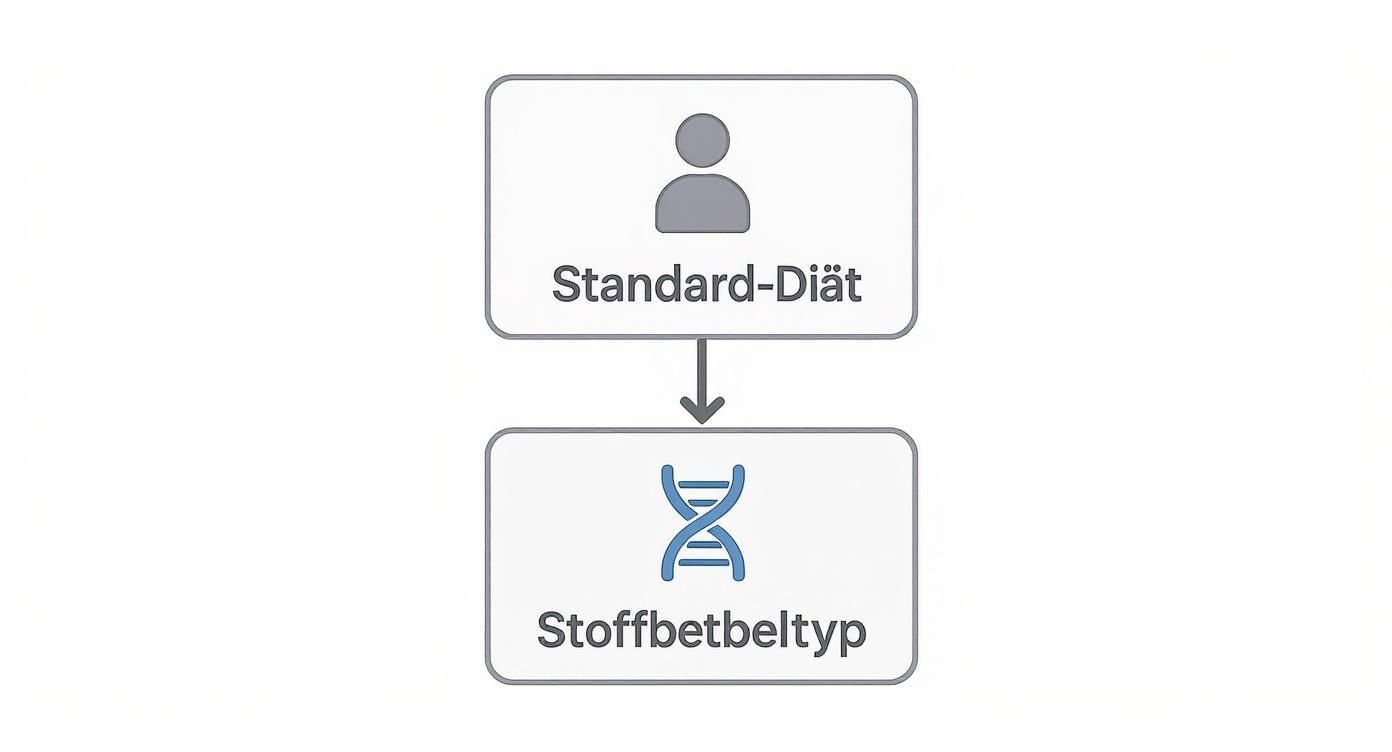
It becomes clear immediately: The step from a “one-size-fits-all” diet to a personalized approach is often the key to success.
Why knowing your type is so important
The fact that more and more people are looking for individual solutions can be seen in the hype surrounding diets such as low-carb diets and intermittent fasting. A 2020 survey showed that around 20% of Germans had already tried intermittent fasting. At the same time, however, studies show that a staggering 67% of all diets fail in the long term. This is often because the body resists and slows down the metabolism. This makes it clear: It is not just about calories, but about what we eat.
This is where the concept of metabolic types offers a logical explanation. Your body is constantly sending you signals—the afternoon slump, a sudden craving for chocolate, difficulty concentrating. All of these can be cries for help indicating that it is receiving the wrong fuel. A diet tailored to your type finally works with your body instead of fighting against it.
This basic understanding is the first, but most important, step. If you want to take a deeper look at how your inner engine works, check out our guide, which explains the most important metabolic processes in simple terms. By learning to understand your body's signals, you lay the foundation for a diet that finally feels right and leads to lasting results.
The typical characteristics of the metabolic types
Have you ever wondered why you feel totally energized after a large portion of pasta, while your partner falls into an absolute afternoon slump? Or why you instinctively reach for salty nuts, while your friend simply cannot live without sweet snacks?
These preferences and reactions are often about much more than mere habit—they can provide valuable clues about your personal metabolic type.

Learning to interpret your body's signals correctly is the first, exciting step toward a metabolic type diet that truly suits you. Take a look at the following profiles and consider which one you identify with most. But remember: this is an initial guide for self-reflection, not an exact diagnosis.
Do you recognize yourself as a carbohydrate type?
Think of the carbohydrate type, often also called the “slow burner”, as a true energy optimizer. Its metabolism is designed to convert carbohydrates into energy slowly and steadily. This gives it consistent energy for hours—provided it gets the right fuel.
Typical signs of this type include:
- Appetite and cravings: You often have only a small appetite and can easily skip meals from time to time. When cravings do strike, they are usually for something sweet, such as fruit, cake, or chocolate.
- Energy levels after eating: A meal rich in good carbohydrates—think whole-grain pasta or potatoes—gives you plenty of energy and leaves you feeling full. After very fatty or protein-rich foods, on the other hand, you often feel heavy and sluggish.
- Personality and concentration: Many carbohydrate types are naturally rather relaxed personalities. They tend to become nervous or jittery quickly from caffeine.
The characteristics of the protein type
The complete opposite is the protein type, also known as the “fast burner”. Its metabolism runs at full speed and burns through energy extremely quickly. That is why it needs a constant supply of nutrients that are digested slowly to keep its blood sugar levels stable and avoid nasty energy crashes.
Here are the characteristic signs:
- Appetite and cravings: You are almost always hungry and feel like you are constantly thinking about your next meal. Your cravings typically center on salty and fatty foods such as chips, cheese, or sausage.
- Energy levels after eating: After a carbohydrate-rich meal (such as white bread or sugary drinks), you quickly feel hungry, tired, or even irritable again. In contrast, a meal high in protein and fat keeps you full and satisfied for a long time.
- Personality and concentration: Protein types are often highly ambitious and energetic, but tend to become nervous and tense when their energy levels drop. Coffee often has a surprisingly calming effect on them.
Important to know: Very few people are a pure extreme type. We often fall somewhere in between, which can make self-assessment somewhat tricky.
Could you be a mixed type?
The mixed type is the all-rounder—it combines characteristics of both worlds. Its metabolism is flexible and handles a balanced combination of all three macronutrients best. Specifically, carbohydrates, proteins, and fats should make up roughly equal portions of your plate.
How to recognize the mixed type:
- Appetite and cravings: Your appetite is usually moderate and may fluctuate. Sometimes you crave something sweet, sometimes something salty, but extreme cravings are rare.
- Energy levels after eating: You feel best after a balanced meal. Too many carbohydrates make you tired, while too much fat sits heavily in your stomach.
- Personality and concentration: Your energy and mood are usually quite stable as long as you eat regularly. However, extremes in your diet can quickly throw you off balance.
Are these profiles making you curious to finally understand your body’s language better? Perfect—that’s the ideal starting point. But to develop a truly well-founded metabolic type diet that works long term, you ultimately need more than just a good gut feeling.
How to reliably determine your true metabolic type
Sure, an initial self-assessment based on your cravings and how you feel after eating is a great start. You’ll learn to interpret your body’s signals better. But honestly: If you want to create a truly effective and sustainable metabolic type diet that still delivers results a year from now, gut feeling alone isn’t enough.
External factors such as stress, lack of sleep, or simply habit can seriously cloud your perception. So, to find the right strategy for you, we need to dig deeper and figure out what your body really needs at a fundamental level. Let’s take a closer look at the most common methods—with all their advantages and disadvantages.
Method 1: Online questionnaires and self-tests
The quickest and simplest way is through online questionnaires. They check the typical characteristics we have already discussed: questions about appetite, cravings, your energy level after meals, and sometimes even your personality.
- Advantages: It is quick, costs nothing, and gives you a rough initial direction. Above all, questionnaires sharpen your awareness of how your body works.
- Disadvantages: The result is extremely subjective and often inaccurate. Many people are mixed types, which makes clear classification nearly impossible. Your answers can also be distorted by your current mood or what you ate yesterday.
A questionnaire is therefore a good starting point, but as the sole basis for a serious dietary change, it is simply not precise enough.
Method 2: Blood tests and laboratory analyses
Blood analyses go one level deeper and are offered by some doctors or nutritionists. Specific values such as blood sugar, insulin, or hormone levels are measured to draw conclusions about your metabolism.
- Advantages: This method is far more objective than a questionnaire and provides solid data about your current metabolic state.
- Disadvantages: A blood test is always just a snapshot. Your values can fluctuate significantly depending on the time of day, your last meal, or your stress level. In addition, these tests are often expensive and not exactly easy to arrange.
A blood analysis therefore gives you insight into your current state, but not necessarily into your underlying genetic predisposition.
Method 3: DNA analysis as the gold standard
If you are looking for the most scientifically accurate and reliable method, there is no way around DNA analysis. Your genes are the immutable blueprint of your body—they determine from birth how efficiently you process carbohydrates, fats, and proteins.
Unlike fluctuating blood values or subjective assessments, your DNA provides a foundation that remains valid for life. It is essentially the user manual for your body, one that never changes.
A DNA-based test such as the mybody® DNA Metabolism Test examines the exact gene variants that are crucial to your metabolism. This gives you a crystal-clear, scientifically sound answer as to which fuel is best suited to your engine.
- Advantages: The highest precision and reliability, results that remain valid for life, as well as clear and truly personalized recommendations for action.
- Disadvantages: Sure, the initial investment is higher than for an online test. But it quickly pays off when you weigh it against all the failed dieting attempts and the frustration.
This is a major topic, especially in Germany. An analysis of the KORA study showed how closely weight gain is linked to changes in fat and amino acid metabolism. This study supports the idea that metabolic type is strongly shaped by genetic mechanisms—and explains why an individually tailored diet often works so much better than one-size-fits-all approaches. You can read more about how changes in weight affect metabolism on dzd-ev.de.
Ultimately, it’s a trade-off between convenience and precision. While self-tests are a nice introduction, DNA analysis provides the most reliable and trustworthy foundation for a lasting, successful change in your diet. If you’re ready to do it properly this time, take a look at our detailed guide to determining your metabolic type.
Practical nutrition tips for your metabolic type
Okay, you’ve figured out your metabolic type—and now what? What exactly goes on your plate? Perfect, because that’s precisely what we’re focusing on now: putting it into practice in everyday life.
A metabolic type diet is not rocket science. Think of it more as an intuitive user manual for your body. You learn to give it exactly what it really needs to function smoothly. Here are practical everyday tips for each of the three main types.

The game plan for the carbohydrate type
Your body is a true master at converting carbohydrates into energy. Give it the right fuel, and it will thank you with steady energy throughout the day.
Your ideal plate could look like this:
- approx. 60% carbohydrates: Think complex, slow-release sources of energy. Whole-grain foods such as oats, quinoa, or brown rice are great, as are potatoes, legumes, and a colorful variety of vegetables.
- approx. 25% protein: Lean proteins are your friend. Choose chicken breast, fish, tofu, or low-fat quark to round out your meals.
- approx. 15% fats: Healthy fats are important, but in moderation. Half an avocado, a handful of nuts, or a splash of quality flaxseed oil over your salad are ideal.
A typical mistake that carbohydrate types often make? Eating too much fat. A heavy, fatty meal can really slow down your metabolism and make you feel tired and sluggish. So keep your meals fairly light and focused on carbohydrates.
Your motto is: Fuel up on complex carbohydrates for long-lasting energy and combine them with lean protein and healthy fats.
The strategy for the protein type
Your metabolism is running at full speed. To keep the engine from overheating while still getting through the day steadily, you need nutrient-dense meals that release their energy slowly.
Your ideal plate proportions look different:
- Approx. 45% protein: High-quality protein is your most important building block. Oily fish such as salmon, good-quality red meat, eggs, as well as nuts and seeds are perfect for you.
- Approx. 30% fat: Healthy fats provide long-lasting satiety. Consciously incorporate olive oil, avocados, nuts, and high-quality butter into your meal plan.
- Approx. 25% carbohydrates: Of course, you need carbohydrates too, but the right ones! Choose fiber-rich options such as vegetables and berries, and only small portions of sweet potatoes or lentils.
Fast carbohydrates from white flour products or sugar are your personal kryptonite. They send your blood sugar soaring, only to make it crash again shortly afterward—cravings are practically inevitable.
The balanced approach for the mixed type
As a mixed type, you are the flexible all-rounder on the team. Unsurprisingly, the key to your success lies in balance. Extremes in either direction—whether too much fat or too many carbohydrates—can quickly throw your system off balance.
This is what your balanced plate looks like:
- Approx. 40% carbohydrates: A colorful mix of starchy vegetables, whole grains, and fruit is ideal.
- Approx. 30% protein: Cleverly combine animal and plant sources, such as fish, poultry, eggs, and legumes.
- Approx. 30% fat: A healthy mix of nuts, seeds, avocados, and high-quality oils keeps you balanced.
Your goal is to consume all three macronutrients in a balanced ratio at every meal. This ensures a stable energy supply and keeps cravings at bay.
General tips for every type
No matter which metabolic type you belong to, a few basic rules apply to everyone and help you get the most out of your diet:
- Listen to your sense of fullness: Learn to perceive your body's signals again. Eat when you are hungry and stop when you feel pleasantly full, not stuffed.
- Drink enough water: It sounds banal, but it is essential. Water is involved in practically every metabolic process.
- Exercise is your friend: Find a form of exercise you genuinely enjoy. Cardio training such as running or cycling boosts fat burning, while strength training builds muscle—and more muscle also burns more energy at rest.
Unfortunately, overweight is widespread in Germany—around 50 % of adults have a BMI above 25. A type-specific diet can help manage risks such as cardiovascular disease more effectively because it takes individual nutrient utilization into account. Experts agree: Sustainable success always comes from a combination of an adapted diet and smart behavioral changes.
When you adapt your diet to your type, you finally work with your body, not against it. Would you like to delve even deeper and learn which foods can give your engine an extra boost? Then take a look at our guide to foods that boost metabolism.
The most frequently asked questions about the metabolic type diet
The concept of adapting your diet to your metabolic type naturally raises questions. That makes sense, because it challenges much of what we have heard about diets for years. Here, we answer the most important questions so that you can get a clear picture and feel confident in this personalized approach.
Can my metabolic type change over the course of my life?
An entirely valid question with a two-part answer. Your genetic predisposition—in other words, the blueprint for your metabolism revealed by a DNA test such as the one from mybody®—remains the same throughout your life. It is your anchor in the storm and your most reliable guide.
What can certainly change, however, is your current metabolic state. Just think of age, hormonal changes such as pregnancy or menopause, ongoing stress, or an extreme training load. Such phases can temporarily shift your needs.
Your DNA-based recommendations are your lifelong foundation. You simply learn to smartly adapt this foundation according to your stage of life and how you currently feel, without deviating from the basic principle.
Isn’t the metabolic type diet terribly complicated?
Quite the opposite! At first glance, the idea may seem complex, but in practice, it’s about radically simplifying your diet. Instead of constantly counting calories, chasing points, or anxiously avoiding entire food groups, you learn something far more valuable: a deep understanding of which nutrients your body really needs to function properly.
It’s about finally interpreting your body’s signals correctly and giving it what makes you feel full, satisfied, and energized. Once you have internalized the principle of your type, choosing the right foods becomes second nature. It is not a short-term ordeal, but a long-term dietary change that fits effortlessly into your everyday life.
Do I now have to completely give up carbohydrates or fats?
A clear and emphatic: No! One of the biggest mistakes of many diets is radical restriction. The metabolic type diet is never about completely eliminating one of the three macronutrients—carbohydrates, proteins, and fats—from your life. Each of them performs vital functions.
The key lies in the right balance and the appropriate emphasis for your type.
- A protein type of course still needs carbohydrates for quick energy, but should focus on complex sources such as vegetables and enjoy them in smaller portions.
- A carbohydrate type performs at their best on a carbohydrate-rich diet, but still needs protein for their muscles and healthy fats for hormones and a good sense of fullness.
As you can see, it’s about intelligently optimizing your personal nutrient mix, not about pointless deprivation.
How quickly can I expect results?
The answer is as individual as you are. However, many people notice the first positive changes after just a few days—and they often have nothing to do with the scale. You may notice:
- A much more stable energy level throughout the day
- Significantly fewer cravings for sweet or salty foods
- Deeper, more restorative sleep
- Calmer, more regular digestion
Losing weight sustainably is a marathon, not a sprint. But because this approach prevents the dreaded yo-yo effect from the outset, the results are often much more lasting than those of typical crash diets.
Stop fixating solely on the number on the scale. Instead, learn to pay attention to the many other positive signals from your body. Eating according to your metabolic type is an investment in your health that pays off on every level. The metabolic type diet is the first step toward finally understanding your body properly.
Are you ready to put an end to the guesswork and find out exactly what your body really needs? At mybody®, our DNA metabolism test provides the scientifically sound foundation for your personal path to success. Discover your genetic blueprint and start your journey toward greater well-being and your desired weight today. Find the right test for you now at mybody-x.com.



Share now:
Genetic analysis – How it influences health and nutrition
Test your metabolism type: Find out what your body really needs