
Metabolic test for weight loss: Your personal guide to success
To truly succeed with a metabolic test for weight loss , you first need to understand why conventional diets so often fail. The key is your biological uniqueness – your body has its own specific needs that a one-size-fits-all plan simply ignores. So instead of fighting against your body, a test helps you to work with it in a targeted way.
Why standard diets often don't work
You meticulously count calories, eat according to a plan, and diligently exercise, but the scale just won't budge? This is not only incredibly frustrating, but also a widespread problem. Many people blame it on a lack of discipline or willpower. But the truth is usually quite different.
The reason so many diets fail lies in their rigid approach: they treat everyone as if they were the same. A "one-size-fits-all" diet plan completely ignores the most important factor for your success – your biological individuality.
Your metabolism: A unique engine
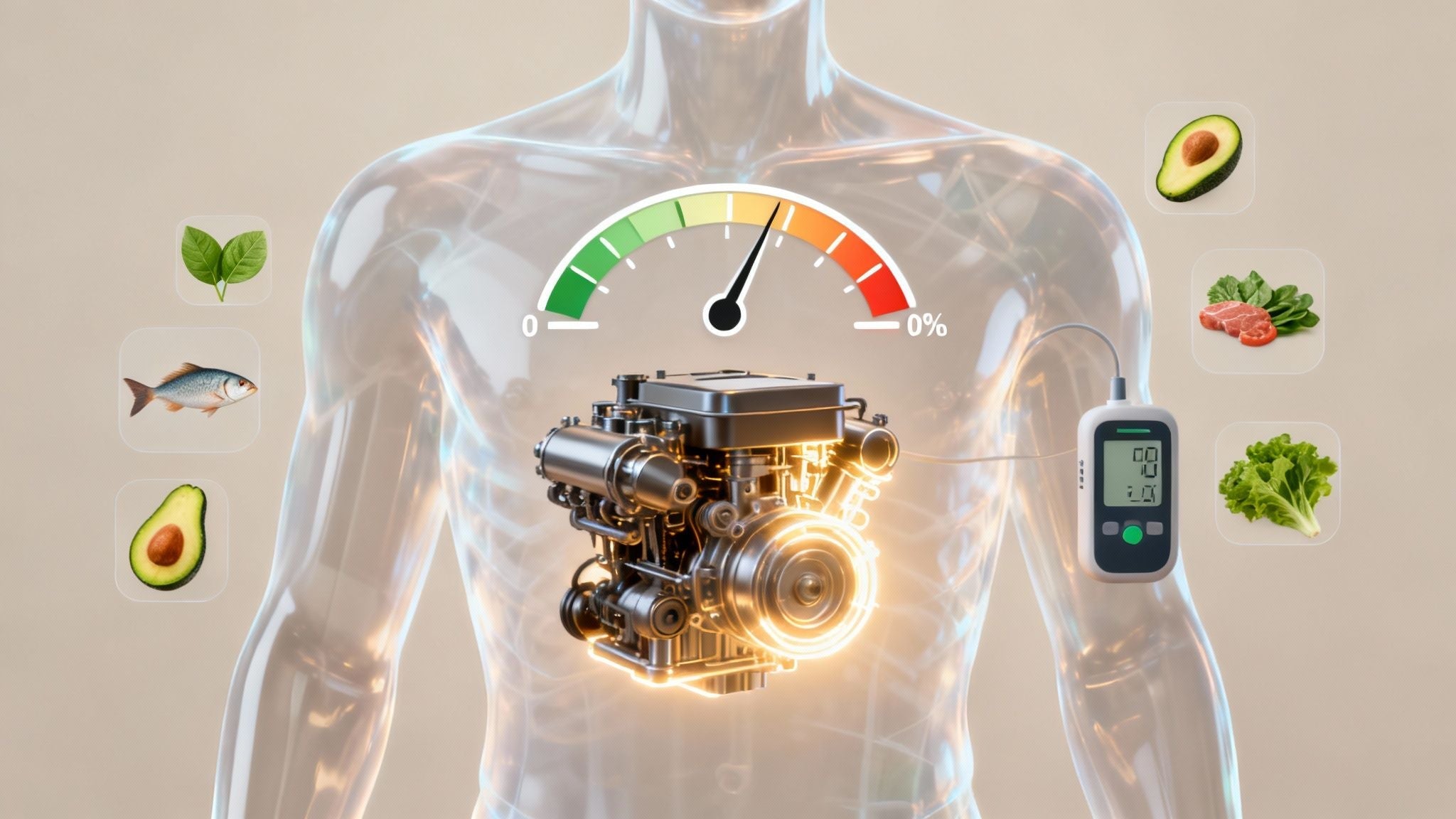
Imagine your metabolism like a car engine. Every engine is built differently and needs a very specific fuel to run smoothly. A high-performance sports car engine would sputter on cheap regular gasoline, while a robust compact car would be completely overwhelmed by kerosene. This same principle applies to your body.
Some people are genetically predisposed to derive energy more efficiently from fats and proteins. Others, however, need a higher proportion of complex carbohydrates to stay fit and avoid cravings. A standard diet is essentially an attempt to fuel all these different needs with the same generic fuel. The result? The engine runs rough, performance drops, and eventually, it breaks down.
Your body isn't fighting against you – it's just trying to cope with the wrong fuel. Feelings of fatigue, cravings, and weight that just won't budge are often clear signs that your diet isn't suited to your metabolic type.
When biology defeats your willpower
It's a persistent myth that losing weight is simply a matter of "eating less, exercising more." Sure, a negative calorie balance is the physical basis for weight loss. But the type of calories you consume has a huge impact on how your body feels and how long you can stick with it.
If you give your body the wrong "fuel", it reacts with pure stress.
- Hormonal chaos: Your body releases increased amounts of stress hormones like cortisol. This can actually promote fat storage, especially around the abdomen.
- Constant hunger: Your blood sugar levels fluctuate wildly, leading to cravings and putting your willpower to a tough test.
- Energy-saving mode: To conserve energy, your body reduces its basal metabolic rate. This makes losing weight even harder.
So you're not just fighting old habits, but deeply ingrained biological survival mechanisms. The key is to understand your body instead of fighting it. This is where the idea of personalized nutrition comes in, helping you tailor your strategy to your individual needs. If you want to know more about how such a customized approach works, check out our article on personalized nutrition and its benefits .
A metabolic test for weight loss is the first step to breaking out of this vicious cycle. It provides you with the information you've been missing: the blueprint of your very own engine. With this knowledge, you can finally choose the right fuel and achieve lasting results.
What a metabolic test really reveals
"Metabolic test" – that sounds like complicated lab jargon at first. But essentially, it's nothing more than a targeted look under the hood of your body. Instead of continuing to guess which fuel is best for you, you get clear, data-based facts. A vague feeling is transformed into a concrete strategy that truly suits you.
The idea is actually quite simple: Every body processes nutrients differently. A metabolic test for weight loss deciphers precisely these individual processes. It shows you how your body reacts to fats, carbohydrates, and proteins, so you can finally adapt your diet to your biological needs.
From the air we breathe to DNA
There are various methods to gain insight into your metabolism. Each has its own strengths and provides different pieces of the puzzle for the overall picture.
- Respiratory gas analysis: This measures how much oxygen you consume and how much carbon dioxide you exhale. From this, it can be determined whether your body relies more on fats or carbohydrates as an energy source at rest or during exertion.
- Blood tests: They provide information about hormone levels, blood sugar, or inflammatory markers that directly affect your metabolism. This is essentially a snapshot of your current metabolic state.
- DNA analysis: Here we examine your genetic predisposition. A test like the one from mybody-x analyzes specific gene variants that help determine how efficiently you process macronutrients. This provides you with a stable, lifelong basis for your nutrition plan.
While breath and blood tests show you what's currently going on, a DNA analysis gives you your body's actual blueprint. You'll find out whether you're naturally more of a "carbohydrate type" or a "fat type." With this knowledge, you can adjust your diet instead of constantly fighting against your own predisposition.
The following infographic clearly illustrates the difference between the "one-size-fits-all" approach and an individual strategy tailored to you.
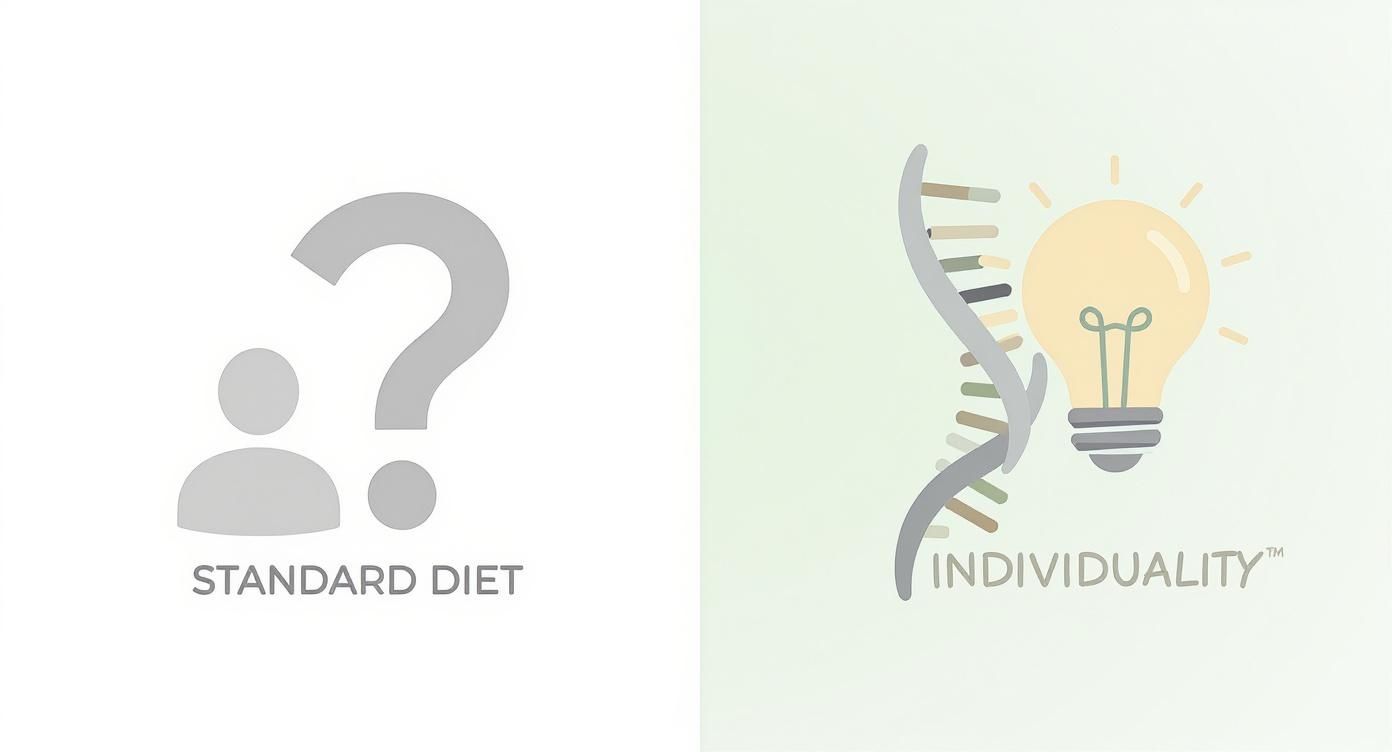
It's immediately obvious: While standard diets are often a shot in the dark, an individual, genetically based approach provides the crucial puzzle pieces for sustainable success.
Your personal compass for nutrition
So what exactly does such a test offer you in everyday life? It's about finally getting precise answers to the questions that determine success or frustration when losing weight.
A metabolic test replaces guesswork with knowledge. It's your personal compass, showing you the most direct path to your ideal weight by translating your body's unique language.
The insights gained are directly applicable and will help you make more conscious decisions every day. For example, you will learn:
- Your primary energy source: Does your body prefer to use fats or carbohydrates to obtain energy?
- Your optimal macronutrient distribution: In what ratio of proteins, fats, and carbohydrates does your body function best?
- Your sensitivity to certain nutrients: Are you perhaps more sensitive to saturated fats or rapidly digestible carbohydrates than you thought?
This information is pure gold. It allows you to create a nutrition plan that leaves you feeling full, satisfied, and energized. You'll learn to give your body exactly what it needs. If you'd like to delve even deeper into the topic, you'll find further information in our guide to metabolic analysis .
Nevertheless, it's important to remain realistic. The market for genetic tests is huge, and the quality varies considerably. Some studies, such as one from Stanford University, found that some commercial tests showed little to no measurable effect on weight loss success. This underscores the importance of relying on scientifically sound analyses from certified laboratories, as we do at mybody-x. You can read more about the scientific debates surrounding the DNA diet and its validity in Spiegel magazine . This isn't about a miracle cure, but rather a powerful tool that helps you make smarter and better-informed decisions about your health.
How to implement your test results in everyday life
You're holding the results of your metabolic test in your hands – a pivotal moment. But what now? A test result alone won't make the pounds melt away. Only when you consistently integrate the findings into your daily life will the raw data translate into visible success on the scale and a whole new sense of well-being.
This chapter is your bridge from theory to practice. We translate the scientific facts into concrete, practical steps so you can get started right away. Your weight loss metabolism test was the starting point – now it's time to put it into practice.

Discover your personal metabolic type
While every person is unique, clear tendencies often emerge from these analyses. These so-called metabolic types are a huge help in planning your meals much more easily. Don't think of them as rigid rules, but rather as guidelines to give you orientation.
Depending on how well your body processes the three main nutrients – carbohydrates, proteins and fats – you tend to belong to one of these types:
- The carbohydrate type (carb type): Your body runs best on carbohydrates. You feel energized and satisfied when your meals are high in complex carbohydrates such as whole grains, potatoes, or legumes. Add a moderate portion of protein and little fat – perfect.
- The protein type: You derive your energy most efficiently from protein and fats. A large portion of pasta tends to make you tired, while a piece of fish or a steak really wakes you up. Your foundation should consist of fish, meat, eggs, and healthy fats.
- The mixed type: As the name suggests, you're a true all-rounder. Your metabolism handles all three macronutrients well. A balanced distribution of carbohydrates, proteins, and fats is usually the best approach for you.
This knowledge is pure gold for putting an end to cravings. By giving your body precisely the fuel it can best utilize, your blood sugar and satiety hormones remain balanced.
From knowledge to a full plate
Let's bring this to life. What does this mean specifically for your breakfast, lunch, or dinner? Here are a few examples that illustrate the difference:
Example breakfast:
- For the protein type: Scrambled eggs with vegetables and half an avocado are the perfect start to the day. This gives you long-lasting energy from proteins and fats without sending your blood sugar on a rollercoaster ride.
- For those who prefer carbohydrates: A bowl of oatmeal with fresh berries and a few nuts is ideal. The complex carbohydrates provide sustained energy, and the fiber keeps you feeling full for a long time.
- For the mixed type: Greek yogurt with fruit and a handful of almonds provides you with a balanced mix of all three macronutrients.
Your plate is your most powerful tool. By adapting it to your metabolism, you work with your body, not against it. The result: less struggle and much more ease on the way to your goal.
Practical tips for shopping and meal planning
The process doesn't begin in the kitchen, but already in the supermarket. With a clear strategy, changing your diet becomes child's play.
- Create a shopping list tailored to your metabolic type: Plan your meals for the next few days before you head out. Focus on foods that suit your metabolic type. This way, you won't end up with impulse buys that get in your way.
- Meal prepping as a success factor: Set aside an hour or two on the weekend to prepare meals or individual components. Pre-cooked quinoa for the carb-type or pan-fried chicken breast for the protein-type can be quickly combined into a healthy lunch during the week.
- Learn to read labels: Don't just look at the calories, but especially at the macronutrient distribution. This way you can be sure that the products you buy really meet your needs.
At mybody-x, we don't just leave you with the raw data. Our approach is to show you not only what your body needs, but also how to best provide it. A test result is the starting point; the clear and actionable instructions are the path to success.
For even more detailed and personalized planning, our myFoodbook diet plan can be a valuable tool. It translates your test results into an individual nutrition plan with specific recipes and suggestions perfectly tailored to your metabolism. This makes daily implementation even easier and helps you stay motivated.
Why weight loss is more than just nutrition
Okay, you have the results of your metabolic test and a clear plan for adjusting your diet. That's a huge step forward. But even the best diet plan is useless if the foundation of your lifestyle is shaky. Losing weight permanently is a holistic process – your mind and body have to work together as a team.
A metabolic test for weight loss provides you with a crucial piece of the puzzle. But it's only one part of the puzzle. Often, it's the invisible adversaries like stress, lack of sleep, or your own mindset that sabotage your progress, even if everything on your plate is fine.

The silent saboteur called stress
Imagine your body was constantly in alarm mode. That's exactly what happens with chronic stress – whether from work, personal worries, or the pressure you put on yourself. Your body then continuously releases the stress hormone cortisol .
Cortisol isn't inherently bad; it helps us react lightning-fast in dangerous situations. However, a persistently elevated level completely disrupts your metabolism. It triggers cravings for fatty and sugary "brain food," can promote muscle loss, and signals your body to store energy as belly fat.
You can eat with the utmost discipline – but if your cortisol levels are skyrocketing, you're fighting a hormonal blockage that actively prevents fat loss. Your body is in survival mode, not weight-loss mode.
Sleep: The magic ingredient for your success
While you sleep, your body is working hard. It repairs cells, processes the day's impressions, and regulates the crucial hormones that control your hunger and satiety signals.
- Ghrelin , the hunger hormone, is produced in greater quantities when we lack sleep. The result: You have a bigger appetite.
- Leptin , the satiety hormone, decreases at the same time. This means you don't feel full as quickly.
Even a single night of insufficient sleep can disrupt this delicate balance. You might already know the result: you wake up not only hungrier, but also with a stronger craving for unhealthy, high-calorie foods. Good sleep is therefore not a luxury, but a biological necessity for successful weight management.
Your mindset determines the outcome
The journey to your ideal weight is a marathon, not a sprint. Your inner attitude plays one of the biggest roles. Negative self-talk, impatience, and that typical "all-or-nothing" thinking are the most common reasons why people give up.
Studies show that psychological and hormonal factors significantly influence weight loss success. While millions of people resolve to lose weight, only a few manage to keep it off long-term. Your body weight is not only biologically but also psychologically controlled. A negative self-image can block success just as easily as stress, which puts the metabolism into crisis mode through increased cortisol levels.
A holistic approach that combines nutrition, stress management, and sleep is therefore the only way that truly works. It's about developing a positive, patient attitude and giving your body the support it needs in addition to the right food. If you're interested in learning more about this topic, check out our article on scientifically sound strategies for weight management .
By harmonizing these three pillars – nutrition, stress management and sleep – you create the perfect conditions for the insights from your metabolic test to have their full effect.
The biggest myths about metabolism and weight loss
"Eating after 6 p.m. makes you fat." "Light products are the key to success." "Cardio on an empty stomach burns the most fat." Countless such "golden rules" for weight loss circulate online and among friends. Many persist surprisingly stubbornly, even though they have long been scientifically disproven or at least grossly oversimplify reality.
Such half-truths often lead to frustration because they promise a one-size-fits-all solution for a completely individual issue. A metabolic test for weight loss makes one thing perfectly clear: your body plays by its own rules. It's time to debunk the most common myths once and for all. Let's take a closer look at some of the most popular misconceptions.
Myth 1: People who eat in the evening gain weight.
The idea that your body simply stops burning calories after a certain magical time is widespread – but simply wrong. For your energy balance, it makes absolutely no difference when you consume your calories. What counts at the end of the day is the total number of calories you consume over 24 hours in relation to what your body uses.
The problem with late meals is usually something else entirely: In the evenings, many people tend to snack uncontrollably on chips, chocolate, and the like while relaxing on the sofa. This quickly leads to a significant calorie surplus, resulting in weight gain. The real culprit, therefore, is not the time of day, but the type and quantity of food consumed.
Myth 2: Light products help with weight loss
Reduced-fat yogurt, low-calorie ready meals, or sugar-free sodas – sounds like a clever shortcut, right? But the term "light" is often more hype than substance. To make the products still taste good, the missing fat is frequently replaced with extra sugar, starch, or artificial additives. This can cause your blood sugar levels to spike and trigger cravings.
A quick glance at the nutrition facts label usually exposes the deception. Often you hardly save any calories, but end up consuming a cocktail of chemical additives. Unprocessed, natural foods are almost always the better choice. They truly satisfy your hunger and provide your body with valuable nutrients.
A myth often arises from oversimplification. The truth is usually more complex and, above all, more individual. Your metabolism doesn't follow general diet rules, but its own genetically determined logic.
Myth 3: Lots of exercise compensates for a poor diet
"I went for an hour-long run today, so I can treat myself to pizza now." Almost everyone has had this thought at some point. Exercise is undoubtedly an extremely important component of a healthy lifestyle and, of course, burns calories. But its impact on weight loss alone is often vastly overestimated.
To burn off the calories in a single pizza (approx. 800 kcal ), you'd have to jog intensely for over an hour straight. It's much, much easier to avoid consuming calories in the first place than to painstakingly work them off later. Exercise shapes your body, strengthens your cardiovascular system, and improves your insulin sensitivity – but without a tailored diet, significant weight loss is usually elusive.
Myth 4: A slow metabolism is to blame for being overweight.
Many people are absolutely convinced that they naturally have a "slow" metabolism, making weight loss impossible. However, in the vast majority of cases, this is not the real reason for being overweight. The differences in basal metabolic rate between people with similar body composition are often surprisingly small.
Far more crucial are factors like your daily activity level, your eating habits, and your individual nutrient utilization. A mybody-x metabolism test shows you in black and white how your body processes fats and carbohydrates. So instead of hiding behind the convenient excuse of a "slow" metabolism, you can find out how to specifically supply it with the right fuel.
The problem of obesity is widespread and steadily increasing in Germany. According to data from the Robert Koch Institute, the prevalence of obesity rose from 12.2% in 2003 to 19.7% in 2023 – a worrying trend that underscores the need for individualized solutions. These figures show that generic diets are often insufficient, as genetic factors play a significant role in metabolism and weight loss success. Learn more about obesity statistics and regional differences in Germany at marcusknispel.com .
Frequently asked questions about the metabolic test
A metabolic test for weight loss naturally raises questions. After all, it's an important decision for your health and your wallet. To give you more clarity, we've compiled the most frequently asked questions and answer them here – honestly, directly, and without technical jargon.
How quickly can I expect to see initial success?
That's probably the most intriguing question of all. And the answer is as individual as your metabolism itself. It's not about a miracle pill that works overnight. Rather, you're laying the foundation for truly lasting change.
Many of our customers notice the first effects within the first two to four weeks . This doesn't necessarily mean a significant drop on the scale. Often, it's other, equally important signals from your body:
- More energy: You feel fitter and get through the day more easily because your body finally gets the fuel it really needs.
- Reduced cravings: Stable blood sugar and the right nutrients noticeably reduce sudden cravings.
- Improved satiety: You feel fuller and more pleasantly full for longer after meals.
Visible weight loss is then the logical consequence. It's a process that gives your body time to adapt – and that's precisely what makes the success so lasting.
Is a metabolic test useful for everyone?
Generally, everyone benefits from understanding their body better. However, a test is particularly valuable for people who:
- You've already tried so many things: you've been on diets, counting calories, and exercising, but the scale just won't budge. A test can provide the crucial clue as to why your efforts have been in vain so far.
- You want to proceed in a targeted and efficient manner: You're tired of wasting your time and energy with a scattershot approach. You want a strategy tailored to your biology from the very beginning.
- Want to better understand your body: You're simply curious and want to know how your body works in order to make healthy decisions for yourself in the long term.
A test might not be strictly necessary if you're already seeing great results with minor adjustments. But for those who want to dig deeper and get to the root of the problem, it's an extremely powerful tool.
A metabolic test isn't a cure-all, but it's an incredibly insightful guide. It gives you the map – you still have to walk the path yourself. But with a map, the journey is infinitely easier.
How much does a test cost and is it covered by health insurance?
The cost of a high-quality DNA metabolic test can vary. It's best to think of it as an investment in your health and in knowledge that will last a lifetime.
Currently, the costs for such genetic analyses for weight loss are generally not covered by statutory health insurance in Germany . They are usually considered an individual health service (IGeL) that you have to pay for yourself.
However, it's worth putting the costs into perspective: How much have you already spent on ineffective diet products, useless supplements, or gym memberships you never used? A test provides you with a clear, data-driven foundation that you can truly build upon.
Do I have to abide by the results forever?
We hear this question often – usually accompanied by the fear of lifelong limitations. But the opposite is true! The knowledge gained from the test gives you freedom and flexibility .
Your genetic predisposition is unchangeable, but your lifestyle isn't. The results aren't rigid rules, but rather guidelines. You learn which foods are good for you and which ones hold you back. That doesn't mean you can never eat pizza or a piece of cake again.
It's more about finding an 80/20 balance . On most days, you give your body what it can optimally utilize. And on the remaining days, you consciously enjoy exceptions without guilt. You develop a much better sense of your body and intuitively learn what you need. So it's not about deprivation, but about conscious, informed choices that bring you closer to your goal.
Are you ready to end the guesswork and finally gain clarity about your metabolism? At mybody-x, you'll not only receive a scientifically sound analysis, but also easy-to-understand instructions to directly implement the results in your everyday life. Discover the right test for you and start your personal journey to greater well-being.


Share:
Boost your metabolism for weight loss: Your path to lasting success
Metabolism explained: Functions, types and influence