
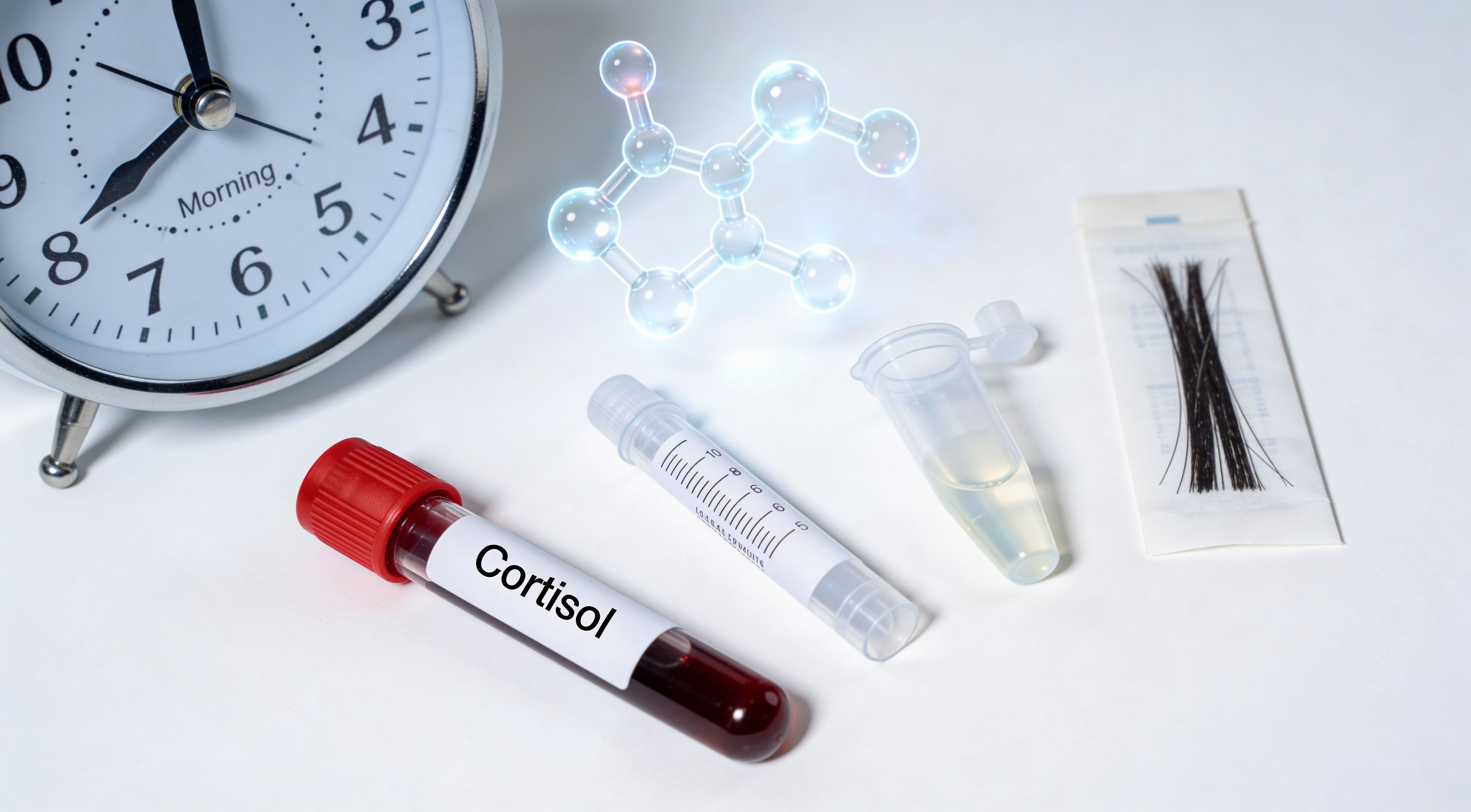
How to measure cortisol levels? The complete guide
You are somehow still functioning, but not properly. In the morning, you struggle to get going. During the day, you are tense or empty. In the evening, your mind is wide awake, even though your body has long been tired. Many people know this exact feeling and eventually quietly ask themselves: What's wrong with me?
If you're looking for answers, you're not oversensitive or "just stressed." Your body is sending signals. Cortisol can play an important role here. And the good news is: How to measure cortisol levels is no longer a complicated specialized question, but something that can be approached in a structured and practical way.
Constantly tired and stressed? Your cortisol level could be the answer
Anna sits at the kitchen table with coffee in the morning and still feels foggy. At work, she's under tension; in the evening, she doesn't relax but falls into inner restlessness. She thinks: Maybe I'm just not resilient enough. But this thought is often the wrong starting point.

Behind such complaints can be a disturbed cortisol rhythm. Not always. But often enough that it makes sense to take a closer look. Especially if you feel that sleep, energy, mood, and resilience no longer fit together.
Typical everyday situations often sound like this:
- Exhausted in the morning even though you've had enough time in bed
- Fidgety or irritable during the day without a clear trigger
- Overstimulated in the evening instead of pleasantly tired
- Physically tense even though you are "just" functioning in everyday life
Sometimes the first helpful feeling is not relief, but confirmation. Your symptoms are real and deserve a thorough clarification.
If you recognize yourself in this, a sober look at your hormone levels is worthwhile. Especially in women, stress-related changes often manifest not only as nervousness but also as sleep problems, mood swings, or the feeling of constantly being "on edge." You can find more about this in the article on typical signs of elevated cortisol in women.
The goal is not to immediately attribute every diffuse symptom to cortisol. The goal is clarity. Others have long begun to understand their values and triggers based on data, instead of remaining in trial-and-error mode for months. You are on the right track if you listen to your body more closely now.
Understanding Cortisol – More than just a stress hormone
Cortisol is often described as purely a stress hormone. That's too simplistic. Cortisol is more like an operations manager in the body. It helps you wake up in the morning, supports metabolism, and is part of the normal adaptation to stress.
It only becomes truly problematic when this operations manager constantly sounds the alarm or is active at the wrong time.

What cortisol controls in your daily life
Cortisol affects several areas simultaneously:
- Energy in the morning. The rise helps you get going for the day.
- Blood sugar and metabolism. Your body provides energy when it needs it.
- Blood pressure and circulation. Cortisol is part of normal regulation.
- Immune system. Inflammatory processes are also co-regulated.
That's why an imbalance often doesn't feel like "just stress." It can manifest as a whole mix of fatigue, inner restlessness, poor regeneration, and concentration problems.
Why the daily rhythm is so important
It's not just how much cortisol is present, but when. Normally, levels are highest in the morning and then drop throughout the day. This is precisely why the cortisol blood test in Germany is performed early in the morning between 6 and 8 a.m. This is when the highest range, with normal values of 140–600 nmol/l, occurs, and daily profiles can show fluctuations of up to 80% throughout the day, as deine-gesundheitswelt.de describes for the cortisol daily profile.
If this rhythm is disturbed, it can manifest itself in very different ways. Some can't get out of bed in the morning. Others are nervous all day. Still others feel flat during the day and suddenly wake up in the evening.
Important for your understanding: A single value is only a snapshot. When it comes to cortisol, the trend often says more than the momentary reading.
Those who want to better understand the basics can find a good overview in the background article what cortisol actually is and how it works.
Why cortisol is not your enemy
Many people want to "lower" cortisol immediately. That's too simplistic. You need cortisol. Without this rhythm, your body lacks a central control signal.
This question is more helpful: Does your cortisol fit your time of day, your well-being, and your lifestyle? That's exactly what a meaningful measurement is about. Not about fear. But about a clearer picture.
The four ways to measure your cortisol levels
If you want to know how to measure cortisol levels, you should think of the methods as different camera lenses. Each shows something different.
Blood provides a precise snapshot.
Saliva primarily shows free, biologically active cortisol and is well suited for tracking levels throughout the day.
Urine can reflect total secretion over longer periods of the day.
Hair is sometimes used when the focus is on long-term stress patterns.
These four methods differ less in "good" or "bad" than in the question: What do you actually want to know?
Four perspectives on the same question
-
The blood test
Useful when a precise momentary value is required. Especially in a medical context, this is the classic approach. -
The saliva test
Practical for home use because multiple time points on the same day are easier to collect. -
The urine test
Relevant when the total cortisol secretion over a longer period is concerned. -
The hair analysis
More of a look back than a current status measurement.
The most common mistake is to treat all methods equally. This quickly leads to confusion. A morning blood value answers a different question than a daily saliva profile. That's precisely why a direct comparison is worthwhile.
Blood, Saliva, Urine, and Hair in direct comparison
Not every measurement method suits every question. If you only want to know if your value is high or low at this moment, the decision is different from the question of whether your daily rhythm has shifted.
Blood test for cortisol
The blood test is the standard method in Germany for precise momentary values. It is particularly useful when a medically sound check of cortisol levels at a specific time is required.
Its advantage is clear laboratory standardization. Its disadvantage in everyday life is obvious. The collection process can be stressful for some people, and precisely this stress can complicate the situation with cortisol.
Saliva test for cortisol
For home use, the saliva test is often the most practical method. Studies show that saliva tests correlate highly with blood measurements, with r=0.90 to 0.93, and that they measure free, biologically active cortisol. This is precisely why they are considered a particularly reliable, non-invasive option for home tests, as ALTA Klinik summarizes for the cortisol saliva test.
This is relevant in everyday life because you don't just get any value, but the part of cortisol that is biologically active. In addition, a daily profile with multiple samples is easier to implement than with repeated blood draws.
For many people, the sticking point is not the theory, but practicality. If a test is suitable for everyday use, it will only then be performed properly.
Urine test for cortisol
The 24-hour urine test is helpful when the focus is more on total secretion. In a clinical context, it plays a role particularly when a continuously elevated production is suspected.
For typical everyday questions like "Why do I feel empty in the morning and restless in the evening?", it is often less insightful than a daily profile. It answers the question of the amount over the day rather than the rhythm.
Hair analysis for cortisol
Hair analysis is often described as a long-term view. It can be interesting if someone wants to know whether there has been stress over weeks or months.
A realistic expectation is important here. Hair does not show fine daily dynamics. Those who want to understand current complaints in the course of the day usually need a method that precisely visualizes this course.
Comparison of cortisol test methods
| Method | What is measured? | Advantages | Disadvantages | Ideal for |
|---|---|---|---|---|
| Blood | Momentary value at a specific time | Precise, medically established | Stress from collection can interfere, not very practical for multiple time points in everyday life | Acute assessment of a single value |
| Saliva | Free, biologically active cortisol over the day | Non-invasive, good for home use, suitable for profiles | Careful preparation important | Stress status and daily rhythm |
| Urine | Total secretion over a longer period | Useful for suspected overproduction | Less insightful for daily patterns | Clinical questions about total secretion |
| Hair | Retrospective view of longer stress periods | Long-term perspective | No fine momentary or daily statement | Retrospective view of chronic stress |
Which method suits which question?
If you want a snapshot, blood is useful.
If you want to understand your daily rhythm, saliva is often the more appropriate choice.
If it's about total secretion, urine comes into play.
If you want to look retrospectively at long-term stress, hair can be interesting.
For most health-conscious people who want to start at home, saliva is therefore often the most practical entry point. For a more comprehensive assessment, a blood test can be added later, for example, if you also want to look at nutrients or other hormone axes. This saves you unnecessary guesswork and allows you to proceed more targeted.
Your path to testing – Doctor, lab, or simply from home
Between "I should check that" and an actual result, there's often just one question: What's the most sensible way to get my test?
Some go straight to the doctor. This is absolutely right for severe symptoms, pre-existing conditions, or clear medical suspicion. However, the classic route often comes with hurdles. Appointments, waiting times, a single blood draw in the morning, and the typical tension surrounding the examination.

The classic route via doctor or lab
The advantage lies in the medical integration. When it comes to a specific diagnosis, this is important. The disadvantage is that everyday life is often not accurately reflected. Especially with cortisol, a single value can leave much unclear.
Additionally, someone sitting in a waiting room, under time pressure, and then having blood drawn is not necessarily in their most relaxed state. For a stress-sensitive hormone, this is not ideal.
The practical route via a home test
Here, the great advantage lies in the environment. You take samples where your daily life takes place. No travel. No practice stress. No feeling of having to "perform."
Especially with saliva profiles, this fits well with the question. Multiple time points can be adhered to more easily and accurately. If you want to read more about how this works specifically, you can find a compact overview in the article Measure cortisol at home.
What you should look for in a provider
Not every home test is automatically useful. Pay attention to three points:
-
Lab quality
The sample should be analyzed in a certified specialized laboratory. -
Clear instructions
With cortisol, much depends on correct preparation and precise timing. -
Result processing
A raw lab value is of little help if you cannot translate it into your everyday life.
An example from the German market is mybody®x. Home samples are analyzed there in ISO-certified laboratories, with a focus on data protection according to GDPR and ISO-27001 standards. This is not a magic solution, but an objective indication of what to look for in reliable offerings.
Those who want to actively optimize their health don't need more information, but better information. A clean home test can provide exactly that.
If you tend to think preventively, home testing is often the more efficient first step. Others experiment for months with coffee abstinence, ashwagandha, sleep hacks, or harder training. Data first is often the smarter way.
Receiving test results – What your cortisol level really means
The results are in. Now begins the part where many get stuck. A value seems objective, but without context, it can quickly be misinterpreted.
With cortisol, it's not just about high or low. It's about the pattern. A high morning value can be normal. A flattened curve can be more interesting than a single outlier. And poor preparation before the sample can skew the picture.
Why preparation and everyday life are so important
A BfR study from 2025 reports that 62% of Germans forget to avoid caffeinated drinks or meals before tests, which can distort values by up to 30%. In the same context, it is described that modern providers not only use precise instructions but also sometimes use AI-based analyses for personalization. According to a DGEM study from 2025, combined evaluations led to 25% better long-term improvements, as ALTA Klinik describes this development.
This doesn't mean that technology solves everything. It means: Your result is only as good as its execution and subsequent interpretation.
How you can roughly interpret your result
Without replacing a diagnosis, these thought models can help:
-
Appropriately high in the morning, falling later
This rather suggests a functioning rhythm. -
Noticeably high all day
This can correspond to inner restlessness, sleep problems, and the feeling of constant alarm readiness. -
Rather flat or unusually low
This can correspond to exhaustion, listlessness, and poor resilience. -
Too active in the evening
This often fits with "tired, but not ready to sleep."
A noticeable cortisol value is not a judgment about you. It's an indication. And indications are useful if you want to improve something.
What you can practically do after the result
A cortisol level alone doesn't tell you why your system is out of whack. But it can be a starting point. It might be worth looking at your sleep rhythm, caffeine intake, training load, meal structure, or recovery. It might also be interesting to see whether your nutritional status or other hormonal issues play a role.
This is where pure symptom-guessing ends and health literacy begins. If you notice that stress is an issue for you, practical strategies from the article Naturally lower cortisol will help you with the next step.
The result becomes particularly valuable if you don't look at it in isolation, but link it with other data. Anyone who is constantly exhausted shouldn't just think about stress hormones, but also about nutrient supply, regeneration and general hormone status. This saves time. And often frustrating self-experiments.
Conclusion – Take control and optimize your health
How can you measure cortisol levels? Today, it's much easier than many people think. Blood, saliva, urine, and hair provide different perspectives. For many people, a home saliva profile is a sensible first step, as it can accurately reflect everyday life and the daily course. When it comes to more comprehensive health optimization, additional blood values are often the next logical step.
So you no longer have to guess whether your feeling is "just stress." You can check it. Objectively, evidence-based, and with a clear benefit for your daily life. This is where the real ROI lies: less trial and error, more clarity, better decisions.
Others have long been optimizing not only their diet and training, but also their health data. Not out of fear, but because it is efficient. If you take your signals seriously, you are already an important step further. A good test simply makes this path more precise.
If you want a broader picture of your health, not just a single cortisol value, you often get the most reliable answer through further blood analyses. Depending on your goal, the Women's Health Test, the Men's Wellness Check, or the overview of Nutrient Deficiency Tests are suitable. This way, you can combine symptoms, blood values, and concrete next steps much more precisely than with pure trial and error.
Share:
Allergy and Intolerance Test: Find the Cause
Allergy test food: Allergy Test Food: