
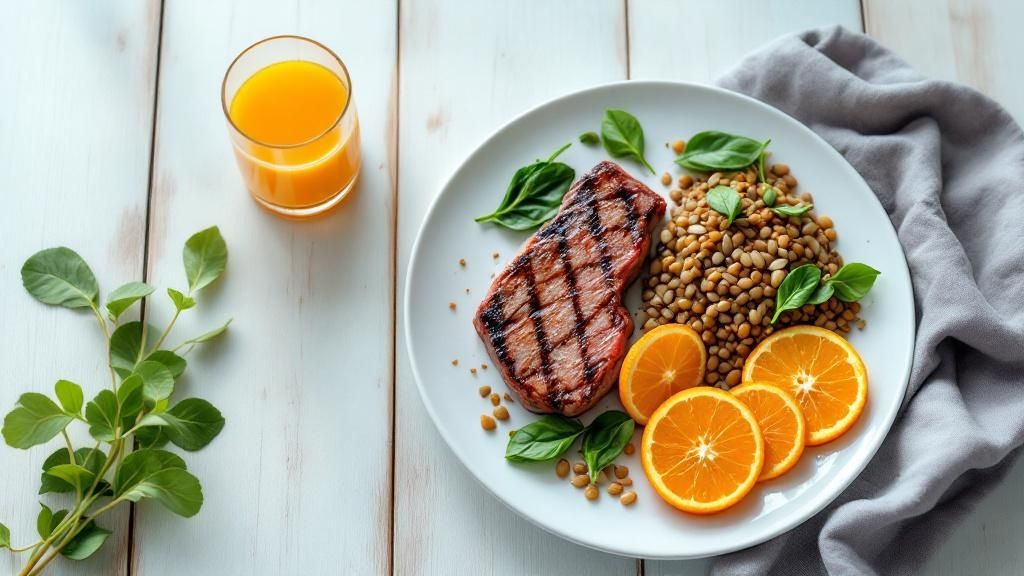
Iron-rich foods for iron deficiency: what really matters
The essentials at a glance
The foods richest in iron are liver, sesame, nuts, and dark bread. What matters, however, is not the content in the food, but how much reaches your body. The body makes better use of iron from animal sources than iron from plants, and vitamin C shifts this balance.
This article gives a source and year for each figure stated for a food. It distinguishes between two questions that are constantly mixed up online: how to meet your daily requirement, and how to treat an existing deficiency. The meal plan is not responsible for the latter.
You will first read what your body needs iron for in the first place. Then come the signs that belong in a doctor's office, the daily requirement in figures, the table showing iron content, three common misconceptions, and an example day. At the end, you will learn how to recognize that food alone is no longer enough.
What to expect in this article
1. What your body needs iron for
2. When your symptoms no longer belong in the kitchen
3. How much iron you need each day
4. Why iron is not all the same
5. Which foods provide how much iron
6. What promotes absorption and what hinders it
7. What a day with enough iron actually looks like
8. How to tell when diet alone is not enough
9. How to find out where your iron levels stand
10. Who should consider testing—and who should not
11. Limitations: what a blood test cannot do
12. What you can change starting tomorrow
Frequently asked questions
Sources
What your body needs iron for
Iron is a means of transport. It is found in red blood pigment and carries oxygen from the lungs to every single cell. If it is lacking, the supply chain becomes thinner, and you notice it first where a lot of oxygen is needed: in concentration and endurance.
According to the Institute for Quality and Efficiency in Health Care (2023), the body needs iron, among other things, to produce hemoglobin, as well as for energy production and cell division. So it is not a niche nutrient for competitive athletes, but a basic building block.
Key message
The iron content of a food tells you nothing about how much iron reaches the body. Between the plate and your blood levels lies absorption in the intestine, and this varies considerably depending on the source of the iron.
Why the body stores iron instead of using it up
Your body handles iron economically. Most of what is released when red blood cells are broken down is reused. Losses occur mainly through bleeding, shed intestinal lining cells, and the skin.
That is why iron deficiency is rarely a one-day problem. It develops over a longer period when intake remains below losses. By the time someone notices it, they are seeing the result of many weeks, not the consequence of a single meal.
The storage marker is ferritin, and it appears earlier
Ferritin is the storage protein for iron, while transferrin is its transport protein in the blood. Together, they show how well the stores are filled (IQWiG, 2023). Depleted stores occur long before anemia, which is why hemoglobin alone cannot reflect an incipient deficiency.
That is why this article mentions ferritin more often than the red blood pigment. Anyone who wants to know early where they stand should look at their iron stores. How to interpret individual ferritin levels is explained in the article on ferritin levels.
Who is most often affected
Iron deficiency is more common in women before menopause, mainly due to menstrual bleeding (IQWiG, 2023). In this case, regular blood loss is part of the equation, without anything being pathological. For pregnant women, the reference value of 27 milligrams per day is far above what a normal diet provides (DGE, 2023), which is why care during pregnancy should be medically supervised.
The third group is related to dietary patterns. In ovo-lacto vegetarian and vegan diets, lower serum ferritin concentrations and a higher risk of iron deficiency, including iron-deficiency anemia, have been observed in some cases (DGE, 2025). “Observed” here means a finding across groups, not a statement about an individual.
When your symptoms no longer belong in the kitchen
This chapter deliberately comes before the foods. A text that places the criteria for stopping at the end fails to reach the very reader they are intended for.
Documented source
“Iron deficiency is the most common nutritional deficiency worldwide. In Europe, around 5 to 10% of people are affected.”
Institute for Quality and Efficiency in Health Care (IQWiG)
Iron deficiency and iron-deficiency anemia, as of 2023
Common does not mean harmless. The same source estimates that around two to five percent of people in Europe with iron-deficiency anemia are affected (IQWiG, 2023). This is the point at which changing your diet would be the wrong answer to the right question.
These signs should be evaluated by a doctor
Visible blood in the stool or black stool
a sign of a source of bleeding that needs to be found
Significantly heavier or prolonged menstrual bleeding
the most common cause of recurrent iron deficiency in women before menopause
Shortness of breath or a racing heart during light exertion
for example when climbing stairs, which was previously effortless
Exhaustion lasting for weeks without improvement
that persists even after sufficient sleep
Iron deficiency despite an iron-rich diet
then the cause is rarely the diet, but rather loss or absorption
This list does not replace an examination, and it is not a diagnostic checklist. A single point means little on its own. Fatigue has dozens of causes, and most have nothing to do with iron.
The picture becomes more significant when several points occur at the same time and persist for weeks. Many people researching this topic have already visited a medical practice. They are missing a data point, not a promise.
How much iron you need per day
The German Nutrition Society last derived its reference values for iron in 2023. They are higher than those given in many older guides, and they distinguish between sex and stage of life.
Reference values per day
11 mg
for men aged 19 and over, unchanged across all age groups
16 mg
for women before menopause; afterward, the value falls to 14 mg
27 mg
during pregnancy, when requirements are highest
Source: German Nutrition Society, reference values for iron, derivation status 2023
Why women before menopause need significantly more
The difference between 16 and 11 milligrams is not a rounding error, but reflects regular blood loss. After menopause, this loss stops, and the reference value falls to 14 milligrams per day (DGE, 2023).
Breastfeeding women need 16 milligrams. The value of 27 milligrams for pregnant women can hardly be reliably achieved through diet alone, which is why medical supervision, not a nutrition article, is decisive during pregnancy.
Why older guides give different figures
This is worth examining closely because two reputable sources give different figures. In its guide, IQWiG writes that women before menopause are advised to consume 15 milligrams of iron per day, that 10 milligrams is sufficient after menopause, and that the recommendation for men is generally 10 milligrams (IQWiG, 2023).
For the same groups, the DGE gives 16, 14, and 11 milligrams (DGE, 2023). For women before menopause and for men, the difference is one milligram. For women after menopause, it is four, which is considerably more than rounding.
This article uses the DGE values because it is the institution that derives reference values for nutrient intake in Germany. If you read 15 and 10 somewhere, you have not found an incorrect source, but a different derivation.
Why these figures are not the amount in the blood
A reference value describes what should be on the plate, not what reaches the bloodstream. It already includes a buffer for limited absorption in the intestine. So, someone who eats 16 milligrams does not absorb 16 milligrams.
That is precisely where this article’s practical leverage lies. The amount on the plate can easily be increased. Whether it gets absorbed is decided elsewhere.
Why iron is not simply iron
Iron occurs in two forms in foods. Heme iron is found in the muscle and blood pigments of animals; non-heme iron is found in plants and, to a lesser extent, in animal products.
The German Nutrition Society puts the difference succinctly: “Heme iron is more readily available to humans than non-heme iron.” (DGE, 2025). It further states, regarding the source: The body can utilize iron from foods of animal origin better than iron from plant-based foods (DGE, 2023).
Key message
Plant-based iron is not inferior iron. It is iron whose absorption can be influenced—through the combination of foods on the plate and through preparation.
What this means for a plant-based diet
The German Nutrition Society describes partially lower serum ferritin concentrations and a higher risk of iron deficiency, including iron-deficiency anemia, for ovo-lacto-vegetarian and vegan diets (DGE, 2025). This is an observation, not a warning against plant-based foods.
In practice, this leads to two conclusions. People who eat a plant-based diet pay attention to combining foods with vitamin C and are more likely than others to know their ferritin level. Both require effort, not abstinence.
Why phytate is not the enemy
Phytate from grains binds iron in the intestine and is therefore considered one of the inhibiting substances (IQWiG, 2023). However, these same whole-grain products are among the main sources of iron intake in Germany, alongside meat, meat products, vegetables, and legumes (DGE, 2023).
So, a food can provide a lot of iron and simultaneously inhibit its absorption. Whole grains nevertheless remain one of the main sources; otherwise, they would not be included in this DGE list.
Which foods provide how much iron
The following values come from the IQWiG food overview (2023). There, they are given as typical serving sizes; for this table, they have been mathematically converted to 100 grams so that the foods can be compared with one another. The serving size is stated in the note each time.
| Food | Iron per 100 g | Note |
|---|---|---|
| Cooked pork liver | 19.5 mg | The highest value in the overview. Liver is discouraged during pregnancy because of its high vitamin A content |
| Sesame | 10.0 mg | Whole grains often pass through the intestines unchewed. They are more readily absorbed when puréed or ground |
| Veal liver, cooked | 9.0 mg | Heme iron, readily absorbed. A usual 125 g serving provides 11.3 mg |
| Beef liver, cooked | 7.8 mg | Like all organ meats, it is a storage organ, hence the high content |
| Blood sausage | 7.7 mg | The usual serving is small, at 30 g, so it provides around 2.3 mg |
| Pistachios | 7.3 mg | Non-heme iron. A 60 g serving provides 4.4 mg |
| Cashews | 6.3 mg | Good as a snack between meals, without foods that inhibit absorption |
| Chanterelle mushrooms, steamed | 5.8 mg | Seasonal, but with a large serving: 200 g provides 11.6 mg |
| Oatmeal | 4.5 mg | Contains phytate, which slows absorption. Adding fruit with vitamin C partly offsets this |
| Soy bread | 4.4 mg | The highest bread value in the overview. A 45 g slice provides 2 mg |
| Spelt bread | 4.2 mg | A 50 g slice provides 2.1 mg, as much as a serving of lamb’s lettuce |
| Blue mussels, cooked | 3.8 mg | The highest-iron item among fish and seafood |
| Duck, cooked | 3.7 mg | The overview lists duck separately from poultry, which is far lower at around 0.9 mg |
| Beef, cooked | 3.3 mg | A 150 g serving provides 4.9 mg, around one-third of women’s daily requirement |
| Spinach, steamed | 3.1 mg | Contains oxalic acid, which binds some of the iron in the intestines |
| Tofu | 2.8 mg | One of the few figures given directly per 100 g |
| Chickpeas, canned | 2.2 mg | Drained and rinsed; 150 g provides 3.3 mg |
| Lamb’s lettuce | 2.0 mg | The most iron-rich leafy green in the overview, raw and without an oxalic acid issue |
Two things stand out in this order. First, nuts, seeds, and dark bread rank highly even though they are considered plant-based sources: at 10 milligrams, sesame even comes ahead of veal and beef liver. Second, only pork liver, at 19.5 milligrams, stands clearly above the rest.
For everyday purposes, the serving size still matters. Blood sausage contains more iron per 100 grams than beef, but it is eaten in 30-gram slices. A serving of beef is 150 grams and therefore provides more in total.
The values most people do not expect
Two groups of foods perform less well than their reputation might suggest. The first is fish. Salmon comes to around 0.3 milligrams per 100 grams, smoked eel to 0.7, and cooked tuna to 1.0 milligrams (IQWiG, 2023). Only blue mussels, at 3.8 milligrams, and shrimp, at 1.8 milligrams, rank near the top.
The second group is poultry. The overview lists it at the equivalent of around 0.9 milligrams per 100 grams, placing it below lamb’s lettuce. Duck is listed separately at 3.7 milligrams. The gap between two items in the same food group is therefore greater than the gap between poultry and leafy greens.
How processing shifts the value
The clearest difference in the overview is seen with rice. White, polished rice contains around 0.3 milligrams per 100 grams when cooked, while unpolished brown rice contains around 1.2 milligrams (IQWiG, 2023). That is four times as much with an identical portion. Bread shows the same pattern: whole wheat bread contains around 1.3 milligrams, while spelt bread contains 4.2.
So if you want to change just one thing, change the type, not the amount. This is the cheapest adjustment in the entire article.
What promotes absorption and what inhibits it
This is the part most lists leave out. Two meals with identical iron content can result in very different amounts being absorbed by the body, depending on what else is on the plate.
Vitamin C promotes absorption. IQWiG names oranges and orange juice, broccoli, and red bell pepper as good sources (2023). The DGE confirms that ascorbic acid can promote the absorption of non-heme iron (2025).
Several groups of substances inhibit absorption. These include tannins from red wine and black and green tea, oxalic acid from spinach, beetroot, rhubarb, and cocoa, phytate from grains, and phosphate (IQWiG, 2023). The same source also lists dairy products, soy products, and coffee as substances that hinder iron absorption.
Three persistent claims
Common belief
“Spinach is the best source of iron.”
Established
Cooked spinach contains around 3.1 mg per 100 g when converted to this basis, putting it behind liver, sesame, nuts, and several types of bread. In addition, the oxalic acid it contains binds some of the iron in the intestine (IQWiG, 2023).
Common belief
“With the right diet, you can get rid of iron deficiency.”
Established
A mild deficiency in stage 1 is generally not treated with medication. In cases of more severe deficiency in stage 2 or anemia in stage 3, iron supplements may be considered (IQWiG, 2023). The meal plan meets the requirement; it does not replenish depleted stores.
Common belief
“You have to cut out coffee and tea completely if you have iron deficiency.”
Established
It has been established that tannins from black and green tea, as well as coffee, inhibit iron absorption (IQWiG, 2023). The sources reviewed here do not indicate by how much, or whether spacing them out in time offsets this effect. Anyone who reads a figure on this should check where it comes from.
What this means in practice
The evidence-based action is the combination, not abstinence. A glass of orange juice with muesli, red bell pepper with hummus, lemon over lentil salad. Anything beyond that belongs in the category of plausible but unproven.
What a day with enough iron actually looks like
Three examples calculated using the portion sizes from IQWiG (2023). They are not meal plans, but show what a realistic day’s intake might look like.
Mixed diet, around 13 milligrams
For breakfast, 60 grams of oat flakes with 2.7 milligrams, plus one kiwi with 1 milligram. At lunch, 150 grams of beef with 4.9 milligrams. In the evening, two slices of spelt bread totaling 4.2 milligrams. That makes 12.8 milligrams and meets the reference value for men, but not the value for premenopausal women.
Vegetarian, around 12 milligrams
In the morning, 50 grams of muesli with 1.7 milligrams and one chicken egg with 1 milligram. At lunch, 150 grams of chickpeas with 3.3 milligrams and 100 grams of lamb's lettuce with 2 milligrams. In the evening, a slice of soy bread with 2 milligrams and 20 grams of sesame seeds with 2 milligrams. Total: 12 milligrams.
Vegan, around 13 milligrams
Oat flakes with 2.7 milligrams, 100 grams of tofu with 2.8 milligrams, 150 grams of white beans with 3.3 milligrams, and 60 grams of pistachios with 4.4 milligrams. That makes 13.2 milligrams on the plate. How much is absorbed here depends more strongly on the accompanying vitamin C than on the other two days.
A note about the vegetarian and vegan days: IQWiG (2023) lists soy products among the substances that hinder iron absorption. Soy bread and tofu therefore provide iron while simultaneously slowing its absorption. Knowing both facts at once is more honest than leaving one of them out.
Chapter at a glance
All three daily examples provide between 12 and just over 13 milligrams of iron on the plate. For men, that is above the reference value of 11 milligrams; for premenopausal women, it is below the reference value of 16 milligrams. The value for pregnant women, 27 milligrams, is reached by none of the three days. Anyone who needs that amount cannot get there through the meal plan alone.
How to tell that diet alone is not enough
This is the section that nutrition guides often leave out because it works against their own headline. It belongs here nonetheless.
The key sentence here is: The meal plan meets the need; it does not replenish empty stores. These are two different tasks, and only the first appears on a shopping list.
Four signs suggest that the cause is not on your plate. First: You have been deliberately eating iron-rich foods for months and feel no different. Second: Your menstrual bleeding has become significantly heavier. Third: You have a known intestinal disease or have undergone stomach surgery. Fourth: The deficiency returns after every replenishment.
In all four cases, the next sensible step is a measurement and a conversation, not another dietary change. If you do not know the loss, you cannot compensate for it.
Intake and loss are two separate calculations
Iron balance works like an account with two sides. One side shows what comes in through food; the other shows what leaves through bleeding and shed cells. A deficiency develops when the second side is permanently larger.
A nutrition article addresses only the first side. That is enough as long as the second is unremarkable. Anyone who recognizes several of the warning signs from Chapter 2 in themselves therefore does not need a better shopping list, but an appointment.
Why larger portions do not solve the equation
The reference values describe what should be on your plate. How much of it reaches the body depends on the form of iron and the accompanying substances in the meal (IQWiG, 2023; DGE, 2025). The amount is therefore only half of the equation.
In terms of expectations, this means that changing your habits today will not give you a different result tomorrow. When a repeat measurement makes sense and what should have changed in the meantime belong in a discussion with a doctor. The sources reviewed here do not provide a reliable timeframe for this, and this article does not invent one.
How to find out where your iron levels stand
Up to this point, we have been discussing amounts you can apply without a number. A measurement does not change that, but it puts things into context. The following four steps prepare you for a conversation at a medical practice; they do not replace it.
Keep a record for two weeks
What was on your plate and how you felt. No judgment, just the note.
Note sources of loss
Menstrual bleeding intensity, known intestinal diseases, blood donations. That is half the answer.
Read the values together
Ferritin and transferrin together show how well the iron stores are filled (IQWiG, 2023).
Discuss the results with your doctor
Bring your records and results with you. This significantly shortens the medical history-taking process.
Reference ranges depend on the laboratory, method, and age. The information on your own report is always authoritative, not the figures from an article.
A capillary blood test by mybody®x (MYBODY Lab GmbH) measures all three of these iron values together. You collect the sample at home with a finger prick, and it is analyzed in a laboratory.
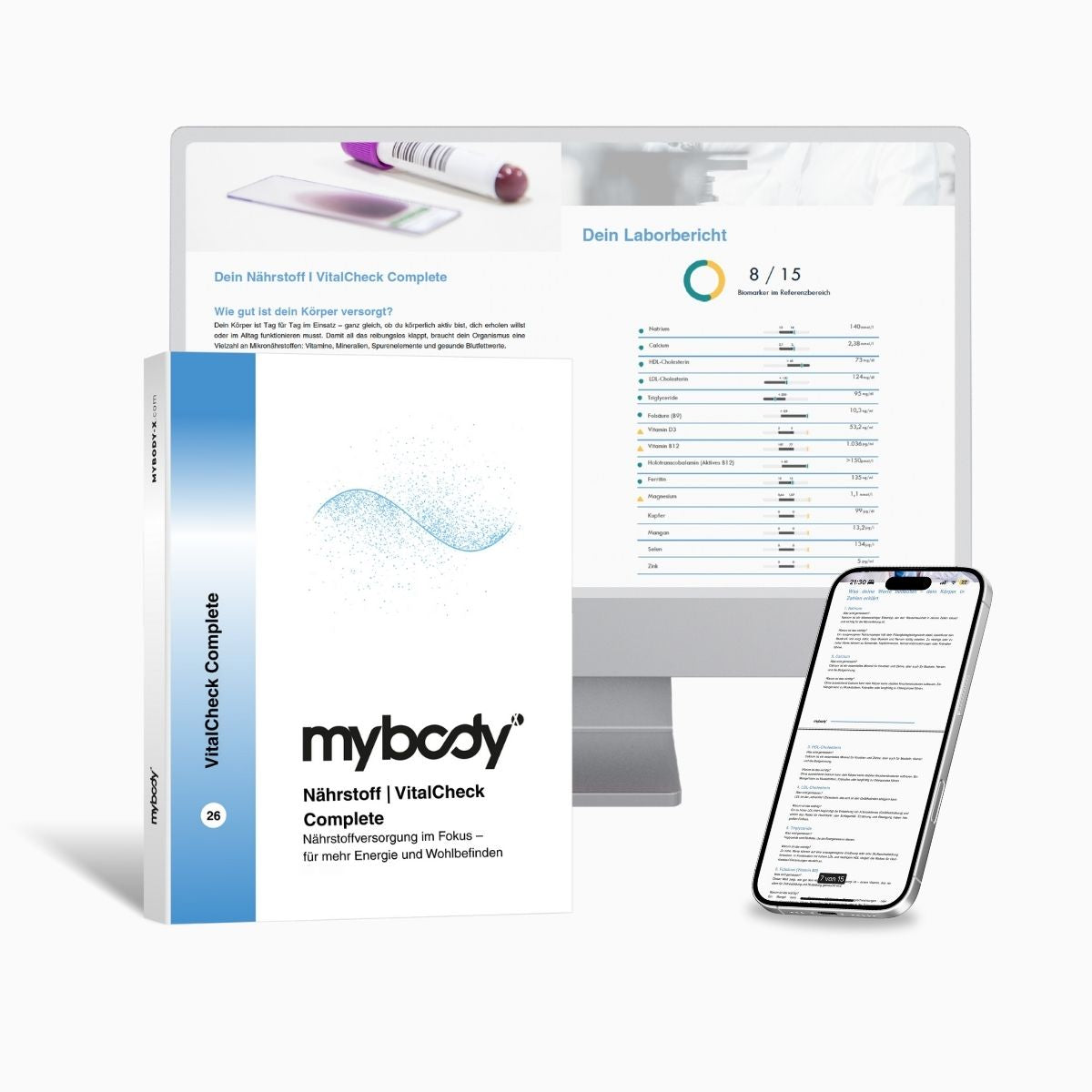
Capillary blood test
VitalCheck | Nutrient & Mineral Test Complete
Measures ferritin, iron, and transferrin together, as well as vitamin D3, B12, folic acid, magnesium, selenium, and zinc. According to the product page, all three iron values are needed to provide a complete picture, because ferritin alone can be misleading in the presence of inflammation. The test provides a snapshot, not a diagnosis, and it does not identify the cause of a loss.
Laboratory analysis 3–5 working days after receipt of the sample
Product page information, accessed on 28 August 2026
Anyone who simply wants to know whether there is anything to it will find an explanation of the symptoms and testing methods in the article on the iron deficiency self-test. This article focuses exclusively on foods.
Who would benefit from a measurement—and who would not
A test answers a specific question. If that question is not relevant, it provides a number without any context.
Useful for you if …
you want to change your diet and need a baseline to use as a reference for a later measurement.
you follow a vegetarian or vegan diet and want to know where your ferritin level actually stands.
you have been exhausted for weeks, only a complete blood count was checked at the doctor’s office, and iron levels were not included.
Probably not if …
you notice visible blood in your stool or become short of breath with light exertion. In that case, medical evaluation is the first step, not the second.
you are pregnant. Iron status is medically monitored during pregnancy anyway, and requirements are significantly higher than what a meal plan can provide.
you are already taking iron supplements. A level measured while you are taking them says little about your status without them.
Limitations: what a blood test cannot do
An iron level is a data point, not an answer. It tells you how much is currently present and says nothing about why it is missing.
The most common cause of recurring iron deficiency is blood loss, not insufficient intake. A home blood test will not detect a source of bleeding in the digestive tract, nor will it assess heavy menstrual bleeding.
There is also a peculiarity of ferritin levels. They rise during inflammation and can therefore make iron status appear better than it actually is. That is precisely why the VitalCheck Complete product page states that ferritin, iron, and transferrin together provide a complete picture.
One limitation concerns the article itself. The values in the table are averages from a food database. The content of a specific piece of meat therefore varies around that figure, without any corresponding information appearing on the packaging.
What you can change starting tomorrow
If you take away just one action from this article, let it be this: Add something containing vitamin C to every plant-based meal rich in iron. Bell peppers with hummus, orange juice with cereal, lemon over lentils.
The reason is unremarkable. Of all the levers in this text, this is the only one described as beneficial by two independent institutions and one that costs you nothing. Everything else works indirectly, and the reviewed sources do not quantify the extent of those effects.
The starting question was which foods help with iron deficiency. The most honest answer is: They meet your needs, and that is significant. They do not treat an existing deficiency, and that is a task for someone who has a diagnosis in front of them.
Frequently asked questions
Which foods contain the most iron?
Pork liver ranks highest at approximately 19.5 milligrams per 100 grams, followed by sesame at 10 milligrams and veal and beef liver at 9 and 7.8 milligrams, respectively. Among plant-based sources, pistachios follow at 7.3 milligrams and cashews at 6.3 milligrams. The figures were converted to a 100-gram basis from the IQWiG’s serving-size data (2023). In everyday life, however, the serving size matters: blood sausage contains more iron per 100 grams than beef, but it is eaten in 30-gram slices.
How much iron do I need per day?
The German Nutrition Society recommends 11 milligrams per day for men aged 19 and over and 16 milligrams for women before menopause. After menopause, the amount drops to 14 milligrams. The recommendation is 27 milligrams for pregnant women and 16 milligrams for breastfeeding women. These reference values were established in 2023 and are higher than the figures in many older guides.
Can I correct iron deficiency through diet alone?
No, that is not the meal plan’s purpose. It meets ongoing needs. According to the IQWiG (2023), mild iron deficiency in stage 1 is generally not treated with medication, while iron supplements may be considered for more severe deficiency in stage 2 or anemia in stage 3. However, the fact that stage 1 does not require medication does not mean that food will correct it. According to the same source, doctors determine the stage through a blood test.
What really inhibits iron absorption?
The IQWiG lists tannins from red wine as well as black and green tea, oxalic acid from spinach, beetroot, rhubarb, and cocoa, phytate from grains, and phosphate (2023). Dairy products, soy products, and coffee are also included. The reviewed sources do not state by how much these substances reduce absorption. Anyone who reads a specific percentage should check what it is based on.
Why isn’t the ferritin level alone sufficient?
Ferritin is the storage protein and, together with transferrin, indicates how well the iron stores are filled (IQWiG, 2023). However, ferritin rises during inflammation and may then indicate better iron status than is actually present. That is why it is interpreted together with the iron level and transferrin level. A single value without this context can easily be misinterpreted.
Next step
A baseline instead of a guess
If you want to know where your ferritin, iron, and transferrin levels stand, VitalCheck Complete provides a starting point for personal monitoring. It does not replace medical evaluation and cannot identify a source of bleeding.
View VitalCheck Complete Understanding ferritin levelsRead more
You might also be interested in this
What the storage marker indicates, why it can be misleading during inflammation, and how it relates to the other iron values.
How to interpret symptoms and testing methods if you first want to know whether anything is actually wrong.
Sources
- Institute for Quality and Efficiency in Health Care (IQWiG): Iron deficiency and iron-deficiency anemia (as of 2023) – gesundheitsinformation.de
- Institute for Quality and Efficiency in Health Care (IQWiG): How can I meet my iron requirements? (as of 2023) – gesundheitsinformation.de
- German Nutrition Society (DGE): Reference values for iron intake (basis of derivation: 2023) – dge.de
- German Nutrition Society (DGE): Frequently asked questions about iron (as of 2025) – dge.de
The verbatim quotation on the prevalence of iron deficiency comes from source [1], as do the information on the three stages, ferritin and transferrin, and the functions of iron in the body. All food values and information on substances that promote or inhibit absorption come from [2] and have been mathematically converted from the serving size to 100 grams for the table. The daily reference values come from [3], while the verbatim quotation on the better availability of heme iron and the observation regarding vegetarian and vegan diets come from [4]. Information on the price, measured values, sample type, and laboratory comes from the mybody®x product page, accessed on August 28, 2026; processing times follow the central requirements for blood tests. All sources were accessed and reviewed on August 28, 2026.

mybody®x Editorial & Expert Team
Laboratory diagnostics Nutritional science Blood analysis interpretation Nutrigenetics
This article was created by the mybody®x editorial and expert team. The team combines laboratory diagnostics, nutritional science, and the interpretation of blood analyses. The people involved are listed on the author page.
Published on August 31, 2025 · Last updated on August 28, 2026
The content is for general information and does not replace medical advice, diagnosis, or treatment. Reference ranges depend on the laboratory, method, and age—the information on your report is always authoritative.



Share now:
What is histamine, and what’s behind it?
Micronutrient analysis: What your body really needs