
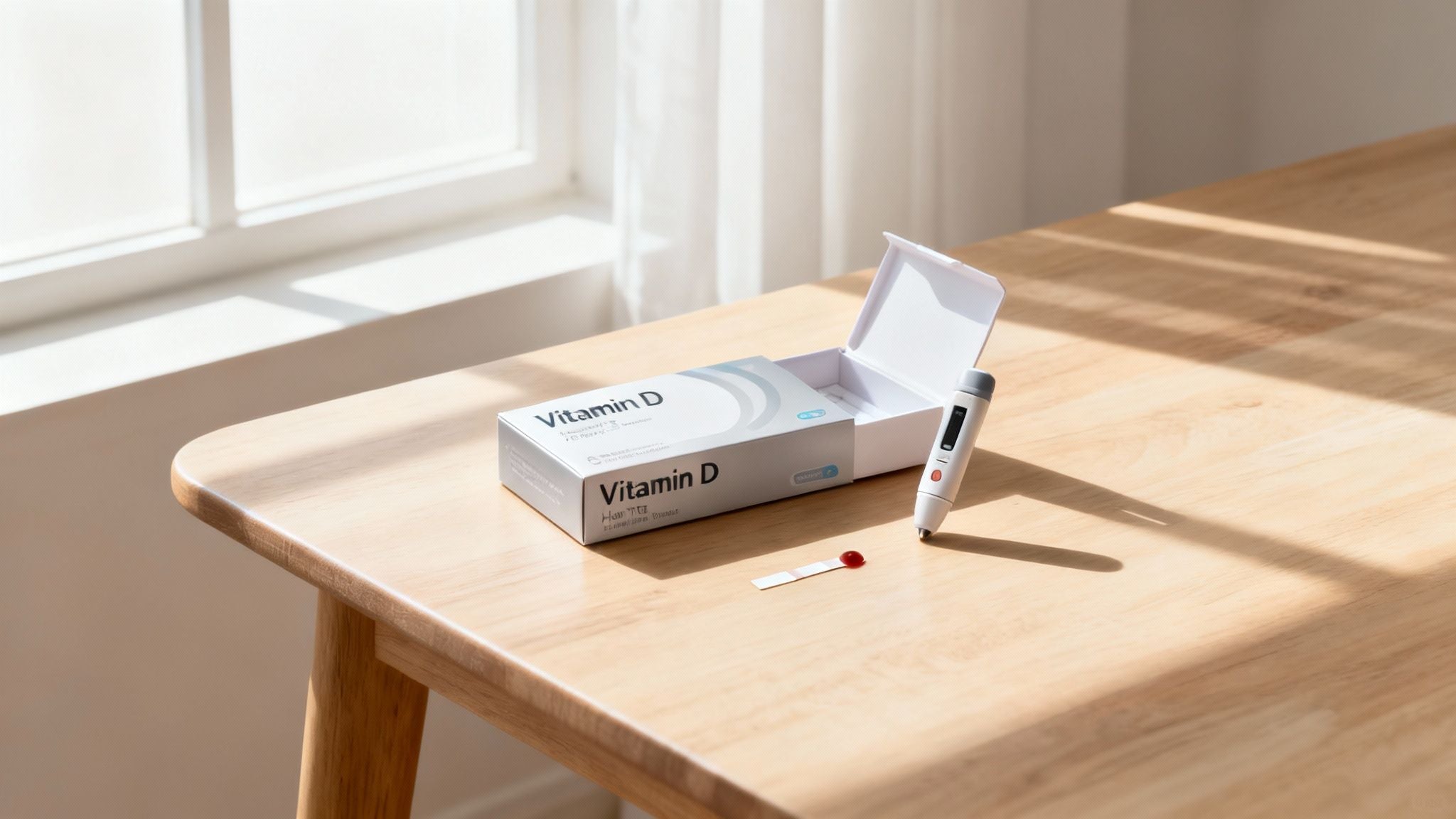
Vitamin D test for home use explained
Do you often feel tired, lethargic, or catch every bug going around during the darker months? A deficiency in the "sunshine vitamin" could be the culprit. A home vitamin D test can quickly and easily provide clarity. With the test from mybody-x.com, you can take matters into your own hands – without any waiting time at the doctor's office.
Why your vitamin D levels are so crucial

Vitamin D is much more than just a vitamin. Think of it more like a hormone that quietly regulates countless processes in your body. Imagine it as a conductor ensuring your entire "body orchestra" plays in time. Without the conductor, everything quickly falls out of rhythm.
Vitamin D deficiency is a real issue, especially here in Germany. Studies repeatedly show that a large portion of the population, particularly in winter, is not optimally supplied. The reason is simple: our bodies primarily produce vitamin D through direct sunlight on the skin. However, between October and April, the sun simply isn't strong enough in our region to adequately replenish our stores.
Symptoms that may indicate a deficiency
A deficiency often develops gradually, and the signs aren't always clear. However, if some of the following points sound familiar, getting tested might be a good idea:
- Constant fatigue: You often feel tired and lack energy, even though you actually get enough sleep.
- Weak immune system: You get sick more often than usual and feel like you catch every cold.
- Low mood: Especially during the winter months, you feel listless or prone to the classic "winter blues".
- Muscle and bone pain: Vitamin D is essential for the absorption of calcium and therefore for stable bones and healthy muscle function.
An undetected vitamin D deficiency can severely impact your well-being. A simple blood test gives you the peace of mind you need to take targeted action and regain your energy.
Take control of your health
A home vitamin D test from mybody-x.com is the easiest first step to gaining clarity. Instead of waiting weeks for a doctor's appointment, you can conveniently check your levels from home. The result provides the foundation for actively taking steps to improve your health and address any potential deficiency. It's about understanding your body better and taking responsibility for your well-being.
Would you like to learn more about how to identify other nutrient deficiencies? In our guide to nutrient deficiency testing, we've compiled further valuable information for you.
Here's how the home test works, step by step.
Are you wondering how you can conveniently measure your vitamin D levels from the comfort of your couch? It's actually much simpler than most people think. The entire process with the mybody-x at-home vitamin D test is designed to offer you maximum safety and ease of use – from ordering to receiving your results.
Think of it as a simple instruction manual that guides you safely through each step. Everything you need comes directly to your home in a small test kit. So you don't have to make appointments or sit in a waiting room.
Your path to success in 3 steps
The process is crystal clear and can be divided into three simple phases. This way you always maintain an overview and know exactly what to do next.
-
Taking a sample: The heart of the test. But don't worry, it sounds worse than it is. Using a tiny lancet provided, you briefly prick your fingertip. The whole process is quick, almost painless, and only requires a few drops of blood, which you collect in the supplied tube.
-
Sending your sample: Once you have taken your sample, pack it securely in the enclosed, prepaid return envelope. Simply drop it in the nearest mailbox – that's all there is to it. Your sample will now be on its way to our certified German partner laboratory.
-
Analysis and report: In the lab, specialists will examine your blood and analyze the level of 25-hydroxyvitamin D. This is the most important and informative indicator for precisely determining your vitamin D status. As soon as the analysis is complete, you will find your personal results report directly in your mybody-x account.
The entire process is optimized to provide you with an absolutely reliable and scientifically sound analysis. You take control; we handle the precise evaluation in the background.
Why laboratory analysis is so crucial
The market for vitamin D self-tests has developed rapidly in recent years. Most reputable providers, like us at mybody-x, rely on the analysis of capillary blood from the fingertip in a specialized laboratory. However, caution is advised: the quality of the tests and the reliability of the results can vary significantly depending on the provider, as comparative tests conducted by consumer protection agencies have shown.
That's precisely why we at mybody-x place the highest value on collaborating with ISO-certified laboratories . This ensures that your result is not just a rough estimate, but an accurate medical measurement you can rely on.
For an accurate result, proper procedure is of course essential. If you are unsure, we have compiled detailed instructions for the capillary blood test that guide you step by step. This way, you can be sure that everything goes smoothly during sample collection and that you receive an accurate picture of your vitamin D status.
How to correctly interpret your vitamin D level
You're holding the results report from your mybody-x test in your hands – an important step has been completed. But what exactly does the number on it mean for your health and your everyday life? Don't worry, we'll explain it for you and help you not only read your results, but truly understand them.
Your vitamin D level is measured in nanograms per milliliter (ng/ml) . This unit is key to assessing your supply. Think of it like a traffic light for your well-being: green means optimal, yellow is a warning signal, and red indicates a clear need for action.
The process is quite simple, from taking a sample at home to receiving the final result. The following infographic illustrates the individual steps on the way to your personal test score.

Each of these steps builds upon the previous one and ensures that you get a reliable result that shows you exactly where you stand.
Understanding the reference values
To properly assess your level, there are generally accepted reference ranges. They act like a compass, showing you whether you are well-nourished or if there is a deficiency.
-
Severe deficiency (< 10 ng/ml): A value in this range is a clear warning sign. Here, the risk of health consequences such as bone problems (osteomalacia) or a severely weakened immune system is increased.
-
Deficiency (10-20 ng/ml): This also indicates an insufficient supply. Symptoms such as constant fatigue, muscle weakness, and a high susceptibility to infections are unfortunately very common in this range.
-
Deficiency (21-29 ng/ml): While you're not in the critically low range, you're far from optimal. You could describe it as a "gray zone" where your body can't reach its full potential.
-
Adequate supply (30-100 ng/ml): This is the target range! A value here indicates that your body has enough vitamin D available for all important functions – from a strong immune system to stable bones.
The following table gives you a quick overview so you can assess your value at a glance.
Overview of vitamin D levels
This table will help you to classify your measured vitamin D level (in ng/ml) and understand its importance for your health.
| Value (ng/ml) | classification | Possible effects |
|---|---|---|
| < 10 | Severe shortage | Increased risk of bone diseases, weakened immune system |
| 10-20 | Shortage | Fatigue, muscle weakness, increased susceptibility to infection |
| 21-29 | Undersupply | The body cannot function optimally, well-being is impaired. |
| 30-100 | Sufficient | Optimal support for bones, muscles and immune system |
This way you can immediately see whether you are in the green zone or whether it is time to take action.
What your value means in everyday life
A purely numerical value is abstract. Let's illustrate this with some concrete examples. Someone with a value of 15 ng/ml might constantly feel tired, struggle with colds all winter, and have a low mood. In contrast, a person with a value of 45 ng/ml often reports much more energy in their daily life, a more stable mood, and the feeling of being better able to ward off infections.
Your result is more than just a number – it's a direct insight into how well your body functions. It shows you whether your "body orchestra" has an important conductor, or whether one is missing and you should take action.
Your test result is therefore the perfect starting point. It gives you the information you need to take targeted action. If you'd like to know what other signs might indicate a deficiency, you'll find further valuable tips on how to recognize a vitamin D deficiency in our article. This way, you'll be well-informed to plan the next steps for your health.
What to do if you have a vitamin D deficiency? Your practical action plan.
You've received your results from your at-home vitamin D test and the level is low? First of all: don't panic. See it as your personal opportunity to take action and give your body exactly what it needs. Now that you have clarity, you can take targeted and, above all, practical steps to improve your daily routine.

Finding the perfect mirror isn't rocket science. It rests on three proven pillars that work together seamlessly.
Pillar 1: Harnessing the power of the sun
Your body is essentially a small solar power plant. By far the most effective way to boost vitamin D production is direct sunlight on your skin. But how much is enough without risking sunburn?
A good rule of thumb for the months from April to September is: Treat yourself to about 15 to 25 minutes in the midday sun three times a week – with your face, hands, and arms uncovered and without sunscreen. The exact duration naturally depends on your skin type. Lighter skin tones absorb more quickly than darker ones.
Pillar 2: Targeted support through nutrition
Even though food only contributes a small portion to vitamin D intake, it is a valuable addition to the diet. However, in most cases, it is not enough to compensate for an existing deficiency.
These foods are little vitamin D boosters:
- Fatty fish: Herring, salmon and mackerel are the absolute top choices here.
- Cod liver oil: A true classic, but unbeatable in its effectiveness.
- Certain mushrooms: Especially button mushrooms or chanterelles that have been exposed to UV light can help.
- Egg yolk: Chicken eggs also provide a small but valuable dose of the sunshine vitamin.
Pillar 3: Dietary supplements – but done right!
Let's be honest: especially during the dark months, taking dietary supplements is the most reliable way for many to compensate for a deficiency and replenish their stores.
Over half of those aged 16 and over in Germany already use supplements. Many rely on self-tests to determine their needs. But this is precisely where the problem often lies: interpreting the results correctly and finding the right dose is crucial. A study on rapid vitamin D tests has shown that incorrect dosing can easily occur.
And that's precisely why a lab-based test like the one from mybody-x is so incredibly important. It gives you a reliable foundation on which to build.
Don't forget important co-factors: Vitamin D isn't a lone wolf. For optimal absorption and utilization in the body, it needs good partners. These include, above all, vitamin K2 (which helps transport calcium to where it needs to go) and magnesium (which properly activates vitamin D).
Nevertheless, caution is advised when dosing supplements. Too much of a good thing can be harmful. Always refer to your test results and seek medical or pharmaceutical advice if in doubt.
Your test result is the starting point for making an informed decision. Want to delve deeper into the topic? Our in-depth article explains everything you need to know about vitamin D deficiency and how to effectively manage it. This way, you can optimize your intake and soon feel fitter and more energetic.
Avoid typical mistakes during implementation
For your at-home vitamin D test results to be truly meaningful, proper execution is crucial. Think of it like baking: if you follow the recipe exactly, the cake will be perfect. If you improvise, the result can quickly become inaccurate. Here, we'll show you the most common pitfalls and how to skillfully avoid them.
A small prick, a few drops of blood – it sounds simple, and it is. However, there are a few details that can ultimately make the difference between a reliable and an unusable result. Your goal is to provide the lab with a perfect sample so that the analysis runs smoothly.
Source of error 1: The blood draw
The most common mistake happens right at the beginning. Insufficient blood volume is the main reason why a sample sometimes cannot be analyzed in the laboratory.
- Too little blood: The tube has a mark, and there's a reason for that. It really must be filled to that point, otherwise the amount simply isn't sufficient for the analysis.
- The wrong technique: Please don't squeeze your finger to try to get more blood out. This not only contaminates the sample but can also damage the blood cells. Much better: Rotate your arm a few times beforehand or briefly hold your hands under warm water. This stimulates blood circulation, and the blood will flow almost on its own.
Remember: The quality of your sample determines the quality of your result. Take a moment, read the mybody-x instructions carefully, and perform the sample collection calmly.
Source of error 2: Handling the sample
Great, the blood draw is complete! Now it's important that the sample arrives at the lab undamaged. Mistakes in storage or shipping can just as easily distort the result.
- Improper storage: Don't leave the sample lying around at home for days. Ideally, prepare it for shipping immediately after taking it and take it to the post office promptly. Extreme heat or cold are strictly prohibited.
- Preparing for shipping: Check that the sample tube is securely closed and safely seated in the shipping container. This will ensure it arrives at the laboratory without any problems.
Source of error 3: External influences
There are also a few external factors that can affect your vitamin D levels. You should keep these in mind before the test.
Medications and supplements: Some medications can disrupt vitamin D metabolism. If you are already taking high-dose vitamin D supplements, the result will naturally reflect your current, elevated level due to the supplementation – and not your natural vitamin D status. For an accurate snapshot, it is therefore advisable to pause supplementation for a while after consulting your doctor.
By avoiding these common mistakes, you create the best foundation for a precise analysis. This way, your test result becomes a reliable guide for your next steps in your health.
Frequently asked questions about the vitamin D test
You've already learned a lot about the at-home vitamin D test , but perhaps a few questions remain. Many people feel the same way. To help you feel completely confident in your decision, we've answered the most frequently asked questions for you here – concisely, clearly, and to the point.
How often should I have my vitamin D levels tested?
That's a great question, because there's no one-size-fits-all solution. But there are a few clear guidelines that can help you find the right rhythm for you.
-
If you're addressing a deficiency: Have you diagnosed a deficiency and are already taking vitamin D supplements? Then it's wise to have your levels checked again after about three to four months . This way, you'll see in black and white whether your strategy is working and the dosage is correct.
-
As a purely preventative check: You feel fit and simply want to make sure everything is okay? Then testing once a year is perfectly sufficient. The best time for this is towards the end of winter, so in March or April. At that time, most people's energy stores are at their lowest, and you'll get an honest picture of your glycogen levels.
Is the home test just as reliable as one done at the doctor's office?
Yes, absolutely – as long as you use a quality provider like mybody-x. The crucial point is not where you take the sample, but where it ends up.
At mybody-x, we send your sample exclusively to ISO-certified specialist laboratories in Germany . These are exactly the same laboratories that doctors' offices work with. The only difference for you: you save yourself the trip to the doctor's office and the wait for an appointment. Your sample will be analyzed according to the same strict scientific criteria and with the same accuracy.
A home test is therefore not a compromise on quality. On the contrary: you gain convenience and retain control. The result is medically absolutely reliable.
What happens if I don't take enough blood for the sample?
This is one of the most common concerns, but we can put your mind at ease: Should the blood sample not be sufficient for analysis, we certainly won't leave you in the lurch. In such a case, our team will contact you directly, and we will send you a brand-new test kit free of charge .
A little tip to make it work the first time: Wash your hands with warm water beforehand and rotate your arm a few times. This stimulates blood circulation and makes taking the sample a breeze.
Do I need a doctor's prescription to order this?
No, you don't need a doctor's prescription for the mybody-x Vitamin D test for home use. You can order it easily and directly from us whenever you want. That's part of our philosophy: We believe everyone should have the easiest possible access to important information about their body. You take control of your well-being, and we give you the right tool to do so – completely without bureaucratic hurdles.
Ready to finally get clarity about your vitamin D levels and take control of your health? With the scientifically sound blood tests from mybody-x, you receive precise results from a specialized German laboratory and concrete recommendations for action that will truly help you.



Share:
Nutrient deficiency and hair loss: How to identify the true cause
Omega-3 deficiency symptoms: Identify, test and correct