

Omega-3 deficiency symptoms: which signs really point to it
The essentials in brief
Omega-3 deficiency is not a finding that a laboratory can confirm or rule out. There is a measurement of intake status, the omega-3 index, but no generally recognized threshold below which a deficiency state with clinical significance begins. The commonly cited list of symptoms—dry skin, fatigue, concentration problems, and brittle nails—also fits a dozen other causes.
This article distinguishes three things that are often confused online: what institutions actually say about EPA and DHA intake, what the omega-3 index measures, and which statements about these fatty acids are legally permitted at all. Every figure here is accompanied by the institution and year. Where no figure is available, that is stated as well.
You will first read what the term refers to, followed by the symptom list and the other causes that can produce the same signs. Next come the omega-3 index, its origins and its limitation, two common misconceptions, the groups with low intake, and the approved wording regarding EPA and DHA. The final section addresses which values you can have determined at home, which you cannot, and where the limitations lie.
What to expect in this article
1. What the term omega-3 deficiency does and does not refer to
2. The symptom list from the internet and what remains of it
3. Why the same signs can have many causes
4. What the omega-3 index measures and where its limitation lies
5. Two assumptions that persist
6. Who actually consumes little EPA and DHA
7. What may be said about EPA and DHA
8. How status can be determined at all
9. Which values you can determine at home—and which you cannot
10. Who would benefit from a blood test now
11. What intake actually changes in everyday life
12. Limitations: what none of these values can answer
13. What matters in the end
Frequently asked questions
Sources
What the term omega-3 deficiency does and does not refer to
For iron, vitamin D, or vitamin B12, there is a clear sequence: a laboratory value exists, a reference range exists, and below that range a deficiency begins that has a name and a treatment. With omega-3, the third link in this chain is missing.
Adequate intake can certainly be measured. The best-known measure for this is the omega-3 index, which indicates the proportion of the two long-chain fatty acids eicosapentaenoic acid (EPA) and docosahexaenoic acid (DHA) among the fatty acids in red blood cells. What is missing is a threshold recognized by professional organizations at which a low value becomes a disease.
The U.S. National Institutes of Health Office of Dietary Supplements makes this point clearly: No concentrations of EPA or DHA are known below which measurable bodily functions would be impaired (NIH ODS, as of 2026). It explicitly specifies no reference ranges for blood status.
Key statement
The omega-3 index describes nutritional status, not a disease state. There is a measurement, but no threshold recognized by professional societies at which a clinically significant deficiency begins.
The one deficiency state that really exists
A genuine deficiency of essential fatty acids exists as a medical condition. It manifests as rough, scaly skin and skin inflammation, and affects both the omega-3 and omega-6 families. However, it is practically nonexistent in healthy people: the NIH ODS describes it as virtually nonexistent in healthy people in the United States (NIH ODS, as of 2026).
What is described online as omega-3 deficiency therefore almost never refers to this condition. It usually means an intake below a reference value or an index below a proposed target level. That is something different, and the distinction determines whether a symptom can explain anything at all.
What this article is—and is not—about
This article addresses the question of symptoms: which complaints are attributed to the subject and which of them withstand scrutiny. How testing works in practice is explained in the article on the Omega-3 Index test; what EPA and DHA actually do in the body is covered in the article on omega-3 fatty acids. These three texts share the subject and do not repeat one another.
The symptom list from the internet—and what remains of it
Anyone searching for omega-3 deficiency symptoms finds almost the same list everywhere: dry and scaly skin, brittle nails, dull hair, fatigue, concentration problems, mood swings, joint complaints, and increased susceptibility to infections. The list is so long that it rules out hardly anyone.
That is precisely the problem. A sign only becomes diagnostically useful when it occurs frequently with one cause and rarely with others. Fatigue does not meet this condition. Neither does dry skin.
One reliable point remains from this list, and it does not come from advice portals but from the description of a genuine fatty acid deficiency: rough, scaly skin and dermatitis. Everything else is nonspecific and therefore consistent with a wide range of causes.
Documented source
“As a general rule, healthy people obtain sufficient omega-3 fatty acids from a wholesome and balanced diet.”
Consumer Advice Center
“Are omega-3 fatty acid capsules a useful dietary supplement?”, as of 03/24/2026
Why the list still seems so convincing
It works because it is almost always applicable. Anyone who has dry skin in winter, becomes tired in the afternoon, and thinks less clearly in the evening than in the morning will recognize themselves in every one of these lists. This recognition feels like confirmation, but it is merely an indication of how broadly the list is framed.
There is a second mechanism as well. The list offers an explanation that seems easy to remedy, and it costs nothing as long as one merely believes it. An explanation that is both plausible and convenient is rarely questioned.
The price is time. Anyone who attributes fatigue to omega-3 for months does not investigate during that time the causes for which actual laboratory values and reference ranges exist.
Why the same signs fit many causes
Take the four complaints that appear at the top of practically every list and turn the question around: What other causes could they have, and which of those have a blood value with a recognized reference range?
Fatigue and reduced resilience are symptoms of iron deficiency, low vitamin B12 status, an underactive thyroid, and disturbed sleep. Reference ranges exist for ferritin, vitamin B12, and TSH. No reference range exists for omega-3 deficiency.
Dry, flaky skin almost always has a mundane cause in winter: low humidity, hot showers, and frequent handwashing. It also occurs with an underactive thyroid and accompanies several skin conditions that require a medical diagnosis.
Problems concentrating and the feeling of being unable to think clearly are primarily related, for most people, to sleep, stress, and recovery in between. There are also blood values worth checking here, but they are not called omega-3.
Brittle nails, finally, change slowly because a fingernail takes several months to grow back completely. A nail that is brittle today tells the story of the past few months, not the past week.
The resulting order
Anyone with these four complaints should first clarify the causes using recognized reference ranges. This is not a question of importance, but of verifiability: A value that can be compared with a reference range leads to a decision. A value without a reference range leads to a conjecture.
If the symptoms persist after the obvious values have been checked, the diet is the next logical area to examine. But the focus should be on overall intake, not on a single fatty acid.
What the Omega-3 Index measures and where its limit lies
The Omega-3 Index originates from a paper by William S. Harris and Clemens von Schacky, published in 2004 in the journal Preventive Medicine. The two authors defined it as the content of EPA plus DHA in red blood cell membranes, expressed as a percentage of the total fatty acids.
The familiar marks come from the same study: an index of at least 8 percent was associated with the greatest cardioprotective effect, while an index of no more than 4 percent was associated with the least (Harris and von Schacky, Preventive Medicine, 2004).
What matters is how the authors themselves phrased it. They proposed considering the value a new risk factor. A proposal from a publication is different from a threshold established by a professional society. That exact distinction disappears when 8 percent is passed on as a target value.
The following table compares the three ways of assessing omega-3 intake and shows what each of them can provide.
| Criterion | Omega-3 Index (red blood cells) | Fatty acids in plasma or serum | Two-week dietary record |
|---|---|---|---|
| What is measured | Proportion of EPA and DHA among the fatty acids in the erythrocyte membrane, in percent | Proportion of individual fatty acids among the phospholipid fatty acids, in percent | Nothing in the blood – only the amounts actually eaten |
| Period represented by the value | Several weeks to months, because red blood cells are replaced slowly | Short term, closer to the most recent meals | Exactly the two recorded weeks |
| Recognized threshold for a deficiency | None. The 8 and 4 percent marks are a proposal from a publication (Harris and von Schacky, 2004) | None. Reference ranges have not been established (NIH ODS, 2026) | Comparison with the DGE reference value for α-linolenic acid is possible, but not with a deficiency threshold |
| In the mybody®x product range | No – the Omega-3 Index is not one of the 18 values measured by VitalCheck Complete and is not offered by any other test either | No – a fatty acid profile is not part of the product range | Not applicable – not a test, but self-monitoring at no cost |
| What it is useful for | Monitoring one's own intake over several months | Research and comparison of groups, rather than the individual | Whether the diet contains any source of EPA and DHA at all |
Why a value is difficult to interpret without a reference range
A laboratory result gets its meaning not from the number itself, but from the range against which it is compared. If that range is missing, the only option is to compare the result with your own values over time.
That is why the NIH ODS does not give reference ranges for blood fatty acid status, but only an average: Among U.S. adults who do not take omega-3 supplements, the mean levels of EPA plus DHA in serum or plasma phospholipids are around 3 to 4 percent (NIH ODS, as of 2026). This describes the population; it is not a target value for you.
Two persistent assumptions
Two statements come up again and again when people discuss omega-3, and both are repeated so often that they sound like established knowledge. Neither stands up to scrutiny.
Widespread versus substantiated
Widespread
“More than 70 percent of people in Germany have an omega-3 deficiency.”
Substantiated
Such a percentage presupposes a threshold at which a deficiency begins. No such threshold exists: For EPA and DHA, no concentrations are known below which bodily functions would be impaired, and no reference ranges have been established (NIH ODS, as of 2026). The consumer advice center notes that healthy people obtain enough from a wholesome and balanced diet (consumer advice center, as of 2026).
Widespread
“Flaxseed oil, chia seeds, and walnuts meet the need for EPA and DHA just as well as fish.”
Substantiated
Plant sources provide α-linolenic acid, not EPA and DHA. The reference values treat the two separately: For α-linolenic acid, the DGE gives a guideline of 0.5 percent of energy intake; for pregnant and breastfeeding women, it additionally recommends at least 200 mg of DHA per day (DGE, Reference Values for Nutrient Intake, 2000 edition). Separate values for two substances that could fully replace each other would be superfluous.
Both misconceptions have the same structure. They take a figure or classification that is accurate in a narrow context and extend it to a claim that the context does not support.
People who actually consume little EPA and DHA
The question of a deficiency cannot be answered. The question of a low intake can, and it is the more useful of the two. It hinges on a single point: whether the diet contains any meaningful source of EPA and DHA at all.
The direct sources are easy to identify. Fatty sea fish provide both fatty acids, as do microalgae and oil derived from them. Meat, dairy products, and most plant oils contribute little. Anyone who eats no fish and uses no algae products takes in virtually no EPA or DHA through their diet.
For this situation, the Verbraucherzentrale recommends relying on food rather than capsules: Instead of taking omega-3 supplements without medical advice, people should eat a serving of fish once or twice a week, preferably oily sea fish (Verbraucherzentrale, as of 24 March 2026).
Groups with visibly low intake
People who follow a vegan or vegetarian diet obtain α-linolenic acid from flaxseed, rapeseed, walnuts, and chia, but obtain EPA and DHA only if they deliberately use algae products. The body does convert α-linolenic acid, but the reference values are nevertheless listed separately.
For pregnant and breastfeeding women, the DGE gives the only specific figure for DHA for any group: an average of at least 200 mg per day (DGE, Reference Values for Nutrient Intake, as of 2000). During this stage of life, the question of intake therefore belongs in prenatal care rather than in a self-test.
To put the amounts into perspective: For α-linolenic acid, the NIH ODS gives an adequate intake of 1.6 grams per day for adult men and 1.1 grams per day for adult women (NIH ODS, as of 2026). These values describe an intake, not a dosage or a recommendation from this article.
What may be said about EPA and DHA
In the European Union, health claims about foods are subject to a positive list. Only claims included in Regulation (EU) No 432/2012 are permitted, using the wording and under the conditions set out there. Anything beyond that is prohibited, even if it sounds friendlier.
The following three claims, among others, are authorised for EPA and DHA. They are given here in their authorised wording, each with the condition under which it may be used.
The first states: “EPA and DHA contribute to the maintenance of normal heart function.” The condition: The claim may be used only for foods that meet the minimum requirements for being a source of omega-3, and consumers must be informed that the beneficial effect is obtained with a daily intake of 250 mg of EPA and DHA (Regulation (EU) No 432/2012, Annex).
The second states: “DHA contributes to the maintenance of normal brain function.” The third states: “DHA contributes to the maintenance of normal vision.” The same condition applies to both: The food must contain at least 40 mg of DHA per 100 g and per 100 kcal, and consumers must be informed that the beneficial effect is obtained with a daily intake of 250 mg of DHA (Regulation (EU) No 432/2012, Annex).
What these sentences do not say
Each of the three claims refers to the maintenance of a normal function. None says that symptoms will decrease, that skin will improve, or that concentration will increase. The difference is not linguistic caution but the substance of the authorization.
So if you read that a supplement eliminates fatigue or makes dry skin disappear, you are reading a claim that is not permitted as such. This is a useful criterion when shopping, and it costs nothing except a glance at the packaging.
Safety involves a second point: There are no binding maximum amounts for omega-3 in food supplements. Verbraucherzentrale considers amounts of up to 1.8 g of EPA or 1 g of DHA per day individually, and up to 5 g per day in combination, to be safe; a warning is required from 2 g of EPA and DHA per day (Verbraucherzentrale, as of March 24, 2026). Anyone with heart disease or corresponding risk factors should take such products only after consulting a doctor.
Chapter at a glance
In the EU, only the claims set out in Regulation (EU) No 432/2012 are permitted for EPA and DHA. Three of them concern normal heart function, the maintenance of normal brain function, and the maintenance of normal vision, respectively, each linked to a daily intake of 250 mg. All three refer to the maintenance of a normal function; none refers to an improvement in symptoms. There are no binding maximum amounts for food supplements; a warning is required from 2 g of EPA and DHA per day (Verbraucherzentrale, as of 2026).
How to determine your status in the first place
If you still want to clarify the question, there is a sensible order for doing so. It does not begin with a test, but with observation, because in many cases the answer is already there.
Keep a record for two weeks
Just one question per day: Did you eat fatty sea fish or consume an algae product today? No changes, no evaluation.
Date the symptoms
How long have fatigue, dry skin, or concentration problems been present? Symptoms that begin in autumn suggest something different from symptoms that begin in June.
Check the values against the reference range
Iron status, vitamin B12, vitamin D, and thyroid function first. These values can be compared with a reference range.
Discussing the results
Recording symptoms and values together shortens the medical history and makes the next step more targeted.
The order is not a coincidence. If you make changes first and observe afterward, you ultimately won't know what caused a change. If you write things down for two weeks first, you have a baseline.
And anyone who realizes during these two weeks that they consume neither fish nor algae oil has already answered the question without a laboratory. Their intake is low, regardless of what an index would show.
Which values you can test at home—and which you cannot
A sentence belongs at the beginning here that a shop would rather not write. mybody®x (MYBODY Lab GmbH) does not offer a test that determines the Omega-3 Index. No product in its range measures EPA, DHA, or a fatty acid profile, and this applies equally to all blood, saliva, and stool tests.
So if you are looking for precisely this value, you are in the wrong place and need to go through a medical practice or a specialized laboratory. There is no separate information on the cost of such a test outside the company's own range, so no figure is given here.
What makes sense to test are the values from Step 3: the causes with recognized reference ranges that can trigger the same symptoms. They do not answer the Omega-3 question, but they do answer whether anything appears abnormal about your overall nutritional status.
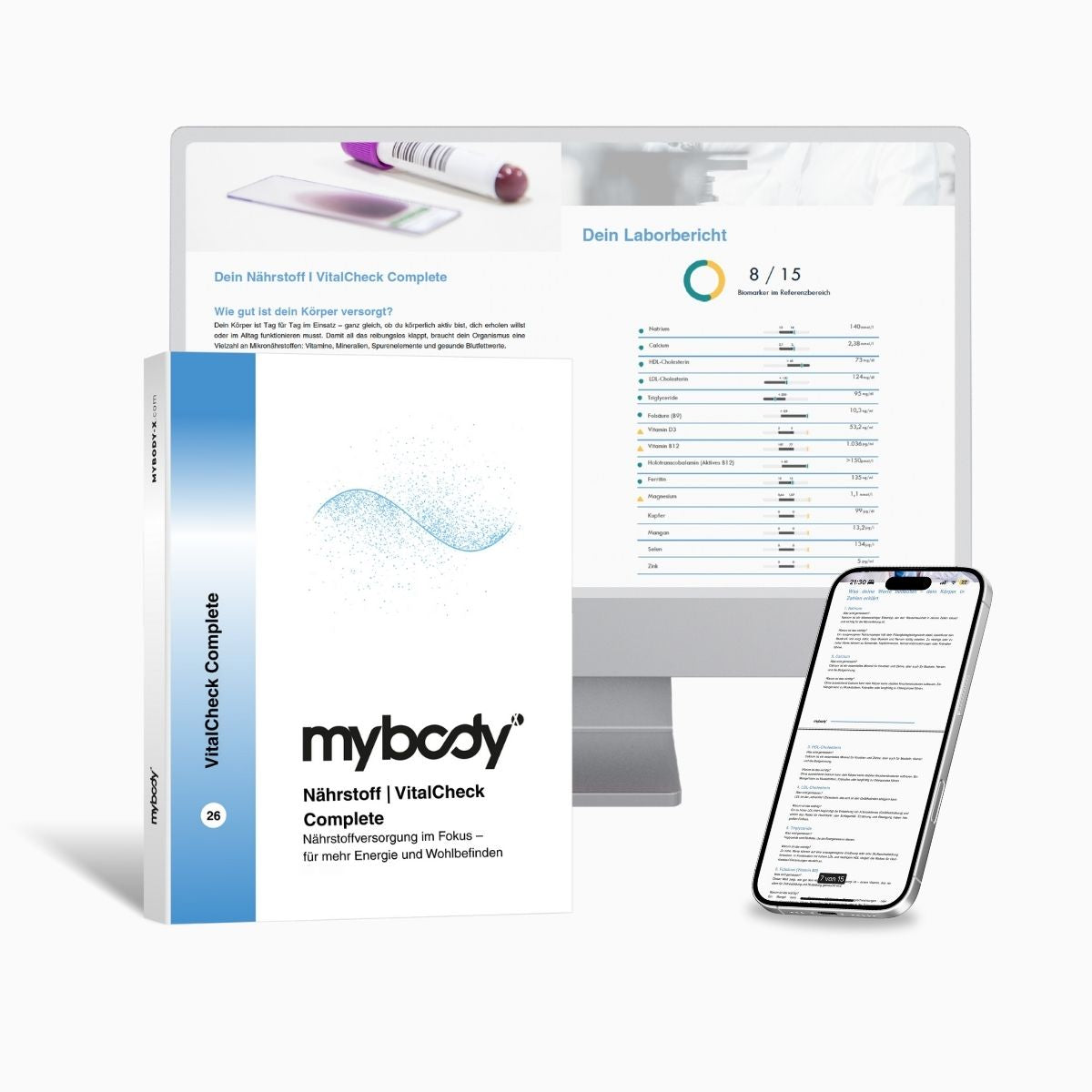
Capillary blood test
VitalCheck | Complete Nutrient & Mineral Test
Measures 18 values: vitamin D3, vitamin B12, and folate; iron status based on ferritin, iron, and transferrin; calcium, magnesium, phosphate, selenium, and zinc; as well as cholesterol, long-term blood sugar, and CRP. The Omega-3 Index is explicitly not included, and EPA and DHA are not measured. Anyone looking for an Omega-3 Index test is in the wrong place here; anyone wanting to clarify whether a value with a recognized reference range could be behind fatigue or dry skin will find iron status, vitamin D3, and vitamin B12 here. The test provides a snapshot, not a diagnosis, and does not replace medical evaluation.
Laboratory evaluation 3–5 business days after sample receipt
Product page information; no laboratory name given; accessed 27 August 2026
Why this test is still listed here
It is not listed here as a substitute for an Omega-3 test, but as an answer to the symptoms that led you to this search. Fatigue, dry skin, and concentration problems are the reason. The Omega-3 Index is only one of several explanations, and it is the only one without a reference range.
We provide the data we can actually measure. What follows from it is something you decide together with your doctor.
Who can benefit from a blood test now
Not every complaint requires a laboratory value, and not every laboratory value brings a decision closer. The following comparison presents both directions honestly.
Useful for you if …
Fatigue or reduced ability to cope with exertion has persisted for several weeks, and you have not yet had any blood values checked for this.
You follow a vegan or vegetarian diet and want to know whether your iron status and vitamin B12 are keeping up.
You want a baseline value to compare against in six to twelve months.
You want to prepare for a conversation at a doctor’s office and go in with numbers rather than guesses.
Probably not if …
You explicitly want the omega-3 index measured. This value is not included in the range, and no other test replaces it.
Your symptoms are acute or accompanied by fever, unintentional weight loss, or blood in the stool. In that case, the appointment comes before the test.
You are already taking supplements with high EPA and DHA intake and want to clarify an interaction. That is a medical question.
You are hoping for a diagnosis from the result. A blood value provides context; it does not identify a disease.
What actually changes intake in everyday life
If the two weeks of recording show that no source of EPA and DHA occurs, there is an unremarkable way to address this. It involves food rather than a capsule, and it is the same one recommended by the consumer advice center: one or two servings of fish per week, preferably oily sea fish (Verbraucherzentrale, as of 24 March 2026).
For anyone who does not eat fish, microalgae products are the direct source. They provide EPA and DHA without the detour of conversion in the body, and they are the reason fish contain these fatty acids at all.
Flaxseed, rapeseed, and walnut oils are still useful, just for α-linolenic acid. For this, the DGE gives a guideline value of 0.5 percent of energy intake (DGE, Reference Values for Nutrient Intake, as of 2000). Two substances, two values, two sources.
Two substances, two values, two sources.
What this section does not say
It does not say that higher intake ends symptoms. This connection has not been established for the symptoms from the introductory list, nor is it among the approved claims in Chapter 7.
It only says: If intake is low, it can be increased through food. Whether this is connected to a symptom remains an open question, and that belongs in a doctor’s office, not in a guide.
Limitations: what none of these values can answer
The omega-3 index describes nutritional status. It does not say whether a symptom is caused by that nutritional status. These two sentences are the entire content of this chapter, and they apply regardless of who measures the value.
A capillary blood test provides a snapshot. It does not make a diagnosis, replace a medical examination, and an abnormal value initially means only that a second look is worthwhile.
Reference ranges depend on the laboratory, method, and age. Findings from two laboratories therefore cannot always be compared directly, even if both use the same unit.
And the point that weighs most heavily for this topic: Even a low index would remain a value without a recognized threshold. It would add to your observations, but it would not settle any question.
When the appointment should come before the test
In the case of unintentional weight loss, fever, blood in the stool, marked paleness, or exhaustion that clearly worsens within a few days, a self-test is the wrong order of events. These signs should first be assessed by a doctor.
The same applies during pregnancy and breastfeeding. There, DHA intake is a separate aspect of preventive care, and the DGE gives a numerical value for this group alone.
What matters in the end
The search for omega-3 deficiency symptoms begins with a question for which there is no laboratory diagnosis. Nevertheless, it does not end in nothing, but with a more precise question: Does your diet contain a source of EPA and DHA at all, and have the values for which reference ranges exist been tested?
This second question costs two weeks of tracking and, if in doubt, a blood test. It can be answered, and it leads to a decision instead of another guess.
One final point that is new in this discussion and that hardly any guide makes: The authorized claims from Regulation (EU) No. 432/2012 are not merely a requirement for manufacturers but also a tool for you to assess products. If a package promises more than the maintenance of a normal function, you now know that this promise is not authorized as such. That is little. And it is more than any list of symptoms can give you.
Frequently asked questions
Does the VitalCheck Complete measure my omega-3 index?
No. The VitalCheck Complete determines 18 values, including vitamin D3, vitamin B12, folate, iron status based on ferritin, iron, and transferrin, as well as several minerals and metabolic values. The omega-3 index is not included, and EPA and DHA are not measured. mybody®x does not offer any other test that determines this value either.
Is there a recognized threshold for omega-3 deficiency?
No. No concentrations of EPA and DHA are known below which measurable bodily functions would be impaired, and reference ranges for blood status have not been established (NIH ODS, 2026 edition). The often-cited thresholds of 8 and 4 percent come from a paper by Harris and von Schacky in Preventive Medicine (2004), where they were explicitly presented as a proposal.
Are dry skin and fatigue signs of insufficient omega-3?
Both are nonspecific. Fatigue is associated with iron deficiency, low vitamin B12 status, hypothyroidism, and disturbed sleep, and reference ranges exist for all these causes. A true deficiency of essential fatty acids manifests as rough, scaly skin and dermatitis, but it practically does not occur in healthy people (NIH ODS, 2026 edition).
What can be said about the effects of EPA and DHA?
Only the claims from Regulation (EU) No. 432/2012, in the wording specified there. Authorized claims include “EPA and DHA contribute to the normal function of the heart,” “DHA contributes to the maintenance of normal brain function,” and “DHA contributes to the maintenance of normal vision.” All three are tied to a daily intake of 250 mg, which consumers must be informed about. Claims about reducing symptoms are not authorized.
Are flaxseed oil and walnuts enough instead of fish?
They provide α-linolenic acid, not EPA and DHA. The reference values treat the two separately: for α-linolenic acid, the DGE specifies a reference value of 0.5 percent of energy intake; for pregnant and breastfeeding women, at least 200 mg of DHA per day is additionally recommended (DGE, Reference Values for Nutrient Intake, 2000 edition). Anyone who does not eat fish has a direct source of EPA and DHA in microalgae oil.
Next step
Check the values that have a reference range
The Omega-3 Index is not offered by mybody®x. If a different value is behind fatigue or dry skin, VitalCheck Complete measures iron status, vitamin D3, and vitamin B12. The linked article explains how an omega-3 measurement is carried out elsewhere.
VitalCheck Complete Omega-3 index test explainedRead more
You might also be interested in this
In case the question about intake falls within a stage of life with its own DHA reference value.
A second nutrient for which the symptom list is broader than the evidence base—with the same distinction between intake and findings.
Sources
- Commission Regulation (EU) No 432/2012 establishing a list of permitted other health claims made on foods, Annex (as of 2012) – eur-lex.europa.eu
- Consumer Advice Centre: Are Omega-3 Fatty Acid Capsules a Useful Dietary Supplement? (as of 24.03.2026) – verbraucherzentrale.de
- National Institutes of Health, Office of Dietary Supplements: Omega-3 Fatty Acids, Fact Sheet for Health Professionals (as of 13.08.2026) – ods.od.nih.gov
- German Nutrition Society (DGE): Reference Values for Nutrient Intake, Fat and Essential Fatty Acids (as of 2000) – dge.de
The authorized wording of the three health claims relating to EPA and DHA, as well as the conditions of a daily intake of 250 mg and 40 mg of DHA per 100 g and per 100 kcal, comes from source [1]. The verbatim quotation concerning the supply of healthy people, the recommendation of one to two portions of fish per week, and the information on quantities assessed as safe and the warning from 2 g are based on [2]. The statements concerning the absence of a threshold value, the lack of defined reference ranges, the average of 3 to 4 percent, the rarity of true fatty acid deficiency, and the intake values for α-linolenic acid come from [3]. The guideline value of 0.5 percent of energy intake and the recommendation of at least 200 mg of DHA per day for pregnant and breastfeeding women come from [4]. The definition and the 8 and 4 percent benchmarks for the Omega-3 Index come from the work of Harris and von Schacky in Preventive Medicine (2004); it is attributed in the body text with the authorship, journal, and year and is therefore not included in this list. Information on price, values, sample type, and laboratory comes from the mybody®x product page, accessed on 27.08.2026; processing times follow the central specification for blood tests. All sources were accessed and reviewed on 27.08.2026.

mybody®x Editorial & Expert Team
Nutritional Science Laboratory Diagnostics Blood Analysis Interpretation Nutrigenetics
This article was created by the mybody®x editorial and expert team. The team combines nutritional science, laboratory diagnostics, and the interpretation of blood analyses. Those who contribute to it are listed on the authors’ page.
Published on 12.11.2025 · Last updated on 27.08.2026
The content is intended for general information and does not replace medical advice, diagnosis, or treatment. Reference ranges depend on the laboratory, method, and age—what matters is always the information on your test report.




Share now:
Nutrient deficiency and hair loss: How to identify the true cause
Your blood HbA1c level: Understanding and optimizing it made easy