
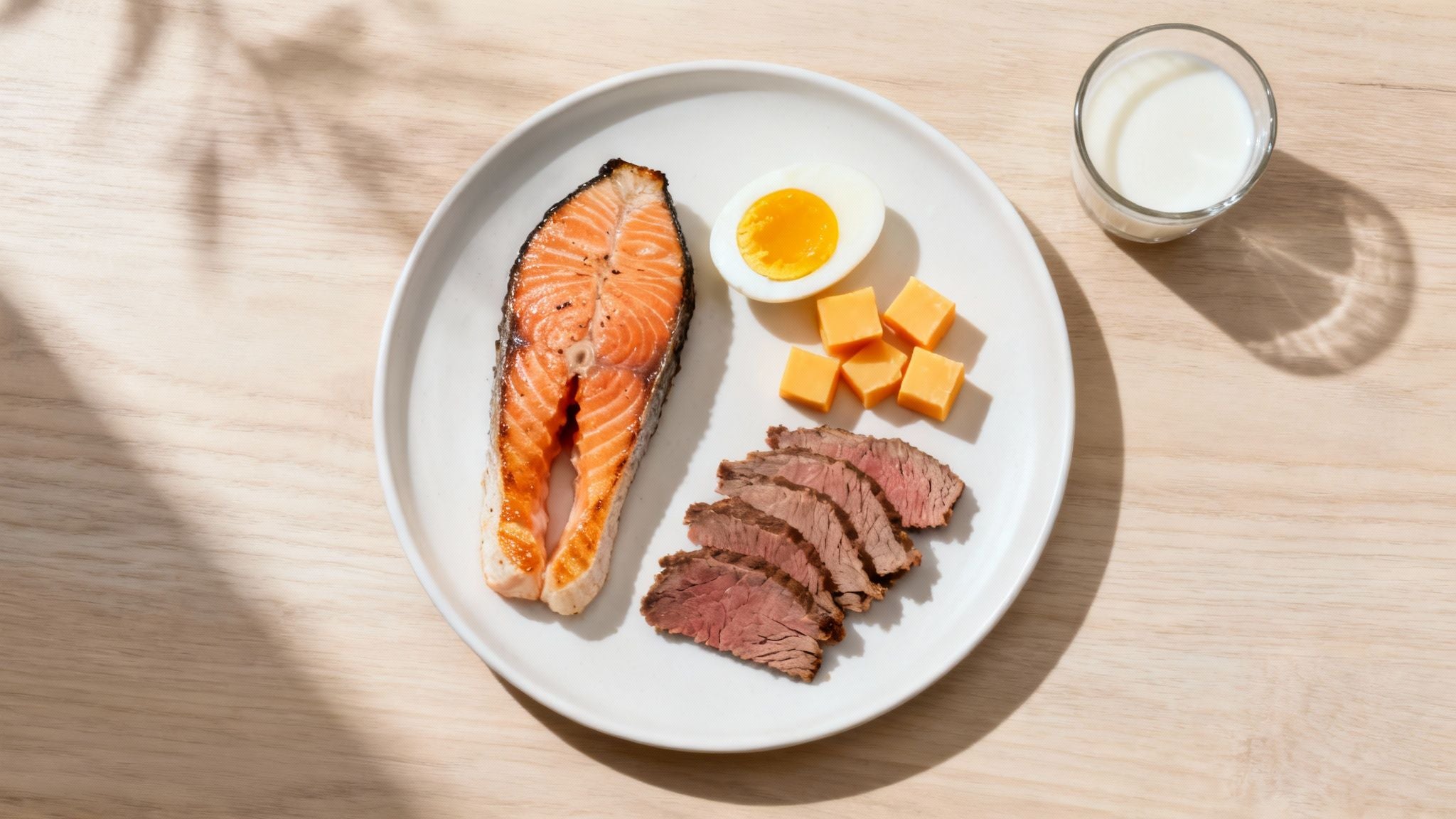
Vitamin B12 foods for vegetarians: what meets the requirement
The essentials at a glance
For vegetarians, dairy products and eggs are the main sources of vitamin B12. Camembert provides around 3.1 micrograms per 100 grams, mozzarella 2.0, and a boiled egg 1.9. The estimated value is 4 micrograms per day, which can be met with a vegetarian diet. It cannot be met through a purely plant-based diet.
This article gives a figure, source, and year for each food. It distinguishes between two cases that are often discussed together: a vegetarian diet, where the issue is food choice, and a vegan diet, for which two institutions consider a supplement necessary.
First, you will learn what your body needs vitamin B12 for and what the estimated value is. Next come the table of vitamin B12 contents, the question of plant-based sources, warning signs, an example day, and the reason why a deficiency only becomes noticeable after years.
What to expect in this article
1. What your body needs vitamin B12 for
2. How much vitamin B12 you need per day
3. Which foods provide how much vitamin B12
4. Why algae and sauerkraut are not enough
5. When symptoms belong in a doctor's office
6. Who needs a supplement
7. What a vegetarian day with enough B12 looks like
8. Why a deficiency only becomes noticeable after years
9. How to tell when food choices alone are not enough
10. How to find out where your level stands
11. Limits: what a blood test cannot do
12. What you can change starting tomorrow
Frequently asked questions
Sources
What your body needs vitamin B12 for
Vitamin B12 is involved in blood formation and the functioning of the nervous system. It is the only vitamin that, in everyday life, reaches the body practically only through animal-based foods, and that is precisely what makes it a central issue for vegetarian and vegan diets.
Unlike most nutrients, your body builds up a genuine reserve of vitamin B12. The reserve is stored in the liver and lasts a long time. That sounds reassuring and is why a deficiency often goes unnoticed until late.
Key message
Vegetarian and vegan diets raise two different questions when it comes to vitamin B12. One concerns food choices; according to the DGE and BfR, the other has only one answer: a supplement.
Why absorption in the intestine is a challenge in its own right
Vitamin B12 is not simply absorbed like other vitamins. It needs a transport helper from the stomach, intrinsic factor, and without it the vitamin remains in the intestine, no matter how much of it was on the plate.
That is why, alongside people who follow a vegan diet, the Federal Institute for Risk Assessment explicitly names older people and those with certain stomach or intestinal diseases as risk groups (BfR, 2023). For them, the problem is not intake but the path into the bloodstream.
How much vitamin B12 you need per day
The German Nutrition Society gives an estimated value for vitamin B12, not a reference value in the strict sense. It is 4.0 micrograms per day for adolescents aged 15 and over and for all adults, regardless of sex and age (DGE, calculation basis as of 2018).
For pregnant women, the value is 4.5 micrograms; for breastfeeding women, 5.5. These are the only two deviations in the entire table.
Why the figure remains the same across all age groups
For iron and protein, requirements change significantly with age and stage of life. Not for vitamin B12. From age 15 onward, the same figure applies, and it remains unchanged from age 65 onward as well.
However, this does not mean that nutritional status is equally secure in old age. The requirement remains the same, but the ability to absorb it does not. This is precisely what the BfR's reference to older people as a risk group addresses.
Why it is an estimated value rather than a reference value
In its tables, the DGE distinguishes between recommended intake and estimated value. For iron and protein, it gives a recommendation; for vitamin B12, an estimated value. The difference lies in the data on which the figure is based.
In practice, this changes little. Four micrograms remain the target against which a day can be measured. It does change how the figure should be interpreted: Anyone who sees a different number has not necessarily found a poor source, but may instead be looking at an older calculation.
Four micrograms sounds like very little, and it is. One microgram is one-millionth of a gram. The entire daily amount for an adult weighs less than a speck of dust, yet it determines blood formation and nerve function.
How much vitamin B12 different foods provide
The following values come from the DGE's example calculation (2025). There, they are given as servings; for this table, they have been mathematically converted to 100 grams so that the foods can be compared with one another. The serving size is stated in the note for each item.
| Food | Vitamin B12 per 100 g | Note |
|---|---|---|
| Lean cooked beef | 4.5 µg | A 100 g serving alone provides the estimated value of 4 µg. Not relevant for vegetarians, but useful as a benchmark |
| Cooked salmon | 4.1 µg | 70 g provide 2.87 µg. Fish is therefore almost on a par with lean meat |
| Camembert, 30 percent fat in dry matter | 3.1 µg | The strongest vegetarian source in the overview. 60 g provide 1.86 µg |
| Gouda, 30 percent fat in dry matter | 2.2 µg | The usual slice weighs 30 g and provides 0.66 µg |
| Mozzarella, 20 percent fat in dry matter | 2.0 µg | One of the few figures given directly per 100 g. The BfR describes one portion as half the daily requirement |
| Egg, boiled | 1.9 µg | A 60 g egg provides 1.14 µg, according to the BfR, around one-quarter of the estimated value |
| Quark, 20 percent fat in dry matter | 0.8 µg | 90 g provides 0.72 µg. Quark ranked near the top for protein, but not here |
| Cream cheese, 50 percent fat in dry matter | 0.5 µg | 60 g provides 0.3 µg. The weakest cheese in the overview |
| Cow’s milk, 1.5 percent fat | 0.4 µg | 150 g provides 0.6 µg. A large glass therefore covers a good one-seventh of the daily requirement |
| Yogurt, 1.5 percent fat | 0.4 µg | Identical to cow’s milk: 150 g provides 0.6 µg |
| Liver | no figure | The BfR names liver as one of the main sources without giving a figure. The sources reviewed provide no information here |
The gap between the cheeses stands out in this order. Camembert, at 3.1 micrograms, is about six times higher than cream cheese at 0.5. Both are cheese, both are made from milk, and yet they differ by almost the entire daily requirement.
For everyday purposes, the portion still matters. Mozzarella is eaten in 100-gram portions and provides 2 micrograms, while Gouda is eaten in 30-gram slices and provides 0.66. The table is sorted by content; the plate by quantity.
Why aged cheese comes out on top
The three strongest vegetarian items in the overview are Camembert, Gouda, and mozzarella. The three weakest are cream cheese, milk, and yogurt. The degree of processing lies between the two groups.
Cheese is milk from which water has been removed, and everything else becomes concentrated along with the water. That is why Camembert, at 3.1 micrograms, is more than seven times higher than milk at 0.4. The same amount on the plate, but a markedly different contribution to the day.
For practical selection, this means that anyone following a vegetarian diet who wants to be on the safe side with this vitamin should choose cheese rather than milk, and aged cheese rather than fresh cheese. This is not a dietary change, but a shopping decision.
What the table does not show
Liver is listed without a figure in the overview, even though the BfR names it as one of the main sources. The sources reviewed provide no figure here, and no estimates are made.
For a vegetarian diet, that does not matter. It does matter for interpreting the remaining figures: anyone who sees a very high figure for liver somewhere should check what it is based on.
Why algae and sauerkraut do not help
This chapter is why the article is called “for vegetarians” and not “for plant-based diets.” The distinction is not a fine point; it is the whole difference.
Documented source
“Vitamin B12 occurs in relevant amounts sufficient to ensure adequate intake only in foods of animal origin.”
German Nutrition Society (DGE)
Reference values for vitamin B12, status of derivation 2018
The same source removes the basis for the most widespread counterargument. Sauerkraut, certain seaweeds such as nori, and shiitake mushrooms may contain vitamin B12 compounds, but the forms they contain are not available to humans (DGE, 2018).
The BfR puts it even more strongly: These foods contain traces, and all other conventional plant-based foods contain no vitamin B12 (BfR, 2023). Two federal institutions, the same statement, formulated independently of each other.
What this means for a vegetarian diet
Anyone who eats dairy products and eggs has not lost access to B12, but merely narrowed it. The table above shows that the vegetarian items range from 0.4 to 3.1 micrograms per 100 grams. The difference between a weak and a strong selection is therefore almost eightfold.
In practice, this means that anyone who eats cheese daily and eggs regularly will meet the requirement. Anyone who consumes dairy products only occasionally should know their level rather than assume it.
Why this point is so often misrepresented
The confusion has a factual basis. Vitamin B12 compounds can indeed be detected in sauerkraut, nori, and shiitake. So a measuring device finds something there.
The difference is between detectability and bioavailability. The DGE explicitly states that the forms present are not available to humans (2018). An analysis can report a value that does not reach the body.
That is precisely why this article gives no figure for algae. A value without bioavailability would be technically correct but practically misleading, and that is the worst kind of number.
When symptoms warrant a medical consultation
The BfR identifies specific signs of vitamin B12 deficiency. They appear early here because a text that places the criteria for discontinuation at the end fails to reach precisely the reader they are intended for.
These signs warrant a medical consultation
Tingling or numbness
explicitly mentioned by the BfR, often affecting the hands and feet
Paleness and persistent fatigue
both are signs that may also have other causes
Memory impairment
the BfR lists them among neurological and mental disorders
Depressive moods
also mentioned in the same list
Years of vegan eating without supplementation
even without symptoms, a reason to have the level tested
This list does not replace a medical examination and is not a diagnostic checklist. Tingling, fatigue, and memory problems have dozens of possible causes, most of which have nothing to do with vitamin B12.
The picture becomes striking when several signs occur together and the diet has been low in animal-based foods for years. What constitutes a deficiency in the blood and which values matter is explained in the article on vitamin B12 deficiency. This article stays focused on foods.
Who needs a supplement
For this vitamin, the answer is unusually clear, and it appears not in an advertising text but in the DGE’s guidance.
A supplement is necessary if …
you follow an exclusively plant-based diet. In this case, the DGE considers taking a vitamin B12 supplement necessary (2018).
you eat only very small amounts of animal-based foods. The DGE explicitly mentions this case as well.
a doctor has prescribed one for you, for example because of a stomach or intestinal condition affecting absorption.
Probably not, if …
you eat cheese, dairy products, or eggs every day. The table above shows that this can provide the estimated value.
you hope a supplement will help with fatigue without a deficiency having been diagnosed. The reviewed sources provide no basis for this conclusion.
you do not know where your level stands. In that case, testing is the first step, not taking a supplement.
What a vegetarian day with enough B12 looks like
Two examples calculated using the portion sizes specified by the DGE (2025). They are not meal plans, but show how borderline or comfortable a vegetarian diet can be.
A comfortable day, around 4.4 micrograms
For breakfast, 150 grams of yogurt with 0.6 micrograms and a boiled egg with 1.14. At lunchtime, 100 grams of mozzarella in a salad with 2.0. In the evening, a 30-gram slice of Gouda with 0.66. That totals 4.4 micrograms, exceeding the estimated value of 4.
A borderline day, around 1.6 micrograms
In the morning, 150 grams of cow’s milk in coffee and muesli with 0.6 micrograms. At lunchtime, 60 grams of cream cheese on bread with 0.3. In the evening, 90 grams of quark with 0.72. That adds up to 1.6 micrograms, or a good forty percent of the estimated value.
A day with fish, around 5 micrograms
People who eat fish have an additional strong source. In the morning, a boiled egg with 1.14 micrograms; at lunchtime, 70 grams of cooked salmon with 2.87; and in the evening, a slice of Gouda with 0.66, plus 150 grams of yogurt with 0.6. That totals 5.3 micrograms, exceeding the value for breastfeeding women.
The comparison of the three days shows the range. There is more than a threefold difference between the low-intake day and the fish day, even though all three consist of everyday foods and none was specifically planned around vitamin B12.
Both vegetarian days are composed unremarkably, and there is almost a threefold difference between them. This is the practical core of this article: With vitamin B12, it is not whether you eat a vegetarian diet that matters, but which dairy products you choose.
Chapter at a glance
The estimated value for vitamin B12 is 4 micrograms per day (DGE, 2018). A vegetarian day with egg, mozzarella, and Gouda reaches it; a vegetarian day with milk, cream cheese, and quark provides a good forty percent of it. The difference lies solely in the choice of dairy products, not in the dietary pattern.
Why a deficiency is only noticed after years
This section explains why the question of food sources is more urgent for vitamin B12 than for iron or protein. The storage reserve delays everything.
Three figures on storage reserves
4.0 µg
Estimated value per day, the same for all adults
1 to 4
Years without vitamin B12 until the liver's stores are half depleted
5.5 µg
the highest value in the table; it applies to breastfeeding women
Sources: German Nutrition Society, Vitamin B12 reference values, as of 2018; Federal Institute for Risk Assessment, 2023
What the delay means in practice
The BfR notes that vitamin B12 deficiency often occurs only after years of inadequate intake and gives a range of one to four years until the liver's stores are half depleted (BfR, 2023).
So if you switch to a vegan diet today, you will not notice it for a long time. This is not an all-clear; it is the opposite: It means that the body's feedback is no longer available as a check.
The same applies to reassurance. Someone who has been eating a vegan diet for six months and feels well has learned nothing about their nutrient status. They have learned that their reserves are still sufficient.
Why the storage reserve reverses the order
For most dietary questions, how you feel is a useful first indication. If you drink too little, you notice it the same day. The same applies if you get too little sleep.
With vitamin B12, this feedback mechanism is absent for years. This reverses the usual order: It is not the symptom that leads to testing, but the diet. Anyone who has eaten little or no animal products for years has a reason to get tested, even if they have no symptoms.
This is the one situation in which a blood test provides more than attention to this issue. Not because it knows more, but because it detects something earlier.
How to tell when choice alone is not enough
Three signs suggest that the question no longer belongs on the plate. First: You have been following a vegan diet for years without taking a supplement. Second: You have a known stomach or intestinal disease. Third: You are over 65 and eat few animal-based foods.
With vitamin B12, it is not whether you eat a vegetarian diet that matters, but which dairy products you choose.
In the first two cases, absorption is the issue, not intake. In the third, both come into play. What all three have in common is that choosing better cheese will not solve the problem.
Intake and absorption are two separate questions
For iron, the most common cause of a deficiency is loss. For vitamin B12, it lies either in intake, when animal-based foods are absent, or in absorption, when the stomach or intestines no longer allow it to reach the bloodstream.
A nutrition article deals exclusively with the first question. That is enough as long as the second is unremarkable. As soon as it is no longer unremarkable, every additional slice of cheese becomes the wrong answer.
That is precisely why the BfR mentions older people and those with stomach or intestinal diseases in the same breath as people following a vegan diet (2023). The groups have nothing in common except the outcome.
How to find out where your level stands
Because the body’s stores delay any feedback by years, testing this vitamin is more informative than relying on how you feel. A capillary blood test from mybody®x (MYBODY Lab GmbH) includes vitamin B12 along with other markers. You collect the sample at home using a finger prick.
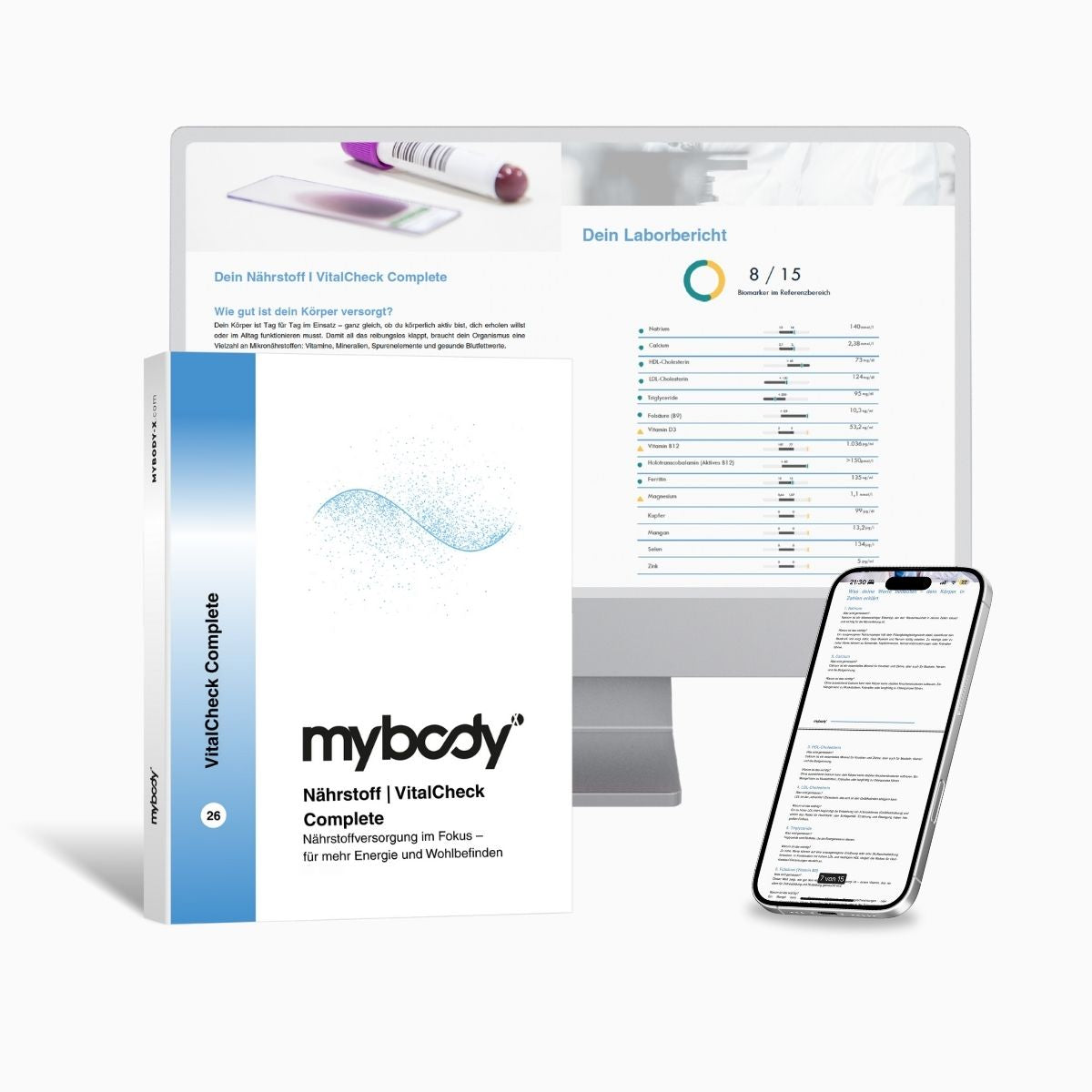
Blood test using capillary blood
VitalCheck | Complete Nutrient & Mineral Test
Measures vitamin B12 together with vitamin D3 and folate, as well as iron status based on ferritin, iron, and transferrin, plus magnesium, selenium, and zinc. According to the product page, the test provides a snapshot, not a diagnosis. It does not show whether impaired absorption in the intestines is the cause of a low value.
Laboratory results 3–5 business days after the sample is received
Product page information, accessed 28.08.2026
When a supplement is the right answer
For people following a vegan diet, the DGE considers taking a supplement necessary (2018). In this case, the question is not whether to take one, but which one. For context: A dietary supplement is not a substitute for a balanced and varied diet.

Food supplement
Vitamin B Complex | Energize
Contains seven B vitamins, including B12, as drops for daily use. The B vitamins support energy metabolism, the nervous system, and the normal function of the skin, hair, and nails. Authorized health claims pursuant to EU Regulation No. 432/2012. Food supplements are not a substitute for a balanced and varied diet.
Product page information, accessed 28.08.2026
Limitations: what a blood test cannot do
A vitamin B12 value is a data point, not an explanation of the cause. It shows how much is currently circulating in the blood and says nothing about whether too little arrived or too little was absorbed.
This difference is particularly important with this vitamin. In the case of a stomach or intestinal disease, a higher intake is of little use if the transport pathway is impaired. That is a question for a doctor's office, not a self-test.
And one limitation concerns this article itself. The table values are averages from an example calculation. The B12 content of a specific piece of cheese therefore varies around them, depending on ripening and variety, without any corresponding information appearing on the packaging.
What a single value cannot answer
A measured value describes a point in time. Only a second measurement shows whether it is currently rising, falling, or has remained there for years. With a vitamin that is stored for years, this trend is often more informative than the individual number.
There is another factor: A low value says nothing about whether too little was eaten or too little was absorbed. But this distinction determines what needs to be done, and it belongs in a doctor's office.
That is why anyone who notices warning signs should not take a test but make an appointment. The test is the tool for the question that comes before: Where do I stand while I have no symptoms?
What you can change starting tomorrow
If you take away one single action from this article, let it be this: Check which cheese you usually buy. With the same quantity, the difference between cream cheese with 0.5 and Camembert with 3.1 micrograms per 100 grams is 2.6 micrograms—well over half the daily value.
The reason is unremarkable. Of all the levers in this text, this is the only one that costs nothing, changes nothing, and still makes a measurable difference in intake.
The starting point was the question of which foods provide vitamin B12. For vegetarians, the answer is: these foods, and the selection matters more than the quantity. For people following a vegan diet, the answer is different—and the DGE and BfR agree on that.
Frequently asked questions
Which vegetarian foods contain the most vitamin B12?
Camembert ranks first at around 3.1 micrograms per 100 grams, followed by Gouda at 2.2, mozzarella at 2.0, and a boiled egg at 1.9 micrograms. Quark is considerably lower at 0.8, followed by cream cheese at 0.5, and cow's milk and yogurt at 0.4 micrograms each. The values were converted to 100 grams from the DGE's serving information (2025). The estimated value is 4 micrograms per day.
How much vitamin B12 do I need per day?
The German Nutrition Society gives an estimated value of 4.0 micrograms per day. It applies unchanged to everyone aged 15 and over, regardless of sex or age. The figure is 4.5 micrograms for pregnant women and 5.5 for breastfeeding women. These values were derived in 2018. Unlike iron or protein, the figure therefore does not change throughout adulthood.
Do seaweed, sauerkraut, or shiitake mushrooms meet the requirement?
No. The DGE states that sauerkraut, certain seaweed such as nori, and shiitake mushrooms may contain vitamin B12 compounds, but the forms they contain are not available to humans (2018). The BfR describes them as trace amounts and states that all other conventional plant-based foods contain no vitamin B12 (2023). Both institutions independently reach the same conclusion.
Why does a deficiency become noticeable only so late?
Because the body stores vitamin B12 in the liver. The BfR states that a deficiency often occurs only after years of inadequate intake and that the liver stores are half depleted after about one to four years of a vitamin-B12-free diet (2023). Anyone who changes their diet and continues to feel well has learned nothing about their intake—only about the state of their stores.
Who needs a vitamin B12 supplement?
The German Nutrition Society (DGE) considers taking a supplement necessary for people who follow an exclusively plant-based diet or consume only very small amounts of animal-based foods (2018). The German Federal Institute for Risk Assessment (BfR) additionally identifies older people and those with certain stomach or intestinal diseases as risk groups (2023). By contrast, anyone who eats dairy products and eggs daily meets the estimated value through their diet. Whether a supplement makes sense in an individual case should be discussed with a doctor.
Next step
Measure first, then decide
Because liver stores delay every feedback by years, how you feel says little about this vitamin. VitalCheck Complete provides a starting point. It does not replace medical evaluation and does not show whether impaired absorption is the cause.
View VitalCheck Complete What a deficiency meansRead more
You might also be interested in this
How to interpret blood values when you already suspect a problem and want to know what the numbers mean.
The same structure for the second nutrient for which a vegetarian diet requires deliberate selection.
Sources
- German Nutrition Society (DGE): Reference values for vitamin B12 intake (basis of derivation: 2018) – dge.de
- German Nutrition Society (DGE): Frequently asked questions about vitamin B12 (as of 2025) – dge.de
- German Federal Institute for Risk Assessment (BfR): Vitamin B12 – people following a plant-based diet should pay particular attention to adequate intake (18.10.2023) – bfr.bund.de
The verbatim quotation about its occurrence in animal-based foods, the estimated daily amounts, and the statements about sauerkraut, seaweed, and shiitake mushrooms, as well as the need for a supplement in a vegan diet, come from source [1]. All food values come from the example calculation in [2] and have been mathematically converted from the serving size to 100 grams for the table. The information on at-risk groups, signs of deficiency, and depletion of liver stores comes from [3], as do the serving-size details for eggs, mozzarella, and beef. Information on prices, measured values, sample type, dosage form, and laboratory comes from the mybody®x product pages, accessed on 28.08.2026; processing times follow the central guideline for blood tests. All sources were accessed and reviewed on 28.08.2026.

mybody®x Editorial & Subject-Matter Team
Laboratory diagnostics Nutritional science Blood analysis interpretation Nutrigenetics
This article was created by the mybody®x editorial and subject-matter team. The team combines laboratory diagnostics, nutritional science, and the interpretation of blood analyses. Those who contribute to it are listed on the authors page.
Published on 05.11.2025 · Last updated on 28.08.2026
The content is for general information and does not replace medical advice, diagnosis, or treatment. Reference ranges depend on the laboratory, method, and age—the information on your report is always decisive.



Share now:
Your vitamin B test for more energy and well-being
Vitamin B6 deficiency: Recognize and address typical symptoms in women