
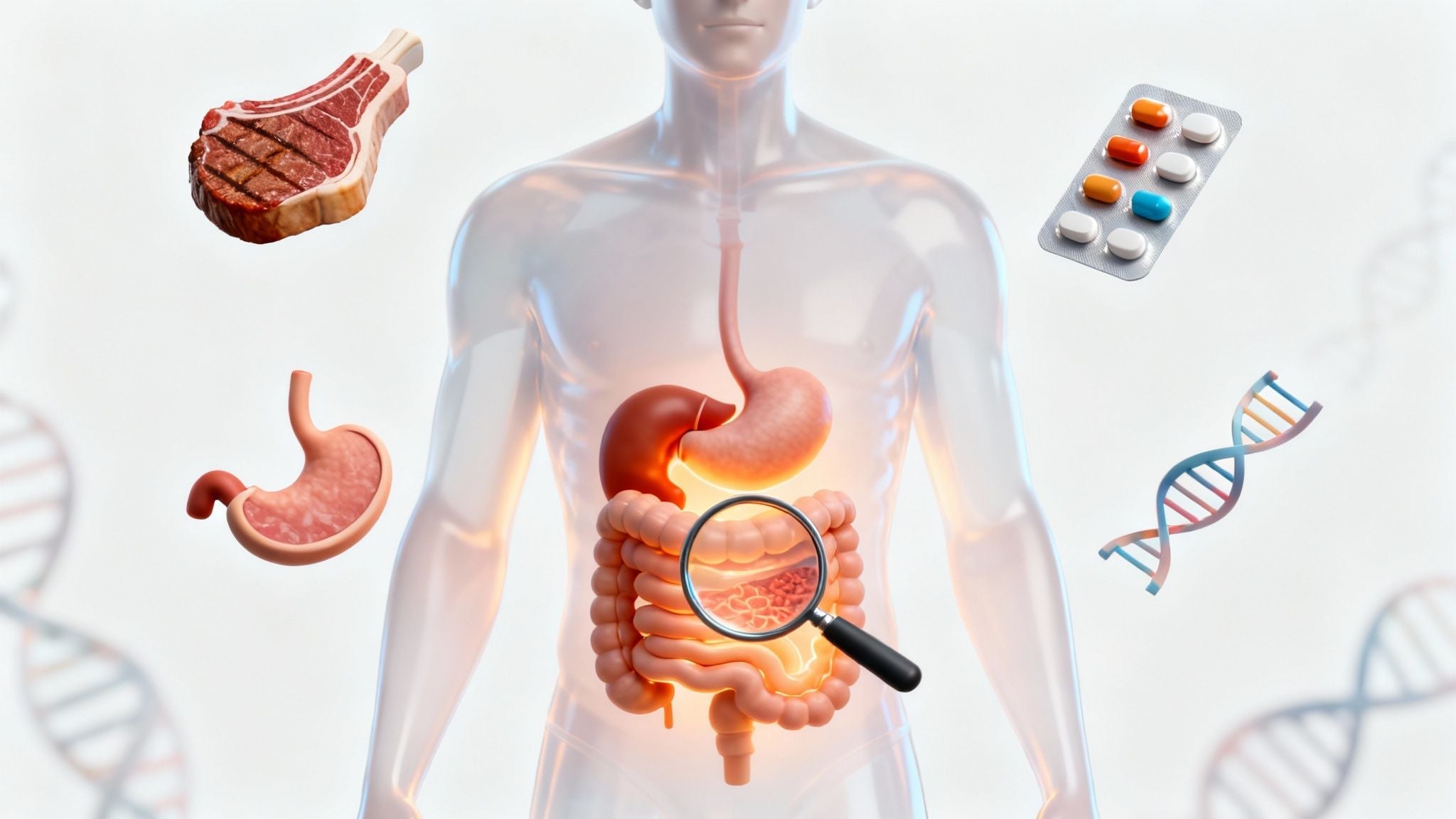
The causes of vitamin B12 deficiency revealed
Do you constantly feel exhausted even though you take care of your health? It could be due to a vitamin B12 deficiency. The causes are surprisingly varied and go far beyond diet alone—from hidden absorption disorders to taking certain medications.
So the root of the problem often lies not on your plate, but hidden deep within your own body.
Why your energy is no coincidence
Constant fatigue, difficulty concentrating, or feeling like you simply cannot get going—such symptoms can make everyday life a real burden. Many people blame stress, but a tangible nutrient deficiency is often behind it. Vitamin B12, also called cobalamin, is a true powerhouse for your body.
It is essential for:
- Your energy production: B12 helps convert food into usable energy. Without B12, your body's engine runs only on low power.
- Your nervous system: The vitamin protects your nerve pathways like insulation around a cable, ensuring smooth communication between your brain and body.
- Your blood formation: It is essential for producing red blood cells, which transport oxygen throughout your body.
The insidious thing about it is that a deficiency often develops over many years. Your liver can store vitamin B12, but when this reserve runs low, the consequences become noticeable. That is precisely why it is so important to understand the causes of vitamin B12 deficiency and get to know your own body better before the first serious symptoms appear.
The most common causes at a glance
The reasons for an inadequate supply are complex and can be broadly divided into four categories. It is not just about what you eat, but above all about what your body can actually absorb and use.
Vitamin B12 deficiency is often a silent process. Symptoms usually appear only when the body's stores are already severely depleted. Taking proactive action and understanding your body are therefore the best protection.
To give you a quick overview, we have summarized the key causes in a table.
The most common causes of vitamin B12 deficiency at a glance
| Cause category | Brief description | Typical examples |
|---|---|---|
| Diet | Dietary intake is too low. | Vegan or strict vegetarian diet, malnutrition in old age. |
| Malabsorption | The body cannot absorb B12 properly. | Lack of intrinsic factor, chronic gastritis, celiac disease. |
| Diseases | Certain diseases disrupt B12 metabolism. | Crohn’s disease, bacterial overgrowth in the small intestine (SIBO), pancreatic insufficiency. |
| Medications | Some medications impair absorption. | Gastric acid blockers (PPIs such as omeprazole), metformin (for diabetes). |
This overview shows that finding the cause sometimes requires detective work.
If you would like to delve deeper into the topic of fatigue and nutrient deficiencies, you will find much more valuable information in our article about which vitamins are lacking when you feel fatigued.

The role of diet in vitamin B12 deficiency
One of the main causes of vitamin B12 deficiency is often on our plates. This actually makes perfect sense, because your body cannot produce this vital vitamin itself. You are completely dependent on obtaining it from food. The catch is that vitamin B12 is produced almost exclusively by microorganisms and enters the food chain primarily through animal products.
Plant-based foods naturally contain no vitamin B12 that our bodies can use. This is precisely what makes a purely plant-based diet one of the greatest risk factors for an inadequate intake. So if you follow a vegan diet, you cannot avoid consciously monitoring your B12 needs.
Why vegans and vegetarians need to pay particular attention
For vegans, the situation is clear: Without targeted supplementation or fortified foods, a deficiency is virtually inevitable in the long term. But even as a vegetarian who avoids meat but still consumes dairy products and eggs, you should definitely keep an eye on it.
Although eggs and dairy products contain vitamin B12, the amounts are often not enough to reliably meet your daily needs. To ensure a safe intake, you would have to eat a considerable amount of cheese or several eggs every day, for example—which is not always the best idea for other health reasons.
What’s important to understand is: This is not about judging dietary styles. It is a biological fact that a plant-based diet alone cannot meet the body’s B12 requirements. Conscious management is the key to a healthy plant-based diet.
To give you a better overview, here is a brief list of the best B12 sources:
- Top choices: Organ meats such as liver are true B12 powerhouses.
- Good sources: Meat (especially beef), fish (such as salmon or herring), and seafood.
- Moderate sources: eggs, milk, yogurt, and cheese.
Fortunately, there are good alternatives for everyone who follows a plant-based diet. Many manufacturers now deliberately fortify their products with vitamin B12. These include plant-based drinks, breakfast cereals, and meat substitutes, for example. So it is always worth taking a quick look at the nutrition table!
Even omnivores are not always safe
Even if you regularly eat animal products, you are not automatically in the clear. A one-sided diet low in nutrient-dense foods can also lead to an inadequate intake. This particularly affects older people, who often have less appetite, or people with very irregular eating habits. Intake can quickly become critical in these cases.
Choosing a particular diet has far-reaching effects on your body. If you would like to take a deeper look at how a vegetarian lifestyle affects you, you can find fascinating insights in our article on vegetarianism and genetic predispositions.
At the end of the day, diet is only one side of the coin. What good is the best intake if your body cannot properly absorb the vitamin in the first place? This is where a nutrient test comes in to provide clarity.
When your body cannot absorb the vitamin
Sometimes the problem isn’t on your plate at all, but much deeper inside your body. Even if you actually get enough vitamin B12 from your diet, your body may simply be unable to use it properly. This is known as malabsorption—one of the most common and, at the same time, most insidious causes of vitamin B12 deficiency.
Imagine the vitamin’s journey through your body as a relay race. For vitamin B12 to reach the finish line—your cells—several stages must work together seamlessly.
The crucial role of the stomach and intestines
It all begins in the stomach. Vitamin B12 is bound to proteins in food and must first be “freed.” A healthy amount of stomach acid is absolutely essential for this. It essentially breaks the bond and releases the vitamin.
As soon as B12 is on its own, it needs a bodyguard for the rest of its journey through the digestive tract: the so-called intrinsic factor. This special protein is produced by cells in your stomach lining. It binds to the free B12 and protects it on its way to the final section of the small intestine—only there can it ultimately be absorbed into the bloodstream.
This process shows how sensitive absorption actually is:
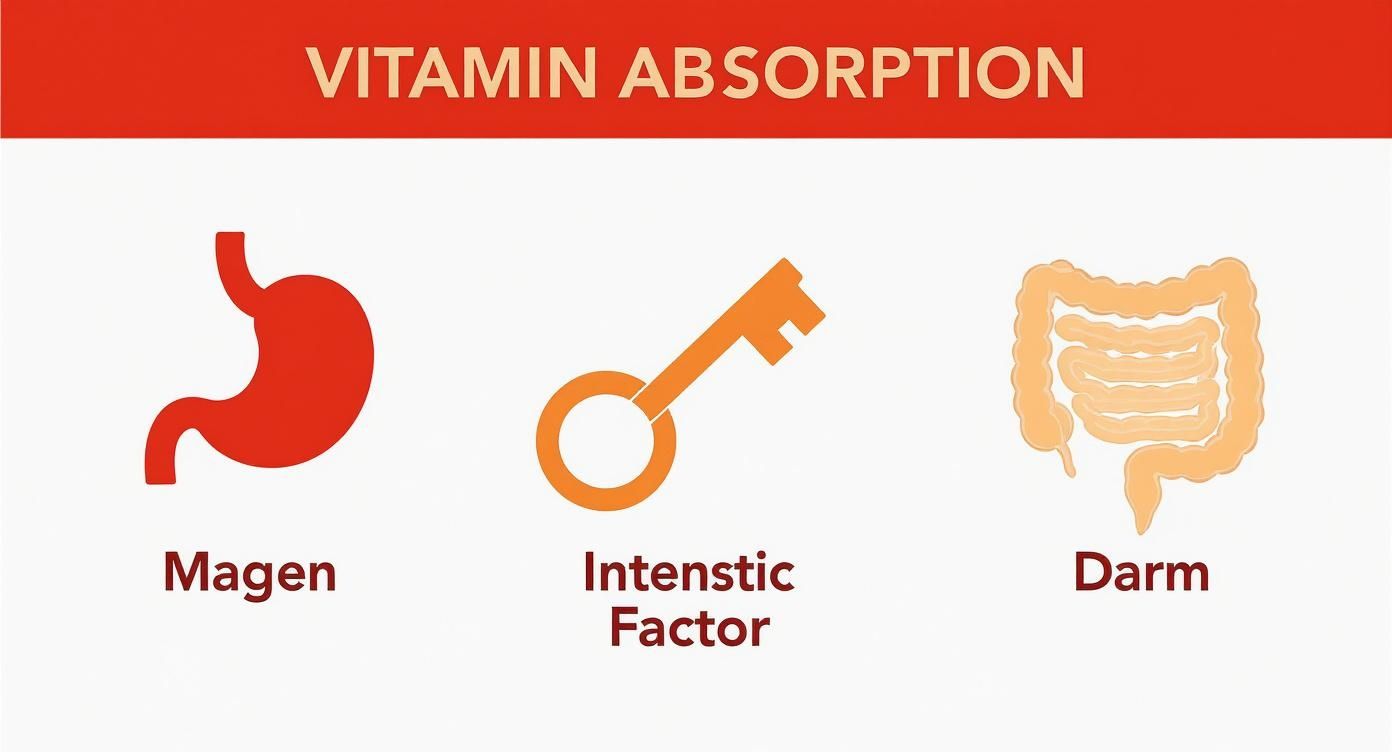
The graphic makes it clear: If just one of these stages fails, the entire supply chain collapses, inevitably resulting in a deficiency.
When Absorption Is Impaired
There are numerous factors that can disrupt this finely tuned process and are among the most common causes of vitamin B12 deficiency.
- Growing older: As we age, the stomach often naturally produces less acid. With atrophic gastritis, a chronic inflammation, the stomach lining becomes thinner, reducing both acid and intrinsic factor production.
- Gastrointestinal diseases: Chronic inflammatory bowel diseases such as Crohn’s disease or celiac disease can damage the intestinal lining. This impairs precisely the area where B12 is supposed to be absorbed. Read more in our article about celiac disease and gluten intolerance.
- Infections: The stomach bacterium Helicobacter pylori can cause chronic inflammation of the stomach lining and thereby severely impair B12 absorption.
- Operations: Anyone who undergoes stomach reduction surgery or other procedures involving the gastrointestinal tract risks having the areas responsible for B12 absorption removed or bypassed.
Precisely because impaired absorption plays such a major role, it is important to understand the underlying causes. In Germany, malabsorption is one of the main reasons for a deficiency, especially among older people. In fact, a vitamin B12 deficiency is detected in 10 to 50% of seniors, often as a result of precisely these age-related changes in the stomach.
The symptoms of a deficiency often develop gradually and are nonspecific, while the causes remain hidden deep within the body. A blood test is therefore the only reliable way to gain clarity about your B12 status and detect an absorption disorder.
A nutrient test from mybody-x can help you with exactly that—quickly and easily from the comfort of your home. This is how you can find out whether your body can actually utilize the vitamin B12 it absorbs.
How Medications Affect Your B12 Levels
Would you have thought that everyday medications can be secret “vitamin thieves”? They are often indispensable and help with many conditions, but as a side effect they can seriously disrupt your body’s absorption of nutrients. This is one of the most frequently overlooked causes of vitamin B12 deficiency, yet it can play an enormous role.
Some medications directly interfere with the complex absorption process we have already examined more closely. They disrupt the delicate balance in the gastrointestinal tract—and that is precisely what is so crucial for the body to process vitamin B12.
The most common B12 thieves from the pharmacy
Two groups of medications are particularly important here. Why? Because they are extremely widespread and have been shown to significantly increase the risk of B12 deficiency when taken long term.
-
Acid blockers (proton pump inhibitors): Medications such as omeprazole or pantoprazole are the standard treatment for heartburn and stomach ulcers. Their job is to drastically reduce the production of stomach acid. The catch is this: As you now know, this very stomach acid is the first key to releasing vitamin B12 from your food. Less acid therefore simply means that less B12 is available for absorption in the first place.
-
Metformin: This is one of the most important medications for treating type 2 diabetes. Studies have clearly shown that long-term use of metformin impairs the small intestine’s ability to absorb the important B12–intrinsic factor complex. The exact mechanism is still being researched, but the connection has been clearly established scientifically.
So if you take one of these medications over a longer period, you should definitely keep an eye on your B12 status. A deficiency often develops unnoticed over months or even years until the symptoms suddenly appear.
Taking certain medications is no reason to panic, but it is a clear reason to be more vigilant. Talk proactively with your doctor about vitamin B12 if you depend on acid blockers or metformin long term.
Most importantly: Never stop taking medication on your own. Being mindful and having regular checkups are the best ways to ensure an adequate supply and prevent a deficiency.
The following illustration shows you a selection of blood tests that you can use to conveniently check your nutrient status, including your vitamin B12 level, from home.
These tests give you the opportunity to take your health into your own hands. You can identify at an early stage whether a medication-related cause of vitamin B12 deficiency could play a role for you.
Genetics and lifestyle as underestimated risk factors
Sometimes the causes of a vitamin B12 deficiency are not obvious. In addition to diet, illnesses, and medications, there are other pieces of the puzzle that are often overlooked. We are sometimes literally born with these risks, or they develop over the years through certain habits.
For example, there are congenital metabolic disorders that disrupt the processing of vitamin B12 from birth. Although such genetic causes are rare, their consequences can be serious.
Your genetic blueprint
Some people are born with a genetic predisposition that makes it difficult for their bodies to use vitamin B12 properly. The vitamin is absorbed, but the crucial conversion into its active form simply does not work.
These congenital factors are increasingly coming into focus in Germany, especially in newborn screening. The Genetic Diagnostics Commission (GEKO) has issued clear recommendations for the early detection of such metabolic disorders. No wonder, because if left untreated, they can lead to severe developmental disorders. You can learn more about the background to early detection on the IGeL Monitor website.
How your lifestyle affects your B12 supply
Your daily life can also significantly disrupt your B12 balance. Excessive alcohol consumption plays a particularly harmful dual role.
- Liver damage: Your liver is the body's most important storage site for vitamin B12. If you regularly drink too much alcohol, you damage your liver cells. This impairs their ability to store this important vitamin and release it again when needed.
- Impaired nutrient absorption: Alcohol also irritates and damages the mucous membranes throughout the digestive tract. As a result, your small intestine is much less able to absorb B12 and other vital nutrients.
Your lifestyle is a powerful lever for your health. While you cannot change your genetics, you have complete control over your habits.
Other chronic conditions can also indirectly lead to a deficiency. For example, pancreatic insufficiency means that too few digestive enzymes are produced. However, these very enzymes are needed to separate B12 from its transport proteins in the small intestine—only then can it be absorbed by the body at all.
So you can see: Investigating the causes can be quite complex. A simple nutrient test from mybody-x gives you clarity about your B12 status so that you can take the right steps for your health.
How to reliably detect a B12 deficiency
Do you constantly feel tired and struggle to concentrate, but aren’t sure whether a vitamin B12 deficiency is really behind it? Many people know that feeling because the symptoms are often vague and can point to all kinds of things. Instead of continuing to grope around in the dark, you need clear facts. And the only way to gain real certainty about your B12 status is a blood test.
This is the only way to see in black and white how well supplied you are and whether one of the many causes of vitamin B12 deficiency applies to you. Fortunately, this kind of analysis is easier than ever today.
What your blood reveals about your B12 status
A blood test looks at very specific values that provide an accurate picture of your B12 status. In the past, this usually meant simply measuring total vitamin B12 in the blood serum. The problem is that this value isn’t particularly smart. It lumps together the active B12 that your body can use with an inactive form that is merely bound to other proteins as a “stowaway” and does nothing for you.
A normal total B12 level can therefore give you a false sense of security while a deficiency is already developing.
Much more modern and informative is the measurement of holotranscobalamin (Holo-TC). Think of it this way: This is the VIP value that measures exclusively “active B12”—only the molecules that actually bind to the right transport protein and can be absorbed by your cells. Holo-TC is essentially your early-warning system, sounding the alarm long before your total B12 level drops into the basement.
The easy way to gain more certainty: the home test
The good news is that you don’t have to make an extra trip to the doctor or sit in the waiting room for this clarity. With a mybody-x nutrient deficiency test, you can simply take matters into your own hands—conveniently from home.
The process couldn’t be easier and only takes a short time:
- Collect your sample: Use the test kit to briefly prick your fingertip and collect a few drops of blood yourself. It really is that simple.
- Send in your sample: Place the sample in the enclosed return envelope and send it directly to our certified German specialist laboratory.
- Get your results: After a short time, you’ll find your evaluation in your personal customer account—discreetly, securely, and presented in a way that’s easy for you to understand.
This is how you take back control of your health data and can finally make fact-based decisions. If you want to take a deeper look at how to identify various nutrient deficiencies, you’ll find even more valuable information in our comprehensive guide to the nutrient deficiency test.
The most important questions and answers at a glance
Finally, let's clear up the most common questions we keep receiving about the causes of vitamin B12 deficiency. This will ensure you are well prepared and can confidently apply what you have learned.
Can stress trigger a B12 deficiency?
The short answer is: not directly. Stress alone neither blocks the absorption of vitamin B12 nor prevents you from getting it through your diet. But—and this is the crucial point—chronic stress can lead to behaviors that significantly increase the risk of a deficiency.
Who doesn't know the feeling? During stressful periods, people are more likely to reach for unhealthy food, their diet becomes one-sided, or their alcohol consumption increases. Chronic stress can also promote gastrointestinal problems such as gastritis, which in turn interferes with B12 absorption. Stress is therefore more of a hidden accelerant than the actual cause.
How quickly does a deficiency develop?
It varies greatly from person to person and depends heavily on the cause and your personal B12 stores. Your liver is a real reservoir and can store the vitamin for three to five years.
So if you start following a purely vegan diet but do not take supplements, it can actually take years for the first symptoms to appear. Things look very different if an absorption disorder is present—for example, after stomach surgery. In that case, the stores can be depleted much more quickly.
Important to know: A deficiency almost always develops quietly. Symptoms often do not become noticeable until the stores have already been dangerously depleted. This makes early monitoring all the more important!
Are people in Germany generally well supplied with B12?
Broadly speaking: yes. According to the National Nutrition Survey II, most men and women in Germany even consume more vitamin B12 than recommended. You can read more about this in the findings on vitamin B12 intake from the German Federal Institute for Risk Assessment.
The real problem is therefore less often the intake itself and much more frequently an undetected absorption disorder. That is precisely why even people who eat a balanced mixed diet can develop a deficiency. Without a test, you are often completely in the dark.
Are you finally ready to gain clarity about your vitamin B12 status and take charge of your health? A mybody-x blood test gives you quick and easy certainty, conveniently from home. Find the right analysis for you now at https://mybody-x.com.



Share now:
Iron and vitamin B12 deficiency symptoms: recognize and take action
Your vitamin B test for more energy and well-being