

Detecting vitamin deficiencies with a self-test: A guide to reliable results
TL;DR:
- Many people in Germany suffer from vitamin D, B12, and iron deficiencies.
- Self-tests can provide initial guidance, but they are not a substitute for medical diagnoses.
- Laboratory-based tests are the most reliable; rapid tests are more prone to inaccuracy and should be used with caution.
Sometimes it is a vague feeling: constant fatigue, brittle nails, poor concentration. Many people attribute these symptoms to stress or poor sleep, but a hidden vitamin deficiency could be behind them. In Germany, this is not a marginal issue: vitamin D, B12, and iron deficiencies are particularly common. Anyone who does not want to see a doctor right away can use a self-test to get a first reliable indication. This guide shows you step by step what tests are available, how to use them correctly, and what to do with the results without falling into the trap of self-medication.
Table of contents
- Important requirements and choosing suitable self-tests
- Preparation: What you need for the self-test
- Step by step: How to use the vitamin deficiency self-test correctly
- Interpreting results and taking sensible action
- Our assessment: The benefits and drawbacks of self-tests for vitamin deficiency
- Next steps: Take your health into your own hands
- Frequently asked questions
Key findings
| Point | Details |
|---|---|
| Self-tests as a starting point | Laboratory-based tests are a safe first step for healthy people to check their vitamin status. |
| Proper preparation matters | Careful preparation and following the instructions minimize errors and provide more reliable results. |
| Review results critically | Rapid tests and hair analyses are less reliable; if you are unsure or have symptoms, always consult your family doctor. |
| Diet is the focus | A balanced, varied diet is usually more effective than taking supplements indiscriminately when there is no deficiency. |
Important requirements and choosing suitable self-tests
Not everyone needs the same test. Before buying a self-test, it is worth honestly considering why you want to test. Healthy adults without known illnesses can use self-tests effectively for prevention. However, anyone who already has symptoms or takes medication should seek medical advice first.
The following groups in particular benefit from regular self-testing:
- Vegans and vegetarians, who often have low vitamin B12 and iron levels
- Older people with impaired nutrient absorption
- People with little sun exposure who have an increased risk of vitamin D deficiency
- Pregnant or breastfeeding women with increased nutritional needs
- Highly physically active people who use more micronutrients
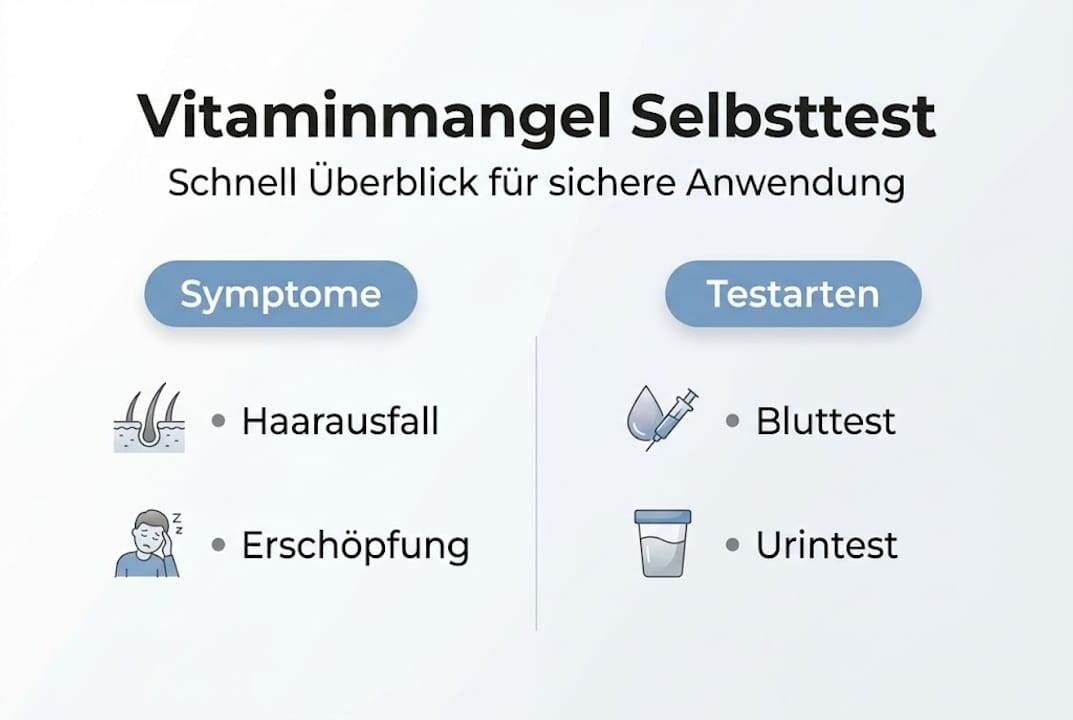
The common symptoms of vitamin deficiencies, such as hair loss, fatigue, or muscle cramps, can provide initial clues about which nutrients you should have tested.
Self-tests for vitamin deficiencies include at-home blood tests, rapid tests, and urine tests, most commonly for vitamin D, B12, and iron. Here is an overview of the main types of tests:
| Test type | Method | Accuracy | Cost (approx.) |
|---|---|---|---|
| Capillary blood test (laboratory) | Finger prick, send in sample | High | 20 to 90 euros |
| Rapid test (strip) | Finger prick, immediate result | Low to medium | 5 to 10 euros |
| Urine test | Urine sample, strip, or laboratory | Medium | 10 to 30 euros |
| Hair analysis | Send in a hair sample | Low | 30 to 80 euros |
The at-home blood tests in detail show that laboratory-based capillary blood tests are the most reliable method for home use. Hair analyses, on the other hand, are considered by experts to provide little meaningful information about vitamin levels.

Pro tip: Only buy self-tests from certified providers, pharmacies, or directly from laboratories. Cheap products without CE marking often produce unusable results.
If you have symptoms of a nutrient deficiency, such as persistent fatigue or numbness, you should not consider the self-test a substitute for a medical diagnosis, but rather as a complementary first step.
Preparation: What you need for the self-test
A good test result begins long before the actual sample collection. Good preparation helps you avoid the most common sources of error and obtain results you can truly rely on.
Laboratory-based self-tests generally provide more reliable results than rapid tests or hair analyses, but only if the sample is collected and transported correctly. This starts with proper preparation.
You should have the following materials and information ready:
- Check the test kit carefully: Are all components (lancet, tube, plaster, shipping box) included?
- Read the instructions for use: Read them completely, rather than just skimming them. Each type of test has specific instructions.
- Prepare hygiene supplies: Disinfectant, a clean surface, and disposable gloves if recommended.
- Check fasting requirements: Many tests, especially those for blood sugar, iron, or vitamin D, require fasting for 8 to 12 hours.
- Clarify the timing: Capillary blood tests should be performed in the morning so that the sample can be sent on the same day.
When testing yourself for a nutrient deficiency, the timing of sample collection is particularly important. A test in the evening after eating can cause deviations that distort the result.
A comparison of the requirements for different types of tests:
| Test type | Fasting required? | Shipping required? | Waiting time for the result |
|---|---|---|---|
| Laboratory-based capillary blood test | Yes, usually 8 hours | Yes, by mail | 3 to 7 business days |
| Rapid test | No | No | 15 to 30 minutes |
| Urine test | Partially | Sometimes | Immediately to 5 days |
If you want to identify a vitamin D deficiency, we recommend taking the test in winter or early spring, when levels are at their lowest. This makes the result particularly meaningful.
Store the test kit in a cool, dry place until use. Heat or direct sunlight can damage the reagents and distort the result.
Step by step: How to use the vitamin deficiency self-test correctly
Now it is time to carry out the test itself. Carefully following the steps below minimizes errors and provides a result that is genuinely meaningful.
- Wash and warm your hands: Clean, warm hands promote circulation and make drawing blood from the finger much easier.
- Disinfect the test site: Clean the side of the fingertip, not the center, with the enclosed swab and let it dry briefly.
- Position the lancet correctly: Place it firmly and vertically, then trigger it. Do not squeeze; gently massage until enough blood flows.
- Fill the sample correctly: Wipe away the first drop of blood, then fill the tube or test strip as instructed.
- Secure and send the sample: Seal the tube, place it in the shipping box, and take it to the post office on the same day if possible.
- Read the rapid test: For strip tests, read the result exactly at the specified time, not earlier or later.
Rapid tests provide only indications and are prone to errors, while laboratory-based finger-prick blood tests provide values that are often close to those obtained by a doctor. This is an important difference that many people underestimate.
Pro tip: Set out the test kit the evening before and set an alarm for the morning. People who carry out the test hastily between two appointments make sampling errors more often.
When testing correctly for vitamin D deficiency, the amount of blood is particularly critical: Too little blood in the tube leads to invalid results. It is better to massage gently once more than to stop too soon.
Important: An abnormal test result is not a reason to immediately buy dietary supplements. Take action only after consulting a doctor or nutrition professional. Overdoses, especially of fat-soluble vitamins such as vitamins D and A, can be harmful to your health.
The risks of rapid tests lie primarily in false-negative results: Someone who has a deficiency may receive an unremarkable result and feel falsely reassured. A home vitamin D test from a laboratory is considerably more reliable in this regard.
Interpreting results and taking sensible action
The result is available. Now comes the part many people underestimate: responding to it appropriately.
With a laboratory-based test, you receive a detailed report with your measured values and reference ranges. If your value is in the green range, everything is fine. If it is just below it, it is worth optimizing your diet first. If the values are significantly abnormal, medical advice is essential.
The following points help with interpretation:
- Pay attention to reference ranges: Each laboratory specifies its own normal values. A value just below the reference range is not the same as a severe deficiency.
- False-positive results are possible: Stress, infections, or the time of day can temporarily change values.
- One measurement is not a verdict: A single value says little. Trends across multiple measurements are more meaningful.
- Nutrition first: Before buying supplements, check whether a targeted dietary adjustment is sufficient.
In the case of concerning symptoms or abnormal results, experts recommend consulting your family doctor first and improving your diet before starting supplementation.
| Result | Recommended response |
|---|---|
| Value within the normal range | No action needed; maintain your diet |
| Slightly below the normal range | Adjust your diet and retest after 8 weeks |
| Significantly below the normal range | See a doctor and, if necessary, take targeted supplements |
| Rapid test abnormal | Have a laboratory test performed for confirmation |
If you want to address symptoms specifically, combining the test result with dietary adjustments is the safest approach. Taking individual action for vitamin deficiency always requires personal context: age, diet, lifestyle, and pre-existing conditions all play a role.
According to Stiftung Warentest, a varied, colorful diet is sufficient for most healthy adults to prevent deficiencies. Supplements are not a substitute for a good diet.
Our assessment: The benefits and drawbacks of self-tests for vitamin deficiency
Self-tests have their place in modern preventive healthcare. But they are often used incorrectly. Anyone who takes a comprehensive test every month without having specific reasons is engaging in health anxiety, not prevention.
The real benefit lies elsewhere: A targeted test for a known risk group, carried out at the right time of year with a reliable laboratory provider, offers genuine added value. A vegan who checks their B12 status is acting wisely. Someone who tests five different vitamins without symptoms or risk factors is primarily spending money.
Self-tests offer opportunities for self-monitoring, but they do not replace critical questioning or medical diagnosis. This applies especially to hair analyses and inexpensive rapid tests, which experts explicitly warn against.
A test result is not a license for self-medication. It is a starting point for a conversation with your doctor, your nutritionist, or well-founded nutrient deficiency and diagnostic resources. By keeping this in mind, you use self-tests as intended: as a tool for informed personal responsibility.
Next steps: Take your health into your own hands
You now know how to properly choose, prepare for, and evaluate a self-test. The next logical step is to find a test that truly suits your profile. Not everyone needs the same thing. If you want to specifically check your personal nutrient status, mybody®x tests and services offer ISO-certified laboratory analyses that can conveniently be conducted at home. With more than 11,300 satisfied customers and an average rating of 4.77 stars, mybody® provides scientifically validated reports including personalized nutrition recommendations. Free shipping from 49 euros, a money-back guarantee, and the highest level of data security included.
Frequently asked questions
How reliable are self-tests for detecting vitamin deficiencies?
Laboratory-based tests provide realistic values that are often close to a doctor's results, while rapid tests offer only rough indications and are significantly more prone to errors. For reliable decisions, you should always choose a laboratory-based test.
Who can benefit from vitamin deficiency self-tests?
At-risk groups particularly benefit from targeted testing, including vegans, older people, and those with little sun exposure. Healthy adults without risk factors can use self-tests for preventive purposes on their own initiative.
How much does a vitamin deficiency self-test cost?
Rapid tests cost around 5 to 10 euros, while laboratory-based tests range from 20 to 90 euros depending on their scope. The higher price generally also reflects significantly greater accuracy.
When should I consult a doctor without fail?
If test results are abnormal or symptoms of illness persist, medical advice is essential. A self-test can never replace a medical diagnosis.
Which vitamins are most commonly checked with at-home tests?
Most at-home tests check vitamin D, B12, and iron as standard markers, as these nutrients are particularly commonly under-supplied in Germany.
Recommendation
- Test for nutrient deficiencies: Identify symptoms & specifically address deficiencies – mybody®x
- Identify vitamin deficiencies and take individualized action – mybody®x
- How to identify nutrient deficiencies: How to test your deficiencies in autumn – mybody®x
- How to properly test for vitamin D deficiency – mybody®x
- Nutrition Profile Self-test – LifeUnlocked



Share now:
Allergic rash: Find the causes & take the right action
Food allergy rash: causes and what you can do