
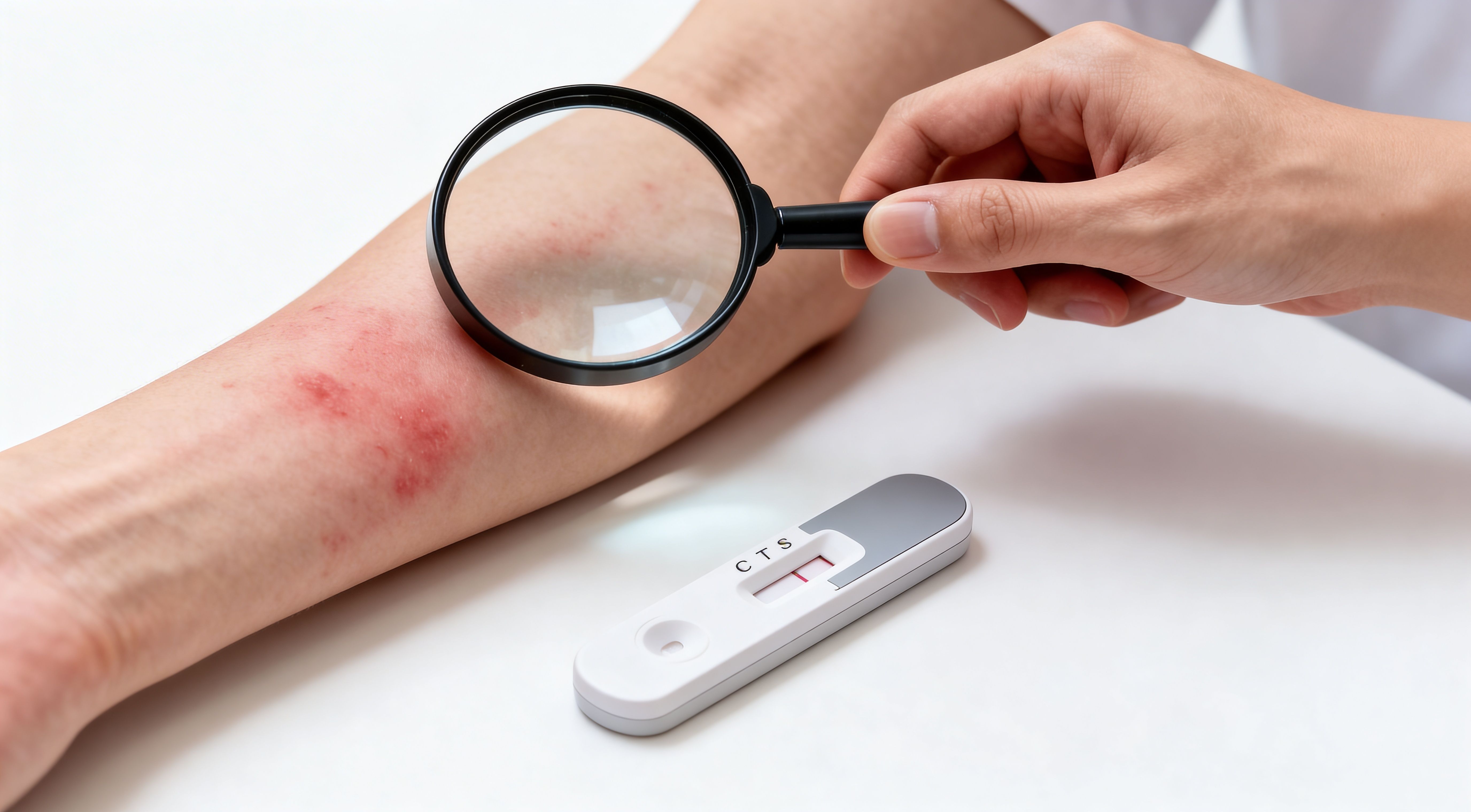
Allergic rash: Find the causes & take the right action
You pull up your sleeve and suddenly there it is. A red patch. Maybe it itches, maybe it burns slightly, or perhaps it is even spreading. Then the thought spiral begins. Was it the new detergent, a food, stress, pollen, or just dry skin?
This uncertainty is exactly what makes skin rashes so distressing. You can clearly see something on your skin, but the cause often remains invisible. And as long as you do not know the trigger, you can quickly end up treating only the surface.
Red skin and itching – Is it an allergic rash?
Perhaps it started harmlessly enough. A small, itchy spot on the wrist after wearing a bracelet. Or red, rough patches of skin on the neck after using a new cream. Some people notice the rash only in the evening, while others see it in the morning after getting up. Precisely because an allergic rash can look so different, it is often confused with dry skin, irritation, or intolerance.

Why so many people are initially left in the dark
Skin reactions are visible, but not always clear-cut. The same redness can have very different causes. This is frustrating, especially when you have already stopped using certain products, switched creams, or started trying to identify possible food triggers.
There is another important point: allergies and skin reactions are not a marginal issue. Almost 20% of adults in Germany have at least one allergy. Allergic skin reactions such as contact eczema affect around 8.1% of the population, according to data from the Robert Koch Institute’s DEGS1 study, as summarized by Springer Medizin.
The most important question is not just what you see
The key question is: What triggered the reaction? Because that determines what will really help you.
A few typical situations:
- After contact with something new, a fragrance, metal, or preservative may be involved.
- After eating, you may immediately think of a food allergy. But sometimes something else is behind it.
- During certain seasons, pollen may play a role, including through cross-reactions with foods. If you want to better understand the issue, this overview of cross-allergies can help.
When a rash comes back, it is a signal. Not necessarily that something is dangerous, but almost always that your body is reacting to something.
Not just soothe, but understand
Many people first try to get rid of the itching. That is understandable. But if you only relieve the symptoms without knowing the cause, the rash often returns.
A good first step, therefore, is not to take immediate action, but to observe. Where is the rash located? When does it appear? What was different shortly beforehand? These questions often provide more clarity than quickly reaching for the next cream.
What Exactly Happens in the Body During an Allergic Rash
An allergic rash is not simply the skin acting up. It is caused by a reaction from your immune system. You can think of it as an overcautious security system. It classifies a substance that is actually harmless as a threat and sounds the alarm.

An Allergy Is Not the Same as an Irritation
This is one of the most common sources of confusion. Not every red or itchy area of skin is an allergy.
According to Techniker Krankenkasse, an allergic rash is caused by an immunological overreaction, often 24 to 72 hours after contact. A skin irritation, by contrast, is a direct, non-immunological reaction. The clinical distinction is important because true allergies require systemic solutions such as allergen avoidance, which can be narrowed down through testing. You can find an explanation in Techniker Krankenkasse’s information on contact allergies.
What this looks like in everyday life
An irritation is more likely to occur when the skin is directly attacked. For example, by harsh cleaning products, frequent handwashing, or irritating substances. The skin then reacts locally, often exactly where contact occurred.
An allergy works differently. The immune system “remembers” a substance. Upon the next contact, it triggers a defense response. Typical symptoms include:
- Redness and itching at or around areas of contact
- Hives or small blisters
- Indistinct edges rather than a clearly defined irritation
- Delayed onset, not always immediately after exposure
Why this matters for your next steps
If you treat an irritation like an allergy, you often look in the wrong place. And if you dismiss an allergy as merely dry skin, the trigger remains active.
This also applies to symptoms after eating. Not everything that itches or turns red after tomatoes, cheese, or wine is automatically a classic allergy. This is exactly where the topic of histamine becomes interesting, because the symptoms can feel remarkably similar.
The best treatment does not start with the cream, but with making the right assessment. Irritation, allergy, and intolerance often look similar, but they require different responses.
A Simple Rule of Thumb
If the skin reacts immediately after intense exposure, that points more toward irritation. If the body responds to a particular substance after a delay and repeatedly, an allergy becomes more likely.
This distinction may seem minor. In practice, it often saves a great deal of time, unnecessary restrictions, and incorrect self-diagnoses.
The Most Common Triggers of Allergic Skin Reactions
When faced with an allergic rash, many people immediately think of a particular food. That may be true. But it is only part of the picture. Skin reactions often result from a combination of contact factors, environmental irritants, and internal processes.
The Usual Suspects in Everyday Life
Some triggers come into direct contact with your skin. Others enter the body through the airways or food. That is precisely why identifying the cause can be so difficult.
Common contributing factors include:
- Metals and jewelry, such as nickel-containing materials in earrings, buttons, or watches
- Cosmetics and skincare products containing fragrances, preservatives, or dyes
- Laundry detergents and cleaning products, especially when the skin barrier is sensitive
- Pollen and contact with animals, which can cause not only sneezing but also skin problems
- Food, either as true allergens or as triggers in cases of existing sensitivity
Your surroundings matter too. Moisture, mold, and persistently polluted indoor air can further irritate the skin and mucous membranes. If you live or work in damp rooms, a practical guide to removing mold in the bathroom can be useful, because the living environment is often underestimated when it comes to sensitive skin.
The Often-Overlooked Difference Between an Allergy and Histamine
A turning point in identifying the cause is the question: Is it really an allergy?
Many symptoms that look like an allergic rash can also be caused by histamine intolerance. According to the specified data, this affects an estimated 1 to 3% of the population in Germany, as described by the Chamber of Pharmacists of Carinthia in relation to skin rashes. Unlike an IgE-mediated allergy, this suspected condition can be narrowed down using home tests, for example by testing the DAO enzyme.
Why This Is So Often Confused
After a glass of red wine, aged cheese, or certain processed foods, redness, itching, or hives may occur. For those affected, this often clearly feels “allergic.” Biologically, however, it may also be a histamine-related issue.
That is why the question is not only “What do I react to?”, but also “How do I react?”. For everyday life, it is worth looking at histamine-rich foods, because patterns often emerge there.
If you avoid entire food groups indiscriminately, you can quickly lose track. It is more precise to compare reactions over time with foods, contact substances, and your surroundings.
A realistic perspective
Not every rash has just one trigger. Sometimes a contact allergen affects skin that is already irritated. Sometimes stress intensifies an existing sensitivity. And sometimes an intolerance looks like an allergy.
That is precisely why guessing rarely gets you far. Patterns are more useful than assumptions.
On the trail of the trigger – How to find the cause
Many people only see a doctor when the rash becomes more frequent or severe. That makes sense. At the same time, it helps enormously to go into such a conversation prepared. The more clearly you can describe patterns, the more targeted the diagnostic process can be.

Traditional diagnostics in a medical practice
Depending on the suspected cause, different tests may be considered at a dermatologist’s office. Contact allergies are often investigated with a patch test. In other cases, additional allergy tests may follow.
The advantage is clear. Doctors can examine the skin directly, clinically assess rashes, and take coexisting conditions into account. The disadvantage: You need appointments, often patience, and sometimes good preparation, such as keeping notes on your symptoms.
How blood tests are different
Modern blood diagnostics can provide clues without requiring you to wait for a visible skin reaction during a skin test. This is particularly helpful if you have recurring symptoms but cannot clearly identify the trigger.
According to the specified data, modern blood tests such as the ALEX-IgE profile can analyze specific antibodies against nearly 300 allergens and achieve a detection rate of 99% of relevant triggers. This molecular precision also makes it possible to identify cross-reactions. This is described by IMD Berlin for the diagnosis of type I allergy.
Two approaches compared
| Method | What it does well | Where it has limitations |
|---|---|---|
| Doctor’s visit with a skin test | Visual examination, clinical assessment, direct questions | Appointment required, not always immediately available |
| Home blood test | a structured initial overview, measurable indications of antibodies or other markers | does not replace medical diagnosis in emergencies or severe cases |
How to proceed wisely
Instead of blindly eliminating everything, follow this order:
-
Record symptoms
When did the rash appear, exactly where, and after which food, product, or contact? -
Take recurrences seriously
A one-time rash may be coincidental. Recurring patterns are less likely to be. -
Narrow it down with suitable tests
IgE tests can help when an allergy is suspected. Other markers are used when histamine or nutritional issues are suspected. -
Compare results with everyday life
A laboratory value only becomes useful when you connect it with real-life situations.
For this first step, a DIY allergy test may be worth considering. In the field of home diagnostics, the mybody x blood test also offers options that are intended to help assess allergens, intolerances, or related nutritional issues, depending on the question.
The aim of a home test is not to self-treat based on assumptions. The aim is to gain more clarity so that you can make more informed decisions about what to avoid, what to monitor, and when to seek medical help.
Why your skin health begins in the gut
Many people look for the cause of an allergic rash only on the surface of the skin. This is understandable because that is where the symptoms are visible. But the skin is not an isolated organ. It is closely connected with your immune system, your diet, and your gut.

The gut-skin axis explained simply
A complex microbiome lives in your gut. This community of microorganisms influences how well your mucous membranes function, how your immune system responds, and how steadily inflammatory processes are regulated.
When this balance is disrupted, the consequences may not be felt in your stomach first, but on your skin. The skin barrier then becomes more sensitive, and reactions can flare up more easily or persist for longer.
What is known
According to the specified data, studies indicate a strong correlation between the skin and the gut. Up to 25% of patients with atopic dermatitis have an impaired gut microbiome, which can weaken the skin barrier and promote systemic inflammation. This figure is cited in the Helios article on the connection between skin rashes and the gut.
This does not mean that every rash originates in the gut. But it does mean that if you treat only the outside, you may be overlooking part of the cause.
When this perspective is especially useful
Looking at your gut and nutrients can be particularly helpful when:
- the rash keeps coming back, even though you have already avoided obvious contact substances
- you also have digestive symptoms or bloating, alternating stools, or discomfort after eating
- your skin has generally become sensitive, without a single clear trigger being identifiable
Why nutrients matter here
Nutrients also influence the skin and immune response. If your body lacks the building blocks for regeneration, barrier function, or histamine breakdown, this can worsen symptoms.
That’s the holistic aspect many guides leave out. Not only “What can’t you tolerate?” but also “What might your system be lacking to respond stably?”
Skin problems are sometimes not purely a matter of contact. They may indicate that your body needs more support internally than externally.
Immediate relief and long-term strategies for a rash
When your skin is acutely itchy or burning, you want relief first. Understandably. At the same time, it’s worth having a plan that not only soothes today’s rash but also provides sensible structure for the coming weeks.
What you can do right now
Keep it simple. Irritated skin does not respond well to experimentation.
-
Stop contact
For now, stop using any new product or piece of jewelry, and avoid any suspicious food. -
Soothe your skin
Use lukewarm water instead of hot showers. Avoid friction. Avoid heavily fragranced products whenever possible. -
Document your symptoms
Take a photo, note the time, and record possible triggers. Later, this can be incredibly valuable. -
Take warning signs seriously
If swelling, breathing problems, circulatory symptoms, or rapidly worsening symptoms occur, you need immediate medical attention.
What helps more in the long run
In the long term, the most extensive avoidance list is not what helps most—it’s a personalized plan. Depending on the cause, it can look very different.
Some people benefit most from consistently avoiding a contact allergen. Others need more structure when it comes to histamine-rich foods. Still others notice that their skin and digestion are both becoming unsettled, with an underlying gut or nutrient-related issue more likely.
A practical long-term plan
| Area | Useful question | Possible consequence |
|---|---|---|
| Contact substances | Does your skin react to jewelry, cosmetics, or laundry detergent | Replace products and avoid triggers |
| Diet | Do you experience reactions after certain meals | Check patterns and test selectively instead of eliminating things indiscriminately |
| Gut and nutrients | Do skin and digestive symptoms occur together | consider internal causes and adjust your diet |
The part of the body also plays a role. Itching on the face, arms, or in the intimate area each has its own pitfalls. If you want to assess symptoms specifically in that area, this overview of itching in the intimate area is helpful for comparison, because not all itching is automatically allergic.
The most important shift in perspective
Don't look for one miracle solution. Look for the pattern. Skin often reacts only at the end of a chain. Once you recognize the chain, the rash becomes much more predictable.
Frequently asked questions about allergic rashes
Can an allergic rash suddenly begin in adulthood
Yes. Your immune system can also react later to substances you previously seemed to tolerate well. This is often only noticed gradually, especially with repeated contact with cosmetics, metals, or environmental irritants.
Is there anything I should bear in mind before taking an at-home test
Always read the instructions for the relevant test carefully. Proper sample collection, correct labeling, and a realistic view of the result are important. A test can help narrow things down, but severe symptoms still require medical evaluation.
What should I do after an abnormal result
The most useful approach is to compare the result with your symptom diary. This allows you to decide more specifically what to avoid for now and what to have medically investigated further.
Can I simply keep experimenting if I have a rash
Not for too long. If you constantly switch products while also eliminating foods, you can quickly lose track. Clear steps are more helpful than frantic trial and error.
If you no longer want to guess when you have a recurring rash, taking a structured look at allergens, intolerances, or possible nutrient-related issues can be useful. At mybody x blood test, you can find at-home self-tests that help you gather initial indications and better assess your symptoms.


Share now:
Recognize vitamin deficiencies and take individualized action
Detect vitamin deficiencies with a self-test: Guide to reliable results