

Pimples before your period: Causes, tips, and how to restore balance to your skin
It is almost an unwritten rule: A few days before your period begins, they appear out of nowhere—the dreaded pimples before your period. If this sounds familiar, you are definitely not alone. These skin changes are not the result of inadequate skincare, but rather the direct result of the hormonal roller coaster your body goes through every month. In this guide, we explain exactly what happens in your body and how, with the right knowledge and targeted measures, you can regain control of your skin.
The monthly countdown: Why pimples appear before your period
Imagine your menstrual cycle as a perfectly rehearsed dance choreography in which different hormones take on the leading roles. In the first half of the cycle, known as the follicular phase, estrogen takes the lead. It is the “glow hormone,” responsible for plump, well-circulated, radiant skin.
But after ovulation, around the middle of the cycle, the music changes—and so does the cast on stage. Your body now prepares for a possible pregnancy and begins the luteal phase.
The hormonal ballet in the second half of the cycle
During this second phase, estrogen levels drop significantly, while another hormone, progesterone, takes over. At the same time, levels of male hormones (androgens), such as testosterone, remain relatively constant. This new hormonal balance has a direct impact on your skin.
The hormonal imbalance before your period is the main trigger for blemished skin. A falling estrogen level, combined with dominant progesterone and relatively higher androgen levels, stimulates sebum production and creates ideal conditions for pimples.
Progesterone causes the skin to swell slightly, which can in turn narrow the pores. At the same time, androgens signal the sebaceous glands to produce more sebum (in other words, skin oil). The result is an unfortunate combination: more sebum that has to drain through narrower pores.
From clogged pore to inflamed pimple
This buildup of sebum is the perfect breeding ground for bacteria that naturally live on our skin. In the clogged pore, they can multiply rapidly and trigger an inflammatory reaction. The result is what you see in the mirror as a painful, red pimple.
To help you better visualize the interplay between your cycle, hormones, and complexion, we have created a short overview for you.
Your skin in rhythm with your cycle
This table gives you an overview of how your skin changes during the different phases of your cycle and which hormones play the leading role.
| Cycle phase | Typical skin condition | Dominant hormones | What happens in your body |
|---|---|---|---|
| Follicular phase (days 1–14) | Usually clear, radiant, and well hydrated | Estrogen | Estrogen stimulates collagen and hyaluronic acid, making the skin plump and resilient. |
| Ovulation (around day 14) | Often the “glow peak,” radiant and rosy | Estrogen (peak), LH | Estrogen levels are at their highest, and the skin looks its best. |
| Luteal phase (days 15–28) | Oilier, more prone to blemishes & pimples | Progesterone, androgens | Estrogen decreases, while progesterone and androgens stimulate sebum production and pores narrow. |
| Menstruation (from day 1) | Often dry and sensitive; blemishes heal | All hormones at low levels | The skin gradually calms down as hormone levels drop sharply. |
These phases give you a good indication of when your skin needs special attention.
The following infographic clearly illustrates how your well-being and skin condition change with the hormonal phases of your cycle.
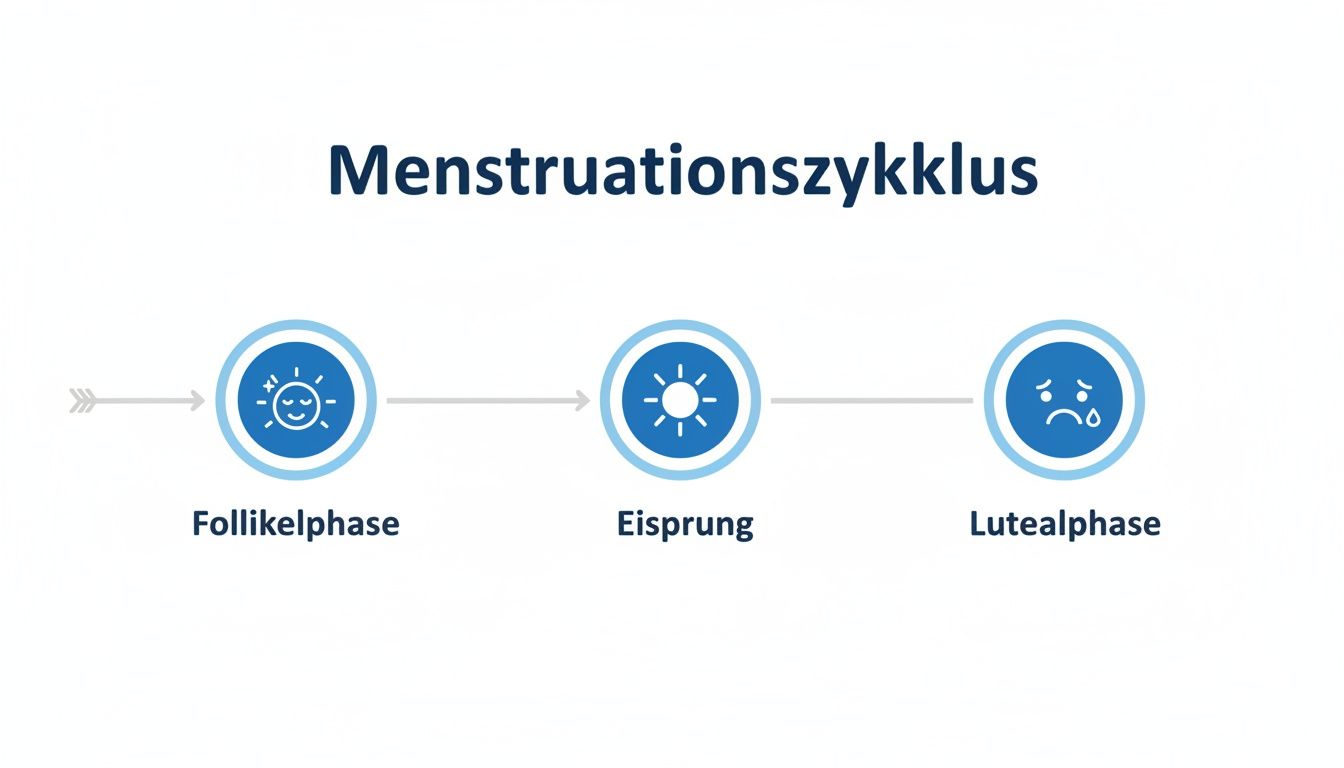
As you can see, the luteal phase is the critical time when your skin is particularly prone to blemishes, before the cycle begins again with menstruation.
This knowledge is the first and most important step toward regaining control. When you understand why your skin reacts the way it does, you can find the right solutions for yourself instead of feeling helpless. It’s not about fighting your body, but about understanding it and supporting it as effectively as possible.
Taking a closer look at your personal hormone levels can make all the difference here. With a hormone test from mybody®x, you can find out exactly whether you have an imbalance that may be exacerbating these skin problems. This gives you the perfect foundation for a strategy that truly addresses you and your needs.
What’s really behind hormonal acne
To understand why your skin goes haywire during certain phases of your cycle, we need to take a look at what is actually happening in your body. Because one thing is certain: it has nothing to do with inadequate skincare, but is the result of a finely tuned—though sometimes turbulent—hormonal dance.
After ovulation, during the second half of your cycle—the so-called luteal phase—the hormonal landscape in your body changes completely. Your estrogen level, the “glow hormone” that often gives you a great complexion during the first half, noticeably drops. At the same time, progesterone takes over, while the level of male hormones, such as testosterone, remains relatively constant.
This exact hormonal shift is the starting signal for what you know as pimples before your period.
The double attack on your pores
Think of your sebaceous glands as small factories that suddenly receive completely new work instructions. Two hormones are the main players, creating a rather unfortunate combination:
- Progesterone makes the pores narrower: This hormone causes slight swelling of the skin. As a result, the openings of your pores narrow, and sebum cannot drain as easily.
- Androgens stimulate sebum production: The now relatively dominant androgens, such as testosterone, simultaneously signal the sebaceous glands to step up their activity and increase production.
The result is the perfect storm for blemished skin. More sebum is produced, while it simultaneously has to flow through narrower channels. This buildup of excess sebum and dead skin cells is the ideal breeding ground for bacteria. The logical consequence: an inflammatory reaction that appears as a deep, often painful pimple.
You’re far from alone, by the way. Studies show that about 60–65% of women who are already prone to acne notice a clear worsening of their skin shortly before their period.
Why the chin, jaw, and neck are affected in particular
Have you ever wondered why these annoying pimples seem to keep appearing in the same places? It’s not a coincidence. The lower part of your face—your chin, jawline, and neck—is often referred to as the “hormonal zone” or “U-zone.”
The reason is simple: these areas have particularly many and particularly sensitive docking sites (receptors) for androgens. The sebaceous glands here therefore react much more strongly to hormonal signals than, for example, those on your forehead.
Your body is telling you exactly where the cause lies. The recurring pattern on your chin and jaw is a clear sign that your skin is reacting to the hormonal changes in your cycle.
This knowledge is the key. It helps you understand that this is an internal process that also requires targeted support from within. Once you know the “why” behind the pimples, you can stop treating only the symptoms on the surface and instead address the root cause.
The exact balance of your hormones is, of course, highly individual. Progesterone plays a crucial role in the second half of the cycle, and an imbalance can trigger a wide range of symptoms. If you’d like to learn more, take a look at our article on the symptoms of low progesterone levels. A deeper understanding of your personal hormone levels can help you better assess the underlying causes.
How a blood test can provide clarity about your hormones
General advice and expensive skincare products are a good start, but let’s be honest: Often, they only scratch the surface. If breakouts before your period stubbornly return month after month, the real cause usually lies deeper—in your personal hormonal balance. Your body is unique, and what works wonders for your friend may not work for you at all.
Instead of feeling around in the dark and trying one cream after another, there’s a way to finally get precise, data-driven answers. This is where an at-home hormone test from mybody®x comes in. It’s like a personal compass that guides you toward a better understanding of your body.
Enough guessing—bring on the facts
A blood test gives you the facts about your hormone profile in black and white. Instead of merely guessing whether your progesterone level might be too low or your relative androgen level too high, you get precise values. That’s the crucial advantage: You move from a general suspicion to a concrete, personal insight.
Imagine trying to repair a car without looking under the hood. A hormone test is that look under the hood—it shows you exactly where the problem lies so you can address it specifically.
With an at-home blood test from mybody®x, you can conveniently and discreetly check the levels of the most important hormones that affect your skin from home. These include:
- Estrogen: The “glow hormone” that helps keep skin plump and clear.
- Progesterone: Takes the lead in the second half of the cycle and can constrict the pores.
- Testosterone: An androgen that directly stimulates sebum production.
Knowing the exact ratio of these hormones to one another is key. It’s the only way to truly understand why your skin keeps reacting with blemishes.
The easy way to check your personal hormone levels
You may associate a blood test with complicated doctor’s appointments and long waiting times. However, the modern at-home self-tests from mybody®x make the process surprisingly simple and straightforward. The process is designed to give you maximum control with minimal effort.
The screenshot shows the mybody-x.com homepage, where you can find the various health tests available. Here you can see how easy it is to access personalized health data delivered directly to your home.
The entire process can be completed in just a few steps:
- Order the test kit: You order the appropriate hormone test online and receive everything you need delivered directly to your home.
- Collect your sample: Following clear instructions, you take a small blood sample from your fingertip yourself. It’s quick and genuinely straightforward.
- Analysis in a specialized laboratory: You send your sample in the enclosed return envelope to a certified German partner laboratory.
- Receive your results: After a short time, you will receive a detailed, easy-to-understand report on your hormone levels, often including personalized recommendations.
This report is much more than just a list of numbers. It is your personal map, showing you where potential imbalances may lie. With this practical information, you can finally take targeted action—whether by adjusting your diet or lifestyle, or in consultation with a doctor.
Learn more about how to test your hormone balance and regain control over your well-being.
More than just hormones: the role of nutrients and stress
If your skin reliably goes haywire before your period, hormones are often the prime suspects. But they rarely act alone. Think of your body as a finely tuned orchestra: hormones may often set the rhythm, but your stress levels, diet, and even digestion also play an important role.
Your skin is often the first thing to sound the alarm when this inner balance gets disrupted. That’s why focusing only on hormones is usually not enough. The key to clearer skin almost always lies in a holistic approach that takes your entire lifestyle into account.
The stress factor and your skin
Have you ever noticed that your skin looks particularly bad during stressful periods? You’re not imagining it. Chronic stress puts your body into a permanent “fight-or-flight” mode and causes a constant release of the stress hormone cortisol.
A persistently elevated cortisol level seriously disrupts your hormonal balance and can further increase sebum production. At the same time, cortisol promotes low-grade inflammation throughout the body—and this also becomes visible on your skin.
Stress is like fuel on the fire of hormonal acne. It intensifies the existing tendency toward inflammation and can turn a few small blemishes into a painful breakout.
So it is not just about biochemistry, but also about your mental balance. That is why it is so important to find ways to unwind and reduce stress in everyday life. Practices such as grounding can help you achieve greater inner balance and stability—and this can also have a positive effect on your skin.
Nutrients: The unsung helpers for clear skin
Your skin is a hungry organ. It needs specific vitamins and minerals to keep its protective barrier intact, control inflammation, and regenerate quickly. If these important building blocks are missing, pimples before your period can be significantly worse.
A few heroes for your skin include:
- Zinc: This trace element is a true all-rounder. It has anti-inflammatory properties, supports wound healing, and helps regulate sebum production.
- Omega-3 fatty acids: The healthy fats found in fish, flaxseeds, and walnuts are known for their powerful anti-inflammatory effects. They help reduce the redness and swelling of pimples.
- Vitamin D: The “sunshine vitamin” is not only good for your bones. It also plays a central role in your skin’s immune system and helps control inflammatory processes.
A deficiency in these nutrients makes your skin more vulnerable to the hormonal ups and downs before your period.
Look within: Find your personal triggers
As you can see, the reasons for skin blemishes are often more complex than you might think. In addition to hormones, nutrient deficiencies or unnoticed food intolerances can also put a strain on your skin. But how are you supposed to know what your personal triggers are?
This is exactly where mybody®x’s at-home self-tests come in. Instead of continuing to search in the dark, you can look for answers in a targeted way:
- Hormone test: Check whether your cycle-related skin problems are caused by an underlying imbalance, for example between estrogen and progesterone.
- Nutrient test: Find out whether you are lacking important vitamins or minerals for healthy skin.
- Intolerance test: Find out whether certain foods trigger inflammatory reactions in your body that show up on your skin.
These tests provide a solid foundation for finally making targeted changes. You can address nutrient deficiencies precisely and adjust your diet so that it truly supports your skin. You can also read more in our detailed article on nutrient analysis via blood test.
With this knowledge, you can develop a strategy that tackles the problem at its root—for a complexion that is in harmony with your body.
Your strategy for clear skin in harmony with your cycle
Now it’s time to get down to business. With an understanding of how your hormones work, you can take action yourself and declare war on your monthly pre-period breakouts. The secret lies in skincare that adapts to your cycle and a mindful lifestyle. It’s about supporting your body exactly when it needs it most.
By the way, your plan doesn’t start only when the first pimples appear—it begins as early as the week after ovulation. During this crucial phase—the luteal phase—you lay the foundation for clear skin when your period arrives.
Your skincare routine during the second half of your cycle
After ovulation, your skin needs completely different care than during the first, usually uncomplicated half of your cycle. The motto now is: clarify gently but effectively and nip inflammation in the bud.
- Gentle cleansing: A pH-neutral, gentle cleanser morning and evening is essential now. It removes excess sebum without weakening the important skin barrier. Aggressive products often have the opposite effect and stimulate sebum production even more.
- Smart active ingredients: This is when clarifying ingredients really come into their own. Products containing salicylic acid (BHA) are ideal because they penetrate deep into the pores and unclog them. Niacinamide is another hero during this phase: It has anti-inflammatory properties and helps normalize sebum production.
- Lightweight hydration: Oily skin gets thirsty too! Choose lightweight, non-comedogenic moisturizers or gels. Well-hydrated skin is simply more resilient.
The goal isn’t to dry out your skin, but to keep it balanced. A targeted routine during the luteal phase can make the difference between a few minor blemishes and a painful breakout.
More than just creams: Your holistic approach
True beauty is known to come from within—and that applies especially to your skin. So your strategy against those pesky pre-period breakouts doesn’t end at the bathroom mirror. Your daily habits have a huge influence on how strongly your skin reacts to hormonal ups and downs.
1. Anti-inflammatory diet What you put on your plate can either fuel or soothe inflammation in your body. During the second half of your cycle, focus on:
- Omega-3 fatty acids: Found in salmon, flaxseeds, and walnuts, they are powerful anti-inflammatory agents.
- Antioxidants: You can find them in colorful vegetables, berries, and leafy greens. They protect your cells.
- Zinc: Pumpkin seeds and lentils are excellent sources. Zinc is great for wound healing.
At the same time, try to avoid foods that promote inflammation. These mainly include sugar, white flour, and highly processed products.
2. Smart stress management Chronic stress is toxic to your skin. It raises cortisol levels, disrupts your hormones, and stimulates the sebaceous glands. Find your personal way to unwind:
- A walk in nature
- A short yoga session
- Breathing exercises for a few minutes at your desk
Even short breaks can lower your stress levels and give your skin a chance to breathe.
3. Sleep as a beauty elixir Your entire body regenerates while you sleep—including your skin. Lack of sleep, on the other hand, causes stress and promotes inflammation. Especially in the days leading up to your period, make sure to get 7–8 hours of restful sleep per night.
With this table, you can always keep the key points for the second half of your cycle in view.
Your action plan for the second half of your cycle
| Area | Specific recommendation | Why it helps your skin |
|---|---|---|
| Skincare | Use a gentle cleanser, salicylic acid (BHA), or niacinamide, and apply a lightweight moisturizer. | Unclogs pores without drying out the skin and counteracts inflammation. |
| Diet | Foods rich in omega-3s (salmon, flaxseeds), plenty of colorful vegetables and berries, and zinc (pumpkin seeds). | Reduces inflammation from within, supports skin healing, and protects cells. |
| Lifestyle | Reduce stress through walks, yoga, or breathing exercises, and aim for 7–8 hours of sleep per night. | Lowers cortisol levels, which can stimulate sebum production, and promotes regeneration. |
This holistic strategy gives you the tools to take proactive action instead of merely reacting. By understanding what your body needs during each phase, you can regulate your hormones naturally and optimally support your skin. Also read our in-depth guide on how to regulate your hormones naturally.
And if you’re also dealing with blemishes in other areas, you’ll find useful tips for treating blemished skin here, for example on your back.
Your questions, our answers: Breakouts before your period
You probably still have a few questions on your mind when it comes to those annoying breakouts before your period. No problem! We’ve collected the most frequently asked questions here and summed them up briefly so you’ll be fully informed.
Why do pimples almost always appear on the chin and jawline?
Good question! These areas are something like the “hormonal hotspots” of the face. They contain especially many sebaceous glands, which react extremely sensitively to fluctuations in male hormones, or androgens. Before your period, this hormonal shift significantly increases sebum production—and suddenly the typical, often deep and painful inflammations appear right there.
Is it over as soon as your period starts?
Yes, in most cases, you can breathe a sigh of relief. As soon as your period begins, your hormones settle down again. Your estrogen level, the skin’s “glow hormone,” rises and acts as a natural anti-inflammatory. Your skin calms down, and excessive sebum production decreases again.
The menstrual cycle has its rhythm: Just as the pimples appear, they usually disappear again. The key is to support your skin properly during this critical phase instead of stressing it further with harsh products.
Can the pill really help with hormonal acne?
In fact, some birth control pills can improve the appearance of the skin because they balance out the major hormonal fluctuations that trigger breakouts before your period. However, this is an important medical decision that you should never make on your own. Discuss it thoroughly with your gynecologist, as the pill is a medication with potential side effects.
Aren’t I getting too old for hormonal acne?
Absolutely not! Cycle-related acne isn’t just a teenage problem. Many women experience it for the first time in their late 20s, 30s, or even 40s—or see its unwelcome return. It’s often caused by natural hormonal changes that come with life, or by increased stress levels.
Do you finally want to understand what is really going on in your body? A look at your personal hormone and nutrient profile can provide the crucial clues you need to tackle your skin problems at the root. At mybody®x, you’ll find the right at-home blood tests for exactly that.



Share now:
What Are Hormone Levels? Effects on Health and Well-Being
What Is a Hormone Analysis – The Key to Greater Well-Being