

Weight is more than a calorie calculation
The key points
The energy balance applies. This article does not question it but examines its input variables.
Energy needs are not a fixed number. According to IQWiG, resting energy expenditure accounts for about 70 percent of it on average and depends primarily on the proportion of muscle mass.
You will read three statements fact-checked, the cited source in full, three documented facts, the calculation and values compared, and why an abnormal value does not explain weight.
What to expect in this article
1. Why the calculation is correct
2. Three statements fact-checked
3. What is variable in the calculation
4. The documented source
5. What follows from the quote and what does not
6. Three documented facts
7. The core in one sentence
8. The rare cases and why the word belongs
9. The calculation and values compared
10. What a value does not explain
11. Who can benefit from testing
12. Which values lead to a panel for this purpose
13. Limitations: what the values leave open here
14. What matters about this topic
Frequently asked questions
Sources
Why the calculation is correct
Let’s begin with what this article does not do: It does not question the energy balance.
This is not a polite formality but a clarification of scope. Our magazine has a detailed article that works through the energy balance using sources from DGE, IQWiG, and WHO, and this article does not contradict it.
What it does is look one level deeper. A calculation has input variables, and if one of them differs between two people, the same calculation produces a different result.
This is exactly where blood test results come into play. They do not change the calculation, but they can explain why one of its factors differs for someone.
A comparison makes this clear. Two people drive the same distance in the same car and use different amounts of fuel. The physics behind it is the same for both. What differs is the load, tire pressure, and driving style—and anyone who wants to understand the difference examines these factors instead of questioning the physics.
Energy needs are similar. The balance still applies, yet it is worth looking at the factors that go into it. That is precisely what this article is about.
Three statements fact-checked
These three statements come up in almost every conversation about this topic.
Checked against the evidence
Common
“Everyone’s calorie needs are roughly the same.”
Documented
IQWiG states that resting energy expenditure depends primarily on the proportion of muscle mass in body weight and accounts for about 70 percent of total calorie needs on average (as of August 24, 2022).
Common
“If it isn’t working, it must be the thyroid.”
Documented
For hypothyroidism, IQWiG describes slight to moderate weight gain as a possible symptom (as of April 24, 2024). It does not provide an explanation for weight in general, and diagnosing hypothyroidism belongs in a medical practice.
Common
“In most cases, there is a hormonal disorder behind it.”
Documented
IQWiG states the opposite: Very rarely is obesity the result of a congenital or hormonal disorder (as of 24 August 2022). The words “very rarely” appear there explicitly.
What varies in the calculation
The energy balance compares intake and expenditure. Neither side is constant.
On the expenditure side, resting energy expenditure comes first. IQWiG describes it as the component that accounts, on average, for about 70 percent of total calorie requirements, and identifies the proportion of muscle mass in body weight as the main influencing factor (as of 24 August 2022).
This already explains why two people of the same weight can consume different amounts. It is not weight alone, but its composition.
And there is a second variable that affects resting energy expenditure and can be measured. It appears verbatim in the next chapter.
Why this is not an excuse
At this point, a misunderstanding regularly arises that we want to clear up right at the beginning.
The fact that an input variable is variable does not mean it is arbitrary. Two people’s resting energy expenditures differ, but they differ within a range that does not invalidate the calculation.
The source itself states what matters. It identifies the proportion of muscle mass in body weight as the main factor influencing resting energy expenditure (IQWiG, as of 24 August 2022)—in other words, something that can change over time and is not fixed as fate.
The purpose of this article is therefore not to offer an excuse. It is to help put an observation that does not fit one’s own calculation into context and to know where to take it.
The documented source
The sentence is brief and describes a mechanism that is central to this topic.
Documented source
“When thyroid hormones are lacking, the metabolism slows down.”
Institute for Quality and Efficiency in Health Care
Underactive thyroid (hypothyroidism), as of 24 April 2024
The sentence describes a direction of effect, and one preceded by a condition: if hormones are lacking. Without this condition, the second part does not apply.
The same source lists mild to moderate weight gain as a possible symptom of an underactive thyroid (as of 24 April 2024). This wording is also notably cautious: mild to moderate, and one symptom among others.
What follows from the quotation—and what does not
The sentence means that the thyroid influences one of the variables included in the calculation. That is a factual and documented statement.
It does not follow that a particular weight can be explained by the thyroid. The sentence describes a relationship, not its extent, and the source explicitly refers to the weight gain as mild to moderate.
Nor does it follow that someone should therefore determine their own value and draw conclusions from it. Identifying an underactive function is a diagnosis, and diagnoses are made in medical practice.
What follows is more modest and still useful: Anyone who observes something over an extended period that does not fit their calculation has, with this information, a reason to raise it rather than blame it on a lack of discipline.
Three documented figures
Three figures from the reviewed sources. They provide context and do not constitute a diagnosis.
Documented figures
about 70%
of total calorie requirements, on average, are accounted for by resting energy expenditure; it depends primarily on the proportion of muscle mass (IQWiG, as of August 24, 2022)
very rarely
According to IQWiG, obesity is the result of a congenital or hormonal disease (as of August 24, 2022)
3 months
The long-term blood sugar level represents a period of time and therefore does not respond to a single week (MSD Manual, as of December 2025)
The middle figure is the most important one in this article. It prevents a factual piece of information from becoming a convenient explanation.
The core in one sentence
At this point, the topic can be brought together.
Blood values do not replace the calculation. They can explain why one of its variables is different for someone.
This sentence is deliberately phrased cautiously, and that restraint is the point.
Anyone who uses blood values to explain their weight is overinterpreting them. Conversely, anyone who considers them irrelevant overlooks the fact that one of the input variables in the calculation can actually be influenced.
The rare cases and why the word belongs there
There are diseases for which an association with weight has been described. IQWiG names them and places a word before them that must be quoted as well.
The sentence reads: Very rarely, obesity is the result of a congenital or hormonal disease (as of August 24, 2022). The same source gives Prader–Willi syndrome as an example, a genetic defect associated with insatiable hunger as early as childhood, and Cushing’s disease, a hormonal disorder in which the body produces too much cortisol.
The words “very rarely” are regularly omitted from informational texts, creating an impression that the source does not support. We are keeping them.
That does not diminish the information. For the few people affected by something like this, the finding is important—and it is made in a medical practice, not through a self-test.
The same source also states that hormones can become imbalanced in obesity, for example because leptin no longer works as effectively in the body (as of August 24, 2022). Here too, the wording is cautious, and here too, this concerns an accompanying effect, not a cause.
The direction of this last point matters. The source says that hormones can become imbalanced when obesity is already present—not that an imbalance caused it. Reversing this direction turns an effect into a cause, which the sentence does not support.
Calories and values in comparison
The table contrasts which question the calculation answers and which one a value answers. It provides context and does not make a diagnosis.
| Question | Energy balance | A laboratory value | Source |
|---|---|---|---|
| How is my weight changing? | It answers it through intake and expenditure | It does not answer it | IQWiG, Causes of obesity, as of August 24, 2022 |
| Why is my resting metabolic rate what it is? | Takes it as a given quantity | Can contribute to one aspect, for example through thyroid values | IQWiG, Hypothyroidism, as of April 24, 2024 |
| Is a disease present? | It does not answer it | It does not answer that either; that is a medical diagnosis | A laboratory value is always only one building block of an overall diagnosis (IQWiG, as of April 2, 2025) |
| How common is a hormonal cause? | Says nothing about it | Also says nothing about it | Very rarely, obesity is the result of a congenital or hormonal disorder (IQWiG, as of August 24, 2022) |
The second row is the only one in which a laboratory value contributes anything, and even there it says “one aspect.”
The third row contains “no” twice and is nevertheless the most important one in practice. It says where the question belongs if someone genuinely wants to ask it.
What stands out about the table as a whole is how few fields contain a clear yes. This is not because we wanted to phrase things cautiously, but because that is how the sources themselves present them. Anyone looking for clear-cut correlations on this topic will find them more often in guidance articles than in specialist sources.
And one more observation: Energy balance and a laboratory value do not answer the same question in a single line. They stand side by side, not in opposition—which is precisely why presenting them in a table makes sense, rather than evaluating them.
What a value does not explain
At this point, a paragraph addressing the obvious misinterpretation of this article.
Anyone who obtains a report after reading this and finds a value at the edge of the range has not found an explanation for their weight. They have found a number.
The IQWiG states that an abnormal laboratory value alone cannot be used to conclude that a disease is present and that there are often harmless reasons for it (as of April 2, 2025). It also states that a laboratory value must always be considered together with other values, symptoms, and findings from other examinations.
These two sentences close the gap that this article would otherwise open. A value is one building block, not an answer.
Anyone looking for an explanation will find it in a consultation where medical history, observations, a physical examination, and, where appropriate, test results come together. This consultation is conducted by a medical practice.
What a value can do instead
After so many limitations, it is fair to ask what a value is actually good for. The answer is modest and practical.
It is a documented starting point. If circumstances change and a second value is recorded months later, a direction can be identified. That direction says more than either individual value on its own.
And it provides a basis for discussion. Anyone who goes to a medical practice with a dated finding that includes the unit and laboratory can talk about numbers rather than impressions. This does not change the medical assessment, but it makes it easier.
The IQWiG summed up what it cannot do in a sentence that could stand above all our articles: A single laboratory value is always only one component of an overall diagnosis (as of 2 April 2025).
Who can benefit from the values
The comparison concerns whether documented values would contribute anything in your situation.
Useful for you if …
You want to bring dated figures to a conversation at a medical practice.
You want a documented starting point to see a trend later.
You understand that a value supplements the assessment rather than replacing it.
You also want to document other values not included in the health examination.
Not recommended if …
You hope it will provide an explanation for your weight. No single value can provide that.
You want to change something about your diet based on the figures. That belongs in a conversation with a qualified professional.
You have symptoms. In that case, you need an evaluation at a medical practice.
You are already undergoing evaluation. In that case, the practice that started it should lead the process.
Which values a panel includes
A capillary blood self-test does not provide a diagnosis, explain weight, or replace medical evaluation. What it provides is documented figures with a date.
The thyroid values are particularly relevant to this topic because they concern the parameter described in the quotation. According to the product page, mybody®x’s (MYBODY Lab GmbH) Women’s Wellness Check measures TSH, fT3, and fT4; the Men’s Wellness Check measures TSH.
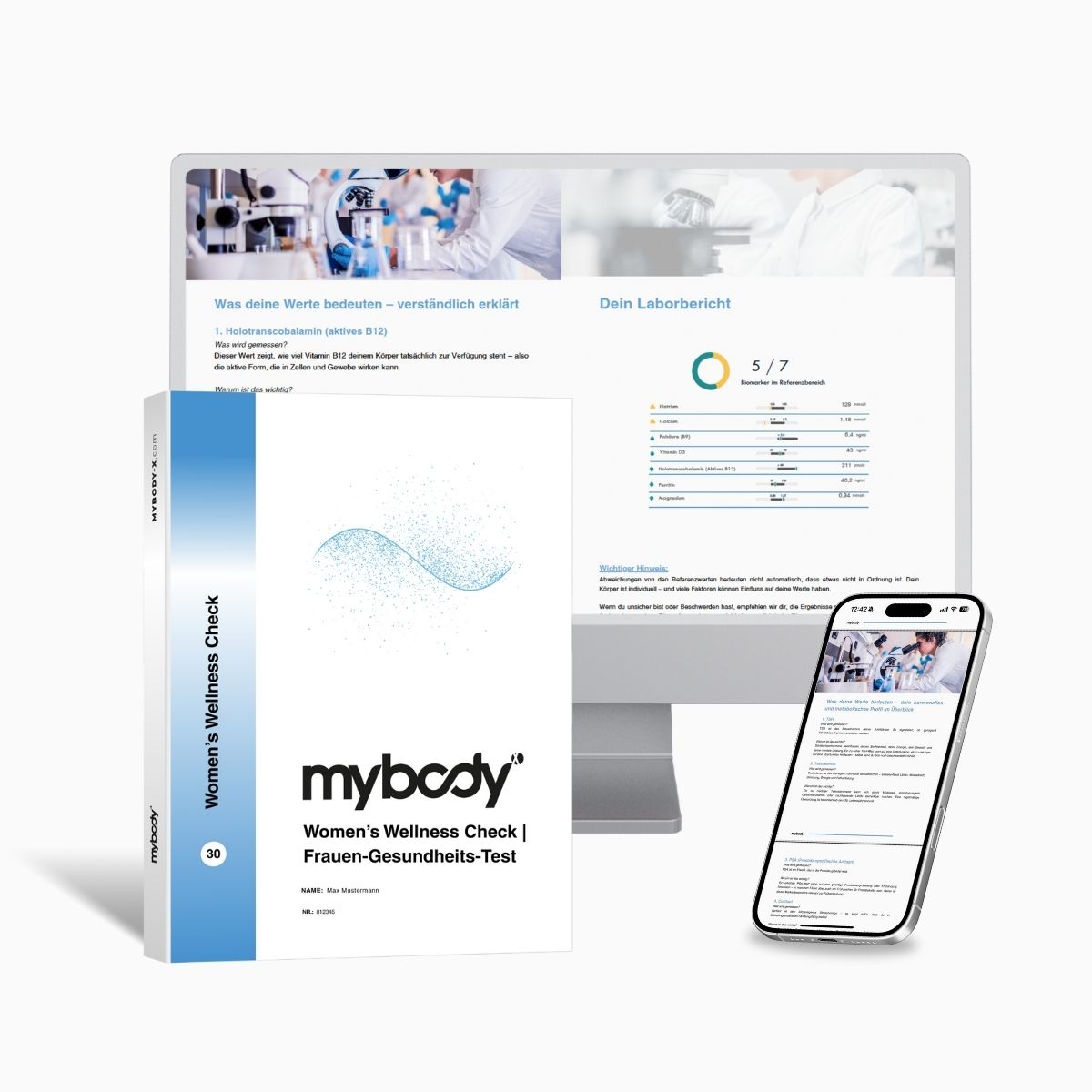
Capillary blood test
Women’s Wellness Check | Women’s Health Test
Tests 18 values from the same sample, including TSH, fT3, fT4, cortisol, prolactin, SHBG, ferritin, vitamin B12, 25-OH vitamin D3, HbA1c, and CRP. What the test cannot do: It does not explain weight or provide a diagnosis. It does not measure resting metabolic rate, body composition, or energy intake. It does not replace medical evaluation.
Laboratory analysis within 3–5 working days after receipt of the sample
Product page information, accessed 19 August 2026
Chapter at a glance
A panel documents values with dates, including thyroid values. It does not explain weight, measure resting metabolic rate or energy intake, or provide a diagnosis. Hypothyroidism is diagnosed in a medical practice.
Limitations: what the values leave unanswered
The first limitation is frequency. Very rarely, obesity is the result of a congenital or hormonal disorder (IQWiG, as of 24 August 2022).
The second limitation is the extent. IQWiG describes mild to moderate weight gain as a possible symptom of hypothyroidism (as of April 24, 2024)—and nothing more.
The third limitation is interpretation. An abnormal laboratory value alone cannot establish that a disease is present, and there are often harmless reasons for it (IQWiG, as of April 2, 2025).
The fourth limitation is the scope of measurement. A blood test measures neither resting energy expenditure nor body composition nor actual energy intake. All three are more important for the calculation than any individual value.
The fifth limitation is diagnosis. All the classifications in this article provide context and do not constitute a diagnosis. A diagnosis is made in a medical practice based on several factors.
What matters in this topic
If you take away just one thing from this article, let it be this: The calculation applies, and its input variables differ between people.
According to IQWiG, resting energy expenditure accounts on average for about 70 percent of calorie requirements and depends primarily on the proportion of muscle mass (as of August 24, 2022). And when thyroid hormones are lacking, metabolism slows down (IQWiG, as of April 24, 2024).
At the same time, the statement that protects this article from being misinterpreted still applies: Very rarely, obesity is caused by a congenital or hormonal disorder (IQWiG, as of August 24, 2022). Anyone who notices something that does not fit their calculation should raise it with a medical practice—not rely on a lab report alone.
Frequently asked questions
So is the calorie calculation correct or not?
It is correct, and this article does not call it into question. It shows that its input variables can differ between people. IQWiG notes that resting energy expenditure depends primarily on the proportion of muscle mass and accounts on average for about 70 percent of total calorie requirements (as of August 24, 2022).
Could my thyroid explain my weight?
IQWiG explains that metabolism slows when thyroid hormones are lacking and describes mild to moderate weight gain as a possible symptom of hypothyroidism (as of April 24, 2024). A medical practice determines whether hypothyroidism is present. A single value does not explain a person’s weight.
How often is a hormonal disorder the underlying cause?
IQWiG states: Very rarely, obesity is caused by a congenital or hormonal disorder (as of August 24, 2022). The same source cites Prader–Willi syndrome and Cushing’s disease as examples. The phrase “very rarely” is part of this information.
Does a blood test measure my basal metabolic rate?
No. A blood test measures neither resting energy expenditure nor body composition nor actual energy intake. It provides concentrations of individual values at the time of sampling. For the calculation itself, the three quantities mentioned are more important than any individual laboratory value.
What should I do if my observation doesn’t match the calculation?
Discuss this observation at a medical practice, including the time frame and, if possible, specific details. A documented test result can help prepare for this conversation, but does not replace it. IQWiG states that a laboratory value must always be considered together with other values, symptoms, and findings from other examinations (as of 02.04.2025).
Next step
Numbers for the conversation
The Women’s Wellness Check measures 18 values from capillary blood, including TSH, fT3, and fT4. It does not explain weight, measure resting metabolism, replace medical evaluation, or provide a diagnosis.
To the Women’s Wellness CheckRead more
You might also be interested in this
The energy balance calculated in detail.
The connection in detail.
Sources
- Institute for Quality and Efficiency in Health Care (IQWiG): Causes of obesity, as of 24.08.2022 – gesundheitsinformation.de
- IQWiG: Hypothyroidism, as of 24.04.2024 – gesundheitsinformation.de
- IQWiG: Understanding laboratory values correctly, as of 02.04.2025 – gesundheitsinformation.de
- MSD Manual, Professional Edition: Diabetes mellitus, Brutsaert EF (as of December 2025) – msdmanuals.com
The figure of approximately 70 percent for resting metabolism, the reference to muscle mass, the statement about the rarity of congenital and hormonal causes, the examples of Prader-Willi syndrome and Cushing’s disease, and the reference to leptin come from source [1]. The verbatim quotation about a slowed metabolism and the figure for slight to moderate weight gain come from [2]. The statement about being one component of an overall diagnosis, the reference to harmless reasons for abnormal values, and the statement that they must be considered together with symptoms and other findings come from [3]. The figure of three months for long-term blood sugar comes from [4]. Information on price, values, sample type, and laboratory comes from mybody®x product pages, accessed on 19.08.2026; processing times follow the central specifications for blood tests. All sources were accessed and checked on 19.08.2026.

mybody®x Editorial & Expert Team
Laboratory diagnostics Blood analysis interpretation Nutritional science Nutrigenetics
This article was created by the mybody®x editorial and expert team. The team combines laboratory diagnostics, nutritional science, and the interpretation of blood analyses. Those who contribute to it are listed on the authors’ page.
Published on 19.08.2026 · Last updated on 19.08.2026
The content is provided for general information and does not replace medical advice, diagnosis, or treatment. Reference ranges depend on the laboratory, method, and age—the information on your test report is always authoritative.




Share now:
From age thirty onward, it’s worth looking at different values.
Understanding DNA Test Results: How to Read Your Report Correctly