

From thirty onward, it is worth looking at other values
The essentials at a glance
Nothing happens in the body at thirty that begins on a birthday. What changes is the entitlement: According to the guideline, between the ages of 18 and the end of the 35th year of life, you are entitled to a one-time health examination; blood tests are included only where the risk profile warrants them.
This means that the years before 35 are different from those afterward. Anyone who has a question about a value during this period does not automatically get an answer.
You will read what the entitlement covers, the cited source verbatim, a fact-check of three common statements, three documented facts, and who might benefit from having an early baseline value.
What to expect in this article
1. Why the question sounds different at thirty
2. What actually changes with age
3. What the entitlement covers and what it does not
4. What the guideline provides for people under 35
5. The documented source
6. Baseline values and early detection are two different things
7. Three statements in a fact-check
8. The core idea in one sentence
9. Which values shift at all
10. Three documented facts
11. What an early result can do
12. Who this is worthwhile for
13. What a panel from capillary blood can show here
14. Limitations: what an early result leaves open
15. What matters at thirty
Frequently asked questions
Sources
Why the question sounds different at thirty
Sometime between their twenty-eighth and thirty-second birthdays, many people ask for the first time where they actually stand. Not because anything hurts, but because their twenties are over and they start thinking it might make sense to find out.
This is a valid question and is rarely answered properly. The most common answer is that there is the check-up, after all. The second most common is that you are still too young for it.
Both answers are inaccurate. There is an entitlement even before 35; it is simply structured differently from the one afterward, and that difference determines what you do and do not receive at thirty.
This article reflects what is stated in the relevant guideline and derives from it what follows for someone of this age. It does not claim that thirty is a medical threshold. None of the sources examined supports that.
What the article shows instead: The difference lies not in the body, but in the structure of preventive care. And anyone who understands that system knows which question to ask in the right place.
What actually changes with age
The most honest answer first: There is no value that suddenly changes at thirty. The reference ranges in the sources are given by adult age group, not by decade of life.
IQWiG gives a range of 9 to 140 µg/l for ferritin in women over 18 and a range of 18 to 360 µg/l in men over 18 (as of 20 March 2025). It does not provide an age-based breakdown within adulthood.
Hemoglobin is similar: for women over 18, IQWiG gives a range of 11.5 to 16.0 g/dL, and for men over 18, 13.5 to 17.8 g/dL (as of 20 March 2025). Here too, sex—not age—is the distinction.
What changes over the years is something else: the probability that an abnormality is meaningful and the length of one’s medical history. Neither is a value; they are circumstances in which values are interpreted.
Why this is not a minor matter
Someone who has a value measured for the first time at age forty-five has a number without a comparison. Someone who has the same value measured at thirty has two numbers fifteen years later, and a trend between them.
That is the only objective benefit the early examination offers, and it is not insignificant. We have described it in detail elsewhere: A value without a previous value is a point; a value with a previous value is a trajectory.
This also clarifies what the early examination is not. It is not preventive care in the sense of early detection, and it does not reduce risk. It merely documents a baseline.
What the entitlement covers and what it does not
The table compares which question the entitlement answers at each stage of life. It provides context and does not constitute a diagnosis.
| Question | Ages 18 to the end of the 35th year of life | From completion of the 35th year of life | Source |
|---|---|---|---|
| How often is there an entitlement? | Once during this entire period | Every three years | G-BA, Health Examination Guideline, effective 12 February 2021 |
| Are blood values included? | Only if a corresponding risk profile is present | Yes: lipid profile and fasting plasma glucose | G-BA, effective 12 February 2021 |
| Does it include a urine test? | Not provided for | Yes, by urine dipstick test | G-BA, effective 12 February 2021 |
| Are nutrient levels tested? | Not covered by the guideline | Also not covered by the guideline | The purpose of the examination is the early detection of diseases of significant public-health importance (G-BA, effective 12 February 2021) |
The second line is the decisive one for this topic. Before age 35, blood values are not automatically included; they depend on whether a risk profile is present.
In practice, this means that someone who goes to a medical practice at age thirty without a specific reason can expect a physical examination, a consultation, and a blood pressure measurement. Whether blood is drawn is decided by the practice based on what it asks and finds.
The last line is the same regardless of age. Nutrient levels are not covered by the guideline for either age group, and the reason is stated in its purpose clause.
What the guideline provides for people under 35
The Federal Joint Committee’s Health Examination Guideline regulates both age groups in the same text. The difference is set out in just a few lines.
For the younger group, there is a one-time entitlement during the entire period between the completion of the 18th year and the end of the 35th year of life. For the older group, there is an entitlement every three years (effective 12 February 2021).
The second difference concerns the scope. In the younger group, laboratory tests are performed only if risk factors are present. A urine test is not included there.
Both groups, by contrast, include medical history, a physical examination, blood pressure measurement, recording of vaccination status, and medical consultation. The core of the examination is therefore not the laboratory work, but the consultation together with an examination.
What practically happens to the one-time entitlement
The one-time entitlement has a feature that is often overlooked in everyday life: It is used up as soon as it has been claimed. Anyone who used it at twenty-two no longer has it at thirty.
This does not constitute a recommendation to wait. It merely means that one’s initial situation depends on what happened previously. Anyone who wants to clarify this question should ask their medical practice what is documented there.
Regardless, the following applies: If symptoms are present, the health examination is not the appropriate setting. In that case, the issue is diagnostic evaluation, which takes place without a fixed schedule or age limit.
The documented source
The sentence this article revolves around appears in the guideline right alongside the eligibility requirements.
Documented source
“Insured persons are entitled to a general health examination once from the age of 18 until the end of their 35th year.”
Federal Joint Committee
Health Examination Guideline, effective February 12, 2021
Two words carry the entire sentence: one-time and entitlement.
Entitlement means that the examination is available and no one has to earn the right to receive it. One-time means that it is not repeated during that period.
So if someone asks at the age of thirty whether they can make use of it, this sentence provides the answer: Yes, provided they have not already used their entitlement. And according to the guideline, the blood values included depend on whether the corresponding risk profile is present.
Baseline value and early detection are two different things
At this point, two terms that have nothing to do with each other are often conflated.
Early detection is a population-based medical program. It looks for diseases in people without symptoms that can be treated more effectively if detected earlier. Whether such a program is beneficial is rigorously evaluated, and IQWiG notes that not all early-detection examinations improve health and that they may also be useless or even harmful (as of September 30, 2009).
A baseline value is something entirely different. It neither searches for nor detects anything. It records where a number stood at a particular point in time so it can be compared later.
This distinction is why you must not infer one from the other. The fact that a value is not part of an early-detection program says nothing about whether it is suitable as a reference point. Conversely, a reference point does not turn a measurement into preventive care.
Knowing this difference helps people phrase their question more precisely. Not “is everything okay with me?” but “where is this particular value for me right now?” The second question can be answered by a test report; the first cannot.
Three sentences in a fact check
These three sentences come up almost every time the topic arises among friends.
Checked against the available evidence
Common claim
“There is nothing at all before 35.”
Documented
There is a one-time entitlement from completion of the 18th year until the end of the 35th year of life. It includes a medical history, physical examination, blood pressure measurement, vaccination status check, and consultation (G-BA, in force since 12 February 2021).
Common claim
“Values change after thirty.”
Documented
The sources reviewed provide reference ranges for adults by sex, not by decade of life. Ferritin is 9 to 140 µg/l in women over 18 and 18 to 360 µg/l in men over 18 (IQWiG, as of 20 March 2025).
Common claim
“An abnormal value means that something is wrong.”
Documented
IQWiG states that an abnormal laboratory value alone cannot be used to infer a disease. There are often harmless reasons for it (as of 02 April 2025).
The core in one sentence
At this point, the topic can be brought together.
Turning thirty does not change the body but the system: the entitlement is available once, and blood values are included only when risk factors are present.
This sentence is not a criticism of the guideline. It describes how the guideline is structured, and its structure follows its purpose.
For the individual person, this has a very practical consequence. Anyone at this age who has a specific question about a particular value should voice it rather than waiting for it to be answered without a specific reason.
Which values can shift at all
If age does not shift the values, what does? The sources name specific factors, and none of them is a birthday.
The most important factor is sex. The reference ranges for ferritin and hemoglobin differ considerably, and this distinction is explicitly reflected in the source in both cases (IQWiG, as of 20 March 2025).
The second factor is the dietary pattern. Anyone who eats differently from before over an extended period thereby changes their intake of individual nutrients. How long it takes for this to show up in a value depends on the value and varies greatly from one value to another.
The third factor is the measurement itself. Reference ranges depend on the laboratory and method, and the relevant range is always the one shown on your own test report (IQWiG, as of 02 April 2025).
What this means for the selection
Because age is not a selection criterion, it is not a good argument for choosing a particular set of values either. A panel does not become appropriate just because someone is thirty.
A selection is appropriate when it fits the question behind it. Someone who has avoided animal-based foods for two years has a different question from someone who trains a lot, and both have a different question from someone who simply wants to document a baseline.
That is why this article contains no list of values for thirty-year-olds. It would be made up, and none of the reviewed sources provides one.
Three documented pieces of information
Three pieces of information from the reviewed sources. They provide context and do not constitute a diagnosis.
Documented information
once
Those who are between their 18th birthday and the end of their 35th year are entitled to a general health examination once (G-BA, effective 12/02/2021)
9–140 µg/l
The IQWiG cites 9–140 µg/l as the ferritin reference range for women over 18; for men over 18, it is 18–360 µg/l (as of 20/03/2025)
0 nutrient values
The guideline provides for 0 nutrients in both age groups: neither iron nor vitamin D or B12 is part of the examination (G-BA, effective 12/02/2021)
And as with every laboratory value, the decisive factor is the reference range stated on your own report, because reference values may vary from one laboratory to another (IQWiG, as of 02/04/2025).
What an early value can do
A value obtained at thirty has exactly one characteristic that a value obtained at fifty can no longer make up for: it is early.
This characteristic only becomes useful later, namely when a second value is added. Before that, it simply exists, and that is fine. A comparison point is created by waiting, not by measuring.
For it to be useful later, it must be traceable. This includes the date, the laboratory, and the circumstances of the sample. A finding without this information is almost worthless as a comparison point because it is impossible to say what changed between two measurements.
What an early value cannot do is equally clear. It does not prevent anything, detect anything early, or say anything about health on its own. It is documentation, not preventive care.
The most common misconception
The most common mistake when measuring early is expecting an unremarkable finding to provide reassurance. It does not, for a very objective reason.
A finding says something about the values it contains, at the time it was recorded. It says nothing about anything else, nor about the time afterward.
That is why the statement “everything was fine for me” is always too broad after a finding. More precisely: These values were within their respective ranges on that day.
Who may benefit
The comparison concerns whether a documented baseline contributes anything in your situation.
Useful for you if …
You have already used your one-time entitlement and want a documented baseline.
You have permanently changed your diet and want to record values that are not provided for in the guideline.
You know that you will measure again in a few years and are therefore establishing a comparison point now.
You want to bring dated figures to a conversation at the doctor’s office.
Probably not if …
You have symptoms. In that case, it is a matter of clarification, which belongs in a medical practice.
You have not yet used your one-time entitlement. Use it first.
You hope it will tell you that everything is fine. No test result can provide that assurance.
You have no question, just more lines on the sheet.
What a capillary blood panel can show here
A capillary blood self-test does not provide a diagnosis and does not replace the health check-up. What it can do is document values that the guideline does not provide for at any age.
mybody®x (MYBODY Lab GmbH) offers two panels for this purpose, which differ in their composition. The Men’s Wellness Check measures 17 values, while the Women’s Wellness Check measures 18. Both include values not covered by the check-up, and neither replaces it.
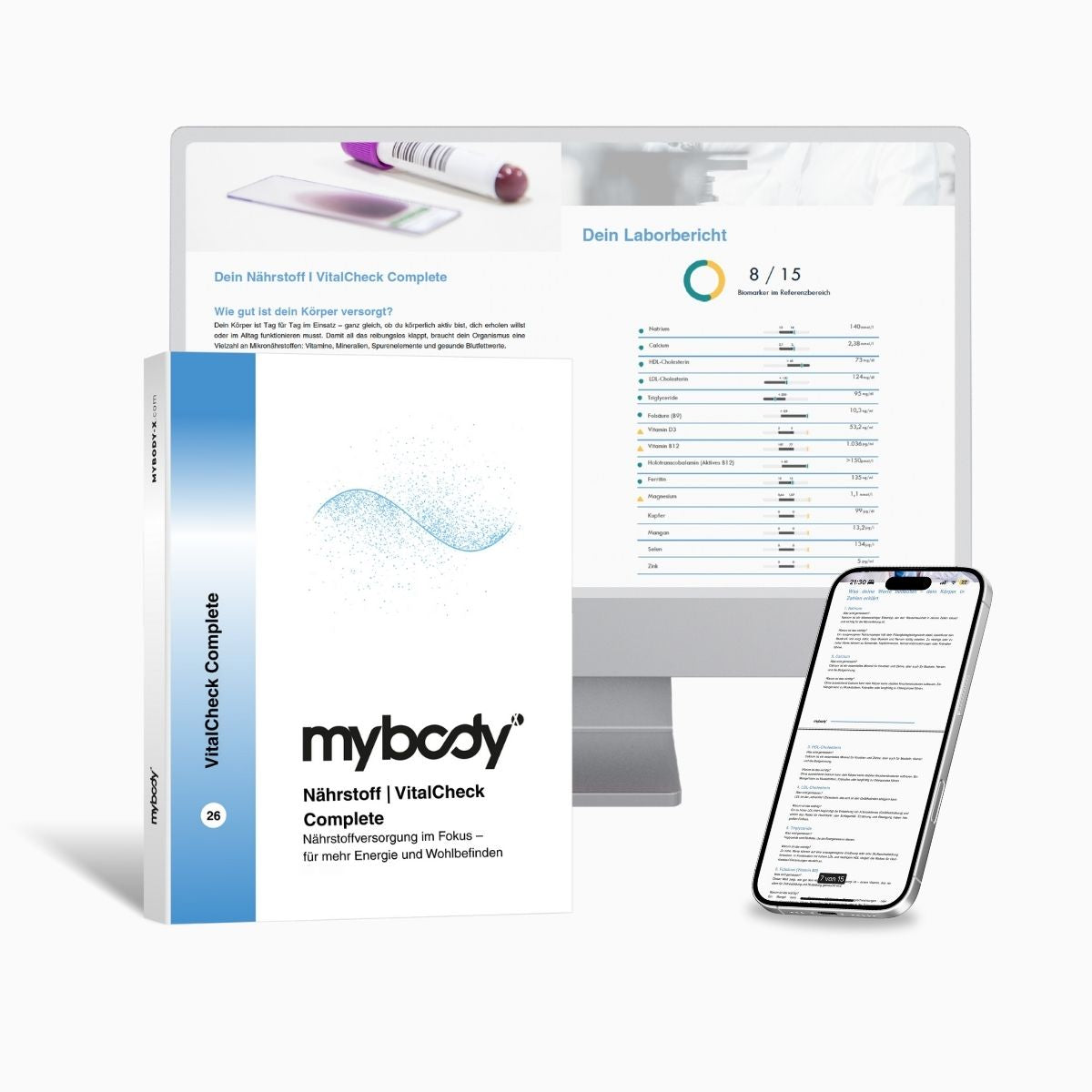
Capillary blood test
VitalCheck | Complete Nutrient & Mineral Test
Measures 18 values from the same sample, including ferritin, iron, transferrin, 25-OH vitamin D3, vitamin B12, folic acid, calcium, magnesium, phosphate, selenium, zinc, albumin, CRP, long-term blood sugar, as well as total cholesterol, LDL, HDL, and triglycerides. What the test does not do: It does not replace the health check-up, and includes no fasting plasma glucose, urine dipstick test, medical history, or physical examination. It does not provide a diagnosis.
Laboratory results 3–5 business days after sample receipt
Product page information, accessed 19/08/2026
Chapter at a glance
A panel using capillary blood can document values that the health check-up does not provide for at any age. It does not replace the check-up: medical history, physical examination, and the purpose of screening are not included. The one-time entitlement between the ages of 18 and 35 exists independently of this and should be used first.
Limitations: what an early value leaves unanswered
The first limitation is replacement. A panel does not cover the purpose of the guideline and does not replace the examination.
The second limitation is the benefit of additional values. The IQWiG states: Not all screening examinations improve health. They may also be useless or even harmful (as of 30/09/2009).
The third limitation is interpretation. An abnormal lab value alone does not indicate a disease, and there are often harmless reasons for it (IQWiG, as of 02/04/2025).
The fourth limitation is time. A baseline value only becomes useful when compared with a second value, and years pass before then. Anyone expecting an immediate conclusion is asking the early measurement to do something it cannot do.
The fifth limitation is diagnosis. All the classifications in this article provide context and do not constitute a diagnosis. A diagnosis is made in a medical practice based on several elements, and no self-test anticipates it.
What matters at thirty
If you take away just one thing from this article, let it be this: The difference between thirty and forty lies not in your values, but in what you are entitled to.
Between the age of 18 and the end of the 35th year, there is a one-time entitlement to a general health examination, and the blood tests included are tied to a corresponding risk profile. From the age of 35, there is an entitlement every three years, including a lipid profile, fasting plasma glucose, and a urine dipstick test (G-BA, effective 12.02.2021).
Anyone who is entitled to it should use it. And anyone who wants to document an additional value will know after reading this article what to expect: a point of comparison for later, not a statement about today.
Frequently asked questions
Am I entitled to a health examination at thirty?
Yes, provided you have not used it yet. The guideline states: Insured persons are entitled, once, from their 18th birthday until the end of their 35th year, to a general health examination (G-BA, effective 12.02.2021). The entitlement applies to the entire period, not once per year.
Are blood values included?
At this age, laboratory tests are performed only if risk factors are present. In all cases, the examination includes a medical history, physical examination, blood pressure measurement, recording of vaccination status, and medical consultation (G-BA, effective 12.02.2021). The practice decides whether blood is drawn.
Do blood values change after thirty?
The sources reviewed provide reference ranges for adults by sex, not by decade of life. For ferritin, IQWiG gives 9 to 140 µg/l for women over 18 and 18 to 360 µg/l for men over 18 (as of 20.03.2025). They do not define a separate age group within adulthood.
Which values should I have measured at thirty?
Age alone cannot determine which tests to choose, so this article does not name any. What matters is the underlying question: a changed diet, a specific symptom, or the desire to document a baseline will lead to different answers. This question belongs in a medical practice.
Is a baseline useful at all if it is unremarkable?
For now, it says little. Its value only emerges when a second result is added years later and a trend can be identified. For this to work, the date, laboratory, and circumstances of the sample must be documented. It is not an indication of health: a single laboratory result cannot be used to infer a disease (IQWiG, as of 02.04.2025).
Next step
Documenting a baseline
The VitalCheck measures 18 values from capillary blood, including several that are not covered by the health examination. It does not replace the examination, provide a diagnosis, or replace medical evaluation. Eligibility for the examination exists independently of this.
Go to VitalCheckRead more
You may also be interested in
What the guideline provides for people aged 35 and over, and why.
Where the figures on the test report come from.
Sources
- Federal Joint Committee (G-BA): Guideline on health examinations for the early detection of diseases, effective 12 February 2021 – g-ba.de
- Federal Joint Committee (G-BA): Health examinations (“check-up”), overview of entitlement and scope, accessed 19 August 2026 – g-ba.de
- Institute for Quality and Efficiency in Health Care (IQWiG): Understanding laboratory results correctly, as of 2 April 2025 – gesundheitsinformation.de
- IQWiG: Ferritin, as of 20 March 2025 – gesundheitsinformation.de
- IQWiG: Hemoglobin, as of 20 March 2025 – gesundheitsinformation.de
- IQWiG: Screening examinations are not always useful, press release, as of 30 September 2009 – iqwig.de
The verbatim quote regarding the one-time entitlement, the information on age groups and intervals, and the list of blood and urine tests are taken from source [1]. The statement that laboratory tests in the younger age group are performed only when risk factors are present, and the list of services included in both groups, are taken from [2]. The sentence that an abnormal laboratory result alone cannot be used to conclude that a disease is present, and the explanation of the reference range, are taken from [3]. The ferritin reference ranges are taken from [4], and the hemoglobin reference ranges from [5]. The statements on the benefits of screening examinations are taken from [6]. Information on price, values, sample type, and laboratory comes from the mybody®x product page, accessed on 19 August 2026; processing times follow the central specification for blood tests. All sources were accessed and checked on 19 August 2026.

mybody®x Editorial & Specialist Team
Laboratory diagnostics Blood analysis interpretation Nutritional science Nutrigenetics
This article was created by the mybody®x editorial and specialist team. The team combines laboratory diagnostics, nutritional science, and the interpretation of blood analyses. Those who contribute to it are listed on the authors page.
Published on 19 August 2026 · Last updated on 19 August 2026
The content is for general information and does not replace medical advice, diagnosis, or treatment. Reference ranges depend on the laboratory, method, and age—the information on your test report is always authoritative.




Share now:
The check-up from age 35: which values it includes
Weight is more than a calorie calculation