

DNA test or blood test: Which should come first?
The key points in brief
The answer depends on your question, not on the test. Do you want to understand why your body reacts to diet, exercise, or caffeine the way it does? A DNA analysis answers that by reading your predisposition. Do you want to know what your levels are today, for example of nutrients or hormones? A blood test answers that. If you have specific symptoms, neither should come first; you should see a doctor.
This article explains the difference between the two types of information, honestly compares the three possible sequences side by side, and explains why, when a change is planned, it is usually best to assess predisposition first and follow with measurement.
First, you will read why the order is a question at all and what distinguishes the types of tests. Then come the three approaches, the direct comparison, the decision-making aid, and the limitations.
What to expect in this article
1. Why the order is a genuine question
2. What fundamentally distinguishes the two types of tests
3. Comparing three possible sequences
4. The decision in a table
5. One example of each type of test in detail
6. The decision-making aid
7. Where this comparison ends
8. The order you can remember
Frequently asked questions
Sources
Why the order is a genuine question
The question sounds like a product comparison, but it is not one. DNA analysis and blood testing do not compete for the same answer; they answer different questions. Nevertheless, many people face precisely this choice for one simple reason: their budget and attention rarely stretch to everything at once.
If you choose the wrong order, you do not lose money in the narrow sense, but you do lose insight. A blood test without a framework for interpretation produces numbers that are of little use to you. A DNA analysis without subsequent measurement remains a map on which no one ever marks your location.
There are three typical starting points. The first: You are planning to change your diet and do not want to start on a hunch. The second: An issue such as fatigue or declining performance has been bothering you for months, without anything acute being behind it. The third: You simply want to know where you stand before changing anything.
All three scenarios lead to the same two-part question, and this is exactly where the usual web search offers little help. The two types of tests are usually explained separately, as if they had nothing to do with each other. But the truly useful information is the relationship between them: what one provides, what the other provides, and what, in which order, becomes more than the sum of its parts.
It is therefore worth thinking the decision through carefully rather than leaving it to chance or the first offer that comes along. The good news is that it follows a simple logic, which can be summed up in one sentence that will appear prominently below.
What fundamentally distinguishes the two types of tests
A DNA analysis reads predispositions from a saliva sample: more than 700,000 individual positions in the genome, evaluated as genetic variations related to metabolism, nutrition, and recovery. This result never changes, which is why the test is taken once in a lifetime.
A blood test measures your current status from capillary blood: vital nutrients, hormones, and metabolic values, depending on the profile. These values change over the course of months, with your diet, the season, and everyday life. That is why the measurement is designed to be repeated, sensibly about every 6 to 12 months.
Important for setting expectations: neither is a more accurate version of the other. The DNA analysis answers its question using more than 700,000 positions read in the genome, while the blood test answers its question with laboratory values and reference ranges. It only becomes inaccurate when you expect one test to provide the answer given by the other.
The time frames alone lead to the most important takeaway of this article: one is a constant, the other a snapshot. Together they provide a complete picture; on their own, each is only half of it.
What the sample types mean in everyday life
Both tests are done at home, but they feel different. The saliva sample for the DNA analysis is the lowest hurdle: fill the tube, seal it, and send it back. The capillary blood test uses a few drops from the fingertip; it is over quickly, but requires being willing to endure a small prick.
The logistics are also barely different now: both samples are sent to the laboratory by post, with no cold chain and no appointment. The practical difference lies in the waiting time afterward, and that should be stated honestly: 3 to 5 business days for laboratory analysis of the blood sample, and 15 to 25 business days for the DNA sample, in each case after the sample arrives.
Why it is not an either-or choice
The question “DNA or blood” only arises at the outset. In the long term, the two work together because one result makes the other easier to interpret: predispositions indicate which values are worth tracking, while measurements show whether the changes are having an effect. That is why this article is about the sequence, not about choosing a winner.
Key message
A DNA analysis reads lifelong predispositions, while a blood test measures your current status: the two types of tests do not compete; they answer different questions.
The blood page should include context provided by the Institute for Quality and Efficiency in Health Care:
Documented source
“Many factors can influence laboratory values, and there are often harmless reasons for this.”
Institute for Quality and Efficiency in Health Care (IQWiG)
Understanding laboratory values correctly, as of 02/04/2025
Despite all the differences, the two types of tests share the same framework here: Both are conducted as ISO-certified laboratory analyses in Germany, both use pseudonymized samples and GDPR-compliant transmission, and for the DNA analysis, the saliva sample and sequence are completely destroyed two months after completion. The choice of sequence is therefore not a choice between levels of security.
The statement protects against a double error. A single abnormal blood value is not an alarm, and the same guide makes it clear that a laboratory value is always only one component of an overall assessment, together with other values and findings. That is precisely why a measurement gains so much when it has a framework, and predisposition can provide that framework.
A comparison of three possible sequences
There are not two options but three, and the third is underestimated. All three are legitimate; they simply suit different starting points.
There is one option you will not find on this list: deliberately ordering both at the same time to avoid the question. It sounds thorough, but gives up precisely the advantage of combining them. Anyone who measures and reads at the same time has no baseline value for the later check and no framework to justify the selection of the measured values. The interval is not a detour; it is the added value.
Option 1: DNA analysis first
You start with the constant. The analysis shows where your organism works differently from average, thereby highlighting the values whose measurement is worthwhile for you.
In practice, this means: After the analysis, you first read the chapters relevant to your concern, note the two or three highlighted needs, and schedule the first measurement with a date right away. This way, the report becomes a roadmap rather than a mere statement of intent.
Best for
People who are planning a change and want to understand what they are working with before measuring where they stand.
In favor
Every subsequent measurement gets a framework for interpretation, and the selection of blood values follows a rationale rather than a catalog.
Against
The analysis takes 15 to 25 business days after the sample is received. Anyone with an acute status question will wait longer for the first result with this option.
Option 2: Blood test first
You start with the snapshot. The results are available within 3 to 5 business days after the sample is received, answering a specific status question.
A typical progression for this path: the winter fatigue persists, the measurement shows the micronutrient status, and the next action is clear depending on the result. If the values are unremarkable but the pattern persists, the question about the present becomes a question about why—and that is precisely when the DNA analysis comes into play as the second step.
Best for
People with a clear question about the present, such as their micronutrient status before winter or values they have wanted to keep track of for some time.
In favor
The quickest answer to a specific question, and a good starting point when a single value has been concerning you for a long time.
Against
Without a framework, collecting data is a risk: many values, little action. And the measurement does not answer the why behind an abnormal pattern.
Path 3: Both, with a gap between them
You begin with the DNA analysis, identify the priorities, and a few months later specifically measure the two or three blood values highlighted in the report. After that, you only repeat the measurement, because the analysis is valid for life.
This path is not a compromise, but the way in which the two types of test genuinely complement each other: it turns two individual purchases into a measurable before-and-after strategy. Its only real drawback is the patience it requires.
As a year-long picture, Path 3 looks like this: order the DNA analysis in the first quarter and read the most important chapters, begin the change and take the first blood measurement in the second quarter, then spend two quarters in everyday life, and measure the same levels again at the end of the year. Four unspectacular steps, but in the end you have a progression rather than a snapshot.
Chapter at a glance
Three sequences are possible: start with the DNA analysis when understanding comes before measuring; start with the blood test when a specific question about the present is pressing; or do both with a gap between them when a change is to be monitored measurably. In the case of symptoms, none of the three paths applies; instead, make a medical appointment before taking any self-test.
The decision in one table
The table compares the two starting points side by side using the same criteria. It does not assess which test is better, but which one is the better fit for which starting question.
| Criterion | Start with the DNA analysis | Start with the blood test |
|---|---|---|
| Your starting question | Why does my body react this way? What suits me in the long term? | How are my levels today? Has anything changed? |
| What you will know afterward | your predisposition, valid for life, as a list of priorities | your status at the time of measurement, with reference ranges |
| What remains open | what your values actually look like today | why the values are the way they are and which ones matter next |
| Time until results | Laboratory evaluation 15 to 25 business days after receipt of the sample | Laboratory evaluation 3 to 5 business days after receipt of the sample |
| Repeat testing | none, the result remains valid | ideally every 6 to 12 months |
Reading the rows from top to bottom reveals the pattern: the DNA side wins wherever duration and explanation matter, while the blood side wins wherever speed and the present matter. The table therefore does not decide anything for you, but it sorts your question into the right column.
Cost logic is also part of this classification because it works in reverse. The DNA analysis is a one-time payment, ranging from €169.00 to €369.00 depending on scope, as of August 24, 2026, with no repeat testing. The blood test has the lower individual price, but recurs at the frequency of the measurements. When calculating over several years, you are therefore comparing a one-time expense with a series of expenses, and both fulfill different functions within the same budget.
Here is an example of how to use the table: If you have been struggling with your weight for years and are planning your next change, you will find your question in the Why column, so you start on the left. If, on the other hand, you want to know your iron status before preparing for a marathon, you will find it in the Now column and start on the right. The same table, two different—and equally correct—answers.
As for the third type of test, the gut microbiome analysis, this is all you need to know: it follows the same logic as the fastest level, with changes occurring within weeks, and should only be included in this decision when digestive issues are the focus. The neighboring article Understanding DNA test results explains how to interpret the results from all levels later.
One representative of each type of test in detail
DNA explains the why; blood shows the now. To make the decision concrete, here is one representative of each type of test from mybody®x (MYBODY Lab GmbH), both evaluated in Germany by ISO-certified laboratories. You can read how others chose their sequence on the customer testimonials page.
The selection of the two representatives follows the purpose of the article: the most comprehensive DNA report as a map for all topics, and the broadest nutrient blood test as a current-status measurement. If you have a more specific question, both types of test also offer narrower options; the logic of the sequence remains unaffected.
DNA explains the why; blood shows the now.

DNA test from saliva – the constant
Longevity | ALL IN ONE DNA Test
More than 170 gene variants presented in 74 reports across twelve chapters, intended to be taken once in a lifetime. What the test does not do: it does not measure current levels, diagnose conditions, or replace a medical examination.
Laboratory evaluation 15–25 business days after receipt of the sample
Product page information, accessed 24 Aug 2026
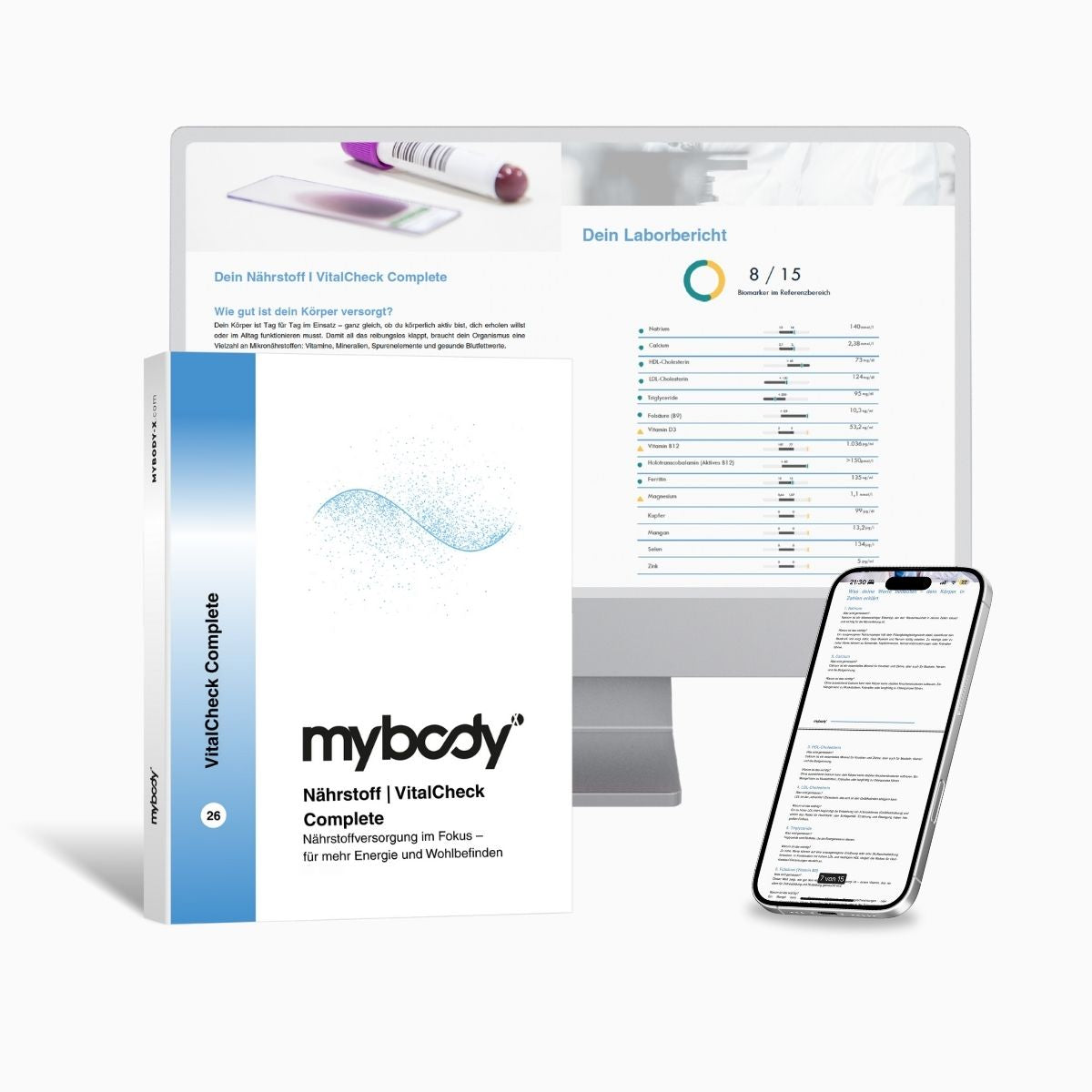
Blood test from capillary blood – the snapshot
VitalCheck | Complete Nutrient & Mineral Test
18 biomarkers from capillary blood, including vitamins, iron status, and minerals, suitable for repeat testing every 6 to 12 months. What the test does not do: it does not diagnose conditions or read predispositions; it measures current status.
Laboratory evaluation 3–5 business days after receipt of the sample
Product page information, accessed 24 Aug 2026
The Biomarker Lexicon with 67 blood values explains which blood values exist and what they mean; the gene variants examined on the DNA side are listed in the DNA Lexicon. Both reference works are freely accessible, so you can review the substance of the decision before making it.
The decision guide
Finally, the decision in the shortest form that remains honest. It applies to the usual case without symptoms; the boundary for all other cases is explained in the next chapter.
If you still cannot decide after reviewing the two columns, this is not a deadlock but an indication to choose option 3: start with the map, followed by the measurement after an appropriate interval. This is the standard recommendation of this article for anyone seriously planning a change, because neither source of information goes unused.
DNA analysis first, if …
you are planning a change in diet or lifestyle and want to align it with your predisposition rather than with general rules.
you are interested in the why behind recurring patterns, such as with weight, caffeine, or recovery.
you are willing to wait a few weeks for the deeper answer and then measure in a targeted way.
Choose the blood test first if …
a specific status question is pressing, such as your nutrient status after a long winter or before a training phase.
you want to monitor a specific value over time and can add the interpretive framework later.
you first want to check with a small, quick answer whether working with your own data suits you.
And if both apply, planability is the deciding factor: Starting the change with a map and measuring your status after some time is the approach that ensures neither piece of information goes unused in the end.
Where this comparison ends
The most important limitation first: If you have symptoms, the question of sequencing is the wrong question. Anyone with symptoms should book an appointment, not take a test, and bring test results only as a basis for discussion. Both types of tests are lifestyle tools, not diagnostic procedures.
The second limitation concerns the DNA side: It does not predict disease. Genetic variants describe probabilities in population groups, not predetermined outcomes for individuals, and predictive testing for diseases must, under the German Genetic Diagnostics Act, be carried out under medical supervision.
The third limitation concerns the blood side: A value within the reference range is not a health certificate, and a value outside it is not a verdict. The information on your test report and, if in doubt, a consultation with a doctor are always decisive. No guide to test sequencing replaces this interpretation.
Finally, this comparison covers only two of the three types of tests. If your question concerns the abdomen, digestion, and gut flora, the path leads through microbiome analysis, whose markers are explained in the gut glossary. The sequencing logic remains the same; only the level changes.
The sequence you can remember
Remember the decision as a single question: Do you want to understand first or measure first? Understanding means DNA, measuring means blood, and when both are done with some distance between them, the two answers make each other more valuable.
If you only want to take one step today, make it this: Check the two glossaries to see what each type of test actually examines in relation to your question. Ten minutes of reading can replace half the decision-making here, because many questions naturally point to the right section as soon as you look at the content.
What you do with this in practice: Formulate your initial question in one sentence before ordering anything. If the sentence contains a “why,” your journey begins with your predisposition. If it contains a “how much” or “current,” it begins with the measurement.
At the beginning was the question of which test comes first. In the end, it becomes clear that it was never a choice between two tests, but between two questions. If you are not sure which one applies to you, the consultation is free and does not try to sell you anything.
Frequently asked questions
What is the difference between a DNA test and a blood test?
A DNA test reads your predisposition from a saliva sample—more than 700,000 positions in your genome—and this result never changes. A blood test measures your current status from capillary blood, such as approximately 18 biomarkers in the VitalCheck Complete, and these values change over the course of months. One answers the question “why,” while the other answers “what is happening now”; they cannot replace each other.
Can a DNA test replace my blood values?
No. A DNA result shows predispositions, such as an inherently higher need for a vital nutrient, but it does not measure any current value. Only a blood measurement can show whether a predisposition has actually resulted in a low level. Conversely, no blood value explains why it has remained at the same threshold for years; that requires looking at your predisposition.
I want to lose weight: Which test comes first?
If your goal is to lose weight, the journey generally begins with DNA analysis because it explains the reasons behind previous attempts through traits such as satiety and fat metabolism, and provides a basis for making changes. A blood measurement is useful after a few months to monitor values such as your vital nutrient status over time. However, no test can predict weight-loss success, and if your weight changes unintentionally, the question should first be addressed by a medical practice.
How often should I measure my blood values and repeat the DNA test?
Blood values are best measured every 6 to 12 months because they change with diet, the seasons, and everyday life; this turns individual measurements into a trend. A DNA test, by contrast, is not repeated: DNA does not change, so the result remains valid for life. New research does not change that; it only expands what can be determined from the same data in the future.
What applies if I have specific symptoms?
Neither test takes priority; the medical appointment does, regardless of how harmless the symptoms may seem. Self-tests are lifestyle tools for times when nothing is urgent; they do not diagnose or replace an examination. You can bring any existing test results as a basis for discussion, while the medical practice provides the interpretation.
Next step
When your initial question is clear
The product finder translates your question into the right test. If you want to read up on which blood values exist first, start with the biomarker encyclopedia.
Go to product finder Go to biomarker encyclopediaRead more
You might also be interested in
The fundamentals of the DNA page behind this decision.
The blood page in detail, from suspicion to measurement.
Sources
- Institute for Quality and Efficiency in Health Care (IQWiG): Understanding laboratory values correctly (as of 2 April 2025) – gesundheitsinformation.de
- Institute for Quality and Efficiency in Health Care (IQWiG): What happens during a genetic test? (as of 5 August 2026) – gesundheitsinformation.de
The verbatim quotation on factors influencing laboratory values and the classification of a laboratory value as only one component of an overall assessment are taken from [1]. The information on the Genetic Diagnostics Act and the significance of genetic tests is taken from [2]. All product information, prices, biomarker and gene variant counts come from mybody®x product pages, accessed on 24 August 2026; processing times follow the central specification for each test type. All sources were accessed and reviewed on 24 August 2026.

mybody®x Editorial & Specialist Team
Nutrigenetics Blood analysis interpretation Laboratory diagnostics
This article was created by the mybody®x editorial and specialist team. The team combines nutrigenetics, blood analysis interpretation, and laboratory diagnostics. Everyone involved can be found on the authors page.
Published on 24 August 2026 · Last updated on 24 August 2026
The content is intended for general information and does not replace medical advice, diagnosis, or treatment. Reference ranges depend on the laboratory, method, and age—always follow the information on your test report.




Share now:
Vitamin D and magnesium: what the research shows
Boosting metabolism: what’s actually proven