

Boosting your metabolism: what is supported by evidence
The essentials at a glance
Metabolism is not an engine you can rev up. It is the sum of all the processes by which the body obtains and uses energy, and by far the largest part of it happens without your input. That is precisely why hardly any of the common recommendations deliver what they promise.
This article sorts out what measurably changes energy expenditure, what changes it only slightly, and what is simply a claim. The only lever with a proven, lasting effect is not the one written about most often.
You will first learn what metabolism actually means, followed by the evidence-based perspective, the three components of energy expenditure, a comparison of common advice, and an honest answer to when an analysis is worthwhile.
What to expect in this article
1. The promise of a boosted metabolism
2. What metabolism actually means
3. What your energy expenditure consists of
4. The only lever with a lasting effect
5. What remains of the home remedies
6. Common advice compared
7. When a metabolism analysis adds value
8. What you will take away from this article
Frequently asked questions
Sources
The promise of a boosted metabolism
Hardly any term carries as much hope as this one. The promise is that if you boost your metabolism, you burn more without doing more. Your body works for you while you live as before. It is the idea of free calorie burning, and it has been selling for decades.
The market delivers accordingly: ginger water in the morning, chili with meals, green tea between meals, cold showers, protein shakes, specific times for breakfast, metabolism-boosting courses with drops. The lists bear titles like “eight ways” or “ten effective tips” and have been repeating the same ingredients for years.
This article is deliberately not another list of that kind. It asks the question missing from those lists: Which of these things actually changes energy expenditure measurably, and by how much? The answer is sobering and, in one respect, highly encouraging—but it is different from what the term suggests.
The reason for its persistence is no mystery. The term explains something that would otherwise be difficult to explain: Why does one person gain weight while the other does not, even though they eat similarly? “A fast metabolism” is a convenient answer because it attributes the imbalance to a trait that can supposedly be upgraded. The differences are real; their cause simply lies elsewhere than the term suggests.
One distinction up front: If you suspect that a medical condition is affecting your metabolism, such as a thyroid disorder, that belongs in a medical practice, not in a guidebook. This article deals with healthy metabolism and the question of what aspects of it can be influenced.
What metabolism actually means
In everyday life, “metabolism” usually means just one thing: how many calories someone burns. Technically, the term is broader and encompasses all the processes by which the body takes up, transforms, and breaks down nutrients. For questions of weight, what matters most is energy expenditure—that is, the amount of energy used.
The Institute for Quality and Efficiency in Health Care describes how this expenditure comes about. Regarding resting energy expenditure, the largest component, it states: It includes the calories needed to maintain vital bodily functions, such as heartbeat and breathing (IQWiG, 2022). And regarding the most popular lever of all, the same source writes:
Documented source
“You can increase calorie expenditure through exercise—but not without limits.”
Institute for Quality and Efficiency in Health Care (IQWiG)
Causes of obesity, as of August 24, 2022
This sentence appears here because it sums up the whole topic in eight words. Yes, it is possible. No, not without limits. Anyone who thinks of metabolism as a dial that can simply be turned up has misunderstood the system, and half the market rests on precisely this misunderstanding.
Key point
Metabolism cannot be revved up like an engine. What can be changed is muscle mass, and it determines the largest portion of energy expenditure.
What your energy expenditure consists of
Daily energy expenditure consists of three parts, and their proportions explain why most tips miss the mark. According to the IQWiG, about 70 percent of calorie needs go toward resting energy expenditure, around 20 percent toward activity-related energy expenditure from movement, and approximately the remaining 10 percent toward the thermic effect of food—that is, the work of digestion itself (IQWiG, 2022).
This distribution is the key to the whole topic. By far the largest block runs while you sleep, sit, and breathe. It is not the result of willpower, but of body composition. Anyone who wants to change it must change the body, not the daily routine.
The second block, movement, can be influenced and is nevertheless regularly overestimated. An hour of brisk walking is in the same ballpark as a slice of cake. That is not an argument against exercise—in fact, quite the opposite—but it explains why training alone less often balances the equation than hoped.
Why two people expend different amounts of energy
This breakdown also explains the observed differences between people. Someone who is taller has more body mass to support and therefore expends more energy at rest. The same applies to someone with more muscle. On average, men have a higher resting metabolic rate than women, primarily because they have more muscle mass and less adipose tissue on average—not because of some mysterious advantage related to sex.
There is also a factor that escapes observation: unconscious everyday activity. Some people sit still, while others bounce a foot, get up more often, or gesture while talking. Over the course of an entire day, this can add up to a difference greater than any tea regimen, and neither person involved notices it.
And finally, we all underestimate how much we eat. Anyone who logs their food regularly finds more than they remembered. That is why the claim “we eat the same amount, after all” rarely holds up when people actually write it down. This is not an accusation, but a well-documented feature of human perception.
The third component, the thermic effect of food, is the favorite target of every miracle remedy. This is exactly where chili, ginger, and green tea come in—and exactly where there is the least to gain: It accounts for about one-tenth of energy expenditure, and the effects claimed for these remedies affect only a fraction of that.
Chapter at a glance
Around 70 percent of calorie needs go toward resting metabolism, about 20 percent toward physical activity, and approximately 10 percent toward digestion (IQWiG, 2022). Anyone who wants to change their energy expenditure permanently has to target that 70 percent, which depends primarily on muscle mass. Home remedies target the 10 percent, where there is the least room for change.
The only lever with a lasting effect
If 70 percent of energy expenditure comes from resting metabolism, the key question is: What does it depend on? IQWiG’s answer is concise: A person’s resting metabolic rate depends primarily on the proportion of muscle mass in relation to body weight (IQWiG, 2022).
In practice, boosting your metabolism means building and maintaining muscle.
This establishes the only lever with a lasting effect, and it is less comfortable than ginger water. Muscles consume energy even when they are not doing anything. Building muscle mass increases your basal energy expenditure around the clock. Losing it lowers that expenditure permanently—and that is exactly what happens with every crash diet.
Honesty also means acknowledging the pace: building muscle is slow, especially without systematic training, and the increases in resting metabolic rate per kilogram are modest. The benefit lies less in a rapid jump in energy expenditure than in the direction: A body with more muscle is more forgiving, maintains its weight more easily, and does not become thrifty as quickly during weight loss.
This insight reverses the usual order. Most people lose weight first and think about their muscles only afterward, if at all. The more sensible approach is the opposite: first make sure that muscle is present and preserved, then create the calorie deficit. Anyone who loses weight without this protection also loses part of their resting metabolic rate and makes the next round more difficult.
The second lever is everyday movement, and it is underestimated. What matters here is not the training, but what happens between workouts: walking, taking the stairs, standing instead of sitting, fidgeting throughout the day. This factor varies considerably between people and can be changed without putting on workout clothes.
What this means in everyday life
The training component is more manageable than the term strength training might suggest: two sessions per week in which the muscles work against resistance, with a day of rest in between. This can take place at the gym, at home with resistance bands, or using your own body weight. What matters is consistency over months, not the intensity of any single session.
The corresponding nutrition component is just as simple: enough protein to give the muscles the material they need, spread throughout the day rather than eaten in one large portion in the evening. Without this component, training is ineffective, and without training, protein is just another nutrient. The two only work together.
For everyday movement, it is enough to make a handful of decisions habitual: take the stairs instead of the elevator, walk short distances, make phone calls standing up, carry the groceries. None of this feels like exercise, and that is precisely why it lasts longer than the third gym membership.
And there is a third point to add because it is missing from the tip lists: Eating itself keeps the metabolism going. Anyone who eats far too little for an extended period lowers their energy expenditure. The most common cause of a genuinely slowed metabolism is not the absence of a miracle remedy, but a long series of strict diets.
What remains of the home remedies
Now to the classics, in order. Spicy spices and ginger: They briefly raise body temperature and, consequently, calculated energy expenditure. The effect falls within the ten percent attributable to digestion, and it lasts for minutes. They are excellent for flavor, but worthless as a weight-loss strategy.
Green tea and caffeine: Caffeine stimulates the cardiovascular system and the central nervous system, which can lead to greater alertness and physical performance (BfR, 2026). A more alert person may move more, and that counts. However, this does not establish a direct, significant fat loss effect from the beverage itself.
Cold showers and cold in general: The body does expend energy to maintain its temperature; that is true. But the contribution is small, unpleasant to induce, and hardly sustainable in everyday life. If you enjoy cold showers, go ahead; as a strategy for increasing energy expenditure, they do not make a meaningful contribution.
Many small meals: The idea that eating frequently keeps the metabolism “running” persists stubbornly. In reality, the thermic effect of digestion depends on the total amount of food, not on the number of meals. Whether you eat three or six meals makes practically no difference to energy expenditure. The distribution can certainly matter for satiety and daily life; that is a different question.
Metabolism cures with drops or powders: Here, it is worth asking what actually works. Almost all of these programs include a strict diet plan. The weight loss comes from the deficit created by that plan, not from the product. What remains is an expensive detour through a product that does not do the actual work.
One special case deserves separate attention because it persists so stubbornly: the supposed breakfast requirement. “If you don’t eat breakfast, you slow down your metabolism,” people say. This has not been established for energy expenditure itself. Whether someone eats breakfast is mainly a matter of satiety throughout the day and personal preference. If you are not hungry in the morning, you do not have to eat to save your metabolism.
The pattern behind all five is this: Every effect exists to some degree; otherwise it could not be claimed. The problem is that the degree is so small that it disappears in the daily energy balance. Advertising names the effect while concealing its magnitude, and that is where the real deception lies.
To be fair, it is worth acknowledging what these methods can genuinely do. Tea without sugar replaces a sugary drink and thereby saves actual energy, though through what is consumed rather than through metabolism. Spicy food makes some people feel full sooner because they eat more slowly. Protein-rich meals keep you full longer. These effects are real; they simply work through a different mechanism than claimed—through intake rather than expenditure.
The common advice compared
The table compares the three approaches that are often mixed up online, using the same criteria.
| Criterion | Home remedies and cleanses | More movement in everyday life | Build and maintain muscle |
|---|---|---|---|
| What it affects | on the thermic effect of food, around 10 percent of expenditure | on active metabolic rate, around 20 percent | on resting metabolic rate, around 70 percent |
| How long the effect lasts | minutes to hours, then nothing | as long as the movement continues | around the clock, as long as the muscle remains |
| Effort | low, often involves costs for supplements | low, requires no equipment | two sessions per week over several months |
| What it does not do | no measurable change in the daily energy balance | does not change resting metabolic rate | no quick results; gains are small per kilogram |
The second row is especially worth a look, because that is where the difference lies that no guide emphasizes: How long does the effect last? A spice works for minutes, a walk works as long as it lasts, and muscle works even at three in the morning. Anyone comparing effort and return should read this row first and the effort row last.
The honest reading: The first column is the most popular and the weakest. The second offers the best return for the effort. The third is the only one that permanently targets the largest component, and it requires patience. Once you know the order, you stop looking in the first column for solutions belonging in the third.
For context: The article Which weight-loss method is right for me? helps determine which weight-loss method is right for you in principle. Losing weight without exercise calculates how much exercise contributes mathematically, using documented figures. This article answers the question that comes before that: whether calorie expenditure itself can be changed.
When a metabolic analysis makes a difference
That leaves the obvious question for a provider of metabolic analyses—and one that therefore deserves an honest answer: Does a DNA analysis help here? It does not boost anything, to get that out of the way. It changes neither resting metabolic rate nor muscle mass, and anyone who advertises it that way is selling the same promise as the tea cleanse.
This clarification matters to us because the metabolic analysis market caters precisely to the expectation that this article has just taken apart. A test that promises to speed up your metabolism sells the same misunderstanding as ginger water, only at a higher price and with a lab logo.
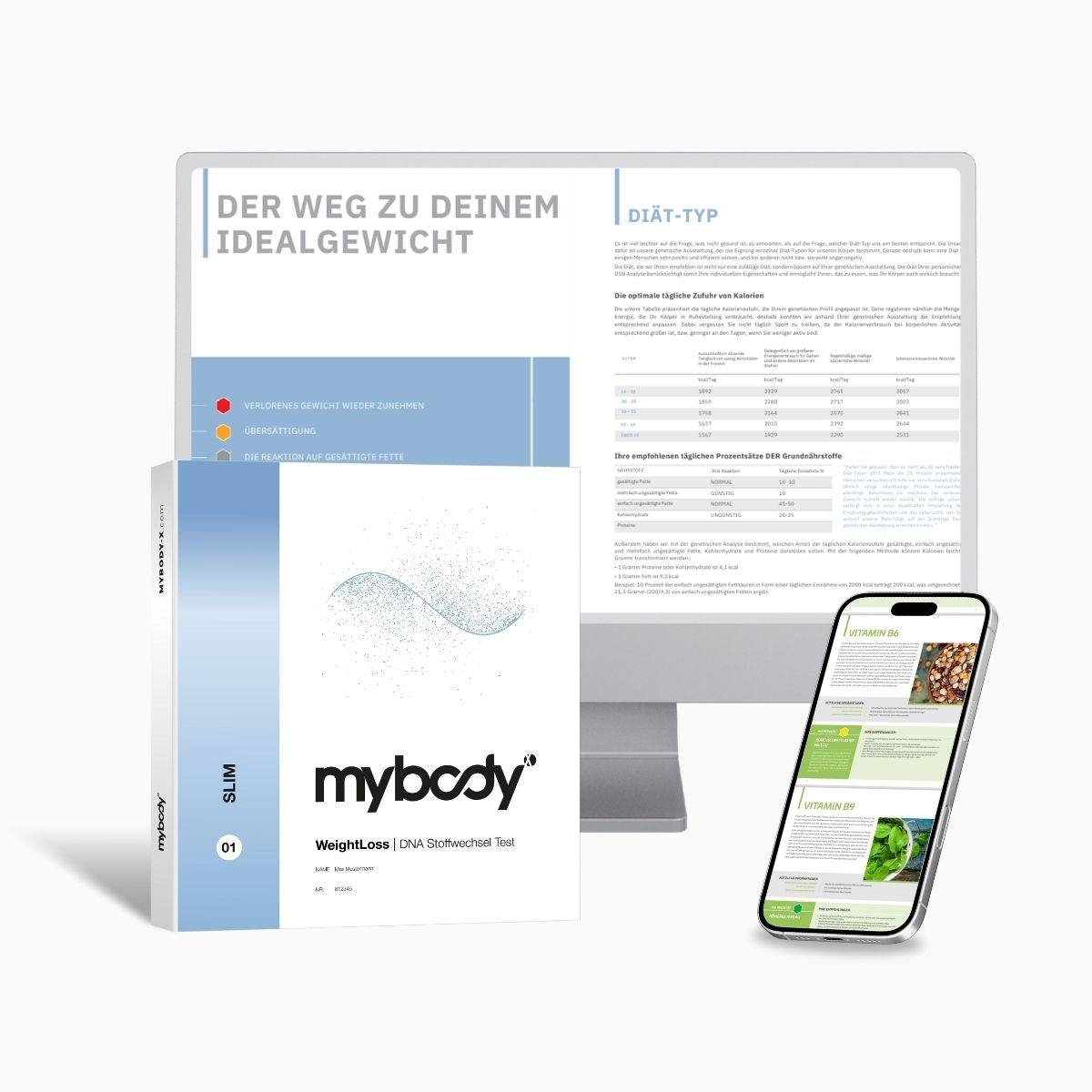
What it shows is something different: how your metabolism is predisposed, for example in how you process carbohydrates and fats. It does not answer the question “how can I get faster,” but rather “which diet suits my predisposition?” Your DNA does not change, so the result remains valid permanently. At mybody®x (MYBODY Lab GmbH), this is what the WeightLoss SLIM DNA Test does, analyzed in an ISO-certified laboratory in Germany.
DNA test from a saliva sample
WeightLoss | SLIM DNA Test
Analysis of more than 80 gene variants related to metabolism and weight, presented in 24 reports. What the test does not do: It does not speed up your metabolism, promise weight loss, or replace exercise or an adapted diet.
DNA analysis 15–25 business days after sample receipt
Product page information, accessed August 26, 2026
Whether it’s worthwhile for you depends on your starting point, and the answer can go either way:
Useful for you if …
you’re already tackling muscle building and everyday movement and want to tailor your diet to your predisposition.
you’ve tried several diets without success and want to know whether one suits you better than the others.
you’re looking for a result that, once measured, remains valid permanently.
Probably not, if …
you expect it to give you a faster metabolism. No analysis can do that, and this article would contradict itself if it claimed otherwise.
you suspect a thyroid or metabolic disorder. That belongs in a doctor’s office, not in a self-test.
you want to see your current values. A blood test is the way to do that; DNA shows your predisposition, not your current state.
What you’ll take away from this article
If you remember one thing, remember the proportions: 70 percent resting metabolism, 20 percent movement, 10 percent digestion. Every tip can be measured against that. Anyone selling you something that targets the ten percent is selling you a rounding error.
Also keep in mind the test that will help you sort through any offer in seconds: Ask about the size of the effect, not whether it exists. “Boosts the metabolism” is not a meaningful claim unless it also states by how much and for how long. Almost all advertising claims on this subject fail that one question.
The second thought is encouraging: The biggest component is not unchangeable. It depends on muscle mass, and muscle can be built at any age. It takes longer than a tea cure, but it is the only thing that keeps working around the clock.
It began with the promise of free calorie burn. It remains just that—and ultimately, that is good news: You can stop looking for a trick and put your time into what has a measurable effect. If you first want to know how your metabolism is structured, the consultation costs nothing, and it will not sell you anything.
Frequently asked questions
Can you really boost your metabolism?
Not in the sense of a regulator that you can turn up. Around 70 percent of energy expenditure comes from resting energy expenditure, which depends mainly on the proportion of muscle mass (IQWiG, 2022). It can therefore be changed through body composition, not individual foods. Exercise can increase energy expenditure, but according to IQWiG, not without limit.
Do ginger, chili, or green tea help with weight loss?
Their rationale is the energy used for digestion, which accounts for around 10 percent of calorie needs (IQWiG, 2022), and they affect only a small portion of that for a short time. It disappears in the daily balance. There is nothing wrong with including them in a flavorful diet, but they do not contribute as a weight-loss strategy.
Do many small meals keep the metabolism going?
The number of meals makes practically no difference to energy expenditure, because the energy used for digestion depends on the total amount, not its distribution. For satiety, cravings, and practicality in everyday life, distribution can matter a great deal. But that is a question of feasibility, not metabolism.
What helps with a slow metabolism?
Start by looking at the cause: A persistently low calorie burn is often caused by lost muscle mass after repeated strict diets. The way back is through strength training and sufficient protein, along with more everyday movement. If fatigue, feeling cold, or unexplained weight changes also occur, the thyroid should be medically evaluated.
Do metabolism programs with drops or powders help?
Almost all of these programs include a strict diet plan. What changes weight is the deficit created by this plan, not the accompanying product. So if you want to evaluate the program, ask one question: What would happen if I followed only the dietary part and left out the product? Usually the answer is: the same thing, only cheaper.
Next step
If you want to tailor your diet to your predisposition
The SLIM DNA Test analyzes more than 80 gene variants related to metabolism and weight. Not a faster metabolism, but a foundation for choosing a dietary approach.
To the SLIM DNA Test To the customer reviewsRead more
You might also be interested in this
How much exercise contributes mathematically, with documented figures.
Why strict diets permanently reduce energy expenditure.
Sources
- Institute for Quality and Efficiency in Health Care (IQWiG): Causes of obesity (as of 24 August 2022) – gesundheitsinformation.de
- German Federal Institute for Risk Assessment (BfR): Questions and answers about caffeine (as of 5 January 2026) – bfr.bund.de
The verbatim quotation about calorie expenditure through exercise, the definition of resting metabolic rate, the breakdown into approximately 70, 20, and 10 percent, and the statement that muscle mass is the determining factor in resting metabolic rate are taken from [1]. The information on caffeine's effect on alertness and physical performance is paraphrased from [2]. Information on price, sample type, gene variants, reports, and the laboratory comes from mybody®x's product page, accessed on 26 August 2026; processing times follow the central specification for each test type. All sources were accessed and reviewed on 26 August 2026.

mybody®x Editorial & Expert Team
DNA analysis Nutritional science Laboratory diagnostics
This article was created by the mybody®x editorial and expert team. The team combines DNA analysis, nutritional science, and laboratory diagnostics. Those who contribute to it are listed on the authors page.
Published on 26 August 2026 · Last updated on 26 August 2026
The content is for general information and does not replace medical advice, diagnosis, or treatment. Genetic predispositions describe tendencies, not certainties—when it comes to health matters, a medical assessment is always decisive.



Share now:
DNA test or blood test: which should come first?
Progesterone levels: what determines them and what does not increase them