

Vitamin D and magnesium: what the evidence shows
The essentials at a glance
The role of magnesium as a cofactor in vitamin D metabolism is described in the scientific literature. However, the wording there is more cautious than what is commonly found online.
A randomized study also shows something unexpected: The direction of the effect depended on the baseline value. At a low baseline value, 25(OH)D increased; at a higher one, it decreased.
You will read the cited source verbatim, three documented findings, three common statements fact-checked, a comparison of four statements, and a chapter on why the source category matters here.
What to expect in this article
1. Two values that are rarely mentioned together
2. The documented source
3. What a cofactor is
4. Three findings from the evidence
5. The study that complicates the picture
6. Three sentences fact-checked
7. Why the source category matters here
8. The key point in one sentence
9. What the major institutes say about this
10. Four statements compared
11. What the magnesium level itself leaves unresolved
12. For whom it makes sense to measure both values together
13. What a capillary blood test can show here
14. Limitations: what remains unresolved
15. What matters when it comes to this topic
Frequently asked questions
Sources
Two values that are rarely mentioned together
Vitamin D and magnesium are based on the same evidence and are read separately. On packaging and in advice guides, however, they often appear together.
The sentence that usually conveys this connection is: Without magnesium, vitamin D works less effectively. It sounds plausible, but is not supported by evidence in this stark form.
What is documented is more precise and, at the same time, more cautious. This article reproduces it verbatim and marks where the evidence ends.
First, a clarification that applies to the entire text: This article does not recommend any supplement, advise against any, or specify a dosage.
The documented source
The central sentence comes from a review article in a medical journal. It is presented here in German translation, followed by the English original below.
Documented source
“All enzymes that metabolize vitamin D seem to require magnesium, which acts as a cofactor in enzymatic reactions.”
Review article, The Journal of the American Osteopathic Association
Uwitonze AM, Razzaque MS: Role of Magnesium in Vitamin D Activation and Function, 2018 – own translation from the English original
The original sentence reads: All of the enzymes that metabolize vitamin D seem to require magnesium, which acts as a cofactor in the enzymatic reactions.
Two words carry all the authors' caution here: “seem to,” meaning “appear to.” This is not a claim about an established fact, but a summary of the evidence.
These exact two words are omitted from most reproductions. “Seem to require” becomes “require,” and a review becomes a fact.
What a cofactor is
The term cofactor determines what the cited sentence actually says.
An enzyme is a protein that enables a chemical transformation. Some enzymes require an additional substance for this, which is not itself consumed. This substance is called a cofactor.
Vitamin D is converted several times in the body before it reaches the form in which it acts in the blood and tissues. The cited review says that magnesium appears to be involved as a cofactor in these conversion steps.
What does not follow from this is that more magnesium means a greater effect. A cofactor is a tool in the process, not a control knob for its quantity. The next chapter presents a study in which this exact difference becomes visible.
The difference between involved and limiting
The word cofactor conceals two very different cases, and everyday language does not distinguish between them.
A substance can be involved in a process without its quantity determining the rate. And a substance can be present in such short supply that it limits the entire process. Only in the second case would more of it make a difference.
The cited review describes the first case: it says that the enzymes appear to require magnesium. It does not say that magnesium is the limiting factor in healthy people.
This is precisely where the widespread oversimplification arises. A substance involved in a process becomes one that is supposedly lacking, and a description becomes a call to action.
Three findings from the research
Three pieces of information from the reviewed sources. They provide context and do not constitute a diagnosis.
Documented information
180
The randomized controlled study on magnesium and vitamin D status included participants aged 40 to 85 (Dai et al., The American Journal of Clinical Nutrition, 2018).
30 ng/ml
was the baseline value around which the direction of the observed effect reversed: below it, 25(OH)D3 increased; above it, it decreased (Dai et al., 2018)
1–2 %
Only a small proportion of total magnesium is found in the blood—the serum value therefore reflects the body's stores only to a limited extent (IQWiG, as of March 20, 2025).
The third point is the quiet caveat hanging over the entire topic. Anyone examining the relationship between two values depends on the quality of both values, and in the case of magnesium, that quality is precisely what is limited.
And as with any laboratory value, what matters is the reference range shown on your own report, because reference ranges can vary from one laboratory to another (IQWiG, as of April 2, 2025).
The study that complicates the picture
Anyone expecting a randomized study to confirm the simple statement will be surprised.
The study by Dai and colleagues was published in 2018 in the American Journal of Clinical Nutrition, included 180 participants aged 40 to 85, and examined how magnesium supplementation affects vitamin D status.
The result in the authors’ wording, translated here: Magnesium supplementation increased the 25(OH)D3 concentration when baseline levels were close to 30 ng/ml, but lowered it when the baseline level was higher. They continue: The relationships between magnesium treatment and plasma concentrations differed significantly according to the baseline concentration of 25(OH)D.
The effect is therefore not simply present or absent. It has a direction, and that direction depends on where someone starts.
The authors’ conclusion is correspondingly cautious, translated here: Our findings suggest that an optimal magnesium status may be important for optimizing 25(OH)D status. Here, too, the sentence contains a caveat, and this one is also omitted in most reproductions.
Three statements in a fact check
These three statements regularly come up on this topic.
Checked against the evidence
Commonly claimed
“Without magnesium, vitamin D does not work.”
Documented
The cited review article is more cautious: All enzymes that metabolize vitamin D appear to require magnesium (Uwitonze/Razzaque, 2018). This is a statement about a metabolic pathway, not about an effect in an all-or-nothing sense.
Commonly claimed
“More magnesium raises vitamin D levels.”
Documented
In the randomized study, the direction depended on the baseline level: The concentration increased at baseline levels close to 30 ng/ml and decreased at higher baseline levels (Dai et al., 2018). No general direction can be inferred from this.
Commonly claimed
“That is what the official health information says.”
Documented
Neither IQWiG’s article on vitamin D deficiency (as of November 15, 2023), nor its article on the magnesium laboratory value (as of March 20, 2025), nor the MSD chapter on vitamin D deficiency (as of April 2025) establishes this connection.
Why the source category matters here
This is where a chapter belongs that is almost always missing from health guides.
In our other articles, we cite IQWiG and the MSD Manual. These are edited secondary sources: They summarize the current state of knowledge, undergo editorial review, and carry a date.
There is nothing on this topic there. Therefore, this article relies on two works from the primary literature: a review article and a randomized controlled study with 180 participants.
That is not a flaw, but it is a different level. A single study is a finding, not yet a recommendation basis. A review article is a summary by experts, not yet a guideline.
We are writing this down so that you can weigh the statements below correctly. As soon as either institution publishes something on this, this article will receive a new date.
The core in one sentence
At this point, the topic can be brought together.
If the direction of an effect depends on the baseline level, then the baseline level is the first piece of information that is missing.
That is the actual message of the cited study, and it is more practical than any recommendation. If you do not know your own baseline value, you do not even know which direction a change would take.
This places the topic in the same position as many others on this blog. Before any decision comes a dated number, and the decision itself is made by a medical practice.
What the major institutes say about this
The answer is short: nothing. However, each value individually does tell you some things, and that is helpful for interpreting them.
Regarding vitamin D, IQWiG states: Low blood levels alone do not yet constitute a vitamin D deficiency (as of November 15, 2023). It also states: Taking vitamin D without a specific reason, for example in the form of dietary supplements, usually offers no benefits.
Regarding magnesium, the MSD Manual states: The serum magnesium concentration is not closely related either to total body magnesium content or to intracellular magnesium concentration (Lewis, as of June 2025).
Both caveats remain unchanged even when the two values are considered together. A relationship between two values does not make either value more reliable.
Four statements compared
The table compares four statements on this topic and assigns each its level of evidence. It provides context and does not make a diagnosis.
| Statement | Source | Level of evidence | What remains unresolved |
|---|---|---|---|
| Magnesium acts as a cofactor in vitamin D metabolism | Uwitonze/Razzaque, JAOA, 2018 | Review article, with a caveat in the original | How large the contribution is in everyday life—a metabolic pathway says nothing about the magnitude |
| The effect of magnesium supplementation depends on the baseline level | Dai et al., AJCN, 2018 | Randomized controlled study, 180 participants, ages 40–85 | Whether this is confirmed in further studies—one study does not yet constitute a recommendation basis |
| Without magnesium, vitamin D appears to work less effectively | Not found in this form in the sources reviewed | A sharpening of the first line without the reservation contained there | Everything—the statement is not supported by evidence in this categorical form |
| Both values belong on the same report | Follows from line 2 in conjunction with the reservations concerning both individual values | Conclusion of this article, not a statement from a source | Interpretation—that takes place in a medical practice |
The third line is the most widespread and, at the same time, the least well supported. It arises because the reservation in the first line is removed.
What the magnesium value itself leaves unanswered
One point needs to be added so that this article does not promise more than a finding can deliver.
IQWiG notes that only 1 to 2 percent of total magnesium is found in the blood (as of 20 March 2025). The MSD Manual states that the serum concentration is not closely related to total body magnesium content or to the concentration in cells (Lewis, as of June 2025).
A magnesium value within the reference range therefore does not rule out reduced reserves. Anyone who reads this value alongside a vitamin D value is reading two numbers, each with its own reservations.
The specific reservations concerning magnesium are discussed in the companion article Magnesium in Serum and Whole Blood: Two Findings.
Who benefits from having both values together
The comparison concerns whether it helps you to see both values from the same sample.
Useful for you if …
You have so far known both values only separately and from different years.
You want to know your baseline value before anything has even been decided.
You want to bring dated figures to a consultation at your medical practice.
You have been taking something for a while and have never established a baseline value.
Probably not if …
You are looking for a recommendation on taking supplements. This article does not provide one.
You expect the two numbers together to produce a third finding.
You are already undergoing evaluation. In that case, the practice that started it remains in charge.
You expect a diagnosis. That comes from a medical practice, not a self-test.
What a capillary blood test can show here
A capillary blood self-test does not provide a diagnosis or answer any question about the state of the evidence. What it can do is provide both numbers from the same sample and with the same date.
The mybody®x VitalCheck (MYBODY Lab GmbH) includes 25-OH vitamin D3 and magnesium among its 18 measurements. It says nothing about supplements, and neither does this article.
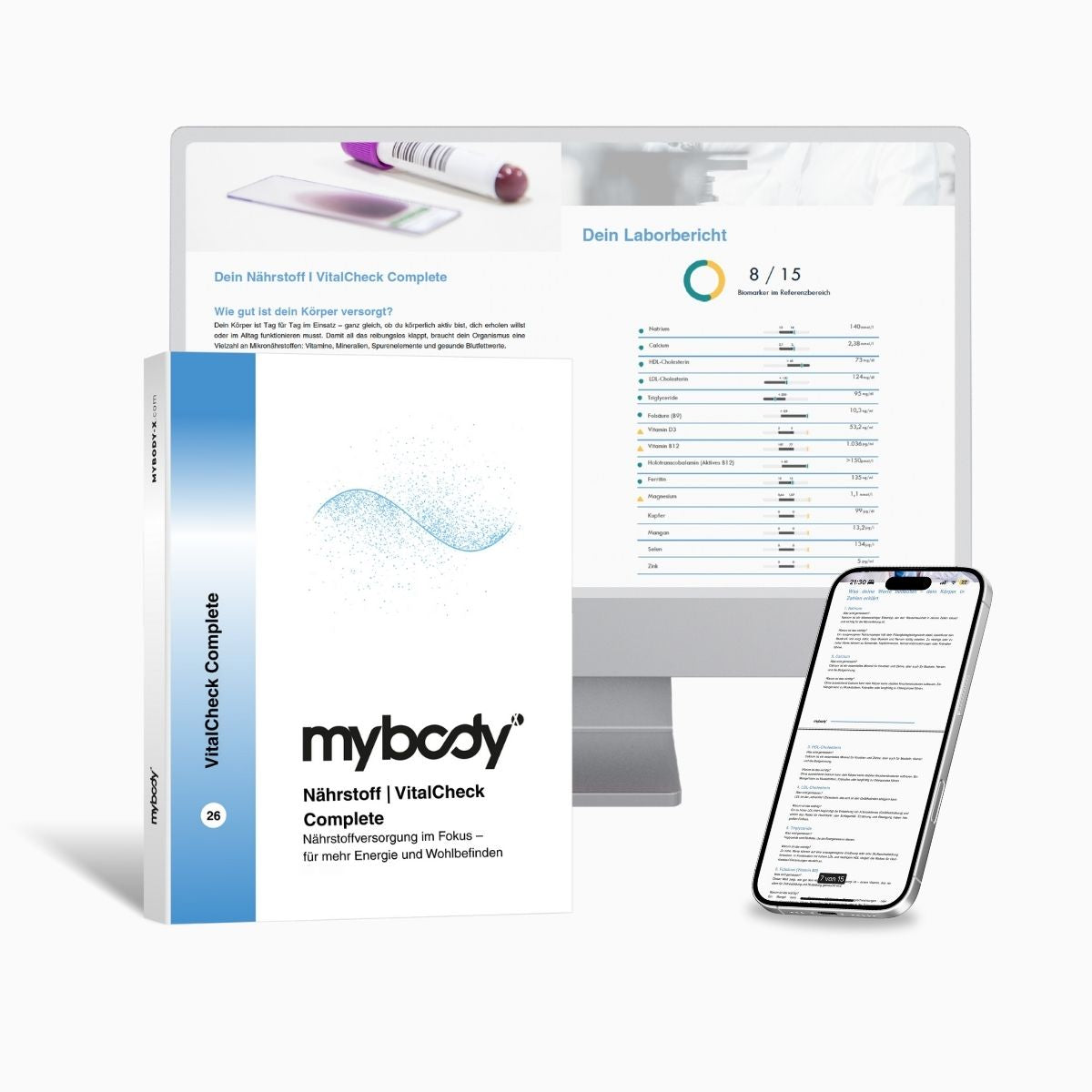
Capillary blood test
VitalCheck | Nutrient & Mineral Test Complete
Measures 18 values from the same sample, including 25-OH vitamin D3 and magnesium, as well as calcium, phosphate, albumin, ferritin, iron, transferrin, vitamin B12, folate, selenium, zinc, CRP, long-term blood sugar, and the cholesterol profile. What the test does not do: It does not recommend a supplement, specify an amount, make any statement about the interaction between the two values, provide a diagnosis, or replace a medical examination. The reservations stated in the article apply to the magnesium value.
Laboratory analysis 3–5 business days after sample receipt
Product page information, accessed 18/08/2026
Chapter at a glance
A capillary blood test provides both values from the same sample and on the same date. It does not answer any question about the evidence from studies, recommend a supplement, or provide a diagnosis. The interpretation of both values belongs in a medical practice.
Limitations: what remains open
The first limitation concerns the type of sources. This article is based on a review and a randomized study. Neither IQWiG nor the MSD Manual establishes this connection.
The second limitation concerns transferability. The cited study included 180 participants aged 40 to 85. What was observed in this group does not automatically apply to others.
The third limitation concerns the magnesium level itself. It is not closely correlated with total body magnesium (MSD Manual, Lewis, as of June 2025), and a value within the reference range does not rule out reduced reserves.
The fourth limitation concerns the implications. All assessments in this article provide context and do not constitute a diagnosis. Whether two numbers imply anything is for a medical practice to determine, and this article makes no recommendation on that.
What matters about this topic
If you take away just one thing from this article, let it be this: The connection has been described, but the common oversimplification goes beyond the available evidence.
A metabolic pathway is described in which magnesium appears to be involved as a cofactor (Uwitonze/Razzaque, 2018). A randomized study observed that the direction of an effect depended on the baseline value (Dai et al., 2018). The statement that vitamin D works less effectively without magnesium has not been established.
The most practically useful part is the least sensational: If the direction of an effect depends on the baseline value, then your own baseline value is the first information you need. Two figures from the same sample and with the same date are the beginning of a conversation to be held at a medical practice.
Frequently asked questions
Does vitamin D really need magnesium?
The cited review states: All enzymes that metabolize vitamin D appear to require magnesium, which acts as a cofactor in enzymatic reactions (Uwitonze/Razzaque, JAOA, 2018). The word appear is in the original and is part of the statement. Neither the IQWiG nor the MSD Manual establishes this connection.
Does magnesium raise vitamin D levels?
Not as a general rule. In the randomized study by Dai and colleagues involving 180 participants, the 25(OH)D3 concentration increased when baseline values were close to 30 ng/ml and decreased when the baseline value was higher (AJCN, 2018). The direction therefore depended on the baseline value. This article does not provide a recommendation for taking supplements.
Why does this article rely on studies instead of the IQWiG?
Because neither the IQWiG nor the MSD Manual says anything about this connection. Both discuss vitamin D and magnesium in detail, but separately. We make this distinction explicit so that the statements can be weighted appropriately: A single study is a finding, not yet a basis for recommendations.
How reliable is a blood magnesium value?
Only to a limited extent. The IQWiG states that only 1 to 2 percent of total magnesium is found in the blood (as of March 20, 2025). The MSD Manual says that the serum concentration is not closely correlated with total body stores or the concentration in cells (Lewis, as of June 2025). A normal value does not rule out reduced reserves.
Should I have both values measured together?
This question is not answered for you by this article. What can be said is this: If the direction of an observed effect depends on the baseline value, then your own baseline value is the information missing before any further consideration. Two figures from the same sample and with the same date are one building block for a discussion at a medical practice.
Next step
Know both baseline values
VitalCheck measures 18 values from capillary blood, including 25-OH vitamin D3 and magnesium from the same sample. It does not recommend any supplement, specify an amount, make a diagnosis, or replace medical evaluation.
Go to VitalCheckRead more
You might also be interested in
What the serum level tells us—and what it leaves open.
Why the season is only one of several conditions.
Sources
- Uwitonze AM, Razzaque MS: Role of Magnesium in Vitamin D Activation and Function. The Journal of the American Osteopathic Association, 2018 (review article) – pubmed.ncbi.nlm.nih.gov
- Dai Q et al.: Magnesium status and supplementation influence vitamin D status and metabolism: results from a randomized trial. The American Journal of Clinical Nutrition, December 2018 (randomized controlled trial, 180 participants) – pubmed.ncbi.nlm.nih.gov
- Institute for Quality and Efficiency in Health Care (IQWiG): Magnesium, as of 20/03/2025 – gesundheitsinformation.de
- IQWiG: Vitamin D deficiency, as of 15/11/2023 – gesundheitsinformation.de
- MSD Manual, Professional Edition: Overview of disorders of magnesium concentration, Lewis JL III (as of June 2025) – msdmanuals.com
- IQWiG: Understanding laboratory values correctly, as of 02/04/2025 – gesundheitsinformation.de
The quotation about magnesium’s role as a cofactor comes from source [1]; the German version is our own translation, while the English original appears in the running text. The details concerning the number of participants, age range, baseline value of 30 ng/ml, direction-dependence of the effect, and the authors’ conclusion come from [2]; these sentences are also our own translations. The figure of 1 to 2 percent comes from [3]. The statements about low blood levels and taking it without a specific reason come from [4]. The statement about the relationship between serum concentration and total body content comes from [5]. The explanation of the reference range comes from [6]. Information on price, values, sample type, and laboratory comes from the mybody®x product page, accessed on 18/08/2026; processing times follow the central guideline for blood tests. All sources were accessed and reviewed on 18/08/2026.

mybody®x Editorial & Expert Team
Laboratory diagnostics Blood analysis interpretation Nutritional science Nutrigenetics
This article was created by the mybody®x editorial and expert team. The team combines laboratory diagnostics, nutritional science, and the interpretation of blood analyses. Contributors are listed on the authors page.
Published on 18/08/2026 · Last updated on 18/08/2026
The content is intended for general information and does not replace medical advice, diagnosis, or treatment. Reference ranges depend on the laboratory, method, and age—always follow the information on your test report.




Share now:
Capillary blood from the fingertip has its own rules
DNA test or blood test: which should come first?