

Hormone test for menopause: Your guide to greater clarity
A hormone test for menopause is essentially a look behind the scenes of your body. It specifically measures your hormone levels, giving you a clear picture of your current hormonal state. So instead of merely guessing why you are experiencing hot flashes, sleep disturbances, or mood swings, you get an evidence-based foundation for your healthcare decisions.
Understanding your body during menopause
Do you sometimes feel as though your inner compass is going haywire? Sudden hot flashes, restless nights, and an emotional roller coaster—these signs are not your imagination. They are often direct signals from your body that something fundamental is changing.
Menopause, also known as the climacteric, is a completely natural phase of life. Your hormonal system, which functioned like reliable clockwork for years, is now recalibrating. The production of important hormones such as estrogen and progesterone is gradually decreasing. This disrupts the delicate balance and can cause exactly the symptoms that may be troubling you.
You are not alone with your symptoms
Even if this phase sometimes feels challenging, you are far from alone. In Germany, around nine million women are currently in the age group in which menopause typically begins. Studies show that around 80% of them experience symptoms that affect their quality of life. You can learn more in the recommendations of the German Menopause Society on frauenaerzte-im-netz.de.
The symptoms can look completely different from one woman to another. The most common signs include:
- Hot flashes and night sweats that disrupt everyday life and, above all, sleep.
- Sleep disturbances that lead to exhaustion and concentration problems. In our guide, you can learn more about the connection between sleep disturbances and menopause.
- Mood swings, a shorter temper, or depressive moods.
- Unexplained weight gain, often linked to a slowed metabolism.
- Dry skin and mucous membranes, as well as thinning hair.
Gain clarity with a hormone test
A hormone test for women going through menopause is like looking into your body’s cockpit. Instead of stumbling around in the dark and wondering why you feel the way you do, a test provides you with concrete data. It shows you in black and white which hormones are out of balance and where the real causes of your symptoms might lie.
A hormone test is much more than just a numbers game. It is your personal guide, helping you interpret your body’s signals and regain control over your well-being.
With this knowledge in hand, you are thoroughly prepared. You have a clear foundation for making targeted decisions together with your doctor. Whether it involves small lifestyle adjustments, natural support, or hormone replacement therapy, a test gives you the power to shape this new, exciting phase of life on your own terms and with confidence.
The key hormones of menopause and their roles
Imagine your hormonal system as a perfectly coordinated orchestra. Each hormone is an instrument with its own melody, but it is only through playing together that a harmonious symphony emerges. During menopause, some of these instruments—especially the ovaries—begin to play more quietly. This change disrupts the overall sound of your body and can lead to exactly the symptoms you may recognize.
To understand what a hormone test for women going through menopause can tell you, let’s take a closer look at the main players in this orchestra and their roles—without any complicated medical jargon.
The following graphic shows the journey from the first symptoms through hormone testing to gaining clarity and taking the right next steps.
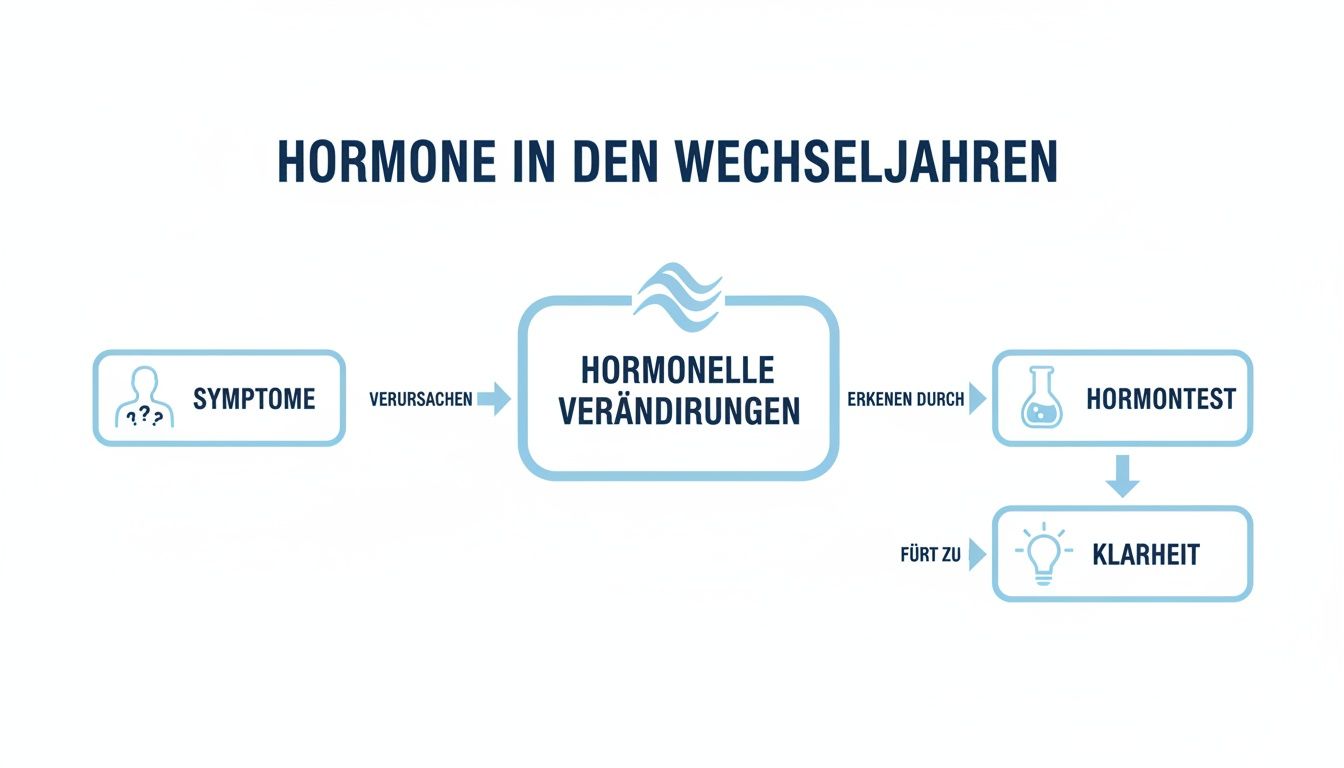
It is clear to see: A hormone test is the bridge between the vague feeling that “something isn’t right” and taking targeted action for your health.
Estradiol – the energy hormone
Estradiol is the most active form of estrogen and a true multitasker. It helps keep your skin firm, your bones strong, and your mood positive. It also keeps your mucous membranes moist and plays a key role in regulating your body temperature.
When estradiol levels drop, this can trigger an entire chain reaction:
- Hot flashes and sweating: Your internal thermostat goes haywire.
- Dry skin and thinning hair: The all-important production of collagen slows down.
- Mood swings: Estradiol influences neurotransmitters in the brain that are responsible for your well-being.
A test shows you in black and white what your estradiol levels are like and whether this could be one of the causes of your symptoms.
Progesterone – the relaxation hormone
Progesterone is the natural counterpart to estrogen. It has a calming, balancing effect and is produced mainly during the second half of the menstrual cycle. More importantly, however, is its relaxing effect on the body and mind.
A progesterone deficiency, which often begins years before the final period, quickly becomes noticeable:
- Sleep disturbances: You often wake up at night or cannot fall asleep in the first place.
- Inner restlessness and anxiety: Its calming effect on the nervous system is missing.
- Water retention: Progesterone has a diuretic effect. When it is lacking, you often feel bloated.
A declining progesterone level is one of the very first signs of perimenopause.
Progesterone acts like your body’s natural Valium. Its decline explains why many women suddenly feel more stressed and less resilient during menopause, even though not much may have changed externally.
FSH – the regulatory hormone
Follicle-stimulating hormone, or FSH, is produced in the brain. Its job is to signal the ovaries to mature eggs. But when the ovaries no longer respond as well to these signals during menopause, the brain tries to compensate by releasing more FSH—it is practically “calling” louder.
A persistently elevated FSH level is therefore a classic indicator that you are going through menopause. It is the official messenger announcing the hormonal transition.
Testosterone – the powerhouse hormone
Testosterone is often mistakenly dismissed as purely a male hormone, but it is absolutely essential for women too. It provides energy, strengthens muscles and bones, and is crucial for your libido and assertiveness.
Testosterone production also gradually declines during menopause. A deficiency can cause symptoms that are often not directly associated with menopause at all:
- Persistent fatigue and lack of drive
- Loss of muscle mass
- Decreased sexual desire
- Difficulty concentrating
The hormones working together
The following table shows which symptoms are commonly associated with a deficiency or excess of the main female hormones during menopause.
Hormones and their typical symptoms when imbalanced
| Hormone | Typical symptoms of deficiency | Typical symptoms of excess (less common) |
|---|---|---|
| Estradiol | Hot flashes, vaginal dryness, mood swings, joint pain, thin skin | Breast tenderness, water retention, weight gain, headaches |
| Progesterone | Sleep disturbances, anxiety, inner restlessness, PMS-like symptoms, irregular periods | Fatigue, depressed mood, dizziness |
| Testosterone | Loss of libido, lack of drive, fatigue, loss of muscle strength, concentration problems | Acne, oily skin, increased facial hair growth, hair loss on the scalp |
| FSH | (No direct symptoms, but a high level is an indicator of menopause) | (A low level indicates normal ovarian function) |
This knowledge is the first and most important step. It helps you see the results of a hormone test not merely as abstract numbers, but in the context of your personal well-being. This allows you to make targeted adjustments in the right areas and find your balance again.
When a hormone test really makes sense for you
Is it just stress, or could there actually be a hormonal imbalance behind it? Many women know this question all too well when their bodies suddenly feel different than usual. A hormone test can give you clarity. It is far more than just a trend—it is a valuable tool for finally interpreting your body's signals correctly.
But when is the right time to take one? There are typical situations and symptoms in which a hormone test for women going through menopause can be particularly informative.
When the symptoms determine your everyday life
Some symptoms are more than just a temporary mood. They persist and begin to noticeably affect your quality of life. If you recognize yourself in the following points, a test could be the first important step toward improvement.
A test makes sense if you are experiencing these signs:
- Persistent sleep problems: You wake up night after night or cannot fall asleep at all, even though you are dog-tired.
- Unexplained weight gain: Despite eating mindfully and exercising, the number on the scale steadily creeps upward, especially around your abdomen.
- Persistent exhaustion: You constantly feel drained and exhausted, even after a full night's sleep.
- Severe mood swings: You are often irritable, anxious, or depressed for no apparent reason—and barely recognize yourself.
- Mental fog (brain fog): Problems with concentration and forgetfulness make things difficult for you at work or in your personal life.
These symptoms are often direct consequences of the hormonal roller coaster. At an average age of 51 to 52, women in Germany experience their final menstrual period, the menopause. For about one third of them, the accompanying symptoms are so severe that their everyday lives are significantly affected. In such cases, a hormone test provides a sound basis for understanding the causes. Find out more in the Robert Koch Institute's surveys on menopausal symptoms.
Proactive health management and targeted decisions
However, severe symptoms do not always have to be the reason to take action. Sometimes, a hormone test is simply a smart, proactive step for your health that provides valuable guidance during different stages of life.
A hormone test is not a verdict but an opportunity. It gives you the data you need to make informed decisions for your well-being and regain control.
A test is worth considering, especially in these situations:
- For symptoms before the age of 40: If typical menopausal symptoms appear unexpectedly early, a test can help identify a premature hormonal transition and rule out other causes.
- As a basis for deciding on hormone replacement therapy (HRT): Are you considering starting hormone replacement therapy? A test provides you and your doctor with precise measurements to plan a treatment that truly suits you and is optimally dosed.
- When you simply want clarity: You don’t have to wait until your symptoms become severe. Maybe you simply want to understand where you stand hormonally so you can make targeted adjustments to your lifestyle, diet, or training. A test gives you a valuable snapshot of your internal balance. Read more in our comprehensive guide to hormone testing for women.
How an at-home hormone test works
Does a hormone test make you think of waiting rooms, complicated appointment scheduling, and a lot of effort? Fortunately, those days are over. Modern at-home test kits, like those from mybody-x, make it incredibly easy to gain valuable insights into your hormone balance—conveniently and discreetly in your own home.
Here, we show you step by step just how straightforward the entire process really is. You’ll see: it’s easier than you think and gives you back control over your health data.

The process of your hormone test, step by step
The entire process is designed to take away any uncertainty. From ordering to your personal results report, every step is clear, simple, and easy to follow.
- Order and receive your test kit: You select the appropriate hormone test for women going through menopause online and receive the complete set discreetly delivered to your home. It contains everything you need—including easy-to-follow instructions.
- Simple sample collection at home: Depending on the test, you collect a small saliva sample or a few drops of blood from your fingertip. Don't worry, it is quick and virtually painless.
- Free return shipping to the laboratory: You securely package your sample in the enclosed return envelope and send it to our certified partner laboratory. Shipping is, of course, free of charge for you.
- Analysis by experts: Your sample is analyzed in the laboratory according to the highest quality standards. Your data is handled strictly in accordance with GDPR guidelines and is protected at all times.
- Easy-to-understand results report: After a few days, you will receive your report by email. Instead of complicated technical jargon, you will get a clear, graphical presentation of your hormone levels and understandable explanations of what they mean for you.
Saliva or blood: Which sample is right?
One of the most common questions is which type of sample is better suited for a hormone test. The answer: Both methods have their place and are used selectively, depending on which hormone is being measured.
The saliva test:
This method is perfect for measuring the free, active hormones. These are precisely the hormones that are currently available to your body and can trigger symptoms. A saliva test is ideal for measuring:
- Estradiol
- Progesterone
- Testosterone
- DHEA
- Cortisol (the stress hormone)
A saliva test is like a snapshot of the hormones that are currently “knocking” on your cells. It provides a very accurate picture of what your body is feeling and experiencing at that moment.
The blood test (from the fingertip):
A blood test measures the total concentration of a hormone in the blood, including both the free and bound fractions. This method is particularly important for hormones that cannot be reliably measured in saliva. Above all:
- FSH (follicle-stimulating hormone): An elevated FSH level is one of the most classic and important indicators that you are entering menopause.
Often, only the combination of both methods provides the most comprehensive picture of your hormonal situation. mybody-x selects the scientifically most suitable method for each test. This means you can be completely confident that your results are truly meaningful.
If you would like to take a deeper look at the different types of tests, you can find more information in our guide about how an at-home hormone test works. This will ensure that you are well informed and can choose the right test for your personal needs.
How to correctly interpret and use your hormone levels
You are holding your test report in your hands—a document full of numbers, technical terms, and charts. This moment may feel quite overwhelming at first. But take a deep breath, because this report is not a judgment; it is your very personal starting point for improved well-being.
Here, we will translate the lab jargon into language that is easy to understand. I will show you what these levels really mean for you and your everyday life, and how you can use them as a powerful tool to actively reclaim your quality of life.

What the normal ranges really tell you
In your results report, you will find so-called reference or normal ranges for each hormone level. These ranges indicate which levels are considered normal in a large group of healthy women. They are an important guide, but they are not everything.
Think of these reference ranges as a map. They show you where most people live, but not necessarily where you personally feel most comfortable. Your progesterone level may technically be “within the normal range,” but close to the lower limit—and you may still clearly feel the effects through sleep disturbances and inner restlessness.
Your individual experience is just as important as the bare numbers on paper. A level is only optimal if you also feel good with it.
That is precisely why a hormone test for women going through menopause is so valuable. It provides you with objective data that you can compare with your subjective experience. This comparison is the key to uncovering the true causes of your symptoms.
Your results as a tool for talking to your doctor
Your hormone results provide the perfect basis for a well-founded, focused conversation with your doctor, physician, or naturopath. Instead of merely describing vague symptoms such as “I constantly feel tired,” you can now say specifically: “My fatigue could be related to this low testosterone level. What can we do about it?”
You are no longer going to the doctor’s office as someone pleading for help, but as an informed partner on an equal footing. You have concrete data that can initiate a discussion about possible next steps. This enables a much more targeted treatment strategy tailored to you.
From data to concrete steps
Understanding your results is the first step toward turning knowledge into meaningful action. The results of your hormone test open up a whole range of possibilities for restoring your balance—from gentle adjustments to your daily routine to medical treatments.
Possible next steps could include:
- Adjustments to diet and lifestyle: If your test shows signs of stress, such as elevated cortisol, you could incorporate targeted stress-management techniques like yoga or meditation into your day and make sure to eat a magnesium-rich diet.
- Targeted supplementation: Low progesterone levels can often be accompanied by a deficiency in certain nutrients such as vitamin B6 or zinc. Targeted supplementation may provide useful support here, ideally after consulting an expert.
- Bioidentical hormone therapy (BHT): If the values deviate significantly from the normal range and the level of suffering is high, the findings may provide a basis for considering bioidentical hormone therapy. This uses hormones whose structure is identical to that of the body’s own hormones.
Your results report puts you back in control. It shows you exactly which levers you can adjust—not just to manage symptoms, but to address their causes. If you would like to learn more about the background and significance of individual values, read our guide to assessing hormone levels. There you’ll find more in-depth information to help you understand your results even better.
Hormone therapy today: What has really changed
Hormone replacement therapy (HRT for short, now often simply called hormone therapy) has a rather eventful history. Many women are still unsettled today, often because of old headlines from the early 2000s. The problem is that these reports were based on studies that are long outdated from today’s perspective. At the time, unsuitable hormone preparations were often tested at excessively high doses on women who were actually already too old for such therapy.
But since then, an incredible amount has changed in science and treatment methods. Today, it’s no longer about a blanket treatment for everyone, but about sensitive, truly personal support tailored precisely to your needs and your body.
From a one-size-fits-all approach to an individual solution
The biggest change lies in the approach. In the past, there were rigid regimens; today, good therapy is guided by your individual symptoms and hormone levels. Modern approaches often use bioidentical hormones. Their molecular structure is identical to the hormones your body produces itself, which may improve tolerability.
Modern hormone therapy now follows three clear principles:
- As little as possible, as much as necessary: Only the lowest dose that effectively relieves your symptoms is used.
- The right timing is crucial: The greatest benefits occur when therapy begins relatively early in menopause—during this so-called “therapeutic window.”
- Choose the right form: Today, hormones are available as gels, patches, capsules, or sprays. This allows treatment to be tailored to you and helps minimize risks.
This precise approach makes it clear exactly why a hormone test for women going through menopause is so valuable as a starting point. It provides the data needed to make an informed decision instead of treating blindly.
A look at developments in Germany
The old skepticism has left a deep mark. In 2000, 37 percent of women going through menopause in Germany still used hormone therapy. By 2020, this figure had fallen to just six percent—a dramatic decline of more than 80 percent. You can read more about the background to menopausal symptoms on endokrinologie.net.
Above all, this change shows one thing: The old “one-size-fits-all” solution has had its day. Modern medicine means taking a close look—and a hormone test is the most important tool for doing so.
With this knowledge, you can approach the conversation with your doctor much more confidently and better informed. It’s not about being blindly for or against hormone therapy. It’s about finding the solution that is best and safest for you personally.
Your most frequently asked questions about hormone testing
We regularly receive questions about hormone testing for women going through menopause. I’ve collected the most important ones here and answered them briefly and concisely. This way, you can quickly gain clarity if you’re still unsure about certain topics.
Does a hormone test make sense at every stage of menopause?
Yes, absolutely. Whether you’re just noticing your first irregular cycles during perimenopause or haven’t had a period for some time, a test can give you valuable insights.
In the early stages, it helps you understand the first, often subtle changes. After your last period (menopause), it shows you your new hormonal baseline. This is a great foundation for all future decisions about your health.
Think of the hormone test as a personal map of your body. It shows you exactly where you are right now—whether you’re at the beginning, in the middle of the process, or already at the end of the hormonal transition.
Can I test while using hormonal contraception?
A very important point. If you use hormonal contraception, such as the pill, ring, or hormonal IUD, your natural cycle is suppressed. Your body then produces hardly any of its own hormones.
A test would therefore not provide a true picture of your natural hormone status, but would mainly measure the synthetic hormones being supplied. To obtain a meaningful result, you would need to stop using hormonal contraception—of course, after consulting your doctor—and wait a few cycles until your body has found its natural rhythm again.
Can a hormone test help with weight gain?
Definitely—it can be a crucial piece of the puzzle. Many women find that they gain weight during menopause without having changed their habits. This is often directly related to their hormones.
An imbalance between estrogen and progesterone can, for example, slow down the metabolism and promote water retention. A test makes these connections visible. This gives you concrete indications of where you can take action—whether through your diet, targeted nutrients, or better stress management.
How often should I have my hormones tested?
An initial assessment gives you a solid foundation to get started. If you then make changes, such as adjusting your lifestyle or starting a treatment, a second test after around six to twelve months can be very useful.
This way, you can see in black and white whether your levels have improved and whether your measures are working. It’s not about constant monitoring, but about targeted checkups at important milestones on your personal health journey.
Are you ready to gain clarity about your hormone status and take control of menopause on your own terms? At mybody-x.com, you’ll find scientifically backed at-home hormone tests. Discover the right test for you and receive easy-to-understand results that help you take the right steps toward your well-being.



Share now:
How At-Home Blood Tests Can Transform Your Health
Understand Your Blood Test Results Correctly – Gain More Vitality