

Why At-Home Blood Tests Are Changing Your Health
More than 60 percent of people in the Central European region are looking for flexible ways to independently keep track of their health. An increasing number of health-conscious people are discovering at-home blood tests as a straightforward alternative to a traditional doctor’s visit. This article shows you how modern at-home blood tests can help you discreetly and specifically analyze your health status from home and what benefits they offer for your individual nutrition and prevention strategy.
Table of Contents
- At-Home Blood Tests: Definition and Benefits
- Variety of Home Tests and Testing Methods
- Process and accuracy of sample analysis
- Data protection and legal requirements in Switzerland
- Advantages over traditional doctor visits
- Risks, limitations, and typical sources of error
Important Findings
| Point | Details |
|---|---|
| At-Home Blood Tests Offer Flexibility | They make it easy to perform the tests at any time without a doctor’s appointment. |
| Easy-to-Use Test Kits | The kits are designed to be user-friendly and include detailed instructions for collecting samples. |
| Data protection is ensured | Swiss legislation ensures the confidentiality of sensitive health data throughout the entire process. |
| Home tests are supplementary sources of information | They do not replace a professional medical diagnosis, but should be used to monitor your health. |
At-Home Blood Tests: Definition and Benefits
At-home blood tests are innovative self-tests that allow you to check important health values directly from your home. These at-home blood tests offer a simple and discreet way to analyze your health precisely.
The basic idea behind at-home blood tests is simple: Using special test kits, you can independently collect a small blood sample from your fingertip and send it in for analysis. These tests cover various aspects of health—from vitamin and mineral levels to immune status. They help you detect potential deficiencies or imbalances in your body at an early stage.
The benefits of such blood tests are numerous. You save the time and effort of visiting a doctor, quickly gain clarity about your state of health, and can take targeted action. The test kits are designed to be user-friendly and come with detailed instructions, allowing anyone to collect a blood sample without difficulty.
Pro tip: Keep the results of your blood tests and make regular comparisons to monitor changes in your health status.
Variety of Home Tests and Testing Methods
The modern world of health testing now offers an impressive variety of home tests that allow you to conveniently check various aspects of your health from home. From stool test analyses to complex blood tests, you can now examine almost every area of your health independently.
The most common home test categories include blood tests for nutrient and hormone analyses, microbiome tests for gut health, allergy tests, and intolerance tests. Each testing method uses different sample collection procedures: while blood tests generally require a small sample from the fingertip, stool or saliva tests are performed using simple swab or collection samples. Modern test kits are designed to deliver accurate results with minimal user burden.
Another advantage of home tests is their specialization. You can specifically choose tests for particular areas of health—whether checking your vitamin levels, analyzing your gut flora, or testing for possible food intolerances. These personalized testing options allow you to obtain highly targeted information about your individual health status.
Pro tip: If in doubt, always consult a doctor and consider home tests as a supplementary source of information, not a complete substitute for professional medical diagnoses.
Process and accuracy of sample analysis
The process of home blood tests is precise and scientifically sound. Home blood tests begin with careful blood collection directly from the fingertip. Using a sterile lancet, you gently prick your fingertip and collect a few drops of blood in specially prepared tubes or on test strips.

After collecting the sample, send your test kit to a certified laboratory. There, your blood samples undergo highly professional analysis using state-of-the-art laboratory methods. Accuracy depends decisively on two factors: correct sample collection and professional analytical methods. Even minor deviations during blood collection can affect the results, which is why following the test instructions precisely is absolutely crucial.
The laboratory analysis is performed according to strict scientific standards. Modern laboratories use highly sensitive analytical devices that can precisely examine minimal amounts of blood. The nutrient analysis provides detailed information about your health status—from mineral levels to hormone concentrations. The results are processed digitally and presented to you clearly and understandably.
Pro tip: When collecting the sample, ensure that your hands are clean, work in a calm environment, and follow the instructions step by step to ensure maximum accuracy.
Data protection and legal requirements in Switzerland
Data protection is highly valued in Switzerland, especially when it comes to sensitive health data. As a customer, you have comprehensive legal safeguards protecting your personal information during at-home blood tests. Swiss legislation sets the strictest guidelines for handling medical data, going far beyond European standards.
The legal requirements for health tests are based on several fundamental principles: absolute confidentiality, informed consent, and maximum data security. Specifically, this means that your blood samples and test results are pseudonymized, so that it is impossible to draw conclusions about your identity. Laboratories are required to destroy your data after analysis and not to store or disclose any personal information.
Companies such as mybody® are also subject to very strict compliance requirements. Data processing is governed by the Swiss Federal Act on Data Protection and the European General Data Protection Regulation (GDPR). This guarantees you maximum transparency and control over your personal health information. Every customer has the right to request information about their stored data and to demand its deletion.
Pro tip: Before every at-home test, read the privacy policy carefully and make sure you fully understand all consent forms.
Advantages over traditional doctor visits
At-home blood tests are revolutionizing the way we monitor our health. At-home blood tests offer unparalleled flexibility and time savings compared with traditional doctor visits. You do not have to make appointments, endure waiting times, and can perform the blood test exactly when it suits you best.
The benefits are wide-ranging: no travel, no searching for parking, and no long waits in waiting rooms. People with limited mobility or tight schedules benefit particularly from this modern testing alternative. The test kits are designed so that you can easily collect your own blood sample—with precise instructions and all the necessary materials.
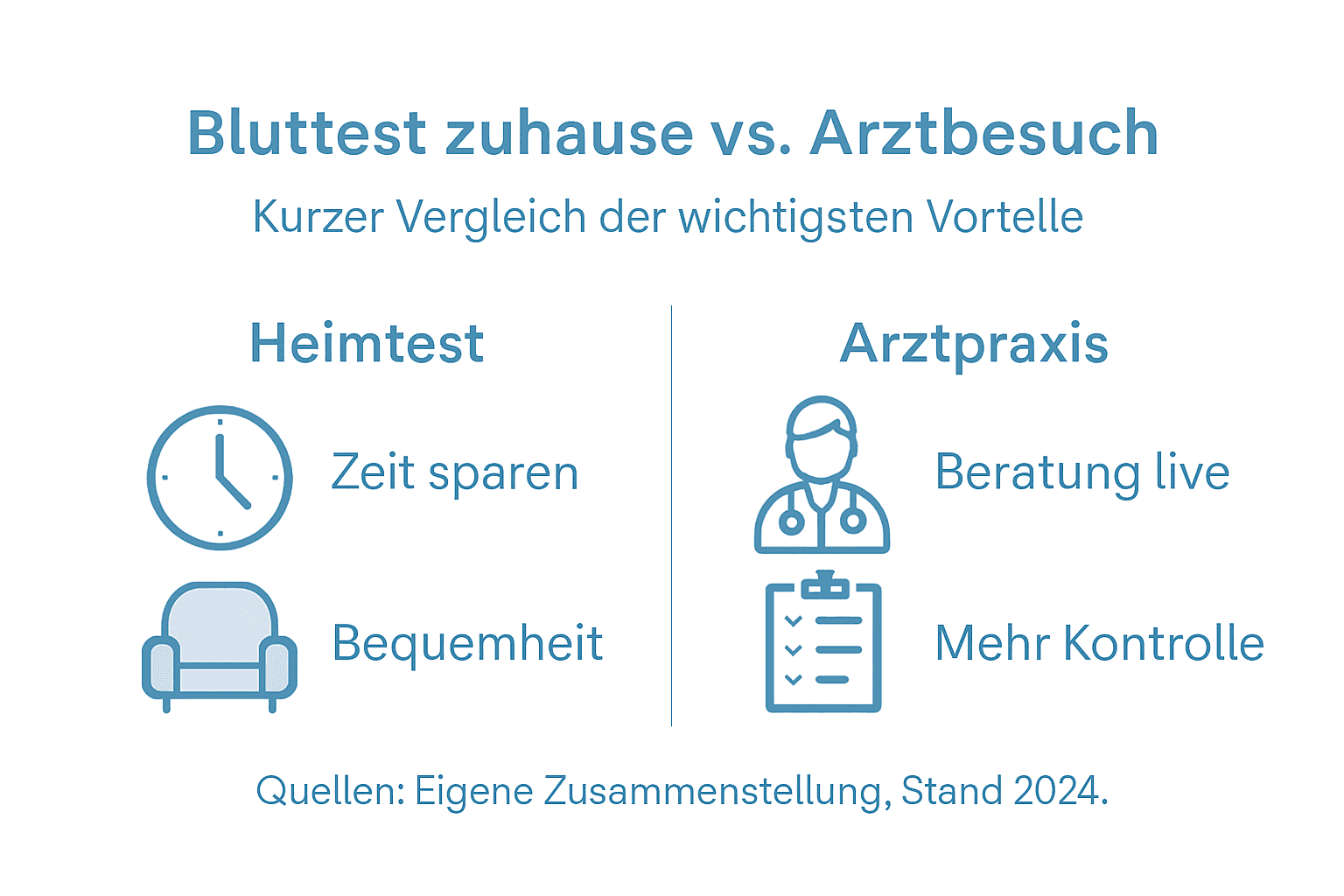
Another decisive advantage is cost-effectiveness. While traditional doctor visits often involve additional expenses such as practice fees, copayments, or travel costs, home tests offer a transparent and often more affordable option. You gain greater control over your health data and can conveniently review it from home. The results are presented digitally and clearly, allowing you to analyze them at your leisure and discuss them with a doctor if necessary.
The following overview shows the key differences between an at-home blood test and a traditional doctor's visit:
| Criterion | At-home blood test | Doctor's visit at a medical practice |
|---|---|---|
| Flexibility | Can be performed at any time | Appointment and fixed opening hours |
| Time required | Very little, no waiting | Often waiting times and travel |
| Result availability | Digital results usually available quickly | Results provided in person or by mail |
| Cost structure | Transparent, often more affordable | Additional fees may apply |
| Data protection control | Personal, often digitized | Usually managed by the medical practice |
Pro tip: Keep your test results and make regular comparisons to detect changes in your health status at an early stage.
Risks, limitations, and typical sources of error
At-home blood tests have limitations that you should be aware of. Self-tests do not replace a professional medical diagnosis and must be interpreted with caution. The most common sources of error occur during sample collection and processing.
The most important risks include possible misinterpretation of the results. As a layperson, you often lack the medical expertise needed to fully understand test results. Minor inaccuracies during blood collection—such as trembling hands, improper sample storage, or unclean work surfaces—can significantly distort the results. In addition, self-tests can cause anxiety when results are read without professional interpretation.
There are also important limitations when it comes to complex health conditions. Not every illness can be detected with a simple at-home test. Chronic conditions, subtle hormonal changes, or developing health problems require a comprehensive medical assessment. At-home tests should therefore be viewed as a supplementary source of information, not as a substitute for professional medical examinations.
For guidance, below you will find typical sources of error and solutions for at-home blood tests:
| Source of error | Possible impact | Suggested improvement |
|---|---|---|
| Unclean hands | Sample contamination | Wash your hands thoroughly before collecting the sample |
| Insufficient blood volume | Incomplete analysis | Warm your finger thoroughly before collecting the sample |
| Improper sample storage | Invalid or delayed results | Package the sample immediately and correctly |
| Improper sample collection | Inaccurate results | Follow the instructions step by step |
| Misinterpretation of the results | Incorrect measures taken | Discuss the results with a doctor if necessary |
Pro tip: When in doubt, always consult a doctor and use home tests as an additional, but not exclusive, source of information about your health.
Discover how at-home blood tests can truly transform your health
At-home blood tests give you the opportunity to monitor your health independently and accurately without the hassle of visiting a doctor. If you are seeking greater clarity in the early detection of nutrient deficiencies, hormonal fluctuations, or intolerances, mybody® is the right choice for you. Here, state-of-the-art ISO-certified laboratory analyses are combined with the highest standards of data protection compliance and expert advice.
Take advantage of our wide range of at-home health tests and specialized at-home hormone tests to specifically improve your individual health. In addition, we offer tailored at-home intolerance tests to help you identify potential triggers of symptoms. Take advantage of the opportunity now with mybody® to sustainably optimize your nutrition, performance, and well-being. Visit https://mybody-x.com and start your personalized health test today!
Frequently asked questions
What are at-home blood tests?
At-home blood tests are self-tests that allow you to easily and conveniently check important health markers from home. You collect a small blood sample and send it to a certified laboratory for analysis.
How is the sample collected for at-home blood tests?
A sample for an at-home blood test is usually collected by making a small prick in the fingertip with a sterile lancet. A few drops of blood are then collected in special tubes or on test strips.
What are the benefits of at-home blood tests compared with a doctor’s visit?
At-home blood tests offer flexibility, save time, and are often a more cost-effective alternative to traditional doctor’s visits. There are no waiting times, and the tests can be performed at any time.
Which aspects of health can be checked with at-home blood tests?
At-home blood tests allow you to check various aspects of your health, such as nutrient and hormone levels, immune status, and even allergies or intolerances.
Recommendation
- Stool test at home: How to check your gut health | MYBODY-X – mybody®x
- Instructions: Capillary blood test – Measure blood values at home – mybody®x
- Get your testosterone tested: Simple and discreet from home – mybody®x
- Irritable bowel syndrome test: How to finally gain clarity about your gut – mybody®x
- What is ‘Vampire Facial’? Potential risks. | Panamedico



Share now:
Your perfect Valentine’s Day menu for an unforgettable evening
Hormone test for menopause: Your guide to greater clarity