
DNA Test Explained: Your Comprehensive Guide to Health and Nutrition
A DNA test unlocks the unique genetic code in your DNA, providing incredibly valuable insights into your body. Think of it as a personal blueprint that finally explains why some diets work so well for you while others fail completely – or which nutrients you truly need.
What your personal blueprint reveals
Have you ever wondered why your friend loses weight effortlessly with carbohydrates, while every gram immediately goes to your hips? Or why you have sore muscles for days after a tough workout, while others are already back to normal? The answers lie in your DNA, the individual code that dictates how your body works.
A DNA test, like the one from mybody® , is much more than just a glimpse into your ancestry. It's a scientifically sound guide to your health. Using a simple saliva sample, specific gene variants (so-called SNPs ) are analyzed that have a direct impact on your metabolism and well-being. This analysis provides you with clear, personalized information.
Insights you can gain
The insights gained from such a test are extremely diverse and can help you achieve your health goals much more directly. Here are a few examples of what you can learn:
- Your metabolic type: You'll find out whether your body metabolizes fats, carbohydrates, or proteins better. This is the key to a diet that truly suits you.
- Individual nutrient needs: Discover if you may have a genetically higher need for certain vitamins or minerals, such as vitamin D or B12 .
- Optimal training strategies: Find out whether your body is better suited for endurance sports or strength training. This way you can adjust your training and achieve significantly better results.
- Sensitivities and intolerances: The test can give you clues as to whether you have a genetic predisposition for lactose intolerance or an increased sensitivity to caffeine .
These genetic puzzle pieces are the foundation for finally truly understanding your body. If you want to delve even deeper into this fascinating world, read our article about what genes are and how they shape our lives . With this knowledge, you can make informed decisions based on your unique biology – instead of just following general advice.
What types of DNA tests are there?
The term "DNA test" is on everyone's lips these days, but it's actually a catch-all term for a wide variety of analyses. Depending on what exactly you want to find out about yourself, a different type of test will be suitable. To make your decision easier, it's important to understand the main categories and their objectives.
Essentially, the at-home tests can be divided into three categories, each answering completely different questions. Each test provides you with different insights and has its own unique practical benefits for your everyday life – from optimizing your diet to exploring your family history.
The following infographic serves as a kind of guidepost. It helps you to recognize which path is the right one for your personal goals.
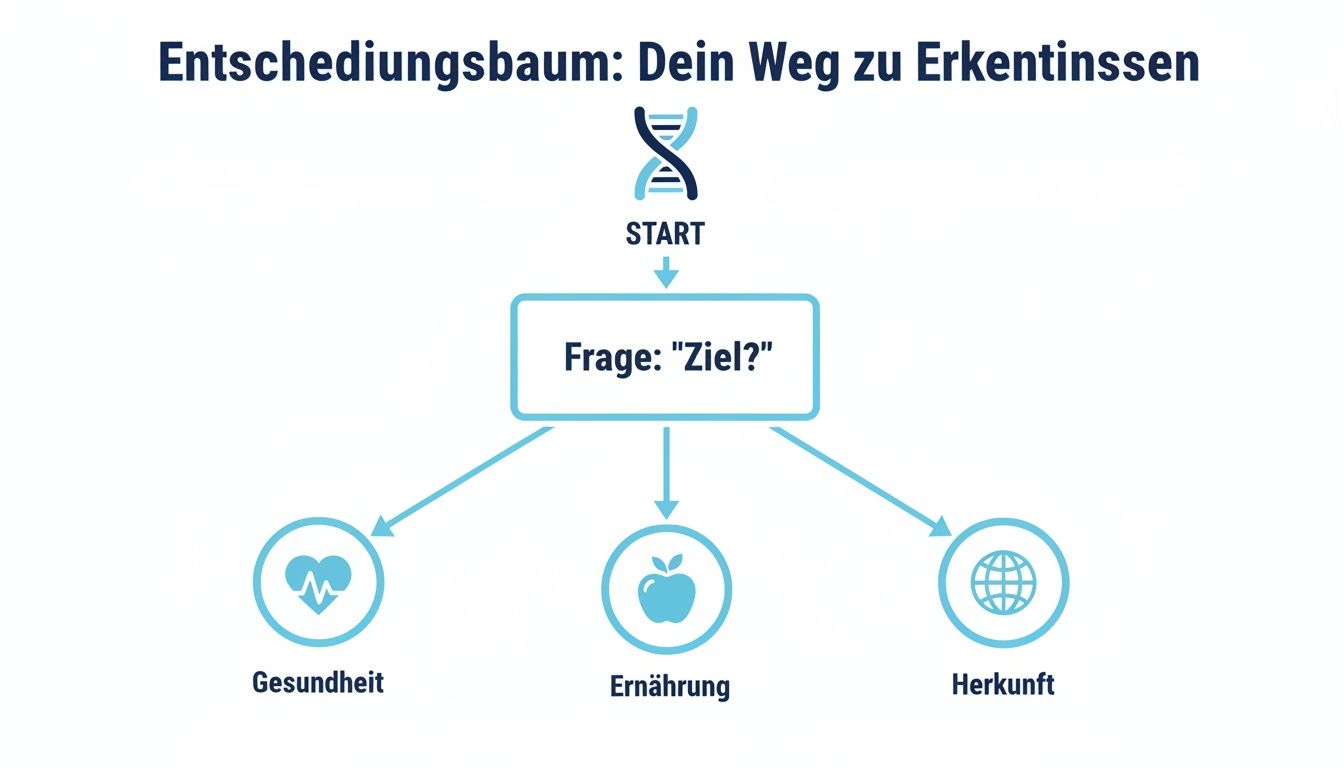
As you can see, the first and most important step is to clarify what motivates you. Your personal motivation will lead you directly to the appropriate test category.
Metabolism and nutrition tests
These DNA tests are specifically designed to decipher your individual metabolism. They analyze genetic markers that influence how your body processes fats, carbohydrates, and proteins. The goal is clear: to provide you with concrete, personalized recommendations for your diet and lifestyle.
The results will help you, for example, to find the most effective diet for you or to specifically meet your nutritional needs. If you want to understand why your body reacts to certain foods, how to manage your weight sustainably, or how to improve your athletic performance, this is exactly the right test for you.
mybody® focuses precisely on this area to provide you with actionable health strategies. If you'd like to delve deeper into the subject, read our guide to the different types of metabolic analyses .
Health tests for genetic predispositions
Health tests go a step further and examine genetic predispositions for certain health aspects. They can provide valuable insights into predispositions and thus help you to proactively take preventative measures.
It's important to make this distinction: These lifestyle tests do not provide medical diagnoses , but rather highlight tendencies. They are a tool for self-responsibility, enabling you to make informed decisions for a healthier lifestyle.
Ancestry tests for genealogy
The third major category is ancestry testing. Its main purpose is to determine your ethnic origins and uncover your geographic roots. To do this, it compares your DNA with reference populations from around the world and can even help you find relatives you didn't know you had.
Especially in the field of genealogy, the market for commercial DNA tests experienced a huge boom because many people wanted to understand their family roots. While these tests are very reliable in finding DNA matches, you should always consider the ethnicity estimates as approximations.
Comparison of DNA test types
This table compares the main types of at-home DNA tests, their primary uses, the types of results they produce, and who they are best suited for.
| Test type | Main purpose | Typical results | Ideal for |
|---|---|---|---|
| Metabolism & Nutrition | Nutritional optimization, weight management | Metabolic type, nutritional requirements, intolerances | People who want to optimize their diet, fitness & well-being |
| Health & Predisposition | Prevention & Health Management | Risk factors for certain health aspects, carrier status | People who want to proactively manage their health and understand their risks |
| Origin & Ancestry | Genealogy, ethnic origins | Ethnicity estimate in %, DNA relatives, migration routes | Curious people who want to explore their family history and discover their roots |
In summary, each type of test provides valuable but very different information. The choice depends solely on your specific question.
Your at-home DNA test: How it works step by step
Are you considering taking a DNA test but unsure how it all works? Don't worry. The process is surprisingly simple and designed so you can complete everything safely and conveniently from home. I'll guide you through each step here so you know exactly what to expect.
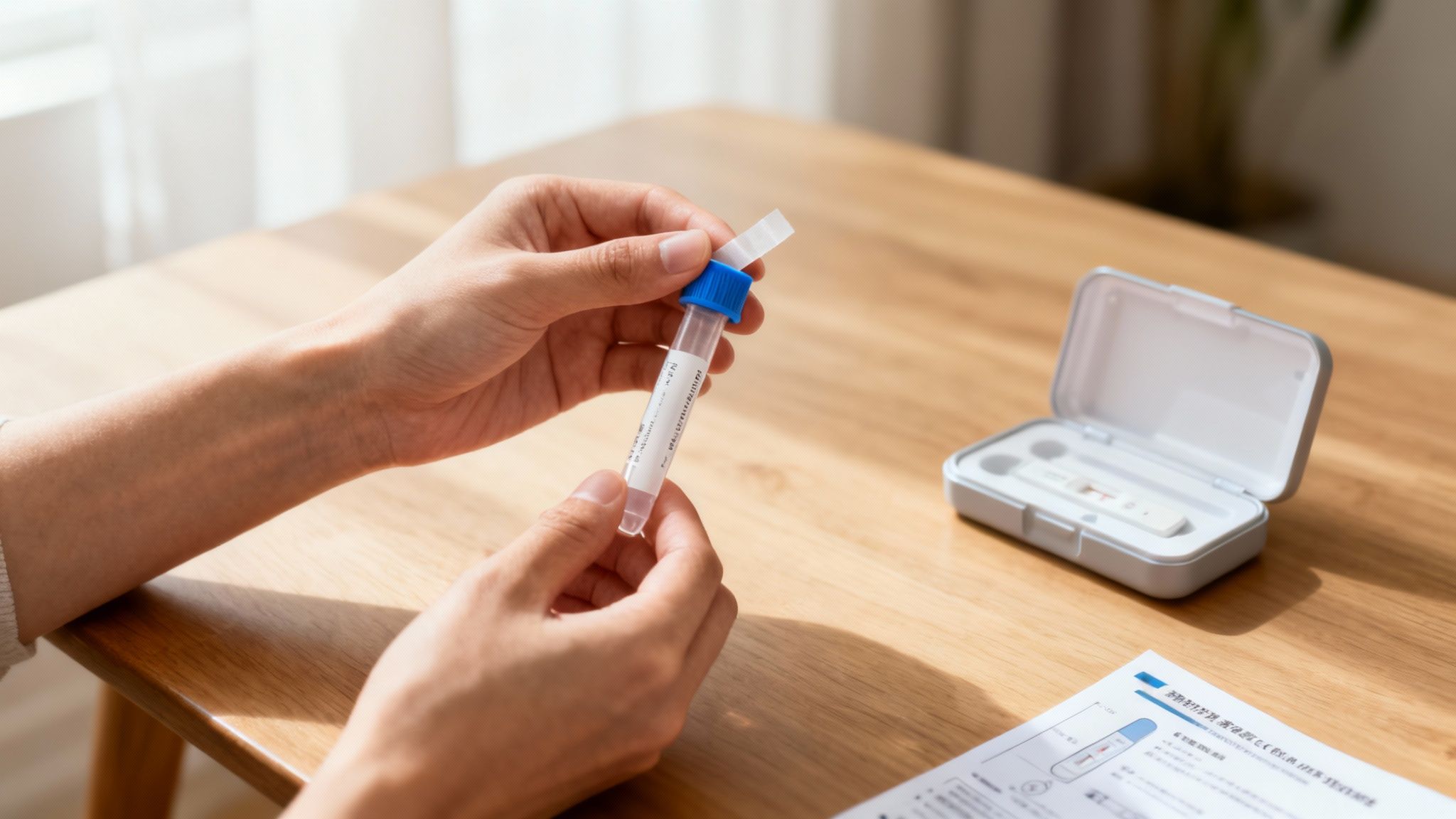
It all starts with ordering your test kit, which will be delivered discreetly to your home. The box contains everything you need for sample collection – and that's really not much.
Sample collection: Simple and quick.
At the heart of the process is a simple saliva test. It's completely painless and only takes a few minutes. Just follow the enclosed, easy-to-understand instructions.
- Preparation: To ensure your sample is clean and uncontaminated, you should refrain from eating, drinking, smoking, or chewing gum for 30 minutes beforehand. This is important for the quality of the analysis.
- Procedure: Using the cotton swab from the kit, simply wipe the inside of your cheek for a short time. This simple swab collects enough cells for a comprehensive laboratory analysis.
- Packaging: The swab is then placed directly into the supplied sample tube, securely sealed, and is ready for shipping.
Activation and delivery: An important point for your data privacy
Before you send the sample on its way, there is one important intermediate step: the online activation of your test kit. This is not unnecessary effort, but a central component of the data protection concept.
Activating your sample with a unique code pseudonymizes it. What does that mean? Simply put: your personal data, such as your name and address, is strictly separated from your biological sample. The laboratory receives only an anonymous number and has no access to your identity.
After activation, you place the sample in the prepaid return envelope and take it to the post office. Reputable providers like mybody® guarantee that this entire process is completely secure and GDPR -compliant.
What happens in the lab
Once your sample arrives at the certified laboratory, the real scientific work begins. Specialists extract the DNA from your cells and use state-of-the-art technology to precisely analyze the genetic markers relevant to your test. These procedures are extremely precise and achieve an analytical accuracy of over 99% .
Once the analysis is complete, the complex genetic data is translated into an easy-to-understand, personalized results report for you. The entire process, from sending your sample to receiving your results, typically takes four to six weeks . You will be notified as soon as your report is available online.
What actually happens to your DNA in the lab?
Once your saliva sample arrives at the lab, the really exciting part begins. What exactly happens behind the scenes? It's less mysterious than you might think and follows strictly standardized, highly precise procedures to deliver reliable results.
First, your DNA is isolated from the cells in your saliva. Imagine filtering out the pure genetic material – this pure DNA strand is then the raw material for everything else. Next, a process called genotyping comes into play. This involves specifically examining certain points in your genome that are particularly indicative of your health predispositions.
What exactly are SNPs?
For health tests like those offered by mybody®, the analysis focuses primarily on so-called single nucleotide polymorphisms , or SNPs (pronounced "snips"). These are tiny variations of individual DNA building blocks that make the small but crucial difference.
These tiny variations can reveal how your metabolism works, which nutrients you absorb particularly well or poorly, and what predispositions lie dormant within you. They are, in essence, the signposts to your personalized health strategy.
Short Tandem Repeats (STRs) – The genetic fingerprint
Another important element in DNA analysis is short tandem repeats (STRs) . Imagine your DNA as a long string of beads, on which certain short bead patterns repeat themselves. The number of these repeats at a specific location in the genome is unique to each individual – like a genetic fingerprint.
While STRs often play a central role in forensics or paternity tests, the aforementioned SNPs are more relevant for health analyses. Both methods, however, are based on strict quality standards. To ensure comparability and quality, the European Union stipulated in 2001 that all laboratories must use standardized marker systems. Incidentally, about 97 percent of our DNA is non-coding; that is, it contains no direct instructions for building proteins and provides no information about your appearance or specific disease risks. You can find more information about the background of standardized DNA analysis on the website of the Federal Ministry of the Interior and Community.
How reliable are genetic tests – and where are the limits?
A reputable DNA test, like the one you receive from mybody®, provides you with scientifically sound insights. The analytical accuracy in the laboratory is over 99% . You can therefore rely on the raw data.
But very importantly: A genetic test is not a diagnosis, and certainly not an unchangeable fate. It shows you your individual potential and predispositions. Your lifestyle, your diet, and your environment always have a massive influence on whether and how your genes are expressed.
The results are therefore a powerful tool for prevention and self-optimization. They provide you with a scientific basis for finally making decisions that truly suit your body. Nutrigenetics deals precisely with this interplay. You can learn more in our article "What Nutrigenetics Is and How It Influences Our Lives ."
Think of your DNA test as your own personal compass – it will show you the way to a healthier and more conscious life.
How to recognize a reputable and safe provider
When you take a DNA test, you're entrusting a company with what is arguably your most sensitive data – your genetic blueprint. That's why security, data protection, and scientific rigor are absolutely crucial criteria when choosing the right provider. It's about making an informed decision so you retain full control over your data.

A reputable provider will always be transparent about how they handle your data. Simply hoping for the best isn't enough – you should actively look for specific quality indicators.
Data protection and the GDPR
The most important thing is strict compliance with the General Data Protection Regulation (GDPR) . This European law gives you extensive rights over your data. A trustworthy provider will not only comply with these rights but also proactively ensure your security.
Key measures you should pay attention to:
- Pseudonymization: Your personal data, such as name or address, is strictly separated from your sample. The laboratory receives only an anonymized sample number and cannot draw any conclusions about your identity. This is the gold standard.
- Secure data transfer: Your results and personal information must be transferred and stored via encrypted connections (recognizable by the "https" in the URL).
- Guaranteed destruction of the sample: A crucial feature is the promise to destroy your biological sample after the analysis is complete. This ensures that no one else can access it.
You have the right to request the deletion of your data and your account at any time. Reputable companies will comply with this request transparently and confirm the process to you.
Laboratory quality and scientific standards
The quality of your results depends entirely on the quality of the laboratory. Make absolutely sure that the provider works with certified laboratories in Europe.
An ISO certification (e.g., ISO 9001 or ISO 15189 for medical laboratories) is a strong indicator of standardized, controlled, and high-quality processes. This simply means that your DNA analysis is conducted according to strict scientific and technical regulations – and that the results are reliable.
Another important point is scientific transparency. The provider should clearly communicate which studies and scientific findings their evaluations are based on. Vague health claims without evidence are always a warning sign.
The importance of data security in a societal context
The sensitivity of genetic data is also the subject of intense public debate. For example, the DNA analysis database of the Federal Criminal Police Office (BKA) has developed into an important tool in law enforcement since 1998 and already comprised over 1.19 million records by 2018. You can find more details about these statistics on DNA use in law enforcement here .
These figures illustrate the immense importance of DNA data and why its protection must be a top priority outside of governmental functions. However, when it comes to a commercial DNA test for your health, the sole concern is your personal data sovereignty.
Providers like mybody® commit to never using your data for other purposes or sharing it with third parties without your explicit consent. Your genetic information is used solely to provide you with personalized insights into your health. Period.
Checklist for choosing a DNA test provider
Use this checklist to assess the quality and reliability of DNA testing providers. It will help you quickly identify the most important points and make an informed choice.
| Quality feature | Description | mybody® fulfills? |
|---|---|---|
| GDPR compliance | The provider demonstrably complies with the European General Data Protection Regulation. | ✅ |
| Server location in the EU | The data is stored on servers within the EU and is therefore subject to strict European data protection law. | ✅ |
| Pseudonymization | Personal data and sample data are strictly separated; the laboratory only works with an anonymous number. | ✅ |
| Certified laboratory | The analysis takes place in an ISO-certified laboratory, which guarantees high scientific standards. | ✅ |
| Destruction of the sample | The biological sample is guaranteed to be destroyed after analysis and will not be stored for other purposes. | ✅ |
| Scientific basis | The evaluations are based on current, verifiable scientific studies. | ✅ |
| Transparent communication | The privacy policy, terms and conditions, and the entire process are clearly and understandably formulated. | ✅ |
| Data sovereignty | You have the right to request the deletion of your data and your account at any time. | ✅ |
Choosing the right provider is the first and most important step. By paying attention to these features, you ensure that you not only gain exciting insights into your genetics, but also that your data is in safe hands.
Put your results into practice.
A results report alone changes nothing – implementation is the crucial step. You now hold, in essence, your personal, genetic blueprint in your hands. But don't see it as a rigid set of rules, but rather as a valuable compass that points you in the direction of your health goals.
The true benefits of a DNA test only become apparent when you actually integrate the findings into your daily life. Your report is packed with personalized recommendations that will help you finally make informed decisions instead of just following generic advice.
From knowledge to action
The first and most important step: Take your time to truly understand your results. Work your way through each section of your report at your own pace. It's best to initially focus on one or two areas that are particularly important to you right now. Want to lose weight? Then the information about your metabolic type is the perfect starting point.
- Example weight management: Your DNA test shows that you are a more carbohydrate-sensitive type . This doesn't mean you have to give up all carbs forever. However, it does mean that your body could benefit enormously if you reduce simple carbohydrates (like sugar and white flour) and instead focus on complex carbohydrates (like whole grains and vegetables).
- Example fitness: Let's assume your genetic profile suggests a predisposition for endurance sports. Perhaps now is the perfect time to firmly integrate jogging or cycling into your routine, instead of focusing solely on heavy weight training, which you're not particularly suited for anyway.
These small but targeted adjustments are key. Because they are based on your unique biology, they are often much more sustainable and effective than any general diet or training plan could ever be.
Your personal roadmap for nutrition and lifestyle
Implementation should be done step by step so you don't feel overwhelmed. Make a simple plan for the next few weeks. Focus on habits you can actually maintain, instead of trying to change everything at once.
Your results report is a personalized guide. It gives you the "why" answers you need to stay motivated. When you understand why your body benefits from certain nutrients or reacts to exercise in a particular way, implementation suddenly becomes much easier.
To make the most of the insights from your DNA test, it's essential to understand the basics of a balanced lifestyle. Discover more here about how you can truly live a healthy life through a healthy diet .
Additionally, tracking your progress can be incredibly helpful. A simple food diary or a fitness app will help you see the effects of the changes directly. Do you feel more energetic? Are you sleeping better? This positive feedback will encourage you on your journey.
If you're looking for more detailed guidance on how to build your diet based on your genes, our guide offers valuable tips for optimizing your nutrition after your test results . This way, your DNA test becomes a powerful tool that supports you in achieving your health goals sustainably and efficiently.
Frequently asked questions about DNA testing
Do you still have unanswered questions about DNA tests? Here you'll find clear and direct answers to what most people want to know. This section is designed to help you clear up any remaining uncertainties and make an informed decision.
How accurate are at-home DNA tests really?
The reliability of a home DNA test depends entirely on the provider. Reputable companies like mybody® work exclusively with ISO-certified specialized laboratories . There, your sample is analyzed according to the latest scientific standards, ensuring an analytical accuracy of over 99% .
This means that the raw genetic data is extremely precise. However, its actual significance depends on how this data is interpreted.
Therefore, make sure that the provider bases its analyses on established and current scientific studies. It's also important to understand: such a test shows you your genetic predispositions , not your destiny. Your lifestyle always plays a crucial role in how your genes ultimately manifest.
Is my genetic data safe with you?
Absolutely. With such a personal topic as genetic analysis, protecting your data is our top priority. We not only strictly adhere to the requirements of the General Data Protection Regulation (GDPR) , but go a step further to protect your privacy.
This includes several crucial security measures:
- Strict pseudonymization: Your personal data, such as name and address, are immediately separated from your sample. The laboratory receives only an anonymous code and cannot draw any conclusions about your identity.
- You remain in control: Your data belongs to you. You can request the complete deletion of your data and your account with us at any time.
- Guaranteed destruction of the sample: A key quality feature is that your saliva sample is destroyed immediately and irrevocably after analysis. This ensures that it cannot be used for anything else.
What is the difference between a DNA test and a blood test at the doctor's office?
A DNA test and a classic blood test are two completely different tools that complement each other perfectly. They are not mutually exclusive, but together they provide a much more comprehensive picture of your health.
A DNA test analyzes your genetic blueprint – your unchangeable genetic material. It reveals your lifelong predispositions. A blood test, on the other hand, is a snapshot of your current state, which can constantly change due to diet, stress, or exercise.
Imagine it like this: The DNA test reveals the foundation and construction of your house. The blood test checks whether the heating is working properly, if there's enough water in the system, or if a window is open. Together, these give you complete control to work on your health in a targeted and sustainable way.
Can a DNA test predict diseases?
This question is extremely important, and the answer is a clear no. Lifestyle genetic tests, like those we offer at mybody®, are intended for prevention and optimization – that is, for nutrition, fitness, and general well-being. They analyze predispositions for metabolic processes or nutritional needs, but never make medical diagnoses .
Medical-diagnostic genetic tests that specifically assess the risk of hereditary diseases are subject to strict regulations in Germany, including the Genetic Diagnostics Act. Such analyses may only be performed after medical explanation and consultation.
A reputable lifestyle provider will therefore never diagnose you with a disease or give you medical advice. Rather, the results are intended to empower you to make well-informed and proactive decisions for a healthier lifestyle.
Are you ready to finally achieve your health goals with knowledge from your own genetics? Discover the DNA test that truly suits you at mybody® and understand your body like never before.

Share:
Fasting metabolism: How your body gains energy
For whom is a bowel analysis really suitable?