
Understanding water retention: where it comes from and when it matters
The most important points at a glance
In the evening, socks leave indentations, a ring is harder to remove from a finger, and the scales show two kilograms more than yesterday. This is rarely fat and usually fluid retained in the tissue. The question is why it is there.
This article organizes the causes from the most harmless to the most serious, explains the hormonal component with supporting evidence, and identifies the signs that require a medical practice rather than another advice article.
What you will not find here: a promise of how to get rid of water retention. Anyone who makes that promise without knowing the cause is just guessing.
What to expect in this article
1. What is actually being stored
2. The common and harmless causes
3. The hormonal component
4. Four approaches compared
5. When it is no longer an everyday issue
6. What actually makes a difference in everyday life
7. When measurements are helpful
8. What you will take away from this article
Frequently asked questions
Sources
What is actually being stored
The medical term for this is edema, and it describes exactly what happens: fluid accumulates in the tissue instead of remaining where it belongs. The tissue swells, and because gravity plays a role, it first appears where it pulls most strongly: around the ankles and lower legs, in the evening.
The simplest test requires no equipment. Press your thumb firmly on the shinbone for a few seconds. If a dent remains and slowly disappears, there is fluid in the tissue. If it disappears immediately, there is not.
For the scales, this means something that misleads many people. One liter of water weighs one kilogram. Someone who gains two kilograms over the course of a day and loses them again by the next morning has not gained and lost fat, but shifted fluid. That is why weighing yourself every day is particularly pointless when it comes to this issue.
That is why the initial question is not how to get rid of the water, but why it is pooling. This can have a harmless or a serious cause, and distinguishing between them is the real focus of this article.
The common and harmless causes
By far the most common cause is a lack of movement while standing or sitting. The Institute for Quality and Efficiency in Health Care names two everyday situations: swelling can occur when someone has stood or sat for too long, for example after a long flight or in people who have to stand during their work (IQWiG, 2022).
The reason behind this is mechanical. Blood does not return from the legs on its own; the muscles pump it upward. Anyone who stands or sits for hours switches off this pump. The fluid remains below, and the pressure pushes it into the tissue.
Heat is the second common cause. In warm conditions, blood vessels dilate to release heat, and more fluid passes from dilated vessels into the tissue. That is why swollen ankles are more common in summer than in winter, and why the effect is most noticeable in the evening after a hot day.
Salty food is another factor. Sodium binds water, and a meal with significantly more salt than usual can show up the next morning in the face and fingers. This is not an illness, but a shift that corrects itself within one or two days.
Medications are the factor most often overlooked. Several common classes of active ingredients can promote water retention. There is only one important rule here, and it is a prohibition: Never stop taking a medication on your own because you suspect a connection. Raise the issue with your prescribing practice; they must make the decision.
Why drinking is not the problem
A reflex that almost always occurs with this issue is to drink less. It is understandable and generally wrong. Drinking less signals to the body that it should conserve, and what gets conserved is excretion. The fluid is more likely to remain instead of leaving.
The same applies to the opposite reflex: drinking liters of water to flush everything out. That is not a solution either, because the congestion is not caused by the amount of fluid but by where the fluid is located. A normal, steady fluid intake throughout the day is the unremarkable but correct answer.
There is one exception: If a doctor’s instructions limit your fluid intake, for example in the case of certain heart or kidney conditions, follow those instructions and nothing else. They take precedence over any general rule, including the one in this paragraph.
Why the swelling appears in the evening and is gone in the morning
The course of the day is the most important observation you can make on this topic without any aids. Throughout the day, gravity works against you: the longer you remain upright, the more fluid collects in the lower parts of your body. At night, you lie down, gravity is no longer working against you, and the body returns the stored fluid to the bloodstream.
That is why many people need to use the toilet during the night or immediately after getting up. This is not a sign of drinking too much in the evening, but rather the removal of what accumulated in the tissue during the day. Knowing this helps you interpret it correctly instead of worrying.
And that is precisely where this article’s rule of thumb comes from: What disappears overnight follows gravity. What remains overnight has another cause. Measure your ankle circumference at the same spot every morning and evening for a week, and you will have the answer in black and white instead of having to guess.
The hormonal component
Many women recognize the connection with their menstrual cycle without being able to name it: In the second half of the cycle, everything feels tighter, and it eases again when menstruation begins. This is not imagined, and it appears in lists of causes:
Documented source
“Many women deal with this before or during their menstrual period or during pregnancy.”
Institute for Quality and Efficiency in Health Care (IQWiG)
Causes and signs of edema, as of 09/03/2022
The sentence is short and says two things. First: The connection is known and common. Second: It is linked to phases in which the balance of sex hormones shifts. Before menstruation, during pregnancy, and for the same reason during the period of hormonal transition beginning around the mid-forties.
Key message
Swelling that recurs cyclically and disappears with menstruation is a different issue from swelling that persists. The pattern is more important than the swelling itself.
This leads to the most practically important observation you can make yourself: Note when it occurs over the course of two or three cycles. A pattern linked to the menstrual cycle points in a different direction from swelling that occurs and persists independently of it. This note is more valuable for a medical consultation than any self-diagnosis.
One clarification is important, because the opposite is claimed online: The hormonal connection does not mean that fluid retention can be resolved through hormones. It explains why it occurs, and nothing more. What follows from this is determined by medical assessment, not by a guide.
What works differently in the heat
Swollen ankles become more common in summer, and there is an understandable reason for this. To release heat, the body widens the blood vessels near the surface. Wider vessels release more fluid into the surrounding tissue, where it accumulates wherever gravity pulls it.
There is also the loss through the skin. Anyone who sweats heavily loses water and salts at the same time, so the body responds by switching to conservation mode. This combination means that on hot days in particular, both things occur together: the feeling of being bloated and an actual lack of fluid in the circulation.
Practically speaking, this means drinking regularly on hot days, elevating your legs more often, and interrupting your longest period of sitting or standing. If your legs are regularly swollen throughout the summer but never in winter, that already explains a good part of it.
Four approaches compared
Once a serious cause has been ruled out, four everyday levers remain. The table places them side by side according to the same criteria, with an honest column explaining what each one cannot do.
| Criterion | movement throughout the day | elevation and compression | keep an eye on salt intake | have the cause assessed |
|---|---|---|---|---|
| What it targets | the muscle pump that carries blood back up from the legs | gravity and pressure in the tissue | the amount of sodium that binds water | whether there is an everyday cause at all |
| What it looks at | get up every hour, walk when possible, flex and extend your feet while seated | elevate your legs in the evening; wear compression stockings as medically recommended | fewer ready-made products; season your own food instead of adding salt at the table | an appointment, a few questions, and possibly blood tests |
| Effort | none; it happens alongside your routine and only requires remembering | minimal; compression stockings take some getting used to in summer | a change in shopping habits; no scale needed | an appointment, but it answers the actual question |
| What it does not do | does nothing if an underlying condition is responsible | relieves the appearance, not the cause; compression must be medically fitted | works only for salt-related fluid shifts; otherwise, not at all | does not replace the everyday steps |
What is conspicuously absent from the table is diuretic teas, preparations, and treatments. That is intentional. No proven effect can be stated here for any of them, and when the cause of swelling has not been clarified, a diuretic can at best shift the symptom and at worst conceal the underlying cause. Diuretic medications belong exclusively under medical supervision.
The table’s honest reading: The first three columns cover everyday hygiene and cost almost nothing. The fourth is the only one that answers the question that really matters. Anyone who skips the fourth and follows the first three for years may be treating the wrong thing.
When it is no longer an everyday issue
IQWiG puts the other side clearly: Edema can be a sign of a serious condition that needs treatment, or a condition that can become chronic and cause serious symptoms (IQWiG, 2022). It goes on to say: For it to be treated properly, it is important to have its cause thoroughly assessed by a doctor.
Swelling is a clue, not a diagnosis.
That is why this chapter comes before the one with the everyday tips, not after it. The following signs are no reason to panic, but they are a reason to make an appointment—and to do so before trying anything else.
The signs that mark the limits of self-care
Only one leg is swollen. One-sided swelling, especially if it appears suddenly, feels warm, or is painful, requires prompt medical evaluation. Swelling in both legs has different causes from swelling in one leg, and this distinction is the most important one in the entire topic.
Shortness of breath, even only during exertion or while lying down. The combination of swollen legs and breathlessness is a pattern that belongs in a medical practice, not in a search engine.
Rapid weight gain over a few days. Several kilograms gained in a short time without any change in eating habits are a sign of fluid retention and should be mentioned.
The swelling remains overnight. Swelling caused by everyday factors subsides when lying down. If it is still present in the morning, it has another explanation.
Swollen eyelids in the morning, especially together with foamy urine or changes in urination. This is a pattern that requires targeted evaluation.
During pregnancy: Swelling is common and usually harmless, but a sudden increase, headaches, or visual disturbances require immediate contact with the medical practice providing your care. The rule here is absolute: it is better to call once too often.
What actually makes a difference in everyday life
Once serious causes have been ruled out, the unremarkable approaches remain. They do not cure anything and promise nothing, but they are what physics allows.
Keep the muscle pump moving
The most effective approach costs nothing and is called standing up. If you work sitting down, set a reminder for every hour and walk around the room once. If you work standing up, shift your weight regularly and rock up onto your toes. Both sound ridiculously minor, and that is exactly the mechanism at issue.
The same applies even more strongly on long flights and train journeys, because both factors come together there: sitting still and having little space. Rotate your ankles, pull your toes up and stretch them out, and do a few repetitions every half hour. If you can stand up, stand up.
Turn gravity upside down
Elevating your legs is the second approach, and it works best when your feet are higher than your heart. A pillow under your lower legs for twenty minutes in the evening is enough to make a noticeable difference for swelling caused solely by positioning.
Compression stockings are the stronger version of the same approach, and they are not a self-service product. They should be medically recommended and fitted to the correct compression class and size, because a poorly fitting stocking can cause more congestion than it relieves. Anyone who orders them online without being fitted has a good chance of making things worse.
Salt, without the bookkeeping
When it comes to salt, the point is not to count grams, but to know the three sources that contribute the most: bread, processed meats, and cheese, along with ready-made meals and snacks. Changing what you eat in those categories does more than simply removing the salt shaker from the table while leaving everything else unchanged.
Conversely, avoiding salt completely is not a good idea and is neither necessary nor sensible for most people. The body needs sodium, and anyone who sweats heavily in hot weather generally needs more rather than less. How closely the body regulates these levels is a topic in its own right; you can read more about it in the Biomarker Lexicon with 67 explained blood values.
What you can skip
Diuretic teas and supplements promise exactly what most people are looking for, but they do not deliver it in the intended sense. At best, they briefly shift something that fluctuates anyway, and they do nothing about what is keeping the fluid there. There is no credible source here demonstrating an effect on fluid retention.
There are two additional reasons to avoid them. First, they conceal the sign that is currently trying to tell you something. Second, diuretic substances are not harmless: They affect your electrolyte balance, and that should be medically supervised rather than self-dosed.
What you can prepare for a doctor’s appointment
Anyone who goes to the doctor’s office with swollen legs will be asked about four things. If you write them down beforehand, the conversation will take less time and be more productive.
First: since when. A period in weeks is more precise than “for a while.” Second: one or both legs, and whether it has changed in the meantime. Third: the course over the day, meaning whether it has gone away by morning. And fourth: the complete list of your medications and supplements, including those you consider harmless.
There is another detail that hardly anyone thinks of and that is extremely valuable: your weight over the past two weeks, measured every morning. Not as diet monitoring, but as a trend. Gaining several kilograms within a few days is information that cannot be reconstructed from memory.
When tests can help
There comes a point when everyday measures have been exhausted and the question remains: Could there be something in the background that can be measured? With fluid retention, two possibilities in particular come into question, and both are first and foremost a medical matter.
The first concerns organ function, especially the heart, kidneys, liver, and thyroid. This is the part that belongs in a doctor’s office, because that is where an examination is performed in addition to measurement. A self-test does not and should not replace this.
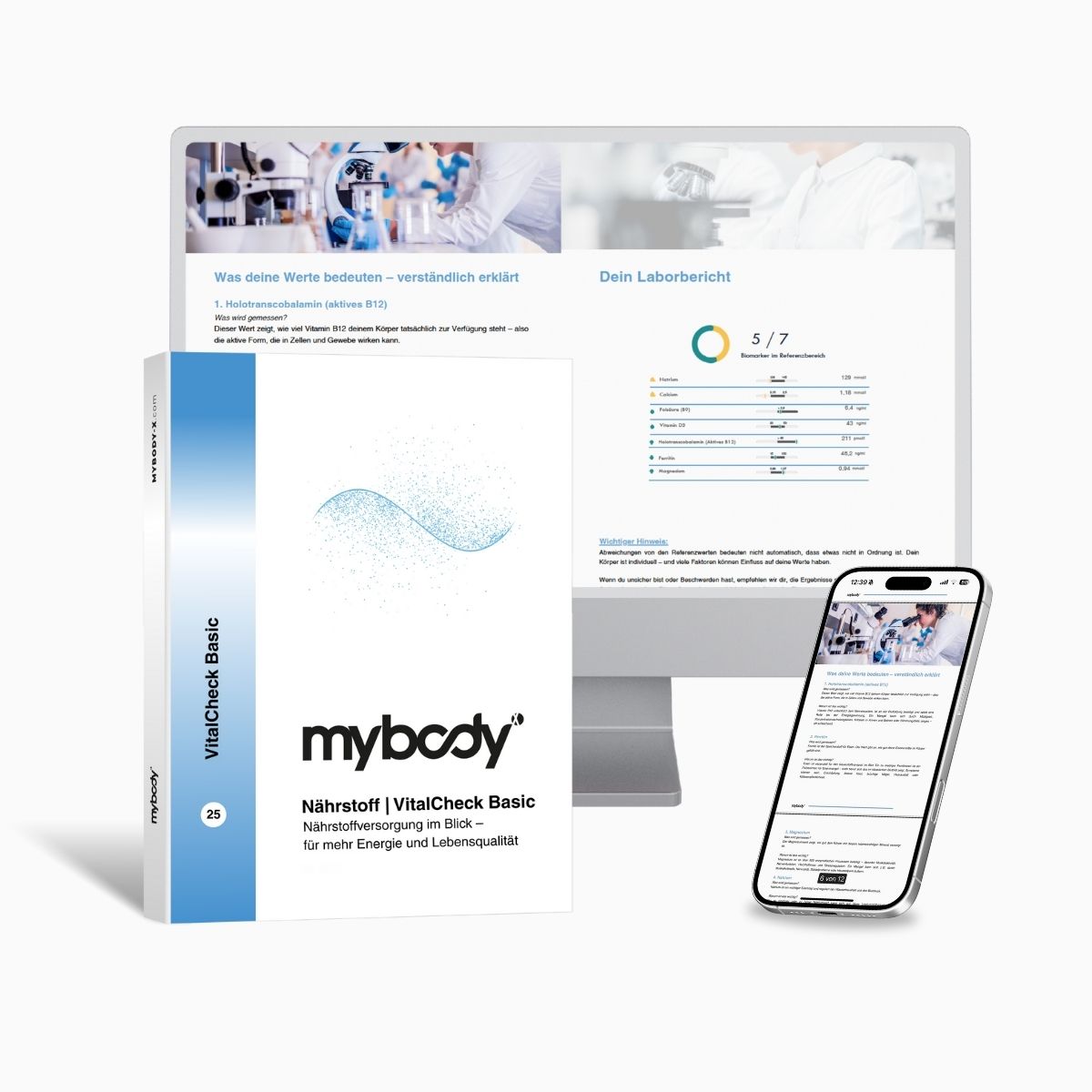
The second concerns electrolyte and mineral balance. Sodium, potassium, calcium, and magnesium are the values regularly mentioned in connection with fluid balance. At mybody®x (MYBODY Lab GmbH), the BalanceCheck covers these, with ISO-certified analysis in Germany.
Blood test from capillary blood
BalanceCheck | Electrolytes & Minerals Test
15 values with a digital report: potassium, sodium, calcium, magnesium, and phosphorus, plus six trace elements and four heavy metals. What the test does not do: it does not provide a diagnosis, determine the cause of swelling, or replace a medical examination.
Laboratory evaluation 3–5 business days after receipt of the sample
Information from the product page, accessed August 26, 2026
The product page itself openly states the limitation: the body keeps calcium, potassium, and sodium levels in the blood tightly regulated, so abnormal values are less common here than with magnesium or zinc. That is the honest framework. If your concern is the hormonal phase beginning in your mid-forties, the Menopause Check is the more suitable test. You can read how others experienced their measurement on the customer reviews page.
Useful for you if …
a medical evaluation has found nothing unusual and you want to know your mineral levels.
you sweat a lot, do sports, or work in the heat and want to assess your electrolyte balance.
you want to bring numbers to your next appointment that you can discuss specifically.
Probably not if …
you have one of the warning signs from Chapter 5. That belongs in a doctor’s office without detours, not in a self-test.
you expect it to make the swelling disappear. A measurement doesn’t move fluid.
you’re looking for the cause. That requires an examination and medical history, not 15 numbers from your mailbox.
Next step
If you first want to see where you stand
The BalanceCheck measures 15 values from capillary blood, including sodium, potassium, calcium, and magnesium. The Biomarker Lexicon explains what each value means and the range in which it falls.
Go to BalanceCheck Go to the Biomarker LexiconWhat you should take away from this article
If you remember one thing, remember the distinction: If the swelling goes down overnight and affects both legs, it is usually part of everyday life. If it remains, affects only one leg, or is accompanied by shortness of breath, it is a warning sign. The first is addressed with movement, elevation, and taking a look at your salt intake. The second calls for a medical consultation.
And keep in mind what is deliberately not stated here: a way to get rid of water retention safely. There is no general answer because the causes vary too much. Anyone who promises you one does not know your cause.
It started with the ring that feels tighter in the evening. If it fits again in the morning, you usually already have your answer. If not, the next step is an appointment, not a search engine. And if you want to know what your body is currently dealing with: The consultation is free, and it does not sell you anything.
Frequently asked questions
What helps quickly with water retention?
There is no universal quick fix because the causes vary too much. For swelling caused by fluid retention, movement and elevating the affected area can help that same evening. If the swelling remains overnight or affects only one leg, the cause should be investigated before trying anything else (IQWiG, 2022).
Should I drink less if I retain water?
Generally, no. Drinking less is more likely to make the body conserve water rather than excrete it. It is advisable to drink a consistent amount throughout the day. If a doctor’s instructions limit how much you should drink, follow those instructions and nothing else.
Why do I retain water before my period?
The connection is well established: Many women experience this before or during their period or during pregnancy (IQWiG, 2022). The pattern is what matters. What occurs cyclically and goes away with the bleeding is different from swelling that persists independently of it.
Do diuretic teas or preparations help?
We have no credible source demonstrating an effect for water retention. There are also two objections: they conceal a sign whose cause is unclear, and diuretic substances interfere with the electrolyte balance. This should be medically supervised.
When should I see a doctor about swollen legs?
If only one leg is affected, if shortness of breath occurs, if your weight increases significantly within a few days, if the swelling remains overnight, or if you are pregnant and it suddenly increases. Edema can be a sign of a serious illness, which is why medical evaluation of the cause is important (IQWiG, 2022).
Read more
You might also be interested in
The hormonal phase during which swelling also becomes more common.
How to prepare for a measurement so that the results are comparable.
Sources
- Institute for Quality and Efficiency in Health Care (IQWiG): Causes and signs of edema (as of 9 March 2022) – gesundheitsinformation.de
The verbatim quotation about menstrual bleeding and pregnancy, the information about prolonged standing and sitting, the definition of edema as a buildup of fluid in the tissue, and the statements about medical evaluation and possible clinical significance are taken from [1]. All other statements in this article are deliberately phrased without quantities or claims about effects because there is no substantiated source for them. Information about the price, sample type, scope of services, and laboratory comes from mybody®x's product page, accessed on 26 August 2026; processing times follow the central specification for each test type. The source was accessed and checked on 26 August 2026.

mybody®x Editorial & Expert Team
Blood analysis interpretation Nutritional science Laboratory diagnostics
This article was created by the mybody®x editorial and expert team. The team combines the interpretation of blood analyses, nutritional science, and laboratory diagnostics. Everyone who contributes to it is listed on the authors page.
Published on 26 August 2026 · Last updated on 26 August 2026
The content is intended for general information and does not replace medical advice, diagnosis, or treatment. Reference ranges depend on the laboratory, method, and age; the information on your test report is always decisive.




Share now:
Weight-loss meal plan for people over 50: this is what a good day looks like
Personalized nutrition based on DNA: what’s behind it