

Losing weight without exercise: what is possible and what is not
The essentials at a glance
Yes, losing weight without exercise is possible because body weight is determined by energy balance, and that balance is shaped primarily at the plate. At the same time, figures from independent assessments show how much exercise actually contributes and what is lost without it—and both are smaller or greater, respectively, than most people think.
This article puts the evidence-based figures on programs, diet, and exercise into context, explains why diet is the stronger lever for weight loss, and honestly identifies the price of giving up exercise.
First, you will learn which ways to lose weight without exercise are available, followed by figures from program evaluations, the underlying mechanics, an honest look at the costs of giving up exercise, and finally how to choose your own path.
What to expect in this article
1. The question behind the question
2. Three ways to lose weight without exercise compared
3. What the evidence-based figures say
4. Why diet is the stronger lever
5. The honest price of giving up exercise
6. Choosing your own path
7. The limitations of this article
8. What you will take away from this article
Frequently asked questions
Sources
The question behind the question
Anyone looking for ways to lose weight without exercise is quickly labeled lazy. Yet there are usually very understandable reasons behind the question: joints that no longer cooperate, a body for which training has long required considerable effort, shift work and caregiving responsibilities that leave no room for fixed training times, or simply the honest self-assessment that a third gym membership would end like the first two.
The question therefore deserves a serious answer rather than a lecture about discipline. And the answer from nutritional medicine is reassuringly clear: Body weight is determined by energy balance—that is, the ratio of energy consumed to energy expended—and this balance can be shifted into a deficit even without a single workout.
The second half of the answer is just as clear: Without exercise, you forgo a measurable contribution to weight loss as well as health benefits that no plate of food can replace. This article openly calculates both, using figures from independent institutions, so you can base your decision on facts rather than on divisions between sports enthusiasts and exercise skeptics.
Where the figures in this article come from is part of the transparency of a scientific article: they come from the assessments of the Institute for Quality and Efficiency in Health Care, which summarizes studies on weight-loss programs and the causes of overweight and evaluates them independently. Such pooled study data are more reliable than individual experiences and before-and-after photos because they average across many people and everyday lives.
One clarification about terminology: Here, exercise means planned training, from the gym to a running group. Everyday movement, such as walking, taking the stairs, and housework, is not exercise in this sense, and it will play an important role in this distinction.
Three ways without exercise compared
Anyone who wants to lose weight without training essentially has three options. The table compares them according to the same criteria, including the question of what each option does not achieve.
| Criterion | Dietary change alone | Diet plus everyday movement | Structured weight-loss program |
|---|---|---|---|
| What it targets | on the deficit through food and drinks | on the deficit plus higher everyday expenditure | on structure, guidance, and support |
| Training effort | none | none in the training sense; more movement in the course of the day | depending on the program, often with a movement component |
| What documented figures are available for | studied as the basis of every program | the additional contribution of exercise is quantified; more on that shortly | best studied; see the next chapter for ranges |
| What it does not achieve | no stimulus for muscle retention; the full burden falls on the plate | does not replace strength training for the muscles | does not reduce the effort required for everyday implementation, depending on the provider it costs |
The honest reading: All three routes work through the same mechanism, an energy deficit. They differ in how much support they organize and how much additional expenditure they bring into the day. The figures from independent assessments show which ranges are realistic.
What is striking is what is missing from the table: the route involving products intended to replace the deficit, from fat-burning capsules to detox cures. It is missing because there is no documented effect on weight to justify a separate column. The chapter on limitations returns to the question of where medications play a role and why this is not a matter of self-service.
What the documented figures show
The most reliable figures on losing weight without an exercise program of your own come from the assessment of structured weight-loss programs by the Institute for Quality and Efficiency in Health Care. According to this assessment, participants in such programs lost between about 3 and 8 kilograms within 6 to 12 months, averaging about 5 to 6 kilograms (IQWiG, 2022). These programs focus primarily on diet and behavior; having a separate training program is not a prerequisite.
For a specific type of program, the same review gives a broader range, and this sentence is worth quoting verbatim:
Documented source
“In studies, programs using formula foods led to greater weight loss of approximately 10 to 15 kilograms.”
Institute for Quality and Efficiency in Health Care (IQWiG)
Weight-loss programs and medications, as of 2022
Formula foods—that is, temporarily replacing meals with shakes or soups under guidance—are explicitly not an exercise program. The greater weight loss results from a strict energy deficit, which is precisely why such a phase requires professional supervision, since a strict deficit carries the risks hinted at in the yo-yo section below.
The context of the formula-food figure is also important: Such programs are generally intended for people with significant excess weight for whom greater weight loss is medically indicated, and they are designed as a limited initial phase followed by a normal, sustainable diet. Meal replacements are not suitable as a long-term solution, nor as an unsupervised experiment.
And what about exercise? The assessment provides a figure for that too, and it may be the most sobering one in the entire topic: After twelve months, participants who were additionally physically active had lost around two kilograms more than those who only changed their diet (IQWiG, 2022). Two kilograms in a year—that is the quantified contribution of exercise to weight loss in these studies.
Weight loss in studies, each over 6 to 12 months
5–6 kg
average weight loss in structured weight-loss programs, with a range of approximately 3 to 8 kilograms
10–15 kg
Weight loss in programs using formula foods, under professional supervision
~2 kg
additional weight loss after twelve months through accompanying physical activity
Source: Institute for Quality and Efficiency in Health Care (IQWiG), 2022
How to interpret such ranges correctly
Before these figures shape expectations, a word about their nature: They are study averages, not promises to individuals. Behind an average of 5 to 6 kilograms are participants who lost significantly more weight and others who saw little change. Where you end up depends on your starting weight, health, daily life, and predisposition, and that cannot be promised in advance.
The framework of the assessment is also important: The figures come from structured programs with guidance and support, not from going it alone with an app and good intentions. Structure itself apparently has an impact, because it translates intention into weekly plans and makes progress visible. Those working alone can take inspiration from what programs provide: fixed routines, regular measurement, and a realistic target range instead of a wishful date.
These three figures side by side answer the initial question more precisely than any opinion: In the programs studied, the majority of weight loss does not come from training. Those who cannot or do not want to exercise lose an average of around two kilograms of the year's result compared with active participants—not their entire prospect of success.
Why diet is the stronger lever
One more word about the time frames: The fact that studies measure periods of 6 to 12 months is not accidental but meaningful. Shorter periods primarily measure water loss and initial enthusiasm; longer periods show what an approach can sustain in real life. Adjusting your own expectations to this time horizon saves you from the disappointment that causes most resolutions to collapse in the second month.
The explanation for this numerical relationship lies in the asymmetry of the energy balance: It is much easier not to consume energy than to burn it afterward. A sugary drink can be consumed in seconds, while burning its equivalent through exercise takes an extended walk. Anyone who controls the balance through their meals is working where the greatest leverage lies.
IQWiG accordingly places the role of exercise on its page about the causes of overweight: Exercise helps with weight loss and offers additional health benefits, but is generally not enough for substantial weight loss without an adjusted diet (paraphrased from IQWiG, 2022). The reverse is true, however: An adjusted diet can support weight loss on its own.
How finely the balance responds is shown by a second figure from the same source: consuming just around 50 kilocalories per day above one's needs—the equivalent of a few bites—can add up to around two kilograms of weight gain over a year (IQWiG, 2022). The same calculation works in the other direction, explaining why inconspicuous habits such as drinks, sauces, and snacks can affect weight more over the years than some exercise programs.
Where the energy in everyday life really comes from
Anyone who wants to control the balance through their meals needs to know where it is determined—and that is rarely lunch. It is the edges of the day: the sugary drink on the side, the juice considered healthy, the glass of wine in the evening, the sauce, the snacks in front of a screen. These items are barely filling, do not register in memory, and still add up day after day.
Anyone who wants to make these margins visible does not need to keep a permanent log: One honest week of recording, either in writing or with photos, is usually enough to identify the two or three biggest hidden contributors. After that, it is enough to change precisely those items instead of overhauling the entire way of eating. Small, lasting reductions beat large, temporary overhauls—that is the lesson from the 50-kilocalorie calculation above.
The second lever is satiety per calorie. Protein-rich foods and vegetables fill you up with comparatively little energy, while highly processed products provide a lot of energy with little satiety. When people restructure their meals so that the filling components increase, they eat less without having to tolerate more hunger—and that is exactly where most resolutions otherwise fail.
And because even the best plate works less effectively without any contribution from the expenditure side, everyday movement belongs in the same calculation: A day involving walking, stairs, and errands without a car uses noticeably more energy than a day spent sitting, without any formal exercise taking place. This invisible activity varies considerably from person to person, and it is the part of energy expenditure you can most easily increase without training.
In practical terms, this translates into a ranking for anyone working without exercise: first, liquid calories, because they provide little satiety and quietly add up. Then protein intake, because it promotes satiety and protects muscle, which is already under pressure without training. Then portions and eating patterns, so that the deficit remains moderate and the yo-yo mechanism has no opening to exploit.
Chapter at a glance
Energy balance can be controlled more effectively at the plate than through subsequent energy expenditure: Exercise alone is generally not enough to achieve substantial weight loss (in essence, according to IQWiG, 2022), while just around 50 kilocalories per day above your needs can add up to roughly two kilograms over a year (IQWiG, 2022). Anyone losing weight without training should prioritize beverages, protein, and portion sizes, in that order.
The honest price of giving up exercise
Up to this point, giving up exercise sounds like a fair trade: two kilograms less in annual results in exchange for no training. But that calculation would be incomplete, and a scientific article owes you the other half.
Exercise is the smaller lever when it comes to weight. For health, it is the bigger one.
The first factor is muscle mass. Anyone who loses weight through diet alone loses muscle as well as fat, and without a training stimulus there is no signal to preserve it. Less muscle means a lower resting energy expenditure, making it harder to maintain the new weight—the very mechanism that drives the yo-yo effect. Even everyday movement and occasional strength exercises in the living room noticeably mitigate this factor.
The muscle factor includes a figure from everyday nutrition: Without a training stimulus, protein intake becomes the most important protective measure for your muscles. Having a recognizable source of protein in every main meal, from quark to legumes and fish, is therefore not a matter of taste in an exercise-free approach, but part of the structural support. It also helps keep you full, making the calorie deficit more tolerable.
The second factor is health beyond the scales. The cited IQWiG assessment states this explicitly: Exercise has other health benefits during weight loss as well, from the heart and circulation to mood. These effects result from movement itself, regardless of what the scales say, and they cannot be replaced by what is on the plate.
A third factor is subtler but noticeable in everyday life: For many people, movement affects sleep and mood, and both are quiet allies in any dietary change. Those who sleep better are less likely to reach for quick calories, and those who have been active during the day find it easier to get through the evening without snacks. These indirect effects do not appear in any kilogram statistic, yet they still contribute.
The most honest way to phrase the answer is therefore: Losing weight without exercise works. Maintaining your weight and growing older healthily without any movement at all works considerably less well. The good news lies in the distinction made at the outset: For most of these effects, you do not need training in a gym with a sports floor and membership card, but movement—and that begins with walking, taking the stairs, and anything that makes your day a little more active.
How to keep this factor small without turning it into exercise: Everyday movement can be scheduled like an appointment. Get off one stop earlier, take phone calls while walking, make the stairs the default, and walk to do your shopping—these are decisions, not workouts. If you also add a few minutes of bodyweight strength exercises twice a week, such as squats and supported variations in your living room, you give your muscles the stimulus they need to maintain themselves without ever setting foot in a gym.
Whether this still counts as “without exercise” is ultimately a matter of wording. What matters is being honest with yourself: The plate drives the weight loss. Your muscles, your health, and maintaining the result afterward need movement in some form, and the threshold for that is much lower than what most people consider exercise.
Anyone who wants to know how to move forward after a diet without a setback will find the continuation of these ideas in the article Avoiding the yo-yo effect, which examines the period after weight loss in detail.
Choose your own path
The question remains how to turn the principles in this article into your specific plan, because between a sound rule and everyday practice lies the choice: Which diet makes it easiest for you to achieve a calorie deficit, with which foods and at what rhythm?
If diet is your main lever, choosing it becomes the most important decision in the entire endeavor. Without the balancing effect of training, this approach leaves less room for mistakes: A diet that does not suit your body and everyday life will cost you more quickly in substance and motivation without exercise.
This is exactly where it can be worthwhile to understand your genetic makeup. A DNA analysis shows how your metabolism is predisposed to function, for example in how it handles carbohydrates and fats, making the choice of diet an informed decision. Your DNA does not change, so the result remains valid permanently. At mybody®x (MYBODY Lab GmbH), this is what the WeightLoss SLIM DNA Test does, analyzed in an ISO-certified laboratory in Germany; the customer testimonials page shows how others experienced their analysis.
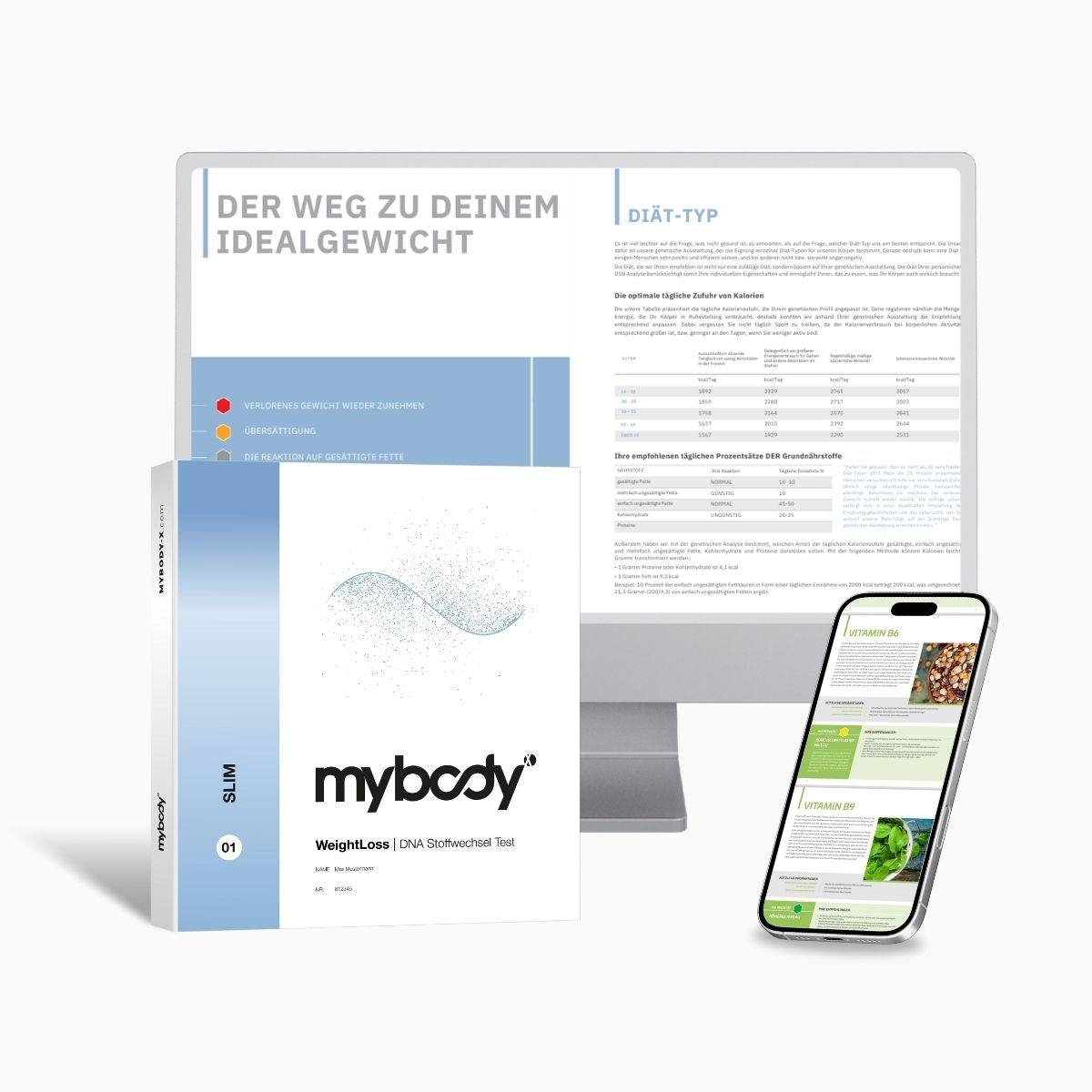
DNA test from a saliva sample
WeightLoss | SLIM DNA Test
Analysis of more than 80 genetic variations related to metabolism and weight, presented in 24 reports. What the test does not do: It does not provide a diagnosis, promise weight loss, or replace dietary changes and exercise.
DNA analysis: 15–25 business days after sample receipt
Product page information, accessed 24 August 2026
What you can realistically expect: reports on how your body handles nutrients, as a basis for choosing your diet. What you cannot expect: a number that promises how many kilos you will lose in the future. There is no scientifically sound way to predict weight loss from genes, and any provider claiming otherwise goes beyond the evidence on which this article is based.
An honest assessment here also requires saying that the analysis does not replace any of the levers discussed in this article. It helps you choose a dietary approach; you create and maintain the deficit yourself. The page How DNA metabolism tests work shows how the test proceeds from ordering to results.
The limitations of this article
This article also has blind spots, and they should be acknowledged before you make plans.
The first limit concerns the numbers themselves: Study ranges are averages across many people, not predictions for you. Your weight loss may be above or below them, depending on your starting weight, daily life, health, and predisposition. The figures are useful as a benchmark for realistic expectations, not as a promise.
The second limit concerns formula diets: The large range of 10 to 15 kilograms occurs under professional supervision and is not a model to try on your own. Such a strict deficit without support increases exactly the risks mentioned at several points in this article, from muscle loss to subsequent rebound.
The third limit is medical: If illnesses, medications, or severe symptoms are involved, if your weight changes for no apparent reason, or if substantial weight loss is planned, the plan should first be discussed with a doctor. This applies just as much without exercise as with it.
A fourth limit grows with age: From middle age onward, muscle mass naturally declines slowly without targeted stimuli, and any weight loss without muscle protection accelerates this process. The older you are, the higher the cost of completely forgoing strength training, and the more worthwhile the living-room option from the previous chapter becomes, especially if conventional exercise is not an option.
What you should take away from this article
If you remember one thing, remember this distinction: For weight loss, diet is the biggest lever, and it can support weight loss on its own, with documented averages of 5 to 6 kilograms in structured programs over 6 to 12 months (IQWiG, 2022). The quantified additional contribution of exercise is around two kilograms per year; its real value lies in muscle, health, and maintaining weight.
Also keep the asymmetry in mind, because it is this article’s most useful everyday insight: not taking in energy is always easier than using it up later. Every decision at the refrigerator door therefore weighs more heavily than its counterpart on the treadmill, which is exceptionally good news for anyone who does not want to run.
So if exercise is not an option for you, that does not disqualify you from losing weight. It simply shifts the burden: Your meals need to be more carefully balanced, everyday movement changes from a nice extra into a necessity, and choosing the right dietary approach becomes more important because no workout is there to compensate for poor choices.
And keep in mind the approach to handling study figures demonstrated by this article: ranges instead of promises, months instead of weeks, averages instead of individual cases. With this standard, you will recognize within seconds which weight-loss offer is working in your interest and which is merely taking advantage of your impatience.
At first, the suspicion was that asking about losing weight without exercise was simply a matter of convenience. In the end, there is a factual answer with numbers, a price, and a comparison of costs and benefits. If you want to set your own course: The consultation costs nothing, and it does not sell you anything.
Frequently asked questions
Can I really lose weight without exercising at all?
Yes. Energy balance determines weight, and diet alone can create a deficit. Studies on structured weight-loss programs that focus primarily on diet and behavior show average losses of 5 to 6 kilograms over 6 to 12 months (IQWiG, 2022). What is missing without exercise is the stimulus for muscle preservation and the health benefits beyond the number on the scale.
How much additional weight loss does exercise provide?
Less than most people expect: In the IQWiG evaluation, physically active participants had lost around two kilograms more after twelve months than those who only changed their diet (IQWiG, 2022). Exercise alone, without an adjusted diet, is generally not enough for greater weight loss (paraphrased from IQWiG, 2022). Its main value lies in preserving muscle and supporting health.
What is the most important lever if I do not exercise?
The order of priority from this article: first cut liquid calories, because drinks are barely filling and quietly add up. Then ensure adequate protein, because it keeps you full and protects muscle, which is under strain without exercise. Finally, choose portions and meal timing so that the deficit remains moderate, because without exercise, a radical deficit triggers muscle loss and rebound especially quickly.
Does everyday movement count as exercise?
No, and that is precisely what makes it so valuable for anyone who does not want to work out: walking, taking the stairs, shopping without a car, and generally having a more active day increase energy expenditure without requiring workout time, equipment, or willpower. Anyone losing weight without exercise should consciously increase everyday movement, because it takes over some of the functions that exercise would otherwise fulfill.
Can I lose weight more slowly without exercising?
On average, somewhat, yes: The studies put the difference at around two kilograms after one year (IQWiG, 2022). Without training, however, the composition of the weight loss is more important than the pace: Without a muscle stimulus, more muscle mass is lost as well. That is why protein and a moderate deficit are even more important without exercise, and why at least some everyday movement is worthwhile even for self-professed exercise enthusiasts.
Next step
When the plate is your main lever
The SLIM DNA Test shows how your metabolism is predisposed, so you can choose the eating pattern that suits you. It is not a weight-loss promise, but a basis for the lever on which everything rests without exercise.
To the SLIM DNA Test How the test worksRead more
You might also be interested in
Why a moderate deficit without exercise counts twice.
Choosing the method when the plate takes center stage.
Sources
- Institute for Quality and Efficiency in Health Care (IQWiG): Weight-loss programs and medications (as of 2022) – gesundheitsinformation.de
- Institute for Quality and Efficiency in Health Care (IQWiG): Causes of obesity (as of 2022) – gesundheitsinformation.de
The direct quotation on formula diets, which achieve losses of around 3 to 8 kilograms with an average of around 5 to 6 kilograms in structured weight-loss programs, and the approximately two kilograms of additional weight loss through physical activity are taken from [1]; the information on structured programs is presented without naming individual providers. The paraphrased conclusion that exercise alone is generally not sufficient for greater weight loss, and the calculation involving around 50 kilocalories per day, are taken from [2]. Information on price, sample type, gene variations, reports, and the laboratory comes from the mybody®x product page, accessed on 24 August 2026; processing times follow the central specification for each test type. All sources were accessed and reviewed on 24 August 2026.

mybody®x Editorial & Expert Team
DNA analysis Nutritional science Laboratory diagnostics
This article was created by the mybody®x editorial and expert team. The team brings together DNA analysis, nutritional science, and laboratory diagnostics. Everyone involved is listed on the authors page.
Published on 24 August 2026 · Last updated on 24 August 2026
The content is intended for general information and does not replace medical advice, diagnosis, or treatment. Genetic traits describe tendencies, not certainties—the medical assessment is always decisive for health-related questions.




Share now:
Avoid the yo-yo effect: what really helps after the diet
Weight-loss meal plan for people over 50: this is what a good day looks like