

Food intolerance test: The guide to success
Do you often feel tired, have skin problems, or struggle with ongoing digestive issues? Then a food intolerance test may be the first step toward finally finding out why your body is reacting badly to certain foods. These tests take a close look at how your immune system responds, usually by measuring the concentration of so-called IgG antibodies in your blood. These are considered an indication of a hidden, delayed immune response.
What a food intolerance test really tells you
Before you decide to take a test, it’s really important to understand the basics. Our bodies’ reactions to food are quite complex and not always the same. Correctly classifying your symptoms is the key to finding the right help and feeling better again.
Intolerance is not the same as an allergy
The terms food intolerance and food allergy are often lumped together, but they describe two completely different things. The key point is how your immune system is involved.
- Food allergy (type I reaction): Things get serious here! Your immune system reacts immediately and often intensely. It produces IgE antibodies against foods that are actually harmless. Symptoms usually appear within minutes—from a skin rash to life-threatening anaphylactic shock.
- Food intolerance (type III reaction): This reaction is a gradual process and much less noticeable. Symptoms may appear hours or even days after eating, which makes it so tricky. The focus here is on IgG antibodies, which signal an immune response.
- Intolerances: The immune system usually plays no role here. The classic example is lactose intolerance. In this case, you simply lack the lactase enzyme needed to digest lactose properly.
Typical symptoms that may indicate an intolerance
The signs are often nonspecific and chronic. Many people suffer for years without knowing what is actually wrong. Could you be one of them?
The most common complaints include:
- Chronic digestive problems such as bloating, abdominal pain, or constant irritable bowel syndrome
- Skin problems such as eczema, acne, or tormenting itching
- Persistent fatigue and the feeling that you simply can’t get fit again
- Recurring headaches and migraines
- Joint pain and a general feeling of illness
The number of people reporting such symptoms is steadily increasing in Germany. A survey of more than 2,400 participants showed that the proportion of affected people in the population is between 4 and 11 percent. If you would like to learn more, take a closer look at the prevalence of food intolerances in Germany.
A food intolerance test can therefore be a truly valuable tool. It does not provide a definitive diagnosis, but it gives you an important indication of which foods may be putting a strain on your immune system and could be possible triggers for your symptoms.
The most common testing methods compared critically
The market for a food intolerance test is huge and difficult for many people to navigate. To make an informed decision, however, you need to understand how the different methods work, what they can really reveal, and where their limitations lie. One thing is clear: Not every test is suitable for every complaint or suspected intolerance.
Choosing the right method depends heavily on your individual symptoms and the suspected cause. Some tests target enzyme deficiencies directly, while others look for immune system reactions or identify genetic predispositions.
IgG blood tests: widespread but controversial
A very well-known food intolerance test is the IgG blood test. A small blood sample is analyzed to determine how many immunoglobulin G (IgG) antibodies against certain foods are present. The theory behind it: Elevated IgG levels are supposed to indicate a delayed immune reaction (type III), which could be responsible for chronic symptoms such as digestive problems, skin rashes, or headaches.
- How it works: In the laboratory, your blood is combined with extracts from often hundreds of foods. A strong reaction indicates a high concentration of IgG antibodies.
- The advantages: These tests can often be performed easily at home and provide a very broad overview of possible immune reactions to a huge number of foods at once.
- Important note: The scientific debate about the validity of these tests is intense. Critics say that elevated IgG levels merely show that you regularly eat a food and that your immune system has developed normal tolerance. Supporters, on the other hand, view them as a valuable indication that—combined with a subsequent elimination diet—can help identify the cause. You can find more in-depth information in our article on scientific insights into IgG blood tests.
Breath tests: The gold standard for sugar intolerances
The H2 breath test is an absolutely established and scientifically recognized method, especially when it comes to intolerances to certain types of sugar. It is used primarily when lactose or fructose intolerance is suspected and is considered the gold standard in these cases.
With this test, you drink a test solution on an empty stomach containing either lactose (milk sugar) or fructose (fruit sugar). The hydrogen level (H2) in your exhaled breath is then measured at regular intervals. The reason: If your body cannot properly break down the sugar in the small intestine, it travels on to the large intestine. There, bacteria feed on it and produce hydrogen gas. This gas enters the lungs through the bloodstream and can then be detected in your breath—a clear sign of malabsorption.
Other diagnostic approaches
In addition to the two main methods, there are other approaches that can shed light on different pieces of the puzzle:
- Stool analyses: These tests examine the composition of your intestinal flora, or microbiome. An imbalance in intestinal bacteria (known as dysbiosis) can itself cause digestive problems or promote the development of intolerances.
- Genetic analyses: These tests examine your DNA for certain predispositions, such as primary lactose intolerance or celiac disease. Such a test indicates an increased risk, but it is not proof of an already active intolerance.
- Alternative methods: Methods such as bioresonance or kinesiology are not recognized by the scientific community. Their results are considered irreproducible, and their diagnostic value for identifying intolerances is therefore viewed with extreme skepticism.
Comparison of testing methods for food intolerances
To give you a better overview, we have compared the most important procedures in a table.
This table compares the most common testing procedures by method, area of application, reliability, and cost.
| Testing procedure | Measurement method | Suitable for | Scientific recognition | Estimated cost |
|---|---|---|---|---|
| IgG blood test | Measurement of IgG antibodies in the blood (ELISA) | Suspected delayed reactions (Type III) | Controversial; often not recommended by professional societies | 100 – 350 € |
| H2 breath test | Measurement of hydrogen in exhaled air | Lactose, fructose, and sorbitol intolerance | High; the gold standard for carbohydrate intolerances | 50 – 150 € |
| Genetic test | Analysis of DNA (e.g., from saliva) | Genetic predispositions (e.g., lactose intolerance, celiac disease) | High for specific markers, but only indicates risk | 120 – 300 € |
| Stool analysis | Analysis of the gut microbiome and inflammatory markers | Dysbiosis, nonspecific digestive complaints | Increasingly used, but not yet a standard for diagnosing intolerances | 80 – 250 € |
| Alternative methods | Bioresonance, kinesiology, etc. | Generalized intolerance diagnostics | No scientific recognition | Highly variable |
As you can see, different questions call for different tests, some of which are more suitable than others.
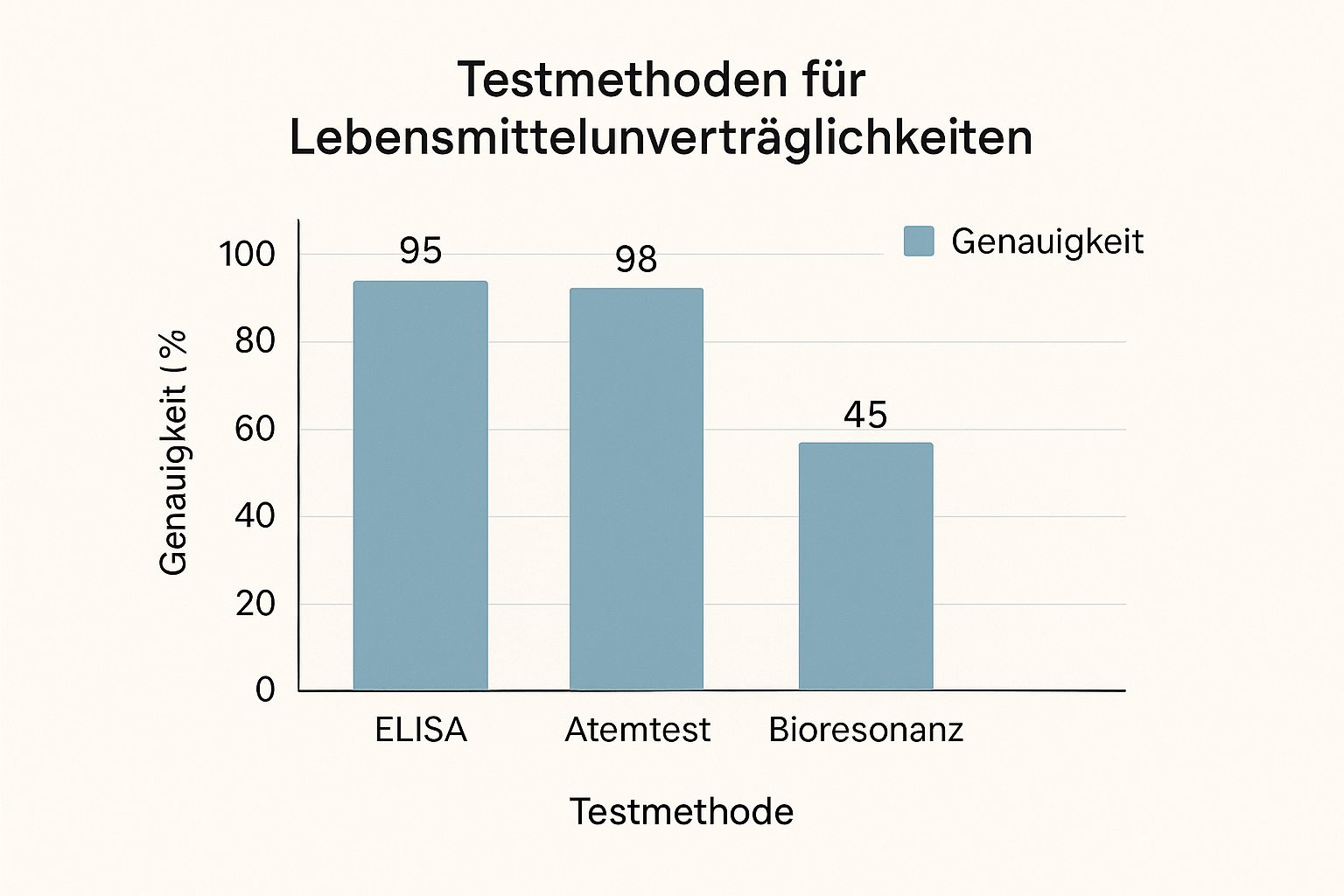
These data underscore that scientifically established procedures such as the ELISA test (the technological basis for IgG tests) and the breath test are significantly more reliable than alternative medicine approaches.
How exactly does a home IgG test work?
A home IgG test is often advertised as a simple way to get to the bottom of food intolerances—and the process is indeed surprisingly straightforward. The entire process, from ordering to receiving the results, is designed to make things as convenient for you as possible. It all begins with purchasing a test kit, which is discreetly delivered directly to your home.

As soon as you have the kit in your hands, the crucial step comes next: collecting the sample. But don't worry—you don't need to make a special trip to the doctor. The entire process is designed so that you can carry it out safely and almost painlessly yourself.
The individual steps—from sample collection to the laboratory
The process is standardized for most providers and explained step by step in the enclosed instructions. Essentially, it involves just a few steps that you can easily complete at home.
- Activate the test: First, register your test kit online using a unique code. This is important so that your sample can later be anonymized in the laboratory while still being correctly assigned.
- Prepare your hands: Wash your hands thoroughly with warm water. This not only stimulates circulation but also cleans the area for the prick.
- Collecting blood: Using the small, sterile lancet included in the kit, you briefly prick your fingertip. It usually feels like just a quick pinch and is enough to obtain a few drops of blood.
- Secure the sample: You then apply the drops of blood to a special test card or fill them into a small tube. Only a very small amount of blood is needed.
- Return to the laboratory: You now safely package the dried sample in the prepaid return envelope and send it directly to the certified partner laboratory.
The major advantage of these at-home tests lies in the clever combination of professional laboratory analysis and simple handling. You gain access to detailed immunological data without having to wait weeks for a doctor's appointment or undergo complex examinations.
What happens to your sample in the laboratory?
As soon as your sample arrives at the laboratory, the actual analysis begins. This is where state-of-the-art laboratory technology comes into play to measure the concentration of IgG4 antibodies against a vast selection of foods. The process usually looks like this:
- Preparing the sample: Your blood is prepared for analysis.
- Analysis using the ELISA method: Using the established ELISA method (Enzyme-Linked Immunosorbent Assay), your blood serum is brought into contact with extracts from up to 300 different foods.
- Evaluating the reaction: The laboratory measures how strongly the IgG antibodies in your blood bind to the respective food extracts. Stronger binding produces a more intense color reaction, which is then analyzed precisely.
The entire process usually takes just a few business days. The results are then processed digitally and made available to you in a detailed report.
You usually receive your results report by email or can access it through a secure online portal. It clearly and understandably shows which foods your immune system reacted to with elevated IgG antibodies—often even categorized by different reaction levels. This gives you a solid basis for the next steps, such as making targeted adjustments to your diet.
Interpreting test results correctly: What your findings really mean
A food intolerance test provides you with a detailed report that may initially look like a clear diagnosis. However, the result you hold in your hands is not a final verdict. Instead, consider it a valuable indication – a single puzzle piece in the larger picture of your health. To use it correctly, it is important to understand the scientific background and the limitations of what it can tell you.

The widely used IgG tests in particular are often the subject of scientific debate. Although they show clear reactions from your immune system, their clinical significance is not always clear. It is crucial to understand what these results really mean.
IgG antibodies – a sign of intolerance or tolerance?
When a test shows elevated IgG levels for certain foods, it signals an immune response. Your body has produced antibodies against components of these foods. The crucial question, however, is whether this is the trigger for your symptoms or simply a normal response from a healthy immune system.
Allergy and gastroenterology organizations repeatedly point out that elevated IgG levels may also indicate the development of physiological tolerance. Put simply: your body recognizes the food and has learned to tolerate it.
A positive IgG result is therefore not automatically equivalent to a clinically relevant intolerance. It is a snapshot of immunological activity that must always be interpreted in the context of your individual symptoms.
Context makes all the difference
This is exactly where your personal symptom diary comes into play. Compare the foods that stood out in the test with the symptoms you observed after eating them.
- Match: A food shows a strong IgG reaction, and you have repeatedly experienced symptoms such as bloating or headaches after eating it. This indicates a strong suspicion.
- No match: The test shows a high reaction to wheat, but you eat bread every day without any discomfort. In this case, a connection is unlikely.
This comparison helps filter out irrelevant results and focus on the truly problematic candidates. The combination of objective test results and subjective observation is the key to success.
It is also interesting that the prevalence of food allergies in Germany varies by gender. A 2018 survey showed that the prevalence among women, at approximately 8.5 percent, was significantly higher than among men, at around 5.5 percent.
The test as a guidepost, not the final destination
Think of the food intolerance test as a kind of map. It points out potential problem areas, but you must undertake the journey toward improvement yourself—ideally with professional guidance. A doctor or qualified nutritionist can help you correctly interpret the results and plan a sensible elimination and challenge diet. Genetic predispositions may also play a role. Also read how a genetic test can detect hidden food intolerances.
Misdiagnoses based solely on a test result can lead to unnecessary and restrictive diets. This not only diminishes your quality of life but can, in the worst case, even cause nutrient deficiencies. A critical and comprehensive assessment protects you from such false conclusions and ensures that you take the right measures for your well-being.
So, the test is done and the report is available. What now? A food intolerance test provides you with a fairly detailed report that may seem somewhat overwhelming at first glance. But don't worry: This document is not a final verdict, but rather your personal starting point for targeted change. The most important thing is to interpret the results correctly so you can derive meaningful steps for your well-being.
Your report usually lists the foods tested according to the strength of the reaction. This is often illustrated clearly using a traffic-light system or categories (e.g., Class 0 to 4). A high reaction simply means that your immune system has produced a significant amount of IgG antibodies against this food.
What the different reaction levels mean
These gradations are worth their weight in gold because they help you set priorities. You can immediately see which foods you should avoid completely for now and which you may only need to reduce.
- High reaction (e.g., red / class 3–4): These are your main suspects. It is recommended that you eliminate them completely from your diet for a certain period—often between four and twelve weeks.
- Moderate reaction (e.g., yellow / class 2): Your body reacted moderately here. You should also avoid these foods, especially during the initial phase.
- Low or no reaction (e.g., green / class 0–1): These foods are considered safe. They can form the basis of your diet and serve as tasty substitutes for the products you have left out.
This first step is known as the elimination phase. The goal is simple: to give your immune system and digestive tract a break. This allows underlying inflammatory processes to subside and your body to recover.
Very important: A positive test result alone is not yet a diagnosis. Its true significance only becomes clear when you compare the result with your actual symptoms. A food that, according to the test, causes a strong reaction but has never seemed to cause you any problems does not necessarily have to be the culprit.
The way back: How to find your tolerance using the rotation principle
After the strict elimination phase comes the most exciting part: gradually reintroducing the foods you have been avoiding. This approach helps you determine your personal tolerance threshold.
The tried-and-tested approach is the challenge and rotation diet:
- Challenge: After the elimination period (say, after 8 weeks), reintroduce just one of the foods you have been avoiding. It’s best to start with one that caused only a moderate reaction.
- Observation: Now it’s up to you. Observe yourself closely over the next 2–3 days. A symptom diary can be very helpful here. Note every change, no matter how minor it may seem—from bloating and headaches to skin blemishes.
- Rotation: If no symptoms occur, great! You can reintroduce this food into your diet on a rotation basis, for example every four days. This prevents you from immediately overwhelming your immune system again.
- Repetition: You now repeat this process individually for each food on your list. If symptoms occur, you should continue avoiding the food in question for now and try it again at a later point.
This structured approach turns your food intolerance test from a simple information sheet into a genuine self-help tool. It gives you back control over your well-being. Nevertheless, it is always a good idea to take this journey together with a doctor or qualified nutritionist. This ensures that you do not develop nutrient deficiencies and that the results are professionally interpreted.
Why your gut is the real key to your food intolerances
A food intolerance test is a great starting point, no question. But often, the real cause of your symptoms lies one level deeper—namely, in your gut. Many intolerances are not the actual problem at all, but rather an alarm signal from your digestive system that something has fallen out of balance. So when we address the root cause, entirely new possibilities open up for getting your symptoms truly under control.

Your gut is so much more than just a digestive tube. It is better to think of it as your body’s control center. Around 80% of your immune cells are located here, along with an incredibly complex ecosystem of trillions of microorganisms—the famous microbiome. These tiny helpers are crucial to your health, but their balance is quite delicate.
Leaky gut syndrome: When the protective wall begins to crumble
The intestinal lining plays a key role here. It is an extremely thin barrier that separates the contents of your intestines from your bloodstream. Normally, it is highly selective and only lets through what is actually supposed to enter: nutrients. But when this barrier becomes weakened or “leaky”—a condition known as leaky gut syndrome—partially digested food particles, bacteria, and toxins can suddenly enter the bloodstream.
Your immune system sounds the alarm immediately, recognizes these intruders as foreign bodies, and launches a defensive response. In the process, it produces antibodies, including IgG antibodies, which are measured in the relevant tests. The result? Chronic inflammation and exactly the symptoms you know as intolerance. If you want to explore the topic in more depth, take a look at our article on why your gut is the key to your well-being.
What is really harming your gut health
There are a few typical culprits that throw your sensitive intestinal barrier and microbiome out of balance, paving the way for intolerances:
- Chronic stress: Constant pressure in everyday life can alter the composition of your gut flora and make the intestinal lining more permeable.
- Medications: Frequent use of antibiotics in particular, but also painkillers such as ibuprofen, can damage the intestinal lining.
- Unhealthy diet: Too much sugar, highly processed foods, and too little fiber can effectively starve your beneficial gut bacteria.
- Infections: A gastrointestinal infection can permanently disrupt the sensitive balance in the gut.
A healthy gut is the foundation for tolerating food well. Instead of focusing solely on avoiding individual foods, deliberately strengthening your gut health can address the underlying cause and raise your tolerance threshold again over the long term.
Official figures also show how vulnerable our digestive system can be. According to the Robert Koch Institute, 7,862 cases of salmonellosis and 3,314 cases of norovirus gastroenteritis were reported in the first 20 weeks of a single year. These figures make it clear how quickly the system can be disrupted—with far-reaching consequences. You can find further insights into this epidemiological data at the RKI.
A holistic approach that puts gut health at the center is therefore the logical next step. It combines the results of your food intolerance test with sustainable measures. This way, you do not just combat symptoms but strengthen your body from the inside out.
Frequently asked questions about food intolerance tests
When it comes to a food intolerance test, the same questions and uncertainties often arise. That is no surprise, because the subject is complex. To give you clarity and confidence in making your decision, we have answered the most frequently asked questions here in a clear and straightforward way.
Think of this section as your personal compass, helping you clear up the most important uncertainties—from distinguishing it from an allergy to understanding what actually happens after a positive test result.
Is an IgG test the same as an allergy test?
No, and this is a crucial point that often causes confusion. An IgG test and a conventional allergy test measure two completely different immune system reactions. They therefore cannot be used interchangeably.
- IgG test (intolerance): This concerns immunoglobulin G antibodies. They are associated with delayed type III immune reactions. This means that symptoms—such as digestive problems, headaches, or fatigue—often occur only hours or even days after eating.
- IgE test (allergy): The classic allergy test performed by a doctor measures IgE antibodies. They are responsible for typical immediate reactions (type I allergies), which usually appear within minutes, for example as a skin rash, sudden swelling, or acute breathing difficulties.
Thus, the two tests examine completely different aspects of the immune response, and each has its own justification.
Do health insurance providers cover the cost of a test?
As a rule, no. The costs of an IgG-based food intolerance test are generally not covered by statutory health insurance providers in Germany. The reason is that the scientific recognition of these tests for diagnosing intolerances is still disputed.
They are therefore generally considered individual healthcare services (IGeL), whose costs you must pay privately. The situation is different for tests ordered by a doctor when there is a specific medical suspicion—for example, a breath test for lactose or fructose intolerance may be covered by statutory health insurance.
Do I have to avoid foods that tested positive forever?
Definitely not. A positive test result is not a lifelong ban, but rather the starting point for a smart dietary strategy. The goal is to give your body a break and then determine your personal tolerance threshold.
The approach is based on the proven principle of elimination followed by reintroduction. First, you avoid the foods in question for a certain period so that your gut and immune system can recover.
This elimination period often lasts several weeks. After that, you begin reintroducing the foods into your diet one at a time and very consciously. You carefully observe how your body reacts. Many people are surprised to find that, after this break, they can once again tolerate in moderation foods that previously caused them problems.
The test therefore serves as a kind of guide to identify the most critical candidates and approach the process in a structured way. You can find more details about the various testing methods and exactly what the results mean in our comprehensive Food Intolerance Test Guide.



Share now:
Finally understand and relieve intolerances
Food intolerance self-test: Find out what’s really good for you