
Helicobacter pylori rapid test for home use – Simple & Reliable
A Helicobacter pylori rapid test is a straightforward way to discreetly find out at home whether you have an active infection with this bacterium. The test is very easy to use: It detects specific antigens in a small stool sample. You will have the result in your hands after just a few minutes—a highly important initial indication.
What is Helicobacter pylori, and which symptoms indicate it?
Perhaps you know the feeling: You keep struggling with stomach problems but simply cannot figure out what is causing them. A constant feeling of fullness after eating, unpleasant belching, or a pressing pain in the upper abdomen—these symptoms can significantly disrupt your daily life. We often blame stress or a poor diet, but a common yet frequently overlooked cause is the bacterium Helicobacter pylori.
A persistent tenant in your stomach
Helicobacter pylori is a spiral-shaped bacterium that has adapted perfectly to the extremely acidic environment of the stomach. It settles in the protective stomach lining and can trigger chronic inflammation there, known as gastritis. This inflammation is often at the root of many stomach problems.
The tricky thing is that an infection often remains unnoticed for years. Many people carry the bacterium without ever developing symptoms. In others, however, the ongoing irritation of the stomach lining causes noticeable discomfort that significantly affects their quality of life.
These signs may indicate an infection
The symptoms of a Helicobacter pylori infection are often nonspecific and can easily be confused with other digestive problems. This makes it so difficult to identify the true cause. Pay attention to these typical warning signs from your body:
- Pressure or pain in the upper abdomen: It often feels burning or gnawing, especially when your stomach is empty.
- Bloating and flatulence: You feel uncomfortably full even after small meals.
- Frequent belching and heartburn: A clear sign that your stomach function may be impaired. If you would like to learn more about the causes of constant belching, read our detailed article on the subject.
- Nausea and loss of appetite: A general feeling of discomfort that ruins your appetite.
- Unintentional weight loss: This is a serious warning sign that you should always have checked by a doctor.
To give you a quick overview, we have summarized the most common signs in a table.
Typical symptoms that may indicate Helicobacter pylori
This table summarizes common and less common signs of an H. pylori infection to help you make a quick assessment.
| Symptom category | Common signs | Less common signs |
|---|---|---|
| Stomach & digestion | Upper abdominal pain/pressure, feeling of fullness, bloating, nausea | Unexplained diarrhea or constipation, bad breath (halitosis) |
| General well-being | Loss of appetite, frequent belching, heartburn | Unintentional weight loss, fatigue, iron-deficiency anemia |
The list shows how varied the symptoms can be. If you recognize several of these signs in yourself, it may be worth taking a closer look.
A home Helicobacter pylori rapid test, such as the one from mybody-x.com, gives you a simple and discreet way to investigate an initial suspicion. It is a valuable tool for taking control of your health and finally gaining clarity.
Why you should take the symptoms seriously
An untreated Helicobacter pylori infection is more than just an annoying stomach upset. Chronic inflammation can permanently damage the stomach lining and significantly increase the risk of more serious conditions such as stomach ulcers or duodenal ulcers.
Statistics show that this bacterium is more widespread than many people think. Studies by the Robert Koch Institute found that the prevalence of Helicobacter pylori in the German population was around 40 % was. Interestingly, there were hardly any differences between the sexes, but people from the former East German states had higher infection rates in all age groups.
Precisely because the symptoms can be so diffuse, it is important to remain attentive. If your symptoms persist, you should take action. A rapid test can be the first decisive step in the right direction to get to the bottom of the cause of your problems.
How to use the Helicobacter rapid test correctly
Great, you have chosen the Helicobacter pylori rapid test—an important step toward finally getting clarity about your stomach problems. To ensure that you obtain a result you can rely on, however, proper use is essential. Don't worry—the whole process is really straightforward. We'll guide you through the entire process here, from preparation to reading the result.
The best part is that the mybody-x.com test is designed so you can perform it comfortably, safely, and hygienically at home. You do not need a doctor's appointment or have to go to a laboratory. Everything you need is already included in the test kit.
Proper preparation is essential
Before you get started, take a moment to make a few important preparations. This is the only way to ensure that the result is not distorted and that you really understand what is going on.
The most important point concerns certain medications. If you take medication for heartburn, especially so-called proton pump inhibitors (PPIs), you should ideally stop taking them at least two weeks before the test. Why? These medications can reduce the bacterial load in the stomach so much that the test can no longer detect it, even though you may have an infection.
The same applies to antibiotics that you may have taken for other reasons. It is advisable to leave an interval of at least four weeks before taking the test.
Important note: Always discuss stopping any medication with your doctor first. Never stop prescribed medication on your own. Your doctor can best assess whether and for how long it is safe for you to take a break from the medication.
How to perform the test step by step
Once the preparations are complete, you can get started. It is best to arrange all the test kit components on a clean, dry surface. It is very helpful to read through the enclosed instructions in full and at your leisure before starting.
Here you can see what to expect in the kit.
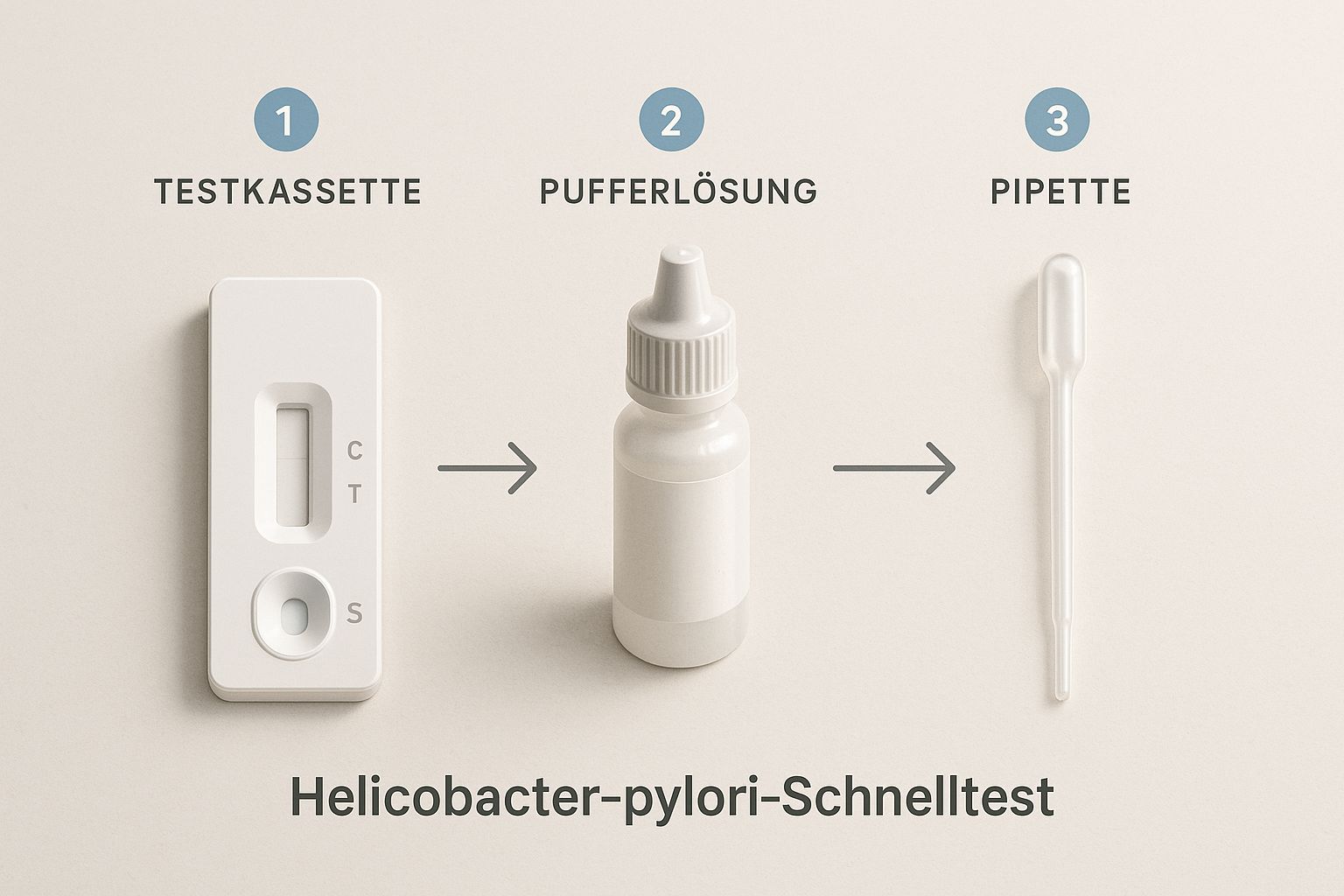
As you can see, everything is clearly laid out and self-explanatory. You have everything you need right at hand.
Collecting the sample may feel a little unusual at first, but with the right technique it is easy and clean. The test kit contains a special sample collector or swab to make collection easier. You really only need a tiny amount of your stool sample. Make sure the sample does not come into contact with water or urine from the toilet.
Next, place the sample in the supplied tube, which already contains a buffer solution. Shake it vigorously for a moment so that everything mixes well. Then drip the specified number of drops from this tube into the small round well on the test cassette.
Reading the result correctly—here’s how
Now you just need to wait a little. Follow the time stated in the instructions exactly—usually around 10 to 15 minutes. Reading the result too early or too late can unfortunately make it unusable. It is best to set a timer on your phone so you do not miss the right moment.
Once the time has elapsed, look at the test cassette. You should now see lines:
- One line in the control area (C): This line must always be present. It confirms that the test has worked properly. If only this one line appears, your result is negative.
- Two lines (in the C and T areas): If you see two lines, the result is positive. This means that antigens from the Helicobacter pylori bacterium were found in your sample.
- No line or only one line in the test area (T): In this case, the test unfortunately did not work. It is invalid, and you should repeat it with a new kit.
A positive result is a clear indication of an active infection and should prompt you to schedule a doctor's appointment. But even if you are unsure or would like to learn more about the background, you can find further information in our guide on how to correctly interpret the Helicobacter pylori rapid test. If your result is negative but your symptoms persist, you should also see a doctor to clarify other possible causes.
Putting the rapid test's accuracy and limitations into perspective
You are holding the result of your Helicobacter pylori rapid test in your hands and are probably wondering now: What exactly does this mean? How reliable is this result? These questions are absolutely valid and important for planning the next steps correctly. Let's take a clear look together at the test's reliability and understand its strengths as well as its limitations.
The at-home rapid test, such as the one from mybody-x.com, is what is known as a stool antigen test. It sounds complicated, but simply means that it specifically looks for tiny components of the bacterium itself—the antigens. If the test detects these in your stool sample, it shows a positive result. This is a strong indication of an active infection currently taking place.
What do sensitivity and specificity mean?
To assess the reliability of a medical test, you cannot avoid two terms: sensitivity and specificity. But don't worry, they are very easy to understand:
- Sensitivity: This value indicates how well the test detects an infection when it is actually present. High sensitivity ensures that an existing infection is overlooked only extremely rarely (few false-negative results).
- Specificity: This value describes how reliably the test classifies healthy people as healthy. High specificity prevents the test from falsely sounding the alarm when there is no infection (few false-positive results).
Modern at-home stool antigen tests generally achieve over 90% sensitivity and specificity. This makes them a very reliable tool for an initial assessment.
A rapid test is like a smoke detector for your stomach health. It goes off when there is a specific indication of a problem, giving you the important information that you should take a closer look and take action. However, it does not replace a thorough analysis of the situation by the fire department—in this case, your doctor.
The high reliability of such tests is also demonstrated in practice. For example, consider the Helicobacter urease rapid test (HUT), an established diagnostic method. A study of 493 patients showed that 97.8% of positive results could be confirmed by other procedures. The rate of false-positive results was just 0.61%, underscoring the low error rate. If you would like to explore the study results in greater depth, you can find further insights into the study on thieme-connect.com.
Which factors can affect the result?
Although the test is very reliable, there are a few things that can affect the result and lead to an incorrect outcome. It is important to be aware of these so that you can interpret the result correctly.
A common interfering factor is the use of certain medications. As mentioned, proton pump inhibitors (PPIs)—often used for heartburn—can temporarily reduce the number of bacteria in the stomach so significantly that the test can no longer detect them. The result would then be falsely negative. The same applies to a recently completed course of antibiotics, which can also reduce the bacterial load.
The rapid test compared with other methods
So how does the home test compare with the methods used at a doctor's office? Here is a brief overview of the most common procedures:
| Test method | How it works | Advantage | Disadvantage |
|---|---|---|---|
| Stool antigen test (home test) | Looks for bacterial antigens in the stool | Non-invasive, fast, discreet, detects an active infection | Medications can affect the result |
| C13 breath test | Measures a gas in the breath after taking a test solution | Very high accuracy, non-invasive | Can only be performed at a doctor's office, more expensive, also dependent on medication |
| Gastroscopy (endoscopy) | Taking a tissue sample directly from the stomach | Enables direct assessment of the stomach lining | Invasive procedure, more complex, not always necessary |
| Blood test (antibodies) | Looks for antibodies against H. pylori in the blood | Simple blood sample | Cannot distinguish between an active and a past infection |
You can see that every method has its place. The rapid test is ideal for quickly and easily investigating an initial but highly informative suspicion. It provides a solid basis for the next steps and for talking to your doctor.
What your test result means for you
Okay, the test has been done and the result is in front of you. Whether it is positive or negative, you are naturally wondering: What does this specifically mean for me, and what happens next? Don’t worry, we won’t leave you alone with this. Think of this section as your personal guide, so you can take the next steps well-informed and safely.
A rapid test is a fantastic tool for getting an initial, reliable assessment. It gives you important guidance, but it can never replace a conversation with your doctor. Consider the result a valuable basis for everything that follows.
If your test result is positive
A positive result means that antigens from the bacterium Helicobacter pylori were found in your stool sample. This is a very strong indication that you have an active infection—and it could indeed be responsible for your stomach symptoms.
The most important next step is: Make an appointment with your primary care doctor. A positive result from a Helicobacter pylori rapid test must always be medically confirmed and interpreted. It is best to take the test result with you to the appointment.
Your doctor will probably suggest further tests to confirm the findings and determine how severely the stomach lining is inflamed. These could include, for example:
- The C13 breath test: A highly accurate, non-invasive test that also detects an active infection.
- An upper endoscopy (gastroscopy): The stomach lining can be examined directly, and small tissue samples can be taken. This confirms the infection while also ruling out other possible conditions.
- A blood test: This is often used to detect associated conditions such as iron deficiency.
If the diagnosis is confirmed, what usually follows is a so-called eradication therapy. This may sound complicated, but it is a proven treatment: a combination of several antibiotics and an acid blocker, which you take for 7 to 14 days. This therapy is highly successful in the vast majority of cases and eliminates the bacterium permanently.
If your test result is negative
A negative result is good news to begin with. It means that no antigens from the bacterium were detectable in your sample at the moment. If you feel well and have no symptoms, you can put the matter aside for now with peace of mind.
But what if your symptoms—such as bloating, stomach pressure, or heartburn—persist anyway? A negative result is no guarantee that everything is fine. There are several reasons why you might still have symptoms despite a negative test:
- The cause is something else: Stomach problems can take many forms. Perhaps a food intolerance, stress, an imbalance in the gut flora, or another inflammatory disease is behind them.
- The result was a false negative: Although rare, this can happen. Taking acid blockers or antibiotics shortly before the test can particularly distort the result.
Very important: Persistent symptoms should always be evaluated by a doctor. A negative test result should never stop you from seeking professional help if you are not feeling well.
Interestingly, the use of rapid tests alone is viewed critically in official clinical guidelines in Germany. The S2k guideline recommends carrying out a test only if it directly leads to treatment. The guideline even officially advises against antigen rapid tests in stool, as their reliability does not always meet clinical requirements. This makes it all the more important to view the result as an initial indication and have it medically assessed, as you can read here on Vorsorge-Online.
The following table provides a clear overview of which steps make sense depending on the test result, giving you an initial guide.
Steps to take after receiving the test result
| Test result | Recommended next step | Possible further diagnostic tests | Important note |
|---|---|---|---|
| Positive | Be sure to make an appointment with a doctor to discuss and confirm the result. | C13 breath test, gastroscopy, blood test. | Do not start treatment on your own. The appropriate treatment will be initiated by a doctor. |
| Negative (with persistent symptoms) | You should also make an appointment with a doctor to identify other possible causes of the symptoms. | Diagnostic tests to rule out other gastrointestinal diseases and intolerance tests. | A negative result is not a free pass. Always have persistent pain checked out! |
| Negative (no symptoms) | No further steps are necessary for now. | None. | Continue to monitor your body. Seek medical advice if you experience new or recurring symptoms. |
Ultimately, the rapid test is a valuable guide, but your doctor is the navigator who will safely get you to your destination.
Prepare well for your doctor’s appointment
Regardless of what your test result showed, being well prepared for your conversation with your doctor can help you enormously. You can describe your situation more clearly and ensure that you receive the best possible help.
It’s best to make a few notes beforehand. This checklist can help you:
-
Describe your symptoms in detail:
- What symptoms are you experiencing exactly (e.g., burning pain, pressure, bloating)?
- When does it occur (e.g., before/after eating, at night)?
- How severe is the pain on a scale of 1 to 10?
-
Bring your test result:
- Show your doctor the result of your Helicobacter pylori rapid test.
-
Provide important background information:
- Which medications do you take regularly?
- Are there any known pre-existing conditions or allergies?
-
Ask questions:
- What further steps does my doctor recommend?
- What other causes could be responsible for my symptoms?
- What can I do myself to relieve my symptoms?
Incidentally, inflammation markers in the body can also provide important clues. If you would like to learn more about what elevated CRP levels mean, you will find valuable information in our related article.
How to get your stomach back on track in the long term
Whether your Helicobacter pylori rapid test was positive or not, your stomach health now deserves your full attention. After all, a calm, balanced stomach is the foundation of your overall well-being. Think of the following tips as your personal toolkit for actively—and above all, sustainably—strengthening your digestive health.
Forget the idea of a short-term sprint. A healthy lifestyle is more like a marathon, where you achieve the most through small but consistent steps.
A stomach-friendly diet as a foundation
What you eat is felt by your stomach immediately. But don’t worry: a stomach-friendly diet doesn’t have to be complicated or boring. It’s more about making conscious choices and selecting foods that soothe your stomach rather than putting additional strain on it.
Focus on foods that are easy to digest yet rich in nutrients. Steamed vegetables, lean meat such as chicken or turkey, fish, and low-fat dairy products are usually safe choices. Mild grains such as oats or rice can also be gentle on the stomach.
However, a little caution is advised with these foods:
- Spicy seasonings: Chili, pepper, and similar spices can irritate the sensitive stomach lining and unnecessarily stimulate acid production.
- Fatty and fried foods: They often sit in your stomach like a stone, linger there for a long time, and can cause a feeling of fullness or heartburn.
- Acidic foods: Citrus fruits, tomatoes, and carbonated drinks can often be an additional challenge for an already irritated stomach.
But most importantly: listen to your body. What helps one person may be exactly the wrong thing for you. A simple food diary can help you identify patterns and tailor your diet perfectly to your needs.
Stress management for a calm stomach
Have you ever noticed how stress directly affects your stomach? It’s not your imagination. Through the so-called gut-brain axis, our nervous system and digestive tract are directly connected. Chronic stress can increase stomach acid production and weaken the natural protective barrier of your stomach lining.
That’s exactly why active stress management is so incredibly important for your stomach health. It’s not about banishing stress from your life completely—that would be unrealistic. Instead, you should find healthy ways to deal with it.
Find your personal oasis of calm in everyday life. Whether it’s a 10-minute walk during your lunch break, a short breathing exercise at your desk, or a yoga session in the evening—regular, short relaxation breaks are often much more effective than one long vacation a year.
Simply try out techniques that are easy to incorporate into your day. Mindful breathing or a short meditation can make a noticeable difference to your well-being and your stomach after just a few minutes.
Probiotics and the power of your microbiome
A healthy stomach and a healthy gut make an unbeatable team. The balance of the trillions of bacteria in your gut—the so-called microbiome—plays a key role in this. These tiny helpers are responsible not only for digestion but also train your immune system.
Probiotics are living microorganisms that can support this delicate balance. You can find them naturally in fermented foods such as yogurt, kefir, sauerkraut, and kimchi. Sometimes, targeted supplementation can also be helpful in rebuilding your gut flora.
A diverse and strong microbiome strengthens your gut’s barrier function and also protects your stomach from unwanted intruders. If you’d like to take a deeper dive and understand how an analysis of your gut bacteria can help you, we recommend our article about the microbiome test for your gut health.
By integrating these three pillars—nutrition, stress management, and gut health—into your everyday life, you create the best foundation for a healthy and contented stomach in the long term.
The Helicobacter rapid test: Your most frequently asked questions
Before taking a Helicobacter pylori rapid test, questions naturally arise. That’s a good thing, because it shows that you take your health seriously. Here, we’ve collected answers to the most common questions we receive time and again, so you know exactly what to expect.
Does the test hurt?
No, don’t worry. The test is completely painless. Professionals call it “non-invasive”—there are no needles, no pricks, and nothing uncomfortable.
All you need is a tiny stool sample. You can collect it easily, hygienically, and discreetly at home using the test kit. This means you can stay in your familiar, relaxed surroundings.
What if I take medication for heartburn?
An extremely important point that you absolutely need to consider! Medications such as proton pump inhibitors (PPIs), which are often used for heartburn or reflux, can distort the test result. They reduce the number of bacteria in the stomach so significantly that the test may produce a false negative, even though you are actually infected.
Our tip: If possible, stop taking such medications at least two weeks before the test. For antibiotics, an interval of four weeks is even advisable. But it’s very important to discuss stopping medication with your doctor first, every time!
How does this stool test differ from a blood test?
Good question, because the two tests use completely different approaches. Knowing the difference is crucial for interpreting the result correctly.
- The stool antigen test (like the one from mybody-x): This test looks for antigens, meaning direct components of the Helicobacter pylori bacterium itself. If it detects anything, this is a very strong indication of an active, ongoing infection.
- The blood antibody test: A blood test, on the other hand, looks for antibodies. These are the “memory cells” of your immune system, which it produced in response to the bacterium. The drawback: These antibodies can remain in your blood for months or even years after an infection has been successfully treated.
In short: The stool test provides significantly more meaningful information about what is happening in your body right now.
How long do I have to wait for the result?
The name “rapid test” delivers exactly what it promises. One of the biggest advantages is that you gain clarity in no time. After adding the prepared sample to the test cassette, all that’s required is a little patience.
As a rule, you can read the result with your own eyes after approximately 10 to 15 minutes. The exact time is, of course, stated in the instructions, but you’ll receive an initial, important assessment of your situation practically immediately.
Are you ready to take the first step and gain clarity about your stomach health? At MYBODY Lab GmbH, you’ll find scientifically backed tests that you can perform easily and discreetly at home. Order your Helicobacter pylori test now and take control. Learn more and find the right test for you at https://mybody-x.com.



Share now:
Helicobacter Symptoms on the Tongue: What Your Tongue Reveals
What symptoms did you have with Helicobacter? The 7 most common signs explained