

Helicobacter symptoms on the tongue: What your tongue reveals
Do you have a white coating, an unusual burning sensation, or a strange taste on your tongue and wonder whether the bacterium Helicobacter pylori could be behind it? The short answer: Yes, that is entirely possible. Although Helicobacter actually settles in the stomach, an infection can sometimes leave visible and noticeable traces in the mouth.
What your tongue can reveal about a Helicobacter infection
It may surprise you that a stomach bacterium could be responsible for problems with the tongue. But your body is a fascinating, interconnected system. An imbalance in one place is often visible somewhere completely different—and the tongue is considered a mirror of your digestive health for good reason.
Helicobacter pylori is an extremely resilient bacterium that can survive in the harsh, acidic environment of the stomach. Many people carry it without ever noticing. In others, however, it causes chronic inflammation of the stomach lining, known as gastritis. And this is exactly where the connection to your mouth begins.
This type of inflammation in the stomach can throw your entire digestive system out of balance and indirectly affect your oral health. Think of it as a domino effect: The first domino falls in the stomach, but the effects appear elsewhere.
Possible signs in the mouth
The symptoms are often nonspecific and can have many other causes. Nevertheless, there are some typical changes that repeatedly stand out in connection with a Helicobacter infection:
- White or yellowish tongue coating: Often a stubborn coating that is difficult to remove even with brushing your teeth or using a tongue scraper.
- Burning tongue (glossodynia): A truly unpleasant burning or tingling sensation on the tongue with no obvious explanation, such as an injury.
- Metallic taste: Some people describe a strange, often metallic taste in their mouth that simply will not go away.
- Bad breath (halitosis): Sour or unpleasant breath that is not related to poor oral hygiene.
What’s important here is that these signs do not occur because the bacterium is directly located on your tongue. Rather, they result from the systemic effects the infection has on your body.
You need to understand: The tongue is not a direct habitat for Helicobacter, but it can reveal signals from your stomach.
The prevalence of Helicobacter pylori is surprisingly high. It is estimated that about 50 percent of the 50-year-old population in Germany carry the bacterium. In some cases, accompanying symptoms such as changes on the tongue, a burning tongue, or taste disturbances occur. These may indicate a subtle inflammatory reaction in the mouth in response to the infection in the stomach. You can read more about the prevalence and symptoms of Helicobacter pylori here.
Possible tongue changes associated with Helicobacter at a glance
This table summarizes the most common signs that may appear on your tongue in connection with a Helicobacter infection.
| Symptom on the tongue | Possible cause related to Helicobacter | What you should observe |
|---|---|---|
| White/yellowish coating | An imbalance in the gastrointestinal flora and digestive problems can affect the oral flora. | Is the coating persistent and difficult to remove? |
| Burning tongue | Systemic inflammatory reactions or nutrient deficiencies (e.g., B vitamins) that may develop as a result of gastritis. | Does the burning occur without any visible injury or irritation? |
| Metallic taste | Altered metabolic processes and the release of certain substances can impair the sense of taste. | Does the taste persist for a long time, regardless of what you eat? |
| Bad breath (halitosis) | Stomach acid problems (reflux) and digestive disorders caused or aggravated by the infection. | Does the smell seem to come from your throat rather than directly from your teeth? |
Keep in mind that these symptoms are only clues. Only a doctor can give you a reliable diagnosis, and special tests are often necessary.
What exactly is Helicobacter pylori?

To understand why your tongue might be sounding the alarm, let’s take a closer look at the possible trigger: the bacterium Helicobacter pylori. It’s best to imagine it as an extremely clever survivor that has adapted perfectly to one of the most inhospitable zones in our body—the aggressive stomach acid.
This spiral-shaped bacterium has a brilliant trick up its sleeve. It produces an enzyme called urease, which converts urea into ammonia. This ammonia neutralizes the stomach acid in its immediate surroundings, creating a kind of protective shield. This allows it to survive undisturbed and attach itself to the stomach lining.
A hidden companion since childhood
A Helicobacter infection is far from rare. In Germany, an estimated 30 to 40 percent of the population carries the bacterium. Infection usually occurs unnoticed during the first few years of life, often through close contact within the family, since the bacterium is found in saliva and stool. You can read more about the spread and transmission routes of Helicobacter here.
This also explains why so many people harbor the bacterium without ever noticing it. It can live in the stomach for decades as a silent “lodger” without causing the slightest problems. Your immune system keeps it in check, and a kind of truce prevails.
Helicobacter pylori is a master of disguise. It can exist unnoticed in the stomach for years because it has learned to protect itself from aggressive stomach acid.
In many cases, the infection therefore has no consequences. The bacterium is simply there but causes no significant harm. You feel nothing, notice nothing—the coexistence works.
From silent guest to troublemaker
But this balance can be disrupted. Under certain circumstances—for example, due to a lot of stress, a weakened immune system, or other influences—Helicobacter pylori can suddenly become active and start causing trouble.
When the bacterium multiplies extensively, it attacks the protective mucus layer of your stomach. The result is chronic inflammation of the stomach lining, which doctors call gastritis.
This persistent inflammation is the real heart of the problem. It is the root of most symptoms associated with a Helicobacter infection, such as:
- Stomach pain or a burning sensation in the upper abdomen
- Feeling of fullness and bloating, even after small meals
- Frequent belching
- Heartburn
In more serious cases, this chronic inflammation can even lead to stomach ulcers or duodenal ulcers. And it is precisely these systemic effects originating from inflammation of the stomach lining that explain why the infection can sometimes become noticeable in a completely different place as well—for example, through telltale signs on your tongue.
Typical signs on the tongue and in the mouth
Okay, now you know what Helicobacter pylori is. Let’s take a closer look at the traces the bacterium can leave in your mouth. This will help you better interpret and classify your body’s signals.
Some signs are particularly typical and keep appearing in connection with an infection. But first, and this is really important: none of these symptoms is proof on its own. They are more like pieces of a puzzle.
Persistent whitish-yellow coating on the tongue
The most noticeable sign is probably a whitish to yellowish coating on the tongue. Unlike the normal coating you may have in the morning, which is easy to scrape off, this one is often thicker and really persistent. It feels as though your mouth simply never gets properly clean, no matter how thoroughly you brush.
This kind of coating usually develops when the balance between good and bad bacteria in your mouth—your oral flora—gets disrupted. A Helicobacter infection can contribute to exactly this, often indirectly through impaired digestion that throws your entire system out of balance.
Unexplained Burning Tongue and Mouth Sensations
Another truly unpleasant symptom is what is known as burning mouth syndrome (glossodynia). Those affected often describe it as feeling as though they had burned their tongue, even though nothing hot came near it. It may tingle, burn, or simply feel sore.
This burning sensation is often an alarm signal for silent inflammation in the body or can be caused by nutrient deficiencies, such as vitamin B12 deficiency. And this brings us full circle: Chronic gastritis caused by Helicobacter can block the absorption of precisely these important nutrients in the stomach.
Your tongue is often a reflection of your digestion. If you notice persistent changes there, it is a clear signal to take a closer look and get to the bottom of the cause—instead of merely masking the symptom.
Strange Taste and Bad Breath
Do you sometimes have a strange, often metallic or bitter taste in your mouth that you cannot explain? This can also be a sign. This unusual taste may occur when metabolites from the inflammation in the stomach enter your bloodstream and thus also reach your taste buds.
At the same time, bad breath (halitosis) may occur, which has nothing to do with poor oral hygiene. It is often described as slightly sour and is caused by gases rising from the stomach or by generally impaired digestion.
This infographic summarizes how often the three most important tongue symptoms occur in people with a confirmed Helicobacter pylori infection.
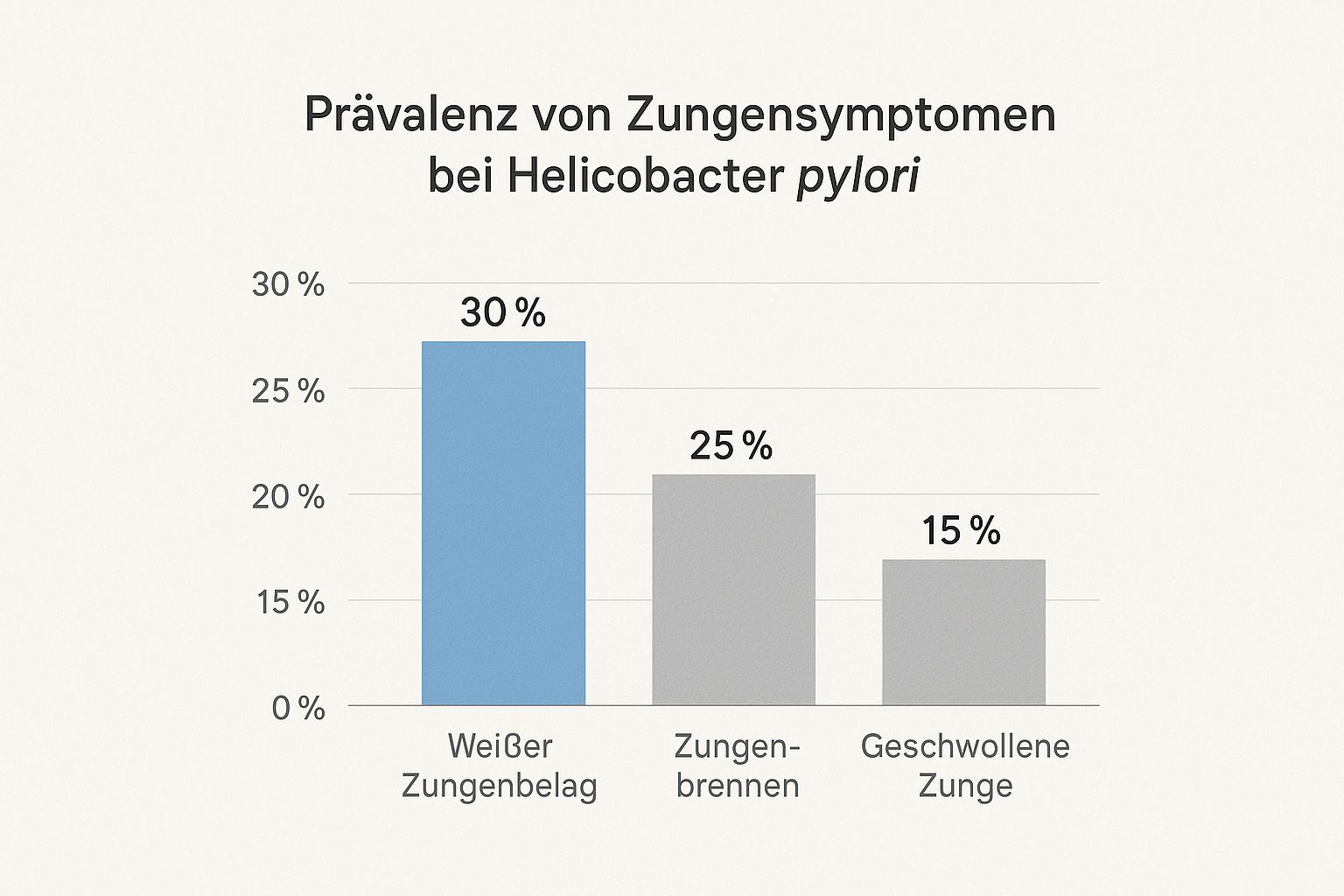
It is clear: A white coating on the tongue is the most common phenomenon, followed by burning tongue. A swollen tongue, on the other hand, occurs less frequently.
But beware: Don’t forget other causes
It is absolutely crucial to understand that these symptoms are not exclusive to Helicobacter. There are a whole range of other possible causes that you should keep in mind.
The following table will help you better categorize the symptoms and see when Helicobacter could play a role and which other causes are also likely.
Tongue symptoms and their possible causes
| Symptom | Possible indication of Helicobacter | Other common causes |
|---|---|---|
| Thick white coating | When it persists and is accompanied by gastrointestinal problems. | Oral thrush (fungal infection), dehydration, smoking, poor oral hygiene. |
| Burning tongue | When digestive problems or fatigue occur at the same time (nutrient deficiency). | Nutrient deficiencies (iron, vitamin B), dry mouth, allergies, hormonal changes. |
| Bitter or metallic taste | When it appears suddenly and cannot be explained by eating or drinking. | Medications (side effect), dental problems (e.g., gum inflammation), pregnancy. |
| Bad breath | When the smell is sour and does not come from your throat or teeth. | Dental problems, tonsil stones, certain diets (e.g., keto), reflux, dry mouth. |
As you can see, the matter is not always entirely clear-cut. The connection between digestion and general health symptoms is complex, and genetic factors often play a role too, determining how your body responds to such disruptions.
If you want to learn more about how to find out whether digestive problems and genes are connected in your case, read our DNA analysis test guide. So if your symptoms persist and you also have gastrointestinal problems, a Helicobacter test could be the next logical step toward finally getting clarity.
How Your Stomach Affects the Health of Your Tongue

Sounds strange at first, right? A problem in your stomach is supposed to show up on your tongue. How could that happen? The answer is actually quite simple: Your body is not a kit made up of individual parts, but a complex ecosystem in which everything is connected.
Think of your digestive tract as a chain of dominoes. Helicobacter pylori knocks over the first domino in your stomach—and the wave can spread all the way to your mouth.
The Chain Reaction from Stomach to Mouth
The main reason for this connection is the chronic inflammation of the stomach lining (gastritis) that Helicobacter pylori can cause. This inflammation rarely remains a purely local problem; instead, it affects your entire body.
The ongoing irritation of the stomach lining often disrupts the production of stomach acid. This can lead to heartburn or silent reflux, in which aggressive stomach acid rises into the throat. There it comes into contact with the sensitive mucous membranes—including those of your tongue.
Your body is constantly communicating with you. A change on your tongue may be a quiet whisper from your stomach, telling you that something has gotten out of balance.
This constant contact with stomach acid can cause a burning sensation in the mouth, a sour taste, and an imbalance in the oral flora. The bacterial balance in your mouth is disrupted, which in turn promotes the development of stubborn coating or bad breath. You can learn more about the causes of constant belching and pressure in the stomach in our related article.
When the nutrient engine starts sputtering
But there is another crucial factor: impaired nutrient absorption. Your stomach is where important vitamins and minerals are prepared for absorption in the intestines. Chronic gastritis can significantly disrupt this process.
B vitamins, especially vitamin B12, and iron are particularly often affected. A deficiency in these nutrients becomes apparent very quickly in the mucous membranes because they constantly need to regenerate. The consequences may include:
- Burning tongue (glossodynia): A classic symptom of vitamin B12 deficiency.
- Smooth, red tongue (glossitis): The small papillae on the tongue may recede.
- Cracked corners of the mouth: Another typical sign of a deficiency in B vitamins or iron.
So the bacterium doesn't just cause problems directly in the stomach; it also essentially cuts off the supply of nutrients to other areas of your body. The so-called Helicobacter symptoms tongue are therefore often indirect consequences of a nutrient deficiency that began in the stomach. Your tongue thus becomes a visible indicator of an invisible process taking place inside you.
How to test for Helicobacter easily and safely
A vague feeling in your stomach or a look at your tongue that makes you suspicious? Guesswork alone won't get you anywhere when it comes to your health. A reliable test, however, will. If you finally want clarity and would like to take back control, this is the crucial next step. Especially if the coating on your tongue, burning tongue, or gastrointestinal symptoms simply refuse to go away, you should seek certainty.
There are various ways to detect an infection with Helicobacter pylori. Each method has its own strengths and weaknesses and may be more or less suitable for your individual situation.
What testing methods are available?
Your doctor has several options for detecting the bacterium. In general, a distinction is made between methods that look directly into the stomach (invasive) and those that do not (non-invasive).
Invasive methods (direct detection):
- Gastroscopy: This is the gold standard. A small camera is used to examine your stomach, and a tiny tissue sample (biopsy) is taken directly from the stomach lining. The sample is then examined in a laboratory. The method is extremely accurate, but it is also more involved and unpleasant for many people.
Non-invasive methods (indirect detection):
- ¹³C urea breath test: Here, you drink a special liquid. If Helicobacter is active in your stomach, it breaks down this substance. The resulting gas can then be easily detected in your breath. A very reliable test.
- Blood test (antibody detection): Your blood is tested for antibodies against the bacterium. The problem is that the test cannot distinguish between an active infection and one that occurred long ago. It only tells you that your body came into contact with the pathogen at some point, not whether it is still present.
- Stool test (antigen detection): This test directly looks for tiny components (antigens) of the bacterium in your stool sample. It is highly accurate, both for the initial diagnosis and for follow-up after treatment.
To reliably detect an active infection without immediately having to undergo a gastroscopy, the stool antigen test and the breath test are the best methods.
The easy way to get clarity: a home test
Not everyone wants to or can go to the doctor right away. Sometimes you simply want to clarify an initial suspicion privately and discreetly. That is exactly what modern at-home stool antigen tests are for.
These tests, like those you can also find at mybody-x.com, offer a high level of reliability comparable to laboratory tests. The huge advantage: You collect the sample conveniently and discreetly in your own home and then send it to a certified laboratory.
The process is as simple as can be:
- You order the test kit online with ease.
- You collect the stool sample at home—a clear set of instructions is included.
- You send the sample directly to the laboratory in the enclosed return envelope.
- You will receive your results securely and digitally after only a short time.
This method is ideal for getting an initial, reliable assessment. If the result is positive, you have a solid basis for discussing the next steps with your doctor. You can find out more about exactly how it works in our article about the Helicobacter pylori rapid test. This way, you can finally have certainty and take targeted action.
Frequently asked questions about Helicobacter and the tongue
Here, we have compiled the most important questions about Helicobacter pylori and tongue symptoms for you, summarizing them briefly and clearly. This gives you quick, easy-to-understand answers to what concerns you most.
Is a tongue coating alone a reliable sign of Helicobacter?
No, a coating on the tongue alone is not conclusive evidence of an infection. It can have many causes: your diet, insufficient fluid intake, or an imbalanced oral flora.
But it becomes interesting when the coating appears along with other typical symptoms—such as stomach pain, heartburn, or a strange metallic taste in the mouth. Then the tongue coating suddenly becomes a relevant piece of the puzzle. See it as a signal from your body to take a closer look and consider getting tested if symptoms persist.
Remember: A single symptom is rarely a diagnosis. Context is crucial. The combination of tongue changes and digestive problems makes a connection with Helicobacter more likely.
Do tongue symptoms disappear after successful treatment?
In many cases, the answer is: Yes. If the Helicobacter tongue symptoms were a direct consequence of the infection and the associated gastritis, they will improve significantly or even disappear completely after successful treatment.
But give your body some time. The mucous membranes in your mouth and stomach are like a construction site after a storm—they first need time to regenerate. You can specifically support this healing process by consciously taking care of your gut and oral flora after treatment, for example by eating probiotic foods.
What can I do myself for my oral and stomach health?
Regardless of whether an infection is present, there is a lot you can do to strengthen the balance in your body. These measures are essentially the foundation of your health:
- Maintain good oral hygiene: Regular toothbrushing and daily use of a tongue scraper are invaluable. They effectively remove plaque and bacteria before they become established.
- Promote gut health: Feed your beneficial gut bacteria! A high-fiber diet rich in vegetables, whole grains, and fermented foods such as yogurt or kefir is ideal for this.
- Reduce stress: Chronic stress is known to affect the stomach. Find your own way to relax—whether through yoga, meditation, or simply taking a regular walk in nature.
- Avoid irritants: Sugar, alcohol, and highly processed foods can disrupt the sensitive balance of your gut flora. Reduce them wherever possible.
These habits support the well-being of your entire digestive tract from the ground up. However, if there is a specific suspicion of Helicobacter, a targeted test is always the first logical step.
Is a Helicobacter home test as reliable as a doctor's test?
Yes, modern at-home stool antigen tests offer a very high level of reliability and are a recognized method for detecting an active infection. They are just as accurate as tests performed in a laboratory because they look directly for components of the bacterium.
A home test is therefore an excellent and discreet way to quickly and easily clarify a suspicion without having to leave the house. If you receive a positive result, you have a solid basis for discussing it with your doctor and planning the next steps.
If you have any further general questions about our tests or health-related topics, you will certainly find the answers you are looking for in our comprehensive FAQ section here.
Do you want clarity instead of uncertainty?
If you feel that Helicobacter pylori could be behind your symptoms, a reliable test is the first and most important step toward improvement. With the mybody-x.com Helicobacter Pylori Test, you receive a precise laboratory analysis that you can carry out easily and discreetly at home. Take control of your health and finally find out what is really going on.



Share now:
Nutrition for celiac disease: 6 safe & delicious options
At-home Helicobacter pylori rapid test – Easy & Reliable