
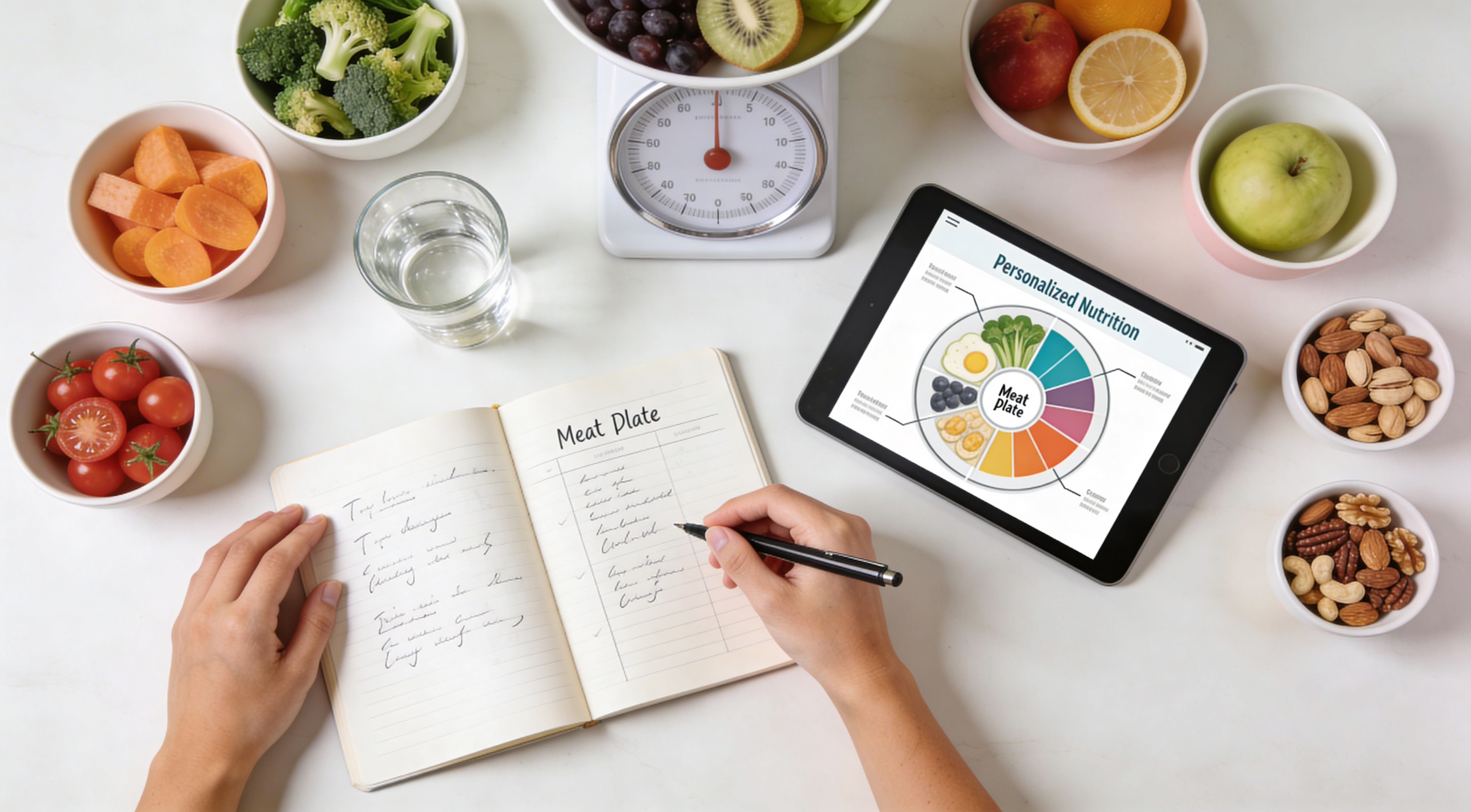
Create a nutrition plan: Your path to the perfect diet
You want to create a nutrition plan that finally fits your everyday life. Not just for five motivated days, but for weeks and months. That is exactly where many plans fail.
Maybe this sounds familiar. At first, everything goes smoothly. Breakfast prepared, calories tracked, salad in the evening instead of frozen pizza. Then a stressful day at work, a restaurant visit, or simply hunger that does not fit into the app comes along. Suddenly, the plan feels wrong, even though you followed it “correctly.”
The problem is often not your willpower. The problem is that many plans are too general. They rely on average values, even though your body, appetite, everyday life, and genetic predisposition are not average. So if you want to create a nutrition plan that lasts, you need more than a list of foods and calories. You need a system that starts with you.
Why a standard diet plan often does not work
Take Anna. She first tried low carb, then calorie counting, and later a very low-fat diet. Each time, she initially felt good because clear rules provide a sense of security. Each time, frustration set in after a few weeks. She was tired, experienced cravings, or found it difficult to maintain the whole thing socially.
This is not an isolated case. Standard plans assume that everyone reacts to food in similar ways. In real life, that is rarely true.

Your body does not follow a template
Two people can eat the same thing and still feel completely different. One stays full for a long time, while the other quickly gets hungry again. One tolerates large portions of carbohydrates well, while the other becomes sluggish from them. Sleep, physical activity, stress, eating habits, and digestion also play a role.
A standard plan often overlooks these points:
- Everyday life: Shift work, working from home, or commuting can significantly change your eating habits.
- Satiety: Some foods keep you full for a long time, while others trigger further eating.
- Training goal: Weight loss, muscle retention, and improved performance do not require the same focus.
- Tolerance: If you tolerate certain foods poorly, even the theoretically best plan will do little for you.
A good nutrition plan does not feel like punishment. It reduces friction in everyday life.
From avoiding deficiencies to true personalization
In the past, nutrition planning was primarily a matter of survival. In Germany’s immediate post-war period, calorie intake for adults during rationing period 101 in 1947 fell to just 914 calories per day, as historical data from the archive on the post-war period show (archiv0711.hypotheses.org). Today, it is no longer just about preventing deficiency, but about tailoring nutrition to your own body.
This is an important change in perspective. In the past, the question was: How can you get enough energy at all? Today, it is more likely to be: Which diet supports my goal, my metabolism, and my well-being?
How to tell that your plan does not suit you
Sometimes a plan is correct on paper but impractical in reality. Look out for these signs:
| Note | What it often means |
|---|---|
| You are constantly hungry | The meals do not satisfy you enough |
| You lose control in the evening | The plan was too strict during the day |
| You are constantly thinking about food | The plan is too restrictive or monotonous |
| You can only stick to it under ideal conditions | It does not fit your everyday life |
If this sounds familiar, you do not need a stricter plan. You need one that suits you better.
The foundation of your plan: calculate your goals and needs
Before choosing foods, you need two things: a clear goal and a realistic energy requirement. Without this foundation, your plan quickly becomes arbitrary.
Define your goal clearly
“I want to eat healthier” is a good intention, but it is too vague. A goal that you can evaluate in everyday life is better.
For example:
- Lose weight: You want to eat more mindfully and reduce your weight.
- Maintain or build muscle: You want to plan for enough energy and protein.
- More energy in everyday life: You do not want to keep fluctuating between energy slumps and cravings.
Write your goal in one sentence. For example: I want a plan that I can stick to even on workdays without overeating in the evening.
Calculate your energy needs
Many people start with a fixed calorie target from the internet. This is usually too rough. It is better to estimate your needs individually.
The total energy expenditure is often used for this. It consists of basal metabolic rate and activity. In practice, a calculator is all you need. If you want to keep it simple, use the kcal requirement calculator from mybody-x.
The so-called PAL factor is important here. It describes how active you are in everyday life. A desk job with little movement requires a different classification than physical work or regular training.
Practical rule: Estimate your activity honestly rather than optimistically. A plan only works if the foundation is right.
Use macros as a framework, not a cage
Once you know your calorie needs, you can distribute your energy among macronutrients. The German Nutrition Society gives the following general range: 50 to 55 percent carbohydrates, 30 to 35 percent fat, and 15 to 20 percent protein (oesterreich-isst-informiert.at).
This isn’t a rigid rule. It’s a starting point. If you train more, get hungry more quickly, or want to preserve muscle, your plan can deviate from this later.
Three mistakes at the beginning
Many people make the same thinking mistakes at the beginning:
- Starting too aggressively: A plan that can only be maintained with a lot of discipline often falls apart quickly.
- Looking only at calories: Quantity matters, but nutrient quality determines satiety and energy.
- Expecting perfection: Your first plan doesn’t have to be ideal. It has to be usable.
If you want to create a nutrition plan, think like a coach first, not a controller. You’re building a system that supports you in everyday life.
Select macros and foods deliberately
You may know the situation: Two meals have a similar number of calories, but after one you’re full and focused for two hours, while after the other you’re soon looking for something sweet again. This is exactly where you see why macros are more than just number-crunching. They determine how consistently your plan works in real life.

Plan protein first
Protein is the best starting point for many goals. It helps you stay full longer, supports muscle retention, and gives every meal more substance. Especially when losing weight or during stressful periods, it makes a noticeable difference.
For practical purposes, a simple rule is often more helpful than perfect tracking: include a recognizable protein source in every main meal.
Good options include, for example:
- Skyr, quark, or plain yogurt
- Eggs
- Fish
- Legumes
- Tofu or tempeh
- Chicken or other leaner meat sources
If you’re unsure whether you’re eating enough of it, don’t look at your daily app first. Look at your plate. If breakfast, lunch, or dinner lacks a clear protein source, that’s usually the easiest lever to pull.
Choose carbohydrates that fit your daily routine
Carbohydrates provide quickly available energy. They are often very useful for training, concentration, and recovery. The problem is rarely the macronutrient itself, but rather the combination and context.
For example, white bread with jam can be useful as quick energy before exercise. The same meal at the office, without protein or fiber, keeps many people full for a much shorter time.
Practical everyday sources of carbohydrates include:
- Oats for a filling breakfast
- Potatoes or rice around active days
- Whole-grain products for more fiber
- Fruit as a practical addition for on the go
For more guidance on macronutrient distribution, see the article on fats, carbohydrates, and protein.
Fats give meals staying power
Fats are not just flavor carriers. They slow gastric emptying, make meals more satisfying, and help you stick to a plan without constantly feeling deprived.
Good sources include:
- Nuts and seeds
- Olive oil
- Avocado
- Fatty fish
- Nut butter in small amounts
This is where moderation is useful. A small amount often significantly improves satiety and flavor. A large amount quickly increases calories without making the portion look noticeably bigger.
Food quality also matters
Macros are the blueprint. Food is the building material.
In theory, you can reach the same macros with ready-made products, bars, and highly processed snacks. In practice, many people then experience more hunger, less energy, or unsettled digestion. Whole foods provide fiber, vitamins, minerals, and phytonutrients in addition to protein, fat, and carbohydrates. These are precisely the building blocks that are often missing from standard plans.
A simple shopping perspective helps:
| Food group | Practical everyday examples |
|---|---|
| Protein | Quark, eggs, tofu, lentils, fish |
| Carbohydrates | Oats, potatoes, rice, whole-grain bread |
| Fats | Nuts, olive oil, seeds, avocado |
| Micronutrient-rich basics | Vegetables, fruit, herbs, legumes |
Personalization starts with food selection
Now the plan becomes truly individualized. If you regularly experience bloating after dairy products, feel tired after large portions of oats, or notice digestive issues with legumes, that is not a sign of a lack of discipline. It is feedback from your body.
That is precisely why a standard macro plan is often not enough. Advanced data such as blood values, DNA analyses, or microbiome results can later help you choose foods more precisely. Some people benefit more from additional fiber, while others tolerate certain fat sources or amounts of carbohydrates better. Such differences are barely visible in traditional nutrition plans, but they become very clear in everyday life.
That is why a simple rule for getting started is: Choose foods not only based on calories and macros, but also on digestibility, satiety, and everyday energy.
A simple building-block approach for every meal
If you want to simplify decisions, use four building blocks per meal:
- A protein source
- A suitable source of carbohydrates
- A sensible amount of a fat source
- Vegetables, fruit, or legumes for volume and micronutrients
This is how theory becomes a plate that truly sustains you. For example, quark with oats, berries, and nuts. Or rice with salmon, vegetables, and a little olive oil. Or lentils with roasted vegetables and tahini.
The goal is not a perfect meal plan on paper. The goal is a plan that suits your body and feels just as good on an ordinary Wednesday as it does during a motivated first week.
From knowledge to practice: Your weekly plan
Theory is of little use if you are standing hungry outside the bakery at 1 p.m. on a Monday with no plan. That is why your nutrition plan needs a weekly structure, not perfect individual meals.
A simple daily framework
A typical day could look like this:
Breakfast
Protein plus fiber. For example, yogurt or quark with oats and fruit.
Lunch
A clear plate structure helps: a protein source, a filling source of carbohydrates, and plenty of vegetables.
Snack
Something to tide you over until your hunger passes. For example, Skyr, fruit with nuts, or vegetable sticks with hummus.
Dinner
The same logic again. Not creativity at all costs, but reliability.
How a working person can plan practically
Take a typical workday. There is little time in the morning. A prepared breakfast is therefore worth its weight in gold. At lunchtime, the meal should be portable or quickly available. In the evening, you need something that works without much decision-making stress.
A weekly plan becomes easier when you do not create seven completely different days. Rotation is better.
For example:
- Two breakfast options that you enjoy
- Three lunches that can be prepared in advance
- Three to four dinners that you can vary
- A fixed snack pool for on the go
This saves mental energy.
Keep shopping and preparation simple
Many people associate meal prep with spending hours cooking in advance. It doesn't have to be that way. Often, it's enough to prepare individual components:
- Pre-cook protein: eggs, legumes, chicken, tofu
- Prepare side dishes: rice, potatoes, couscous
- Keep vegetables ready to use: wash, cut, and portion them
- Keep emergency options on hand: frozen vegetables, canned beans, plain yogurt
If you're looking for inspiration for a practical everyday structure, take a look at this weekly plan for healthy eating.
The best weekly plan is rarely the most varied. It is the one you can still follow on a stressful Wednesday.
Stay flexible without losing track
A restaurant visit won't ruin your plan. Neither will a spontaneous invitation. It only becomes problematic when, after deviating from your plan, you mentally switch to “everything goes.”
So think in terms of guardrails:
| Situation | Good response |
|---|---|
| Business meal | Prioritize protein and vegetables, and stay relaxed |
| Late finish at work | Use a prepared standard meal |
| More hungry than usual | Increase your serving of vegetables, protein, or a planned snack |
| Less exercise | Don't panic and cut back—just keep eating normally |
That makes your plan sustainable. And that is exactly what you need in the long term.
The key aspect: personalization through DNA analysis
Your weekly plan can be well structured and still not suit you properly. You eat the right portions, pay attention to protein, and prepare meals in advance. Yet your energy, satiety, or progress still falls short of your expectations. The reason is often not a lack of discipline, but that standard plans work only with average values.

Why genetics is relevant to nutrition planning
A traditional nutrition plan is like a well-intentioned off-the-rack suit. It may fit well, but not perfectly everywhere. Your genetics provide clues about how your body processes nutrients, how sensitive you are to certain dietary patterns, and where your individual fine-tuning may lie.
This does not mean that genes determine everything. They are more like a guide. You still need to actively shape your daily routine, eating habits, sleep, and exercise. That is precisely why DNA analysis is not a substitute for the basics, but an additional layer of personalization.
What a DNA perspective specifically changes
It becomes especially interesting when you not only read the lab results but translate them into decisions. This is exactly where many guides do not go far enough. They explain calories and macros, but not how to incorporate real body data into your plan.
A DNA analysis can, for example, help answer these questions more precisely:
- Which macro distribution you should test more precisely
- Where your metabolism may react differently from average
- Which nutritional structure better suits your everyday life and biology
- The topics where a closer look at tolerance or nutrient status is worthwhile
When you combine this with additional data such as blood values or microbiome results, your plan becomes significantly more individualized. It is no longer a general nutrition plan, but a system tailored to your body. That is exactly what bridges the gap between general nutrition advice and true personalization.
Who can benefit from this step
DNA data is especially helpful when you no longer want to simply experiment, but instead make more targeted decisions.
This often applies to you if:
- you have consistently followed several nutrition plans and always struggle with similar issues
- you track accurately, but satiety, energy, or weight changes do not match your expectations
- you want to understand why your body reacts differently to certain patterns
- you want to build your nutrition plan around more than calories and macros
The mybody-x DNA Nutrition Test was developed for this purpose. It analyzes genetic traits related to nutrition and can provide additional guidance for fine-tuning. If you first want to understand how such results are generally interpreted, the article on the DNA Test is a good place to start.
What you can practically derive from the results
What matters is translating this into everyday life. A lab report only helps you once it leads to clear actions.
For example:
- You may tolerate a heavily carbohydrate-focused structure less well. Then you can test meals with more protein, vegetables, and a more controlled amount of carbohydrates.
- You have indications of specific nutrient-related issues. Then you can incorporate certain foods more deliberately or discuss appropriate diagnostic testing as a supplement.
- Your body may react more sensitively to certain dietary mistakes. Then you can structure your plan more simply, consistently, and repeatably.
Personalization does not mean that you suddenly have to eat according to your genetics alone. It helps you make smarter decisions, with less guesswork and a stronger focus on your own body.
Adjust your plan and stay successful in the long term
A nutrition plan is a living process. It isn't a PDF that you fill out once and then follow forever. Your body changes. So does your daily life.
Observe instead of sticking to it blindly
If your weight stagnates, that doesn't automatically mean the plan has failed. Maybe you only need a small adjustment. Perhaps you're sleeping worse, moving less, or eating significantly differently on weekends than during the week.
Pay particular attention to these signals:
- Hunger: too frequent, too intense, or too difficult to control
- Energy: stable performance or regular slumps
- Digestion: does eating feel good or burdensome
- Practicality: does the plan still fit your life
Biomarkers can reveal gaps
If you're “doing everything right,” it can sometimes be worth looking beyond calories and macros. According to the provided data, integrating biomarker tests can increase long-term adherence to a nutrition plan by 45 percent, and 62 percent of Germans suffer from undetected nutrient deficiencies such as vitamin D in winter, which can make it harder to follow through (kcalculator.de).
This explains why some people feel sluggish, hungry, or held back despite following a well-structured plan. It's not always a lack of discipline. Sometimes it's a lack of information.
Think in cycles rather than rules
Long-term success often follows this process:
| Step | What you do |
|---|---|
| Plan | Define your needs, meals, and structure |
| Implement | Test consistently but realistically for several weeks |
| Observe | Record energy, hunger, weight, and digestion |
| Adjust | Refine quantities, meals, or data basis |
If you approach it this way, your plan will improve over time. Not more perfect on paper, but better suited to your life.
You don't need to know everything. But you should stop starting the same standard plan over and over again. If you want to create a nutrition plan that supports you in the long term, combine the basics with genuine personalization. This is usually where the difference between short-term motivation and sustainable change begins.
If you no longer want to build your nutrition plan solely on average values, a data-based approach may be useful. MYBODY Lab GmbH offers at-home analyses covering DNA, the microbiome, nutrients, and other health topics. This allows you to plan your diet on a more personal basis and better understand your body.



Share now:
Gut health test: Your path to greater well-being
What should I eat? Your path to optimal nutrition in 2026