
VO₂max value: Increase your endurance and performance
Imagine your body as an engine. The VO₂max value is the most important measure of how well this engine uses oxygen as fuel to produce performance. It is the key to your endurance and reveals a great deal about your overall cardiovascular health.
What your VO₂max value really says about your fitness
The term “VO₂max” appears increasingly often on fitness watches and in health articles. But what is really behind it? Put simply, the value indicates how much oxygen (in milliliters) your body can use per minute and per kilogram of body weight during maximum exertion. You could also call it the gross domestic product of your endurance.
A high value shows that your heart, lungs, and muscles work perfectly together to produce energy. This not only makes you better at sports, but also gives you more energy and vitality in everyday life. You get out of breath less often, recover more quickly from exertion, and simply feel fitter.
More than just a number for professional athletes
Of course, VO₂max is often impressively high in elite athletes. But this value is important for everyone who cares about their health. It is a clear, objective measure of the condition of your cardiovascular system.
A good VO₂max value is one of the best indicators of long-term health. It shows how resilient your body is under stress and how efficiently it can supply itself.
Typical VO₂max values at a glance
To give you an initial indication of where you stand, we have compiled an overview of average values here. This will help you better assess your own value.
| Training status | VO₂max for men (ml/min/kg) | VO₂max for women (ml/min/kg) |
|---|---|---|
| Untrained | 35 - 45 | 30 - 38 |
| Recreational athletes | 45 - 55 | 38 - 48 |
| Competitive athletes | 55 - 70+ | 48 - 60+ |
These values are of course only guidelines. Your personal VO₂max depends on many factors, such as your age, genetics, and sport. But they give you a good idea of where you stand in terms of fitness.
Maximum oxygen uptake is therefore a key component in assessing your endurance. On average, untrained men in Germany have values of around 40 ml/min/kg, while women reach approximately 35 ml/min/kg. If you would like to explore the topic in greater depth, you can find more information about the importance of maximum oxygen uptake on helios-gesundheit.de.
Why a good VO₂max value is important for you
Knowing your VO₂max and deliberately improving it gives you benefits that go far beyond your next workout:
- More efficient cardiovascular system: A trained heart pumps more oxygen-rich blood into your body with every beat.
- Better energy production: Your muscles learn to use the available oxygen more efficiently, helping you keep going for longer.
- More energy in everyday life: Whether climbing stairs, carrying groceries, or playing with your children, everything becomes easier.
- A strong foundation for your health: A fit cardiovascular system is the best foundation for a long and active life.
How to find out your personal VO₂max
Are you curious and would like to know where you stand with your personal VO₂max? Excellent, because knowing your starting point is the first step toward any improvement. There are many different ways to determine this key fitness marker—from highly precise lab tests to practical everyday estimates.
The most accurate method, considered the gold standard by experts, is spiroergometry in a sports medicine laboratory. You exercise on a treadmill or stationary bike while breathing through a special mask that analyzes your respiratory gases. This makes it possible to measure exactly how much oxygen your body actually takes in and processes under maximum exertion.
Lab tests as the gold standard
However, this performance assessment provides more than just your exact VO₂max. You also learn a great deal about other important metrics, such as your anaerobic threshold. This information is pure gold for precisely controlling your training and clearly defining your personal training zones. Such a test is ideal for ambitious athletes or simply anyone who wants to know exactly where they stand.
However, it is also clear that this method is the most time-consuming and expensive. For many health-conscious people, a good everyday estimate is perfectly sufficient to track progress and stay motivated.
Practical alternatives for home
Fortunately, there are more accessible alternatives that can give you a good idea of your VO₂max. These can be roughly divided into two groups:
- Field tests: These are standardized exercise tests that you can easily perform yourself. The best known is the Cooper Test, in which you try to run as far as possible in exactly 12 minutes. Your VO₂max can then be calculated approximately based on the distance and your body weight.
- Fitness trackers and smartwatches: Many modern wearables use sensors such as heart-rate monitors and GPS to estimate your VO₂max during your runs. They combine your heart rate at a given speed with personal data such as your age and weight.
While professional laboratory tests are naturally the most accurate, many modern fitness trackers and smartwatches provide surprisingly good estimates of your VO₂max value. If you're considering purchasing one, you'll find tips for affordable smartwatches here.
Important to know: The values from watches and field tests are always estimates. Their accuracy may vary, but they are an excellent tool for tracking trends and your personal development over time.
Regardless of the method, it is also interesting to understand your genetic predispositions. Your DNA can influence how well your body responds to endurance training. Insight into your genetic makeup can help you tailor your training even more effectively. You can learn more about this in our Fitness & Vitality DNA Metabolism Test, which shows you how your genes shape your athletic performance. This allows you to make targeted use of your strengths.
How to correctly interpret your VO₂max value
You've determined your VO₂max value—great! But what do you do with this number now? A “good” value isn't a fixed benchmark, but depends heavily on your age and gender. Only the right comparison gives you a sense of where you really stand in terms of cardiovascular fitness.
A typical mistake is comparing your own value with that of professional athletes. That only frustrates you and doesn't help you move forward. It is much smarter to compare yourself with people who are similar to you. This helps you set realistic goals and assess your progress fairly.
Why age and gender matter
It is completely normal for your VO₂max value to decrease somewhat over time. From the age of 30, maximum oxygen uptake decreases by an average of approximately per decade 10 % decrease. But don't worry: with regular training, you can significantly slow down this process and stay fit well into old age.
There are also natural differences between men and women. Statistically speaking, women have approximately 10–15 % lower VO₂max value. This is due to very simple biological reasons: on average, women have slightly less muscle mass, a smaller heart, and less hemoglobin, which is responsible for transporting oxygen.
For example, men between 20 and 29 years old average between 35 and 40 ml/min/kg, while women in the same age group usually fall between 27 and 30 ml/min/kg. So this is completely normal.
The following infographic gives you a quick overview of the most common methods for determining your VO₂max value.
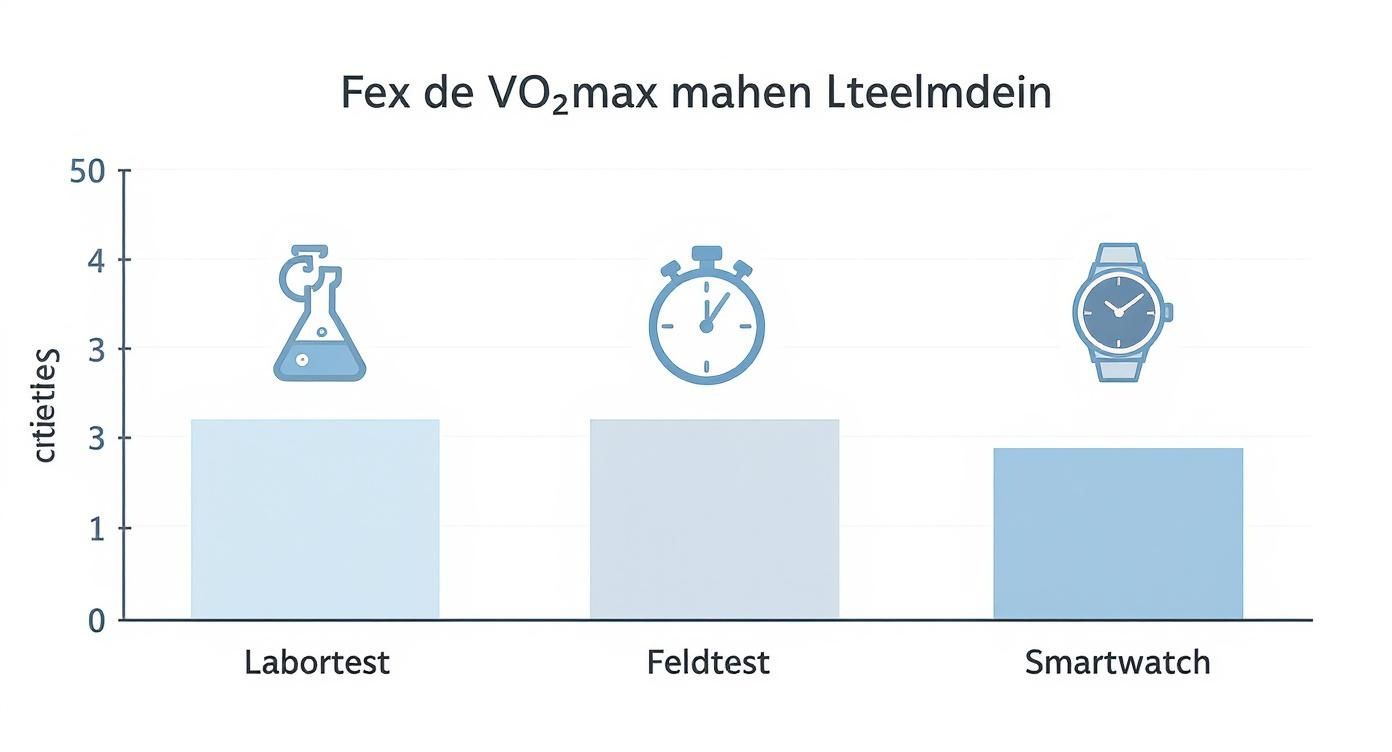
As you can see, the range extends from highly precise laboratory tests and practical field tests to estimates from your smartwatch—there is something for every need.
VO₂max reference values by age and gender
To give you a specific point of reference, we have included a table here. Compare your value with the averages for your age and gender group to assess your cardiorespiratory fitness.
| Age group | Very good (Men) | Good (Men) | Very good (Women) | Good (Women) |
|---|---|---|---|---|
| 20–29 | > 52 | 47–52 | > 41 | 37–41 |
| 30–39 | > 49 | 44–49 | > 38 | 34–38 |
| 40–49 | > 47 | 42–47 | > 36 | 32–36 |
| 50–59 | > 44 | 39–44 | > 33 | 29–33 |
These values give you a useful reference point for realistically assessing your fitness and planning your next goals.
By the way, it’s not just training and age that play a role—your genes also have a say. If you’re curious about what your DNA reveals about your athletic potential, take a look at our article about how athletic success begins in your genes.
The most effective training methods for improving your VO₂max
Here’s the good news: Your VO₂max value is not set in stone. You can actively improve it and train your cardiovascular system to use oxygen much more efficiently. The key lies in a smart mix of intense training stimuli and a solid aerobic base.
Numerous studies have shown that one method stands out when it comes to deliberately increasing maximum oxygen uptake: high-intensity interval training, better known as HIIT.
HIIT: The turbo boost for your oxygen uptake
Imagine repeatedly giving your body short but extremely intense exertion stimuli. That is exactly what you do during HIIT. By constantly alternating between maximum effort and short recovery periods, you make your heart pump harder and your muscles use the available oxygen down to the very last molecule.
This intense stimulus sends a clear signal to your body to adapt. The result? Your heart muscle becomes stronger, and the number of mitochondria—the tiny power plants in your cells—increases. This effectively and, above all, sustainably improves your VO₂max.
A classic HIIT workout for runners could look like this, for example:
- Warm-up: 10 to 15 minutes of easy running.
- Main set: Run 8 x 400 meters at a very high pace that really challenges you.
- Recovery: Between sprints, jog very easily for 90 seconds or simply walk.
- Cool-down: Finish with 10 minutes of relaxed running.
This structure can also be applied to almost any endurance sport—whether cycling, swimming, or rowing.
The foundation: Long, easy endurance sessions
Even though HIIT is the ultimate turbo boost for your VO₂max, you should not neglect the foundation. Long, easy endurance sessions, often referred to as “Zone 2 training,” form the foundation of your overall fitness.
During these sessions, you move within a moderate heart-rate range in which you could still hold a conversation without difficulty. This improves your aerobic base, strengthens your cardiovascular system, and teaches your body to use fat more efficiently as an energy source.
You can think of it like building a house: without a stable foundation, you cannot build high walls. The long, easy sessions make you more resilient for the demanding HIIT sessions and ensure that you recover more quickly.
A balanced training week therefore combines both: one or two intense HIIT sessions to specifically boost your VO₂max, and one or two longer, relaxed runs to strengthen your overall endurance.
However, every body responds differently to training stimuli, which is often due to individual genetic predisposition. Some people respond better to high-intensity training, while others benefit more from long endurance sessions. If you would like to understand more precisely how your genes influence your optimal training plan, our article on the personalized DNA training plan provides valuable insights. This allows you to tailor your training even more precisely to your personal strengths and achieve your goals more efficiently.
How nutrition and lifestyle affect your VO₂max
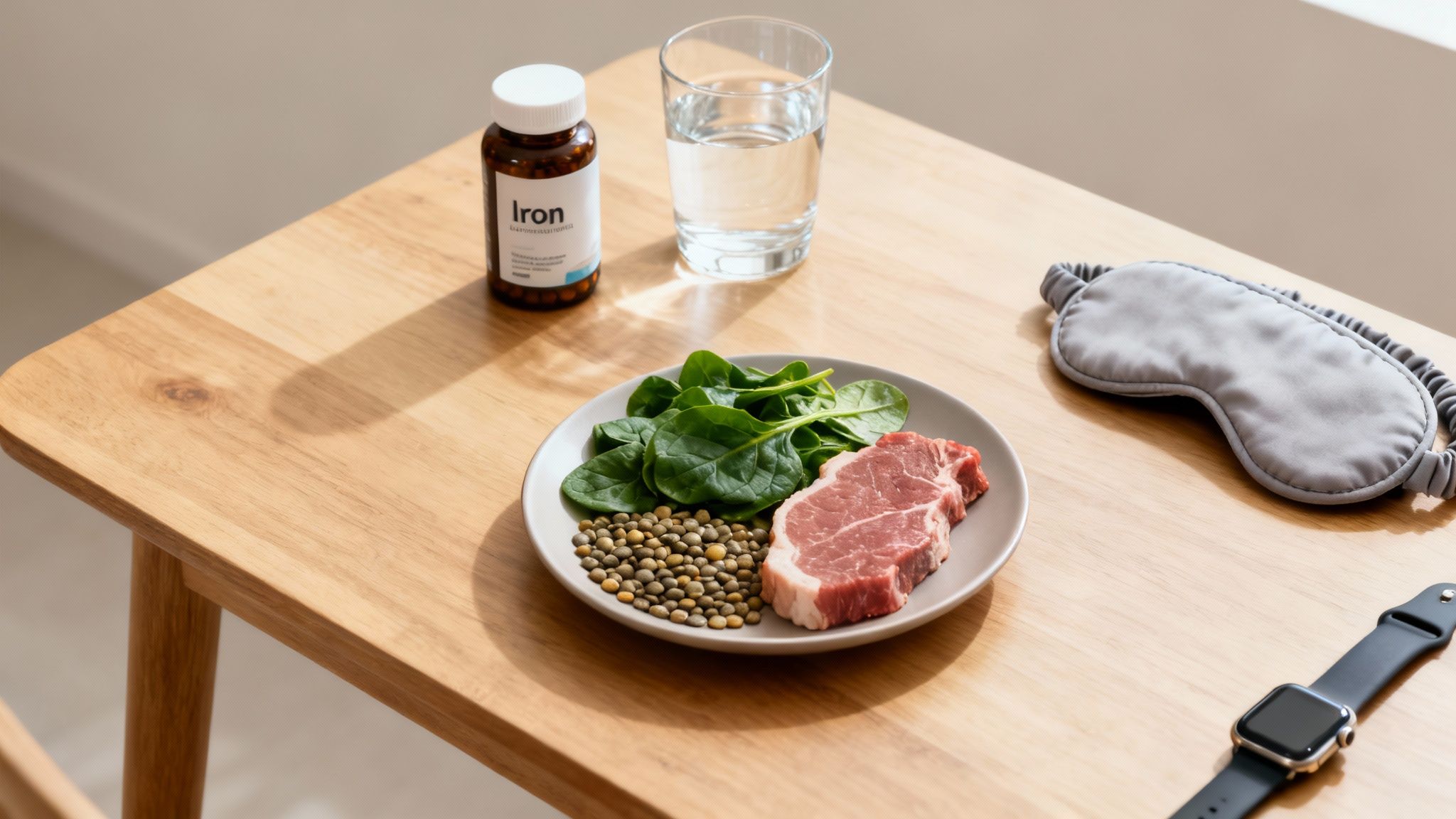
Hard training is clearly the engine when you want to improve your VO₂max value. But even the most powerful engine sputters without the right fuel and necessary maintenance. This is where your nutrition and lifestyle come into play—they are the co-pilots that can either accelerate your progress or unknowingly hold you back.
Many athletes focus so intensely on their training plans that they lose sight of the bigger picture. Yet poor nutrient intake can undo all your hard work. Without the right building blocks, your body simply cannot adapt and recover optimally.
The key role of iron and antioxidants
An adequate supply of iron is absolutely crucial for your maximum oxygen uptake. Think of iron as the countless taxis in your bloodstream. Their job? To bind oxygen to the red blood cells and chauffeur it directly to your working muscles.
But if there are too few of these “oxygen taxis,” the valuable cargo arrives only slowly—no matter how fit your cardiovascular system is. Iron deficiency is indeed one of the most common causes of unexplained performance declines in endurance athletes.
Your body is a complex system. A high VO₂max is the result of a chain in which every link works perfectly together—from oxygen transport in the blood to energy production in the muscle cells. A single weak link, such as a nutrient deficiency, can weaken the entire chain.
Antioxidants are just as important. Intense training produces oxidative stress in your cells. Antioxidants, which are abundant in fruit and vegetables, act like a personal protective shield. They protect your cells from damage and accelerate recovery.
- Iron-rich foods: Enjoy red meat, lentils, beans, spinach, and whole-grain products more often to replenish your iron stores.
- Antioxidant boosters: Berries, dark leafy greens, nuts, and seeds help your body cope much better with the stress of training.
More than just nutrition: Sleep and stress
In addition to what ends up on your plate, your stress levels—and above all, the quality of your sleep—also determine success or failure. Especially if you suffer from fatigue despite getting enough sleep, this can hinder your VO₂max improvement. Learning more about the role of sleep quality in your fitness can help you finally put this important piece of the puzzle in the right place.
Ultimately, a holistic approach that combines training, nutrition, and lifestyle is the key to success. You can also find comprehensive tips in our guide to 10 ways to lead a healthy lifestyle.
Are you wondering whether your body is truly receiving optimal nourishment? An undetected deficiency in iron, vitamin B12, or other micronutrients could be the reason your performance has plateaued. A mybody-x nutrient test can provide you with a clear, easy-to-understand answer. It analyzes your levels precisely and provides targeted recommendations to help you close nutritional gaps and finally unlock your full potential.
FAQ: Your most frequently asked questions about VO₂max
Do you still have unanswered questions about your VO₂max? No problem! We’ve collected the most frequently asked questions here and answered them with practical advice, so you can better understand this important fitness marker.
How quickly can I improve my VO₂max?
That depends greatly on your starting point and training routine. If you are still a beginner, you will often see the first noticeable results after just four to six weeks with two to three targeted sessions per week—a increase of 5–15 % is certainly realistic here.
Those who have been training intensively for a longer time generally need to be a little more patient. Progress is smaller here and requires more fine-tuning in training. But the key to success is the same for everyone: Keep at it! Consistency always pays off.
Is a high VO₂max always better?
Basically, yes—for your general cardiovascular health and endurance, a higher value is a clear plus. It is considered a strong indicator of a lower risk of cardiovascular disease and shows that your body is fit and resilient.
More important than chasing elite-level values, however, is aiming for a healthy value for your age and sex and maintaining it over the long term. It’s about your personal fitness, not a competition.
Think of your VO₂max as a compass for your health. It shows you not only your current fitness level, but also how robust your cardiovascular system is for the future.
Why is my VO₂max dropping despite training?
If your value suddenly drops even though you train regularly, it usually has nothing to do with the training itself. Often, external factors are sabotaging your recovery and weakening your body.
The most common culprits are:
- Overtraining: You are not giving your body time to recover.
- Increased stress at work or in your personal life.
- Lack of sleep or poor sleep quality.
- An infection creeping in quietly.
Sometimes it may simply be due to an inaccurate measurement by your watch, which was affected by heat, altitude, or other conditions. So take your overall circumstances into account and consciously give your body more rest when it needs it.
Which sport improves VO₂max the most?
All sports that engage large muscle groups and really get your heart pumping are particularly effective. Classics such as running, cycling, swimming, and rowing are absolute front-runners here. In winter, cross-country skiing is also a real secret weapon for endurance.
At the end of the day, the best sport is always the one you enjoy. That’s the only way to stay motivated, stick with your training, and achieve lasting results.
Want to make sure your body has all the nutrients it needs for peak performance and recovery? With the self-tests from mybody-x, you can find out whether you’re lacking important building blocks such as iron or vitamins that could be holding back your VO₂max. Discover the right at-home self-tests on mybody-x.com now and take your health to the next level with targeted action.



Share now:
Your exact daily protein requirement: Find out what your body really needs
What is matcha tea, and how does the green powder work?