
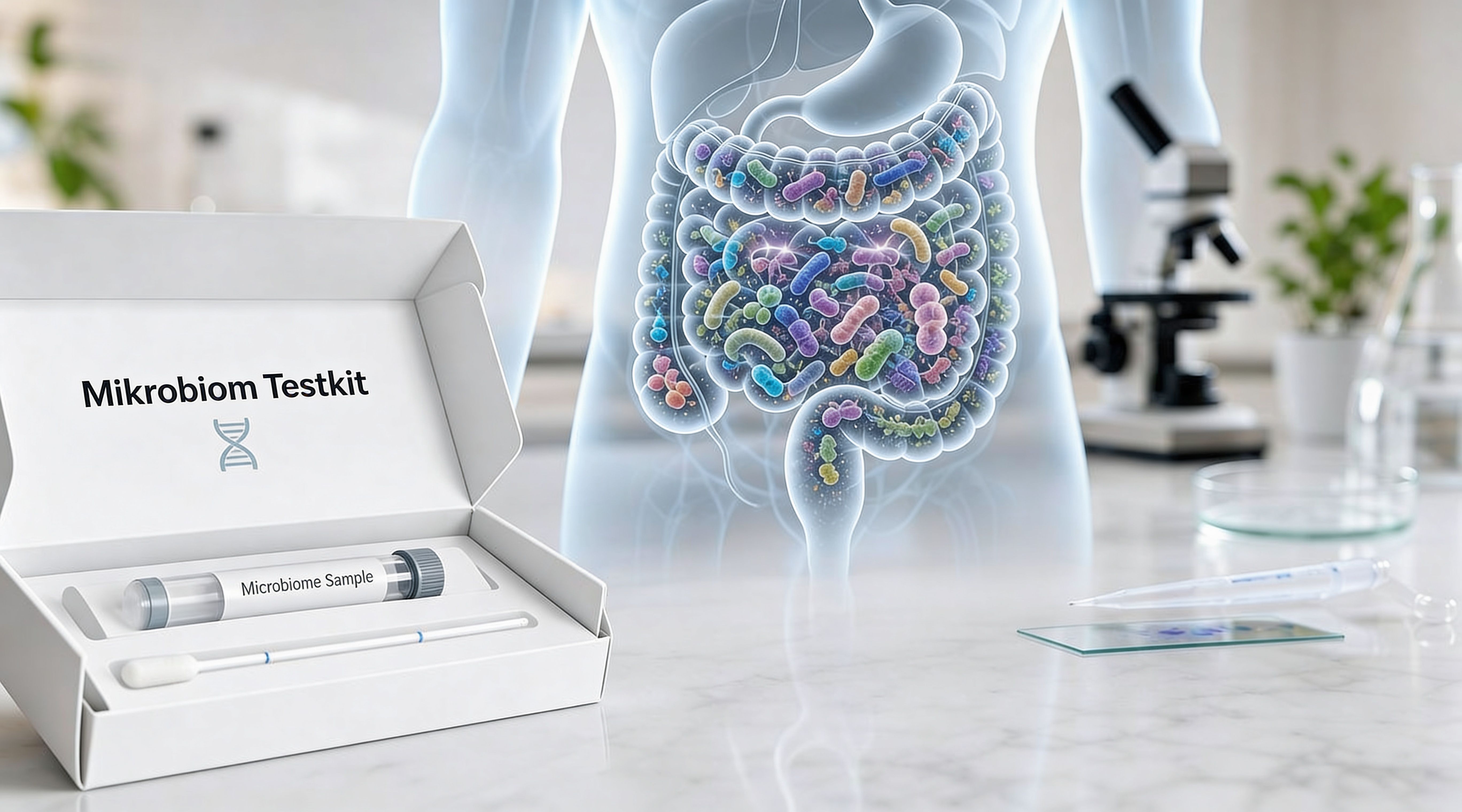
Microbiome Test: Understanding & Optimizing Gut Health
It's frustrating when you do a lot for your health, but your gut still doesn't cooperate. Maybe you alternate between bloating, feeling full, restless digestion, fatigue, or the feeling that certain foods suddenly don't agree with you. Then it's absolutely understandable that you're looking for a clear answer instead of the next general tip.
This is where the topic of microbiome testing becomes interesting. Not as a miracle promise, but as an attempt to turn vague gut feelings into concrete data. If you want to understand your gut better, such a test can be a useful next step, as long as you know what it can do and where its limits lie.
You're not feeling well and your gut is acting up
You eat more consciously than before. You might pay attention to protein, vegetables, sleep, and exercise. Nevertheless, there are days when your stomach feels tight, your energy levels drop, and you feel heavy rather than strengthened after eating.
Many people end up exactly there. They try less gluten, more probiotics, intermittent fasting for a while, or eliminate certain foods. Some things help briefly. Many things remain unclear. The problem is not that you are doing something wrong. The problem is often that you lack the right information.
When symptoms remain vague
Digestive problems rarely manifest cleanly and unambiguously. One person primarily notices bloating, another feels more unrest in the abdomen, fatigue, or a diffuse sense of unease. In addition, stress, lack of sleep, and overwork often affect the gut. If this topic concerns you, a look at the connection between stress and physical symptoms can also be helpful, for example, in the article on dealing with overwork in nursing.
What unsettles many: Abdominal complaints often seem mundane, but can strongly affect concentration, performance, and mood. You function, but not as you would actually like to feel.
Important: If you are looking for clarity, you are already on the right track. A microbiome test is not a criticism of your previous efforts, but a more precise supplement.
Why a microbiome test is interesting at all
A microbiome test is intended to help make patterns visible that you cannot recognize yourself. Instead of just guessing, you receive a structured evaluation of your stool sample. This can be particularly valuable if you are tired of trial and error and want to understand whether your gut needs support in terms of diversity, balance, or specific everyday factors.
Others have long been more actively engaged with their gut health. Not because it's a trend, but because the gut plays a big role in energy, well-being, and food tolerance. So if you feel that your gut is sending you signals, it makes sense to take a closer look.
Your gut as a superorganism – What the microbiome is
Your gut is not an empty tube through which food simply passes. It's more like a densely populated ecosystem. In this system, countless microorganisms live in contact with each other and with your body. This community is called the microbiome.
You can imagine it like a city. Some residents help process food. Others are involved in metabolic processes. Still others are in close exchange with your immune system. So it's not just about whether bacteria are present, but how diverse and balanced this community is.

Eubiosis and dysbiosis simply explained
Two terms constantly appear when discussing the microbiome. They sound technical but are easy to understand.
- Eubiosis means a healthy balance. Your gut environment is stable, diverse, and functions rather calmly.
- Dysbiosis describes an imbalance. Certain groups may be underrepresented, others may dominate more strongly than would be beneficial.
This does not automatically mean illness. It simply means that the ecological balance in the gut may be shifted. Exactly such shifts are of interest in a microbiome test.
Why diversity is often more important than a single bacterium
Many people look for the one good or bad gut bacterium. It's usually not that simple. The mix is often crucial. A diverse microbiome acts more like a stable team. If one group is weaker, others can take on their functions.
When diversity decreases, the system becomes more vulnerable. Then some people react more sensitively to diet, stress, or changes in everyday life.
A good basis if you want to delve deeper into the topic can be found in the article What is the Microbiome.
What influences your microbiome
The microbiome doesn't change by chance. Several things simultaneously affect it:
- Diet with high or low fiber
- Medications, especially if they alter the gut environment
- Stress and a permanently tense everyday life
- Sleep and exercise, which indirectly regulate
A microbiome is not a rigid label. It is more like a current state of your internal ecosystem.
That's exactly why a test result is not only interesting if you have complaints. It can also be exciting for people who want to optimize their diet and regeneration more specifically.
Common gut problems and their possible causes
Not every gut reports problems in the same way. Some people tend to have a nervous stomach. Others experience sluggishness, irritation, or the feeling of reacting sensitively to many things. A microbiome test does not replace a diagnosis, but it can help to better classify such patterns.

The stressed gut
You may know the feeling. During calm periods, things are more or less fine. But in stressful weeks, your gut reacts immediately. It bloats, rumbles, or feels irritated. This is often accompanied by poor sleep and the feeling of not being able to properly unwind.
Here, the gut-brain axis often plays a role. The gut reacts sensitively to stress, tension, and irregular routines. This does not make symptoms imaginary, but biologically understandable.
Typical signs include:
- Restless digestion before appointments or under pressure
- Fluctuating complaints that are difficult to predict
- Fatigue despite sleep when the body is constantly under tension
The sluggish gut
In this profile, the focus is less on restlessness and more on stagnation. The stomach feels full, digestion is slow, and a feeling of heaviness quickly sets in after meals. Often, affected individuals don't even eat particularly much and still feel burdened.
Here, it is often worthwhile to look at everyday factors such as fiber, fluids, exercise, and eating rhythm. A microbiome test can additionally provide clues as to whether the bacterial balance shows little diversity or an unbalanced pattern.
The sensitive gut
Some people have the impression that more and more foods cause problems. Sometimes it's after dairy products, sometimes after legumes, sometimes after onions or wheat. This is accompanied by bloating, pressure, or diffuse irritable bowel-like symptoms.
The difficult thing is that it is often hard to distinguish through observation alone whether it is a matter of real intolerances, functional sensitivity, or a gut environment that reacts more strongly to certain stimuli. It is precisely at this point that self-observation is helpful, but limited.
The irritated or permeable gut
Some describe their gut as particularly sensitive. They quickly feel bloated, react to many things, and sometimes also feel that their skin, energy, or general well-being are affected. Colloquially, the term Leaky Gut is often used.
Sobriety is important here. Not every irritation automatically means a "leaky gut". But if this topic concerns you, a more targeted analysis may be more useful than always new elimination diets.
Guidance, not labels: Such profiles are not diagnoses. They only help you to better categorize your symptoms and ask more targeted questions.
What you can already recognize yourself and what you cannot
A small self-assessment is useful. Ask yourself:
| Observation | What it can tell you |
|---|---|
| Symptoms after stress | The gut-brain axis could be involved |
| Fullness and sluggishness | Diet, rhythm, and gut balance deserve attention |
| Reactions to many foods | More clarity is needed instead of blanket avoidance |
| Fluctuating symptoms | Pure gut feeling is often not enough for clear decisions |
Self-observation is a good start. It usually doesn't provide a definite answer.
How a home microbiome test works easily
Many people imagine a home test to be more complicated than it is. In practice, it's mainly about cleanly collecting a stool sample, sending it in, and then having it understandably evaluated. This is discreet and can be done comfortably at home.

The process in four steps
-
Receive test kit
You order a kit and get everything you need for sampling delivered to your home. -
Collect sample
The collection takes place at home. For many, this is more pleasant than an out-of-home appointment, as they can do everything at their own pace. -
Send back sample
Then you send the sample to the laboratory. -
Read results report
After that, you receive an evaluation that should make your gut profile more tangible.
Why this is better than guessing
Online questionnaires can be interesting. However, they do not replace a laboratory analysis. They rather tell you how likely a problem might be. A microbiome test, on the other hand, works with a real sample and provides data from your current gut environment.
This is particularly efficient if you no longer want to change everything at once. Instead of haphazardly cutting out foods or trying supplements, you can proceed more targeted.
The more diffuse the complaints, the more valuable structured data becomes. Not as a final judgment, but as a significantly better basis for decision-making.
What you should clarify for yourself beforehand
Before you test, three questions will help you:
- Do you want to better understand symptoms? Then you need a report that doesn't just list names of bacteria.
- Do you want to optimize your diet? Then concrete, everyday steps should be derivable from it.
- Do you want medical certainty? Then it's important to know that a home test does not replace a medical diagnosis.
What a microbiome test really tells you and where the limits lie
Honesty is worthwhile here. A microbiome test can be exciting and useful. But only if you classify it correctly.
Commercial microbiome tests have been widely available in Germany for several years. According to a specialist article, such stool tests are offered online from around 130 Euros, often including individual dietary recommendations. At the same time, the DGVS emphasizes that currently offered microbiome analyses neither provide reliable indications of specific diseases nor can therapeutic benefits be safely derived from them. The article also explains that commercial tests usually use 16S rRNA sequencing in practice, a method that only describes bacteria relative to each other and does not constitute a reliable medical diagnostic substitute, as can be read in the specialist article on commercial microbiome analyses and their validity.
What a test can do well
A microbiome test can give you a snapshot. It can show whether your bacterial community appears more diverse or more one-sided. It can reveal patterns that fit your daily life. For example, whether your gut profile suggests a lack of balance, low diversity, or a shifted composition.
This is valuable for people who want to manage their diet more consciously or are looking for a more factual basis instead of relying solely on symptoms.
What a test cannot do
A home test cannot provide a confirmed diagnosis for specific bowel diseases. It does not reliably tell you if you have a particular illness. It does not replace medical clarification for more severe, persistent, or alarming symptoms.
It is also important to note that many results describe relative relationships. This means that the finding always depends on the measurement method and cannot simply be interpreted like a classic laboratory value.
Why standards are crucial
A good report is more than a colorful list of bacteria names. For clinically more meaningful interpretation, standardized sampling, standardized evaluation, and comprehensible key figures are required.
According to IMD Berlin, microbiome tests are only well comparable and clinically interpretable if sampling, sequencing methods, and evaluation are standardized. It is described there that standardized CE-based methods specifically detect clinically relevant bacteria and also provide key figures such as deviation from a healthy microbiome, dysbiosis index, and bacterial diversity. The advantage of these standardized molecular genetic methods, according to IMD Berlin, lies primarily in reducing variability between laboratories. More on this can be found in the specialist information on standardized microbiome diagnostics at IMD Berlin.
A microbiome test is most useful when you use it as guidance. Not as a definitive label, but as data-driven help for the next sensible steps.
Understanding your results and turning them into success
The actual benefit does not come from reading bacterial names. It only arises when you make good decisions based on the report. This is exactly where many evaluations fail. They are interesting, but not actionable.
The practical core question is always: What are you going to change specifically now? Sobriety is important here. According to the myBioma article, the evidence for a clear health benefit after microbiome findings is often still inconsistent. Truly evidence-based measures after a finding include, for example, a targeted increase in fiber intake or medically supervised FODMAP strategies, while other recommendations remain rather theoretical derivations. This is well explained in the article on sensible steps after a microbiome test.

If the report indicates low diversity
Then the first adjustment is often not an exotic supplement, but your daily routine.
Helpful things can be:
- More plant diversity in your food instead of always the same few foods
- Gradual fiber build-up if you've previously eaten a low-fiber diet
- Regularity in meals, sleep, and exercise
If you increase fiber too quickly, it can initially cause more bloating. Therefore, not only "what" you do is important, but also "how" you do it.
If certain foods consistently cause problems
Then blindly avoiding them is rarely the best long-term solution. In such cases, a structured approach can be beneficial.
One possible approach:
| Finding or daily signal | Sensible next step |
|---|---|
| Many reactions after eating | Keep a food diary for a limited time |
| IBS-like symptoms | Explore the FODMAP topic with medical or nutritional professional guidance |
| Frequent bloating | Adjust eating rhythm, portion size, and fiber intake |
If stress is a factor
This also plays a role in implementing a microbiome test. If your report shows gut patterns, but your daily life is characterized by hustle, sleep deprivation, and constant tension, then diet alone often won't get you far.
- Short relief routines in everyday life
- Better sleep hygiene
- Regular exercise, without overtaxing the body
Data is only useful if it is translated into small, consistent actions.
A test is only as good as the follow-up actions
If you only buy more products after the results, without working on the fundamentals, you are wasting potential. If, on the other hand, you adjust your diet, rhythm, and stress levels according to your data, the test becomes a tool for genuine optimization.
For those who want to delve deeper, the article on building a healthy gut flora offers many practical approaches.
Providers like mybody x Gesundheit use a stool sample for microbiome analysis in their home test and provide personalized recommendations based on it. For you, the most important thing is whether the report is understandable and whether you can derive realistic next steps from it.
Choosing the right microbiome test for you
Not every microbiome test is equally helpful. What matters less is how modern the interface looks, but whether you can interpret the results meaningfully later.
How to recognize quality
Use this short checklist:
-
Standardized evaluation
For meaningful interpretation, microbiome tests must be standardized. According to IMD Berlin, CE-based procedures that specifically detect clinically relevant bacteria and provide key figures such as a dysbiosis index allow for greater comparability and significance than purely percentage distributions. -
Understandable results report
You should not only receive a list of taxa, but also a clear classification of what is relevant and what is merely background noise. -
Concrete recommendations for action
Good reports help you with nutrition, routines, and next steps. Poor reports leave you with question marks. -
Data security and laboratory quality
When it comes to health data, data protection and clean laboratory processes should be a matter of course.
If you want to compare different offers, the overview in the article on the Microbiome Test Comparison will also help you.
The practical decision
If you're just curious, a rough orientation might suffice. But if you really want to change something, look for a test that offers more than just pretty graphics. You need standardization, good interpretation, and actionable recommendations.
Secure answer only with Microbiome Gut Test: Microbiome Leaky Gut Test and the overview of Gut Health and Microbiome Collection
Frequently Asked Questions about Microbiome Tests
| Question | Answer |
|---|---|
| Is a microbiome test a medical diagnosis? | No. It can show patterns and tendencies, but it does not replace medical diagnostics. |
| Is a test worthwhile even without severe symptoms? | Yes, if you want to optimize your diet and gut health more specifically. The added value then lies primarily in individual guidance. |
| Can I infer my microbiome from symptoms alone? | Only very limited. Self-observation helps, but it does not provide a reliable assignment. |
| What do I do first after an abnormal result? | Start with the basics: structure your diet, gradually increase fiber appropriately, consider stress, and seek medical clarification for severe or persistent symptoms. |
If you no longer want to rely solely on intuition to manage your body, but want to work with clearer data, check out the self-tests from mybody x Gesundheit. They help you understand digestion, nutrients, intolerances, and other health topics more structurally at home.



Share:
Understanding Antioxidants: Your Guide to Healthy Eating
Your microbiome test kit: A guide to gut health 2026