
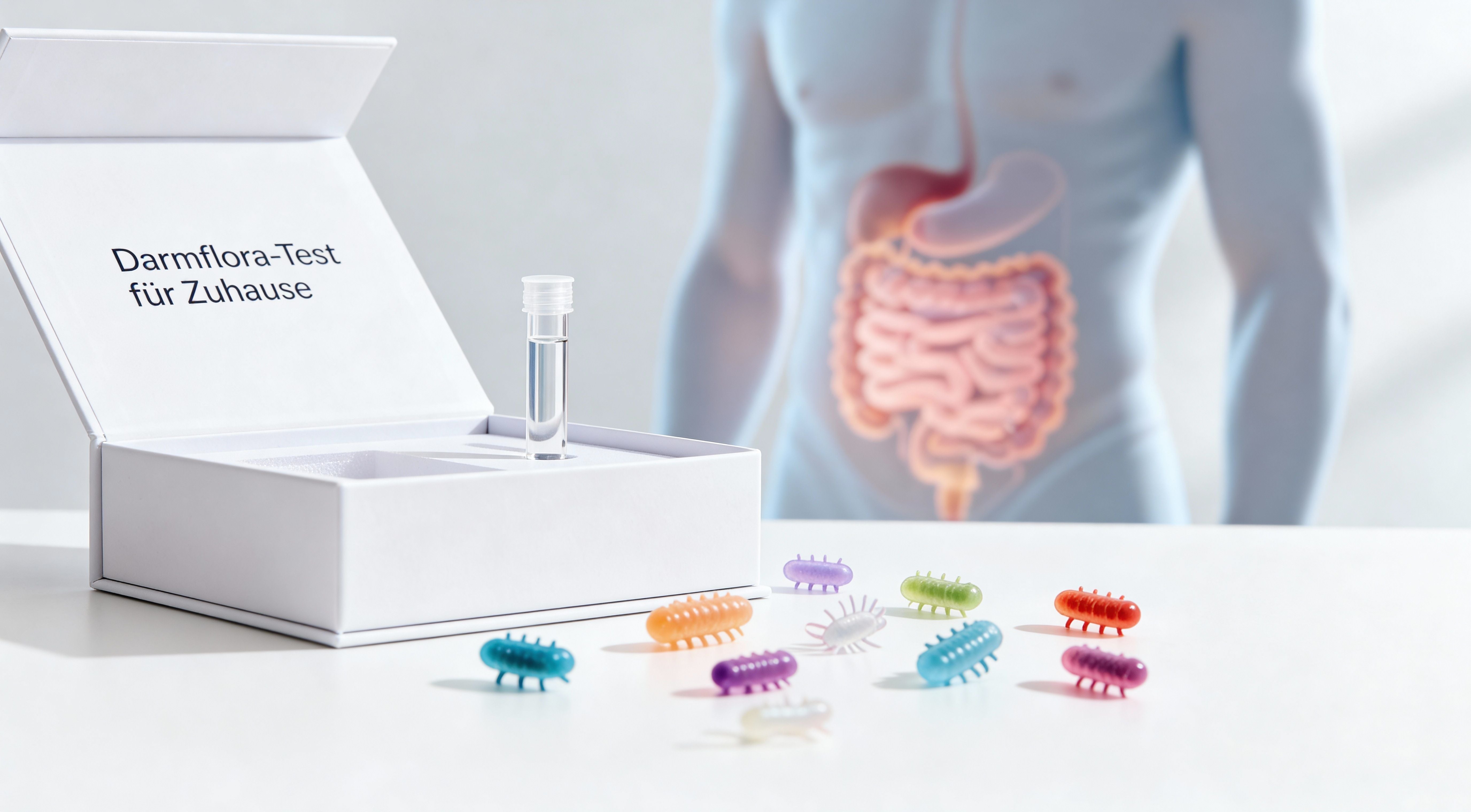
Your gut microbiome test: The key to a better gut feeling and greater well-being
Do you often feel sluggish, bloated, or struggle with digestive problems you simply cannot explain? Many of these everyday complaints originate exactly where you might least expect: in an imbalance in your gut. A gut microbiome test is the first logical step toward finally understanding the cause instead of constantly treating only the symptoms.
Why your gut is the key to your well-being
Imagine your gut as a huge, vibrant garden. Trillions of microorganisms—your gut microbiome—live and work here every day. This complex ecosystem is crucial to your overall health. It is responsible not only for digestion but also plays a role in your energy, mood, and the strength of your immune system. But when the wrong “plants” take over in this garden, the entire system falls out of balance.
This imbalance, also known as dysbiosis in technical terms, can manifest through a whole range of symptoms that at first glance seem to have nothing to do with the gut.
Do you recognize yourself?
Many health-conscious people suffer from symptoms without knowing their true source. Surprisingly often, the root of the problem lies in the gut. The most common signs of an imbalanced gut microbiome include:
- Persistent digestive problems: These include bloating, constipation, diarrhea, or a constant feeling of fullness that simply will not go away.
- Unexplained fatigue: A deep feeling of low energy that does not go away even after getting enough sleep.
- Skin problems: Blemishes, acne, or eczema can be a direct reflection of your gut.
- Mood swings: Your gut produces important neurotransmitters such as serotonin. When it gets out of balance, this can also affect your mental well-being.
- Constant cravings: Certain gut bacteria can literally fuel your cravings for sugar and unhealthy foods.
This table shows you at a glance which common symptoms may indicate an imbalance in your gut and how a test can provide clarity.
Typical signs of an imbalanced gut microbiome
| Symptom | Possible cause in the gut | How a gut microbiome test can help |
|---|---|---|
| Bloating & fullness | Imbalance of gas-producing bacteria, slow digestion. | Identifies the bacterial groups responsible for excessive gas production. |
| Unexplained fatigue | A lack of bacteria that produce important vitamins (e.g., B vitamins). | Reveals deficiencies in beneficial bacterial strains and provides indications of nutrient deficiencies. |
| Skin problems (acne, eczema) | A permeable intestinal barrier (“leaky gut”) that promotes inflammation in the body. | Measures markers of gut health and a tendency toward inflammation. |
| Mood swings | Low production of “happiness hormones” such as serotonin by certain bacteria. | Analyzes the diversity of bacteria that are important for producing neurotransmitters. |
| Sugar cravings | Overgrowth of yeasts or bacteria that feed on sugar and demand more of it. | Reveals an imbalance between beneficial and harmful microorganisms. |
Analyzing your gut flora can therefore provide you with specific starting points for addressing the causes of your symptoms, rather than merely scratching the surface.
You are by no means alone. A recent study shows that three out of five Germans—that’s an impressive 60 percent of the population—suffer from digestive problems. At the same time, only around 10 percent feel truly familiar with the topic of gut flora. Learn more about these findings in the gut health market report on mintel.com.
This is exactly where a gut flora test comes in. Instead of groping in the dark and trying one diet after another, an analysis gives you a clear map of your inner ecosystem.
The mybody-x gut microbiome test is more than just a snapshot. It provides you with a scientifically sound analysis of your gut that you can conveniently carry out from home. Based on your results, you receive a personalized roadmap with specific, actionable recommendations—so you can restore your balance and improve your well-being in a targeted and sustainable way.
The various analysis methods explained clearly
When you search for a “gut flora test,” you quickly come across technical terms such as 16S rRNA sequencing or shotgun metagenomics. That may sound intimidating and complicated at first, but don’t worry: The basic idea is actually quite easy to understand. We’ll translate the technical jargon for you and show you how these methods work to shed light on what’s going on in your gut.
It’s best to think of the various analysis methods as the tools of a detective who has to solve a complex case. Each tool has its own particular strengths and provides different types of clues.
16S rRNA sequencing: The census of the gut
16S rRNA sequencing is, so to speak, the classic among gut flora tests and the most widely used method. You can think of it as a kind of census in your gut. It focuses on a very specific gene—the 16S rRNA gene—which is found in almost all bacteria but has tiny, unique differences from one species to another.
By analyzing this gene, the laboratory can determine exactly which bacterial species are present in your sample and the proportions in which they occur.
- The key question is: “Who is there?”
- The advantage: It is an established, cost-effective method that provides an excellent overview of the composition of your microbiome.
- The limitation: This method tells us who is there, but not what these bacteria actually do.
For most everyday questions, this method is entirely sufficient. It detects imbalances (dysbiosis), reveals low species diversity, and provides clear indications of which bacterial groups should be strengthened or reduced.
Shotgun metagenomics: A look at capabilities
Shotgun metagenomics is the next, significantly deeper step. It does not examine just a single gene but analyzes the entire genetic material of all microorganisms in your sample—including viruses and fungi.
This method answers not only the question “Who is there?” but above all: “What are they actually doing?” It deciphers the potential functions of the microorganisms. For example, we can find out which bacteria are responsible for producing important vitamins or which may produce substances that promote inflammation.
The following infographic illustrates the connection between the causes, symptoms, and the solution that a targeted test can provide.

The illustration clearly shows how an imbalance in the gut (cause) can lead to various complaints (symptoms), and how a test kit (solution) is the first step toward clarification.
Quality and precision are crucial
Regardless of the method, the quality of the laboratory analysis is crucial. A gut flora test is only as good as the laboratory evaluating it. That is why mybody-x relies exclusively on state-of-the-art, ISO-certified laboratory procedures in Germany. This certification guarantees the highest standards during testing and ensures that your sample is analyzed precisely according to scientifically validated criteria.
This way, you can be sure that your report provides a reliable basis for making informed decisions about your health. If you’d like to delve even deeper into the subject, you can learn more in our article about the science behind microbiome analysis at mybody®x. We provide you with the tools you need to truly understand your body and purposefully improve your well-being.
How your at-home gut test works—simply and discreetly
Let’s be honest: The thought of providing a stool sample initially puts many people off. We completely understand. That’s why we designed the entire process to be not only simple, but also completely discreet and hygienic. From the straightforward ordering of your test kit to digitally accessing your results, we’re with you every step of the way.
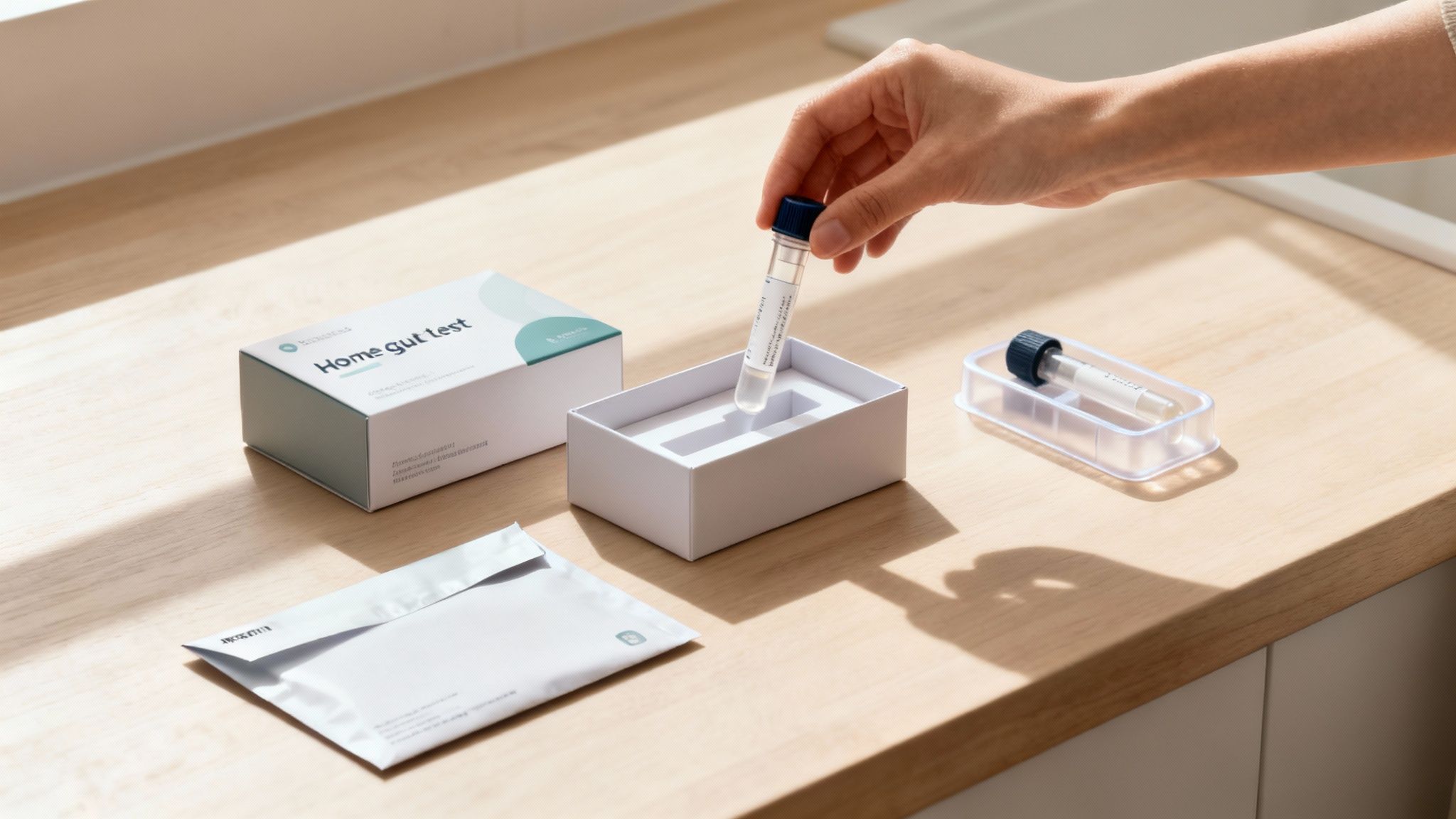
You can carry out the gut flora test comfortably in your own home. No doctor’s appointment, no waiting times. You have complete control and maximum convenience.
Your path to the results: From ordering to analysis
The entire process is clear, transparent, and divided into four simple steps. This gives you deep insight into your gut health.
-
Order online & receive your test kit Simply order your mybody-x gut microbiome test kit online. We’ll send it directly to your home within a few days in discreet packaging.
-
Collect your sample discreetly and hygienically The kit contains everything you need for quick and hygienic sample collection: easy-to-follow instructions, a sample tube, and a special stool collector. This hygienic system ensures everything is done without contact and within just a few minutes.
-
Return it to the lab free of charge Then safely package the sample in the enclosed, already prepaid return envelope. You can simply drop it in the nearest mailbox. Shipping to our certified German specialist laboratory is completely free for you.
-
Access your results digitally Once the analysis is complete, we’ll send you an email. You can then securely view your results at any time in your personal, password-protected mybody-x health portal.
We developed this process to remove every possible obstacle. If you’re still unsure, you’ll find detailed instructions in our guide on how to collect your stool sample correctly.
What exactly is included in your test kit?
Each mybody-x test kit is assembled so you don’t have to worry about a thing. You don’t need any additional materials—everything you need is already included:
- Step-by-step instructions: Clear, easy to understand, and illustrated to guide you safely through the process.
- A stool collector: Special paper that you simply attach to the toilet to hygienically collect the sample.
- A sample tube: A sturdy tube with a small scoop in the lid that you use to collect a tiny sample.
- A transport tube: An additional protective tube into which the sample tube is placed for safe shipping.
- A prepaid return envelope: For easy, free shipping to our laboratory.
Your data privacy is our priority. Health data is extremely sensitive. That’s why we strictly comply with the GDPR and are certified to ISO 27001 for information security. Your data is anonymized and used exclusively for your analysis. Your privacy is protected at all times.
The entire process, from collecting the sample to shipping it, takes no longer than five to ten minutes. This is an easy way to take an important step toward better gut health—with no hassle and the reassuring feeling that your data is safe with us.
Understanding and using your gut microbiome report correctly
It’s finally here: your personal gut microbiome report. A document filled with charts and data. That may seem overwhelming at first glance—but don’t worry, we won’t leave you alone with it. Think of this chapter as your personal translator, helping you turn the complex numbers in your report into clear, actionable insights.
Your result is not an endpoint. It is the exciting starting point of your journey toward greater well-being—a unique snapshot of your inner ecosystem that shows you exactly where you can begin.

Decoding the most important values in your report
A mybody-x report is deliberately designed so that you can grasp the most important information immediately. We focus on the markers that can genuinely help you. Here are the key values you should understand.
Bacterial diversity is one of the most important measures of a healthy gut. Imagine your gut as a flourishing rainforest: the more different plant and animal species there are, the more stable and resilient the entire ecosystem is. The same applies to you—a high diversity of different bacteria makes your microbiome more robust.
Another central point is the ratio of beneficial to potentially harmful bacteria. Both groups live in every one of us. What matters is that the “good” helpers are in the majority. If this balance gets disrupted—a condition known as dysbiosis—it can lead to digestive problems and other issues.
Your report shows you this ratio in detail. A typical indicator is the Firmicutes-Bacteroidetes ratio. An imbalance here may be associated with various health aspects, including weight management.
Finally, let's take a close look at the presence of certain key bacteria. These are true superstars among microbes that perform particularly important functions. They include bacteria that produce short-chain fatty acids such as butyrate. Butyrate is practically a super fuel for your intestinal cells and has a powerful anti-inflammatory effect.
Important markers in your gut flora report and what they mean
This overview summarizes the key values analyzed in a microbiome test and explains what they reveal about your gut health.
| Marker | What it means | Optimal state |
|---|---|---|
| Bacterial diversity | The variety of different bacterial species in your gut. It is a measure of the stability of your microbiome. | High diversity. This means your gut is resilient and can perform many different functions. |
| Dysbiosis index | A value that describes the overall balance of your gut flora. | A low level. This indicates that beneficial bacteria dominate and potentially harmful strains are under control. |
| Butyrate production | The ability of your gut bacteria to produce the anti-inflammatory short-chain fatty acid butyrate from dietary fiber. | A high level. A good supply of butyrate strengthens your intestinal barrier and protects against inflammation. |
| Akkermansia muciniphila | A key bacterium that supports the intestinal lining and is associated with a healthy metabolism. | An adequate presence. This bacterium is essential for an intact gut barrier. |
| Faecalibacterium prausnitzii | One of the most common and important butyrate-producing bacteria in the human gut, with strong anti-inflammatory properties. | A high proportion. This bacterium is a strong ally for a calm and healthy gut environment. |
These markers give you a clear picture of your gut’s current state and its potential for improvement.
From Results to Action: Your Personalized Recommendations
A gut microbiome test would be incomplete without concrete next steps. At mybody-x, we translate your laboratory results directly into personalized, easy-to-understand recommendations for action. You won’t receive generic advice, but targeted tips tailored precisely to your individual microbiome profile.
These recommendations typically cover the following areas:
- Diet: You’ll learn which foods you should eat more often to promote diversity and nourish your beneficial bacteria (e.g., prebiotic foods such as leeks, onions, or oats). At the same time, we’ll show you what you may want to reduce.
- Lifestyle: Factors such as stress management and your exercise habits often play an important role as well. We give you practical tips on how to initiate positive changes in these areas, too.
- Further diagnostics: Sometimes your gut microbiome results may point to other connections. In that case, it may make sense to consider an additional nutrient test or a intolerance test from mybody-x to complete the picture and work even more specifically on your well-being.
Your mybody-x health portal presents all this information clearly and concisely. You can see not only your results, but also immediately understand what they mean and what you can do next. This turns your results into a powerful tool on your journey toward better gut comfort and a higher quality of life.
From Results to Action: Concrete Steps for Your Gut Health
Holding a test result in your hands is the first step. But real change only begins when you put this knowledge into practice. Your personal results from the gut microbiome test are the perfect roadmap for taking targeted action to improve your gut health. Here you’ll find a practical guide for your everyday life, packed with concrete tips.

Based on your results, you now know where the most important levers for you personally lie. This is not about turning your life upside down from one day to the next. Rather, it is about making smart, small adjustments that can have a big impact.
Feed your beneficial gut bacteria
The simplest and most effective way to support a healthy gut flora is through your diet. Think of it like a garden: if you want certain flowers to bloom, you give them exactly the fertilizer they love. The same applies to your beneficial gut inhabitants.
Prebiotics are the magic word here. These are indigestible fibers that serve as favorite food for beneficial bacteria such as bifidobacteria. When these bacteria metabolize prebiotics, they produce valuable short-chain fatty acids such as butyrate in return. Butyrate is superfood for your intestinal lining: it strengthens it and helps keep inflammation under control.
The following foods are particularly rich in prebiotics:
- Alliums: Garlic, onions, leeks, and asparagus.
- Root vegetables: Chicory, Jerusalem artichokes, and parsnips.
- Whole-grain products: Oatmeal, rye bread, and barley.
- Unripe bananas and legumes: Green bananas or cooled potatoes.
The basic principle is: variety on your plate means variety in your gut. Try to eat as wide a range of different plant-based foods as possible. A frequently cited rule of thumb is to aim for 30 different plant species per week—herbs and spices count too!
Establish new helpers with probiotics
In addition to feeding the beneficial bacteria you already have, you can also actively introduce new, beneficial microorganisms into your gut. This works best with probiotic foods. These are foods that contain live cultures of microorganisms.
These live cultures can help stabilize the balance in your gut.
- Fermented dairy products: Plain yogurt, kefir, and buttermilk.
- Fermented vegetables: Sauerkraut (important: unpasteurized!), kimchi, and pickles.
- Other fermented products: Kombucha, a fermented tea drink, or miso, a Japanese seasoning paste.
When purchasing, make sure that the products have not been pasteurized (i.e., heat-treated), as this process kills the valuable cultures.
Recognizing and reducing harmful influences
Reducing harmful influences is just as important as adding beneficial ones. Your test results can provide important clues about which factors are particularly significant for you.
Sugar and highly processed foods A high sugar intake can fuel the growth of harmful bacteria and yeasts. These then displace beneficial strains. Try to consciously reduce sugar and processed foods.
Chronic stress Stress is a real gut killer. It can negatively affect the composition of your microbiome and make the intestinal barrier more permeable (“leaky gut”). Find suitable stress-management techniques, such as walks in nature, meditation, yoga, or simple breathing exercises.
Broadening your perspective for a holistic picture
Your gut is not an isolated unit but is closely connected to your entire body. Sometimes an imbalance in the gut is just one piece of a larger puzzle. Your results from the gut flora test can provide valuable clues about further connections.
For example, if your results indicate an increased tendency toward inflammation or the absence of certain bacteria that are important for nutrient absorption, it may be useful to look beyond the immediate issue.
- If you suspect intolerances: If your gut shows signs of stress, an intolerance test can clarify whether certain foods are putting additional strain on your system.
- If you may have an insufficient supply of nutrients: If you lack bacteria responsible for producing B vitamins, a nutrient test could reveal whether there is actually a deficiency.
The combination of different tests from mybody-x gives you a 360-degree view of your health. This allows you not only to alleviate symptoms, but also to tackle the root causes.
What you should really look for in a gut flora test
The market for health tests is booming. Finding a truly reliable gut flora test is not that easy. But this is exactly where it pays to take a closer look, because your health and sensitive data are at stake. An inaccurate result or a lax approach to your privacy are not only frustrating, but can also lead you in the wrong direction.
That is why it is crucial to look for clear quality indicators when choosing a provider. There are criteria that can help you identify a reputable provider like mybody-x. They give you the confidence you need to make informed decisions about your health.
ISO certification of the laboratory as a guarantee of precision
The laboratory is the centerpiece of every analysis. An ISO certification for medical laboratories (ISO 15189) is not a nice extra, but an absolute necessity. This seal of quality proves that the laboratory operates according to internationally recognized and extremely strict quality standards.
What this means for you in concrete terms: Every single step is continuously monitored and standardized. This guarantees the accuracy, reliability, and comparability of your results. Without this certification, you are left in the dark as to whether the analysis was carried out in accordance with sound scientific standards.
Data protection first: GDPR and ISO 27001
Your health data is among the most sensitive information about you. A trustworthy provider ensures that your privacy is protected unconditionally at all times. Pay attention to two crucial points:
- Strict GDPR compliance: Compliance with the General Data Protection Regulation is required by law.
- ISO 27001 certification: This information security certification goes one important step further. It proves that a company has taken active, verified measures to protect data from unauthorized access.
At mybody-x, we take the protection of your data extremely seriously. By combining German laboratory quality, strict GDPR compliance, and ISO 27001 certification, we guarantee you the highest level of security and trust.
Scientific foundation and transparent processes
A good gut microbiome test is not based on vague assumptions, but on solid, up-to-date research. Reputable providers disclose which analytical methods they use. If you would like to take a deeper look at the different testing methods, you can read about the differences in our microbiome test comparison. This transparent approach builds trust and gives you the assurance that your health decisions are based on a solid foundation.
All clear? The most frequently asked questions about the gut microbiome test
To conclude, we would like to answer a few questions that we are asked time and again. This will help you resolve any remaining uncertainties and make an informed decision about your health.
How long will I wait for my results?
Once your sample has arrived at our laboratory, the analysis usually takes about 10 to 14 business days. As soon as your report is ready, you will receive an email from us. You can then view your results at any time in your personal, secure mybody-x health portal.
Do I need to change my diet before the test?
No, absolutely not—that would actually be counterproductive. For the most accurate result possible, you should eat normally in the days before collecting your sample. The test is intended to provide an accurate picture of your everyday life, allowing suitable recommendations to be made based on it.
How often should I repeat a gut microbiome test?
That depends on your personal situation. If you implement specific measures, such as changing your diet, a follow-up test after three to six months is a great idea. This allows you to see in black and white whether your efforts are paying off. Many people also take the test once a year as a kind of gut health check-up.
Is there a difference between the test for men and women?
The basic microbiome analysis is the same for all genders. Of course, hormonal cycles can have some influence in women. However, your report is always prepared individually for you, so these natural fluctuations are interpreted in the context of your personal situation.
A healthy gut is not a coincidence but the result of conscious choices. Testing your gut microbiome gives you the scientific foundation to make exactly the right decisions for your body.
Ultimately, a test gives you the chance to take proactive action instead of simply reacting to symptoms. It is like a personal compass on your journey toward more energy and a better feeling in your gut.
Are you ready to take control of your gut health? Discover at mybody-x how a simple at-home test can guide you toward greater well-being. Find out more and start your journey: Find the right gut test for you



Share now:
At-home gut test: Your guide to greater well-being
Why Balance Hormones – The Key to Women’s Health