

Exercise and Nutrition for Weight Loss: Your Complete Guide
If you want to lose weight, you need both: exercise and the right nutrition. This is the most effective combination there is. It’s not about being perfect in one area. The trick is to harness the synergy between mindful nutrition and targeted exercise to create a sustainable calorie deficit—the key to any success.
Why Exercise and Nutrition Are Inseparable
You probably know the feeling: You give it your all at the gym, but the number on the scale simply doesn’t move. An incredible number of people share this frustration. The reason is often a fundamental misunderstanding of how our bodies really work. The combination of exercise and nutrition for weight loss isn’t an optional extra—it’s the foundation of every lasting success.
Think of your body like a car. Nutrition is the fuel. Exercise is the engine. A powerful engine is no use if you fill up with the wrong or low-quality fuel. In the same way, a poor diet sabotages even the greatest training success.
The Myth of “Working It Off”
Many people believe they can simply compensate for a poor diet by exercising more. That’s a misconception. An hour of intense jogging may burn 500 calories. A single donut, a slice of pizza, or a large glass of cola can undo all that effort in just a few minutes.
The core principle of weight loss is simple: energy balance. You need to burn more calories than you consume. Exercise boosts calorie expenditure, but nutrition controls calorie intake—and intake is usually much easier to manage.
Many people in Germany know this challenge all too well. According to the German Obesity Society, around two-thirds (67%) of men and half (53%) of women are overweight. At the same time, an analysis estimates that around 7.17 million people are actively trying to lose weight. This huge gap between aspiration and reality shows how crucial it is to know the right strategy. Find out more about the background to losing weight through exercise on tum.de.
The Synergy for Your Success
When you intelligently combine exercise and nutrition, something magical happens. It’s not just 1 + 1 = 2, but more like 1 + 1 = 3. This synergy goes far beyond simply counting calories.
Here are the key benefits that you only get through the combination:
- Your metabolism runs at full speed: Regular training, especially strength training, builds muscle. Muscles are true furnaces—they burn calories even when you are sitting on the couch. This turns your body into a much more efficient fat-burning machine.
- You protect your muscles: If you lose weight through dieting alone, you lose not only fat but also valuable muscle mass. Exercise sends your body the signal: “Hey, these muscles are needed!” This helps preserve them.
- Your hormonal balance and satiety improve: A diet with enough protein and fiber keeps you feeling full for a long time and prevents cravings. Exercise can also positively influence appetite-regulating hormones, making the whole process even easier.
This holistic approach ensures that you do not simply lose weight. You specifically reduce body fat, tone your body, and benefit your health in the long term. That is the secret to shaping your body not just to be slimmer, but in a truly sustainable way.
How to Use Your Diet as a Lever
When it comes to exercise and nutrition for weight loss, many people turn to exercise first. But as important as physical activity is, by far the greatest lever for your success is on your plate.
Imagine trying to empty a bathtub with a bucket while the faucet is turned on full blast. That is similar to trying to offset an unhealthy diet through exercise alone. It is a battle you cannot win in the long run.
This insight is not merely an opinion but is supported by scientific evidence. An informative international study, which also involved researchers from Duke University, showed that diet plays a role in weight loss that is around ten times greater than exercise. So if you really want to make a change, you need to start with your diet.
Not Every Calorie Is the Same
You often hear the phrase: “A calorie is a calorie.” Physically speaking, that is of course true. But to your body, it makes a huge difference where that calorie comes from.
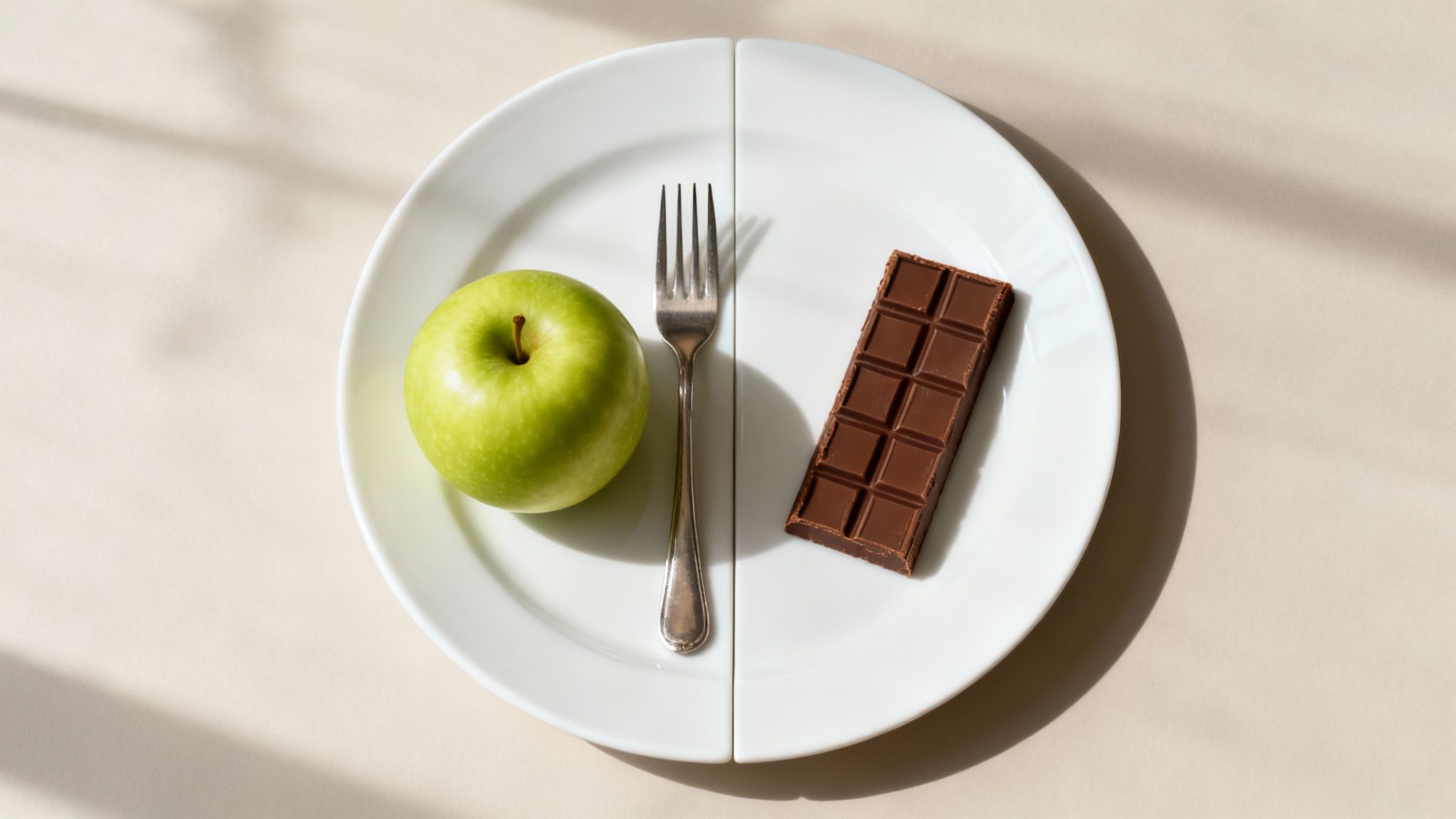
An apple and a chocolate bar may have the same number of calories, but their effects on your metabolism, blood sugar level, and feeling of fullness could hardly be more different.
The apple provides you with fiber, vitamins, and complex carbohydrates. It keeps you feeling full for a long time and gives you steady energy. The chocolate bar, on the other hand? It consists mainly of sugar and unhealthy fats. It makes your blood sugar level shoot up and then drop just as quickly—leading to cravings shortly afterward.
Your goal should therefore be to achieve a healthy calorie deficit by choosing nutrient-rich foods. This way, you stay full, provide your body with everything it needs, and avoid cravings.
The power of macronutrients
To manage your diet effectively, it is important to know the three main players: macronutrients. Each of them fulfills a crucial function on your journey to your comfortable weight.
Here is a brief overview to help you get started:
An overview of the most important macronutrients
This table provides a simple overview of the three most important macronutrients, their role in weight loss, and where to find them.
| Macronutrient | Your weight-loss goal | Good sources |
|---|---|---|
| Proteins | Protect your muscles from breakdown and keep you feeling full the longest. Ideal for preventing cravings. | Lean meat, fish, eggs, quark, legumes (lentils, chickpeas), tofu |
| Carbohydrates | They are your most important source of energy. The right ones (complex carbohydrates) keep you fit and productive for a long time. | Whole-grain products, oats, potatoes, quinoa, vegetables |
| Fats | Important for hormones and the absorption of vitamins. Healthy fats are essential for a properly functioning body. | Avocados, nuts, seeds (flaxseeds, chia seeds), olive oil |
Let's take a closer look at these three.
1. Proteins are your muscles' bodyguards
During a diet, there is a risk that your body will break down not only fat but also valuable muscle mass. Sufficient protein intake protects your muscles and ensures that you lose fat specifically. In addition, protein is the most satiating macronutrient, which helps you stick to your calorie deficit more easily.
2. Carbohydrates are your fuel
Quality is key here. Complex carbohydrates, such as those found in whole-grain products, oats, or potatoes, are digested slowly. They provide you with energy for hours and keep your blood sugar levels stable. You should avoid simple carbohydrates (white bread, sweets), however.
3. Healthy fats do not make you fat
Quite the opposite! Healthy fats are vital for your body. They are essential for hormone production and the absorption of fat-soluble vitamins. Unsaturated fatty acids from plant-based sources are your best friends here.
By understanding how these nutrients work together and making conscious choices, you transform your diet from mere calorie intake into an intelligent tool. You control your energy and satiety, creating the ideal foundation for your weight-loss success. You can also find a detailed guide in our article about healthy eating for weight loss.
The right training for maximum fat burning
If your diet is the foundation of your success, then the right training is the turbocharger that shapes your body and takes fat burning to an entirely new level. The combination of exercise and nutrition for weight loss is simply unbeatable. But what many people wonder is: Which type of training actually delivers the most?
The answer is not one or the other, but the smart combination of both. The real magic happens when you skillfully use the strengths of endurance and strength training to your advantage.
Endurance training: Your calorie burner
Think of endurance training as classics such as running, cycling, swimming, or even just brisk walking. These activities are worth their weight in gold for burning a substantial number of calories during the workout itself. They strengthen your cardiovascular system, improve your overall fitness, and directly create the calorie deficit you need.
During half an hour of jogging, depending on your pace and body weight, you can easily burn 200 to 400 calories. That is a direct, measurable contribution to your negative energy balance. The catch? The effect is limited in time and ends fairly soon after you take off your running shoes.
Strength training: Your secret metabolism booster
And this is exactly where the real game changer comes into play: strength training. Even if you may not burn quite as many calories per minute while lifting weights or doing bodyweight exercises as you do while sprinting, it has a decisive long-term advantage.
Strength training builds muscle. Imagine each individual muscle in your body as a small power plant that uses energy around the clock—even when you are lying on the sofa or sleeping.
More muscle mass increases your basal metabolic rate—that is, the amount of calories your body burns when completely at rest. This means you automatically burn more calories every day without lifting a finger.
This brilliant effect, also known as the afterburn effect (EPOC), can last up to 48 hours after an intense strength-training session. During this time, your body uses additional energy to repair and strengthen your muscle fibers. If you want to take a deeper dive into how you can specifically promote these processes, check out our comprehensive guide on how to stimulate fat burning.
The unbeatable combination of both
So you see, both types of training are absolutely worthwhile. Endurance training is the sprinter that burns calories immediately. Strength training is the marathon runner that raises your metabolism to a higher level in the long term.
For maximum results, you should include both in your weekly plan. A proven approach is to focus on different aspects on different days.
Here is a simple but extremely effective approach to structuring your training week:
- 2–3 strength-training sessions: Focus on full-body exercises. Squats, lunges, push-ups, and rows are perfect. These compound exercises engage several muscle groups at once and are highly efficient for building muscle and burning calories.
- 1–2 cardio sessions: Choose something you enjoy! It can be a longer, relaxed session (e.g., 45–60 minutes of running or cycling) or a short, intense session such as HIIT (High-Intensity Interval Training).
An example weekly plan for getting started
This plan is only a suggestion that you can adapt flexibly. Always listen to your body and plan at least one, or preferably two, rest days per week. True wonders happen during recovery.
| Day | Training | Focus |
|---|---|---|
| Monday | Strength training (full body) | Get your metabolism going for the whole week with basic exercises. |
| Tuesday | Active recovery or rest | A relaxed walk or some light stretching will do you good. |
| Wednesday | Cardio training (moderate) | 45 minutes of running, cycling, or using the elliptical at a comfortable, steady pace. |
| Thursday | Strength training (full body) | Train large muscle groups again to make the most of the afterburn effect. |
| Friday | Cardio training (HIIT) | Short, intense intervals, e.g., 30 seconds of sprinting followed by 60 seconds of walking (15–20 minutes total). |
| Saturday | Active recovery | A longer hike, yoga, or a relaxed swim. |
| Sunday | Complete rest | Time to recover. Your muscles grow during rest! |
With this structure, you ensure that you burn calories directly while also sustainably increasing your basal metabolic rate. You sculpt your body, build strength, and gradually transform it into a more efficient fat-burning machine.
Your practical weekly plan for exercise and nutrition
The theory is clear and the knowledge is there—now it's time to put it into practice. After all, the best plan is useless if it exists only on paper. Here you'll find your specific roadmap for a successful week. It will show you how simple and delicious the combination of exercise and nutrition for weight loss can be.
This plan is deliberately designed as a flexible template. You can easily adapt it to your taste, schedule, and preferences. Think of it as the starting point for finding your own personal, perfect routine.
Nutrition: Your daily structure
A key to success is the regularity of your meals. Three main meals and perhaps a planned snack help you keep your blood sugar levels stable, provide energy for the day, and prevent cravings from arising in the first place. This means you don't have to think about food constantly and can focus on what's important.
The best nutrition plan is the one you can actually stick to in the long term. It's not about perfection on a single day, but about consistency over weeks and months.
Your weekly training routine
For sustainable results, we recommend a good mix of strength and cardio training. A rhythm of three to four sessions per week is ideal for providing your body with the right stimuli while ensuring that the important recovery process is not neglected.
This infographic shows you a proven weekly routine that ideally combines cardio, strength, and rest periods.
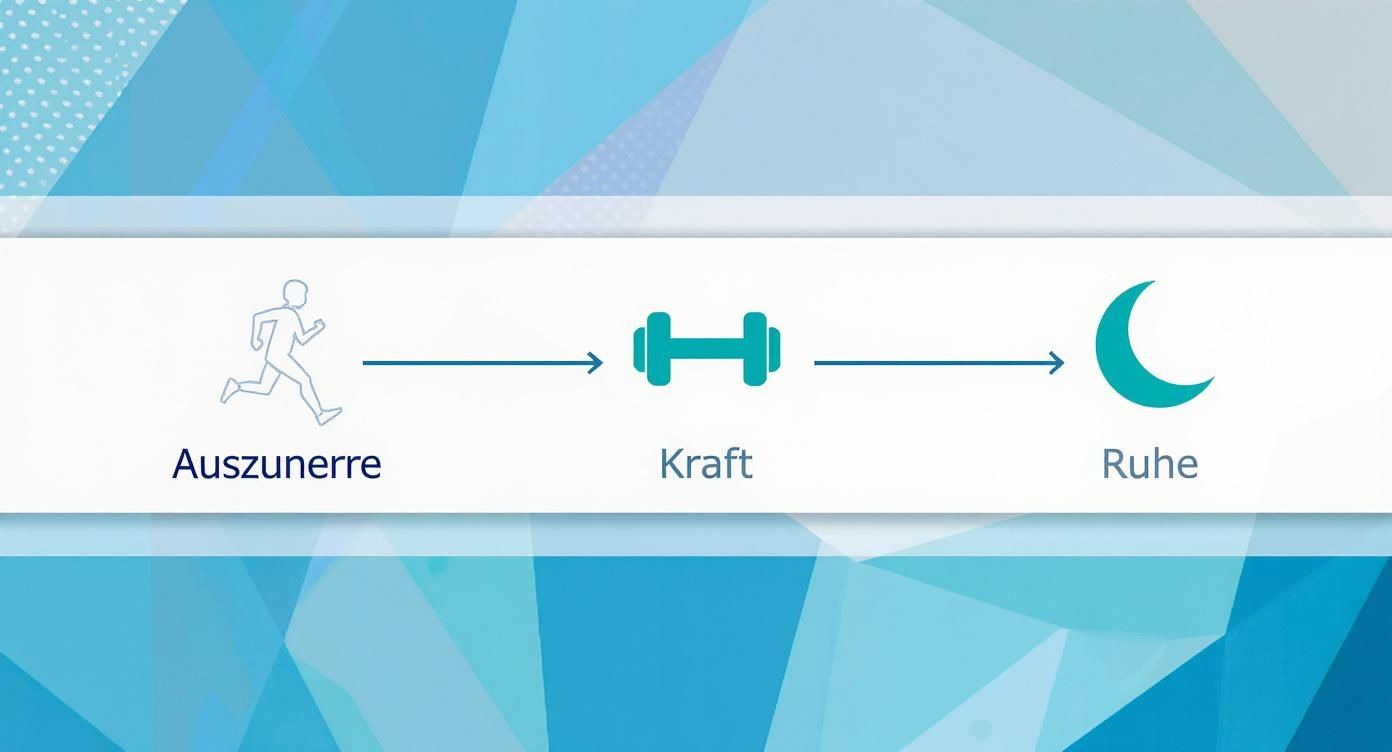
This clearly shows that intensive training days should always be followed by periods of active or passive recovery. This is the only way to give your body the time it needs to adapt.
Your sample weekly plan in practice
Okay, now let's bring both together—nutrition and training—in a concrete, practical plan. The recipe suggestions are intentionally simple and quick to prepare. All meals are rich in protein and fiber, so you'll stay full and satisfied for longer.
Here is an example of what your week could look like:
| Day | Breakfast | Lunch | Dinner | Training |
|---|---|---|---|---|
| Monday | Low-fat quark with berries, nuts, and a teaspoon of flaxseed | Large mixed salad with strips of chicken breast and whole-grain bread | Lentil and vegetable stew | Strength training (full body) |
| Tuesday | Scrambled eggs made with 2–3 eggs, tomatoes, and spinach | Quinoa salad with chickpeas, cucumber, and feta | Pan-fried salmon fillet with broccoli and a small sweet potato | Active recovery: 30–45 min. walk |
| Wednesday | Oatmeal (porridge) with apple pieces and cinnamon | Chicken curry with plenty of vegetables and a small portion of brown rice | Large vegetable stir-fry with tofu or shrimp | Cardio training (moderate) 45 min. |
| Thursday | Greek yogurt with a little honey and walnuts | Leftovers from dinner (lentil stew or chicken curry) | Tuna salad (in its own juice) with beans and onions | Strength training (full body) |
| Friday | Whole-grain bread with avocado and cottage cheese | Vegetable soup with a slice of whole-grain bread | Pan-fried turkey strips with bell peppers and zucchini | HIIT (15–20 min.) or rest day |
| Saturday | Protein smoothie made with low-fat quark, banana, spinach, and water | Omelet with mushrooms and herbs, served with a small salad | Chili sin carne (vegetarian) with kidney beans and corn | Active recovery: cycling, hiking |
| Sunday | Free choice (e.g. a healthy breakfast with the family) | Light meal of your choice | Light meal of your choice | Rest day |
This plan gives you a solid foundation. Feel free to adapt it as you like!
Smart snack ideas for between meals
Do you sometimes get a little hungry between meals? Be prepared! Instead of reaching for unhealthy snacks, keep one of these options on hand:
- A handful of unsalted nuts (approx. 20-30 g)
- An apple or a banana
- A cup of low-fat quark or cottage cheese
- Vegetable sticks (carrots, cucumbers, bell peppers) with herb quark dip
This sample plan is intended to inspire you. Swap out foods you do not like and adjust the portion sizes to suit your individual hunger levels and calorie needs.
If you are looking for even more inspiration and a perfectly structured guide, the myFoodbook diet plan offers a huge collection of recipes and plans developed specifically for weight-loss success. This makes planning a breeze, allowing you to focus fully on your goals.
How to stay motivated and avoid common mistakes
Okay, you have the theory down. You have the plans, knowledge, and strategies to get started with the combination of exercise and nutrition for weight loss. But honestly? Knowledge alone is rarely the problem. The real hurdle usually comes after a few weeks, when the initial euphoria has faded and everyday life takes over again.
Your journey to a comfortable weight is a marathon, not a sprint. Many people do not give up because their plan was bad, but because they fall into common mental traps or simply lose motivation. Think of this section as your inner compass, helping you recognize these pitfalls and safely navigate around them.
The biggest motivation killers and how to eliminate them
Motivation is not an unlimited resource. You have to nurture and care for it like a good plant. The good news is that you can actively make sure it does not wither. Let’s look at the most common mistakes—and how to prevent them from the outset.
1. Overly radical diets and restrictions
This desire to see results as quickly as possible often leads straight into the crash-diet trap. You ban everything you love and force yourself into an extreme calorie deficit. What happens? Before long, you are exhausted and dissatisfied, and cravings are virtually guaranteed.
- Your strategy: Follow the 80/20 rule instead. Focus 80% of your diet on healthy, nutrient-rich foods. In the remaining 20%, consciously allow yourself a small indulgence now and then. This creates a healthy balance and makes the whole thing sustainable in the long term.
2. Focusing solely on the scale
Nothing can be as demotivating as that one number on the scale. Your weight fluctuates daily—sometimes because of water retention, sometimes because of stomach contents or hormonal cycles. And don’t forget: Strength training builds muscle, which weighs more than fat. So a lack of movement on the scale certainly doesn’t mean that nothing is happening.
-
Your strategy: Redefine success! Pay attention to all the other positive changes.
- Does your favorite pair of jeans fit better again?
- Do you noticeably have more energy in your everyday life?
- Can you do more repetitions during your workouts or lift more weight?
- Do you simply feel fitter and more comfortable in your own skin? Those are the real victories.
Realistic goals and dealing with plateaus
One major source of frustration is unrealistic expectations. If you set out to lose ten kilograms in four weeks, disappointment comes as part of the package. Instead, set smart, achievable goals. A healthy—and above all, sustainable—pace is around 0.5 to 1 kilogram per week.
A plateau is not failure. It’s a sign that your body has adapted to the new conditions. This is a completely normal part of the process and a signal that it’s time for a small adjustment.
So if your weight stagnates for two or three weeks, don’t panic. Calmly review your habits. Have small snacks crept in unnoticed? Or has your training intensity decreased somewhat? Often, all it takes to give your metabolism a new stimulus is trying a new sport or replacing a few of your standard meals.
Recovery and sleep—the forgotten heroes
You can train and eat as perfectly as possible—but if you neglect recovery and sleep, you’re sabotaging your own success. While you sleep, your body repairs muscles, regulates vital hormones, and reduces stress.
Lack of sleep, on the other hand, causes the stress hormone cortisol to skyrocket, which promotes fat storage—especially around the abdomen—and stimulates the appetite. Seven to eight hours of good sleep per night are not a luxury but an absolute necessity for your weight-loss success. Give your body the rest it deserves—it will thank you with better results.
Smart aids on your way to your goal
You have the knowledge, you have the plan—great! But sometimes there’s still that small yet crucial difference that makes everything a little easier and more effective. Especially when it comes to the perfect combination of exercise and nutrition for weight loss, targeted aids can be worth their weight in gold.
I’m not talking about miracle cures, but smart support for your body exactly when it needs it most. Think about a stressful day when there’s simply no time for a balanced meal, or immediately after a hard workout. This is precisely where getting the right nutrients can determine success or stagnation.
How to support your body intelligently
A high-quality protein shake is a classic example. It makes it easy to meet your protein needs after training. Why is that so important? Because protein protects the hard-earned muscle you’ve built and boosts recovery.
Other specially developed products can naturally stimulate your metabolism. They’re not a substitute for a healthy lifestyle, but rather the finishing touch that helps you optimize your results.
Think of it this way: These helpers fill the small gaps in your nutrition. They provide exactly the building blocks your body needs for fat loss and muscle retention. They’re a smart shortcut for upgrading your nutrition—not replacing it.
That the right combination of nutrition and exercise really works is demonstrated by an impressive example from a German health program: In just seven months, one participant lost 13 kilograms of pure fat while building muscle at the same time. This is the best proof that you can lose weight healthily without starving yourself—when all the pieces fit together perfectly. You can read the full success story at Deutschlandfunk Kultur.
Want to take a more personal approach? Then it’s worth taking a closer look at your own biology. If you really want to understand how your body responds to certain nutrients, a DNA analysis for weight loss can provide incredibly fascinating insights and make your journey even more personalized.
Your questions, our answers
Questions come up on your journey toward your goal—that’s completely normal and a good sign! To clear up any lingering doubts and give you the confidence you need for the next steps, we’ve gathered the answers to the most pressing questions about exercise and nutrition for weight loss here. Clear, direct, and without any unnecessary fluff.
How many calories are really needed to lose weight?
The simple truth is this: You need to burn more energy than you consume. A healthy and, above all, sustainable calorie deficit is around 300 to 500 calories per day. That’s a great guideline for losing about half a kilogram per week without sending your metabolism into a tailspin or feeling hungry all the time.
An overly aggressive deficit actually has the opposite effect: Your body switches into “conservation mode” and starts breaking down valuable muscle mass. So it’s not about starving yourself, but about finding a balance you can maintain comfortably.
Should I eat before or after exercising?
Both are important, but they serve different purposes. Think of food as fuel for your car. A light, carbohydrate-rich snack about 1–2 hours before training fills your tank and gives you the power to give it your all during your workout. A banana or a small serving of oatmeal is ideal for this.
After training, your body is like a construction site—it needs materials for repair and growth. A meal with a good serving of protein and carbohydrates within two hours afterward is ideal. This helps your muscles recover and replenishes depleted energy stores.
Which workout burns the most calories?
If the focus is purely on the calorie-burning boost during training, high-intensity interval training (HIIT) often comes out on top. These short, intense bursts of exertion alternating with brief breaks really fire up your metabolism. Classics such as running or cycling at a high pace are also excellent calorie burners.
In the long term, however, strength training is the real game changer. Why? Because it builds muscle. And muscles are true furnaces that increase your basal metabolic rate—which means you burn more calories even when you're lying on the couch. The smartest strategy is therefore always a combination of both.
How often do I need to train per week?
To achieve visible, lasting results, three to four training sessions per week is a strong goal. This consistency is the key to repeatedly giving your body the necessary stimuli for muscle building and fat burning.
Even more important than the sheer number is consistency. Find a routine that you can realistically integrate into your everyday life without stressing yourself out. And this is crucial: Listen to your body! Consciously schedule rest days, because the real magic—the adaptation and progress—happens during the recovery phase.
Do you want to know exactly which nutrition and exercise type is encoded in your DNA? At mybody-x.com, we offer scientifically sound analyses that help you understand your body better and perfectly tailor your strategy to your needs. Discover mybody® Lab GmbH's personalized health tests now.



Share now:
Nutrition for athletes to maximize performance
Personalized nutrition: Everything important for your health