

Nutrition for athletes seeking maximum performance
Top-quality nutrition is so much more than just counting calories for you as an athlete—it is the fuel that drives you to peak performance. Imagine your body as a Formula 1 engine: Give it the right fuel, and it runs at full throttle—efficiently, powerfully, and absolutely reliably. But fill it with cheap gasoline, and it starts to sputter, loses power, and wears out much faster.
The foundation of your athletic success
Welcome to your guide to nutrition that really makes a difference. Many people immediately think of complicated plans and strict prohibitions when they hear “sports nutrition.” But at its core, it comes down to a very simple principle: Give your body exactly what it needs to perform at its best and recover optimally afterward.
Instead of overwhelming you with technical jargon, I'll show you in a practical way how to better understand your body's signals and get the full potential out of your nutrition. It's about building a solid foundation that will help you progress over the long term.
This understanding is the key to tailoring your nutrition specifically to you. Every body is different, responds differently to stress, and absorbs nutrients differently. What is ideal for a marathon runner can be completely unsuitable for a strength athlete.
Your nutrition isn't just a nice extra; it's a central part of your training. It determines how quickly you recover, how susceptible you are to injuries, and whether you can consistently perform at your best.
Strategically smart nutrition gives you decisive advantages as an athlete:
- Maximum energy: You have enough power for hard training sessions and competition day.
- Effective muscle growth: You give your muscles exactly the building blocks they need for growth and repair.
- Faster recovery: You shorten recovery periods and protect yourself from overtraining.
- Strong immune system: You stay more resilient against infections that could otherwise set you back for weeks.
In this guide, you'll learn how to deliberately put these puzzle pieces together. We'll go step by step through the most important topics—from the essential macronutrients and micronutrients to the right timing for your meals and the often-underestimated importance of hydration. My goal is to give you the knowledge you need to take control of your nutrition confidently and successfully.
Targeting your body's energy sources
Imagine you are building a high-performance house. Carbohydrates would be the foundation and the electricity—they provide the basic energy. Proteins are the bricks and mortar that build and repair everything. Fats, on the other hand, are the high-tech insulation and lubrication system that ensures everything runs smoothly and efficiently.
Each component is important in its own right, but only perfect interplay creates a stable, high-performance structure. The same applies to nutrition as an athlete with macronutrients.
Your performance depends directly on how well you understand this interplay and use it to your advantage. It's not about demonizing one nutrient and putting another on a pedestal, but about knowing their specific roles and using them strategically.
Carbohydrates: The fast fuel for your training
Carbohydrates are the most important and fastest source of energy for your body, especially during intense exertion. Your body stores them as glycogen in your muscles and liver—essentially your personal, readily available energy tanks.
When these tanks are well filled, you can give it your all during training. When they are empty, you feel sluggish and powerless. It's as simple as that.
However, not all carbohydrates are created equal. The key is choosing the right type at the right time:
-
Complex carbohydrates: You can find these in whole-grain products, oatmeal, potatoes, and legumes. They provide energy slowly and steadily over a longer period. This makes them ideal for your main meals, ensuring a stable energy supply throughout the day and filling your stores for long endurance sessions.
-
Simple carbohydrates: They are found in fruit, honey, and glucose. Your body can absorb them extremely quickly and convert them into energy. This makes them perfect for a quick boost shortly before or even during an intense training session, helping prevent a dip in performance.
Proteins: Your building blocks for muscle and recovery
Proteins are far more than just “muscle food.” They are the fundamental building blocks of nearly every cell in your body. After a hard training session, tiny microtears form in your muscles—a completely normal process. Proteins provide the necessary amino acids to repair these tears, making the muscle stronger and more resilient.
But their role goes even further. Proteins are essential for a strong immune system, the production of hormones and enzymes, and the transport of nutrients in the blood.
A deficiency can not only sabotage your muscle growth, but also make you more susceptible to infections and slow your recovery. Therefore, make sure to spread your protein intake throughout the day to continuously provide your body with the building blocks it needs.
This infographic sums up the core functions of macronutrients: fuel, building material, and recovery support.
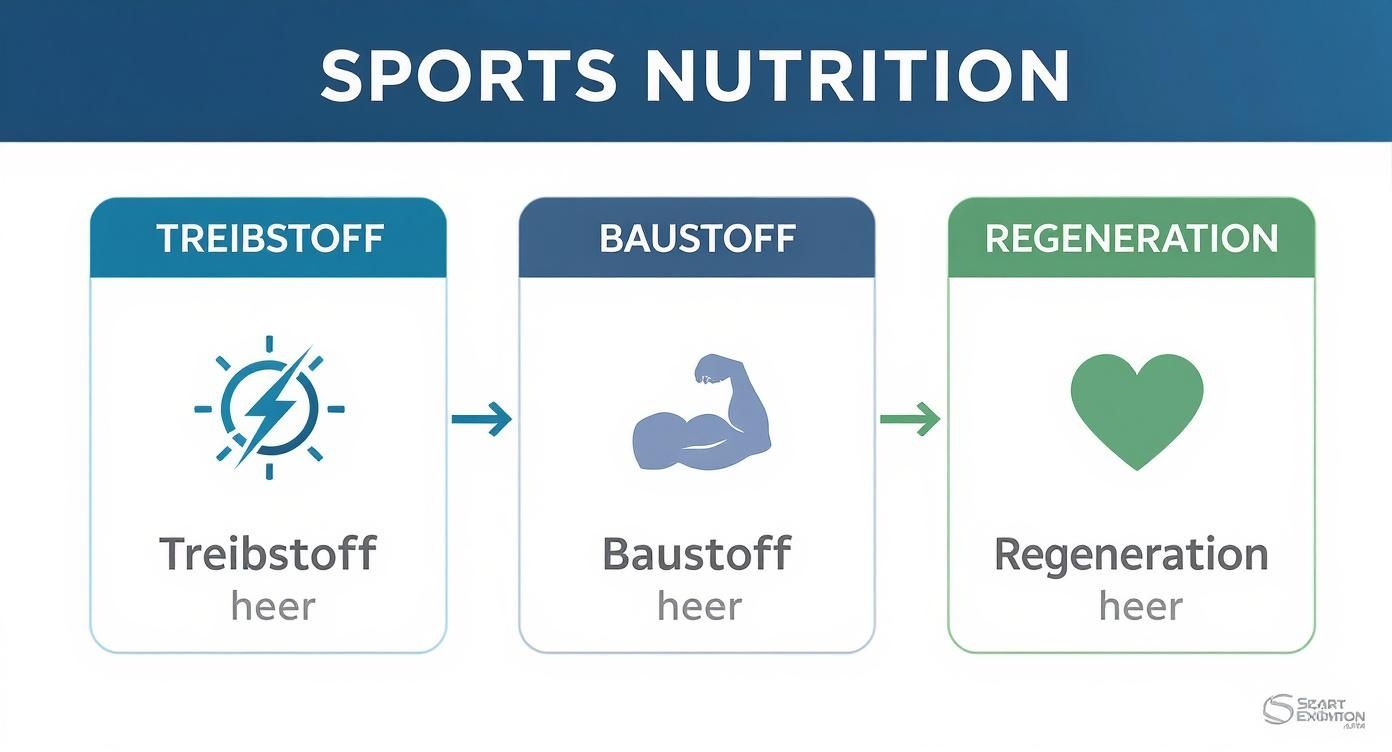
The visualization makes it clear that a balanced diet as an athlete must rest on all three pillars if you want to achieve lasting success.
Healthy fats: The underrated helpers
Fats had a bad reputation for a long time—but unfairly so. As an athlete, they are indispensable. They not only serve as a dense source of energy for long, moderate-intensity efforts, but also play a central role in the absorption of fat-soluble vitamins (A, D, E, K).
They are also involved in producing important hormones such as testosterone, which is crucial for muscle growth.
Too little fat can negatively affect your performance, concentration, and even coordination. It's about choosing the right fats.
Focus on unsaturated fatty acids, which you can find in avocados, nuts, seeds, and high-quality plant oils such as olive or flaxseed oil. They have anti-inflammatory effects and support your recovery.
A scientific analysis by the German Sport University Cologne recommends that athletes consume 20 to 30 percent of their energy intake from fat to avoid compromising performance and minimize the risk of injury.
Want to dive deeper into the world of macros? If you'd like to better understand the roles of fats, carbohydrates, and protein, you'll find further valuable insights in our article about the three macronutrients.
Micronutrients: The unsung heroes of your performance
If macronutrients are your body's engine, micronutrients are what make that engine run in the first place: the oil, spark plugs, and coolant. You can't see them directly, but without them, nothing works.
Their role in nutrition as an athlete is often neglected. Yet even a small deficiency can severely hinder your performance. Imagine giving it everything you've got, but one spark plug fails—the entire engine starts to sputter. Likewise, a deficiency in just one vitamin or mineral can impair your overall performance.
As an athlete, you already have a much higher need for certain micronutrients. Through intense training, you sweat out not only water but also valuable minerals. Your body is constantly running at full speed and needs these small helpers for countless processes, from energy production to recovery.
A micronutrient deficiency is like driving with the handbrake on. You invest all your strength and training, but still do not get anywhere.
Critical micronutrients you should keep an eye on
Of course, not all micronutrients are equally important for athletes. But there are a few candidates that play such a central role in energy, recovery, and muscle function that you should pay them particular attention.
-
Iron: Think of iron as the oxygen taxi in your blood. It is a key component of hemoglobin, which carries oxygen from your lungs to your working muscles. If you lack iron, too little oxygen reaches them—the result is fatigue, reduced performance, and shortness of breath. Good sources include not only red meat but also lentils, spinach, and oats.
-
Magnesium: If your muscles tend to cramp more often, a magnesium deficiency could be behind it. This mineral is involved in more than 300 enzymatic reactions and regulates, among other things, the interaction between muscle contraction and relaxation as well as energy metabolism. You can find plenty of it in nuts, seeds, whole grains, and green vegetables.
-
Vitamin D: The well-known “sunshine vitamin” is good for much more than just strong bones. It is absolutely crucial for a robust immune system and can protect you from infections that could set your training back for weeks.
Although a balanced diet should always be the foundation, it is no secret that many athletes turn to supplements. A study by the DGE showed that 88,4 % of the athletes surveyed had taken dietary supplements in the past six months. Sodium, calcium, iron, and vitamin D can quickly become critical, especially with high sweat losses or while dieting. You can find more information about the results of this study in the scientific publication.
Listen to your body's signals
Your body is pretty good at telling you when something is wrong. Persistent fatigue, frequent muscle cramps, or an increased susceptibility to colds are often clear signs of a micronutrient deficiency.
To better understand the connections and take targeted action, also read our comprehensive guide to the most important vitamins and minerals. This will teach you to interpret your body’s signals correctly and adjust your diet so that your engine always runs smoothly.
Optimizing the timing of your meals

You have the best ingredients in the fridge, but do you use them at the right time? In sports nutrition, the timing of your meals is a real game-changer. It is often the decisive factor determining whether valuable nutrients actually reach where they are needed—namely your muscles, exactly when you are challenging them the most.
Imagine you want to keep a campfire burning. You need good wood (your nutrients), but you also have to add it at exactly the right time, when the flame is at its strongest, to keep it from going out. Your body works in much the same way: The right timing gives you consistent energy, better performance, and significantly faster recovery.
Planning your pre-workout meal intelligently
Your last meal before exercise lays the foundation for your performance. The goal is clear: Your glycogen stores—the energy tanks in your muscles—need to be completely full without the food sitting heavily in your stomach. A full stomach during training is counterproductive because it draws valuable blood away from your muscles and into your digestive tract. You definitely want to avoid that.
An ideal pre-workout meal should therefore meet two simple criteria:
- Make it easy to digest: Choose complex carbohydrates that provide you with long-lasting energy. However, you should avoid large amounts of fat and fiber, as they significantly slow digestion.
- Time it right: Your last large meal should be about 2–3 hours before training. A small, easily digestible snack such as a banana or a rice cake is still a good idea 30–60 minutes beforehand.
Timing is everything: A well-planned meal before exercise not only prevents nasty drops in performance, but also protects your muscles from being “cannibalized” as an energy source during exertion.
Make optimal use of the anabolic window after training
Immediately after training, your body is in a very special state. Your muscles are extremely receptive to nutrients—almost like a dry sponge eagerly soaking up water. This phase, often referred to as the “anabolic window,” is the perfect time to start recovery and maximize muscle growth.
Ideally, you should eat your post-workout meal within 60 to 90 minutes after training. The combination of readily available carbohydrates and high-quality protein is key here. The carbohydrates replenish depleted energy stores, while the protein immediately begins repairing the stressed muscle fibers. A classic post-workout shake or a meal of potatoes with lean meat or tofu is perfect for this.
Especially after exercise, it is important to choose the right carbohydrates to specifically influence your blood sugar level. If you would like to learn more about how to use food strategically, take a look at our article explaining the glycemic index table. This will teach you how to take your recovery to the next level.
Maintain your performance through optimal fluid intake

We often get lost in the details of macros and micros while overlooking what is probably the most important building block for athletic performance: water. Without optimal fluid intake, your engine quickly overheats and your performance drops.
Imagine trying to drive up a mountain with the handbrake on. That is exactly what happens when you are dehydrated. Even a small fluid loss of just 2% of your body weight can noticeably reduce your strength, endurance, and concentration. It costs you unnecessary energy, and you simply cannot make progress.
Good hydration is therefore not optional but the absolute foundation. It not only supports your physical performance but also the mental sharpness that can make all the difference in competition.
Recognizing your individual fluid needs
The familiar rule of two to three liters of water a day is a good starting point, but it is usually too little for athletes. Your actual needs depend heavily on the intensity and duration of your training and, of course, environmental conditions such as heat.
A very simple way to quickly check your hydration status is to look at the color of your urine. Light, pale yellow? Perfect, everything is in the green. But if your urine is dark yellow or even amber-colored, that's a clear warning signal. Your body is crying out for fluids.
Dehydration develops gradually. Thirst is already a late warning signal from your body that a deficiency is present. So don't wait until you're thirsty—drink proactively and regularly throughout the day.
When water is enough and when electrolytes are useful
For easy sessions of up to 60 minutes, plain water is generally completely sufficient to compensate for fluid loss. But if you train longer and harder and sweat heavily, you lose more than just water. You also flush out important electrolytes such as sodium, potassium, and magnesium.
However, these minerals are essential for proper muscle contraction and nerve signal transmission. A deficiency can quickly lead to drops in performance, nasty cramps, or even dizziness.
- Plain water: Ideal for everyday use and shorter, moderate exercise sessions.
- Isotonic drinks: They make sense during long endurance sessions lasting more than 90 minutes. In addition to fluids, they provide quickly available carbohydrates and directly replenish electrolyte losses.
- Electrolyte powder: A smart alternative for specifically replenishing mineral losses during intense sessions without consuming unnecessary calories.
Personalize your nutrition with data
Standard plans are a good starting point, but real optimization begins with you. Every body works differently and responds differently to food, training, and stress. That's why a personal strategy is the key to achieving sustainable success as an athlete through your nutrition. Instead of blindly following recommendations, it's about listening to your body's signals—and understanding them.
This is how you turn a good nutrition strategy into a perfect one that truly suits you, your sport, and your training intensity.
From general advice to an individual strategy
The first step toward personalization is actually quite simple: careful observation. Keep a food and training diary for a few weeks. Don't just note what you eat, but above all, how you feel while doing so.
- Did you have enough energy during training?
- How quickly did you feel fit again afterward?
- Did you experience digestive problems or nasty performance slumps in between?
Even these simple notes are worth their weight in gold. They give you initial clues about which meals do you good and which tend to hold you back. By the way, this mindful approach to food is not a niche topic. A survey shows that around 22.7 percent of Germans consciously pay attention to their diet for health reasons. You can find more information in these findings on dietary awareness.
Your body is constantly sending you feedback. Your task is to listen and draw the right conclusions. This turns your nutrition into a dynamic process that you actively shape.
Data-driven optimization for maximum precision
But if you really want to know and take your nutrition to the next level, you cannot avoid scientifically sound analyses. Modern tests give you insights you would never gain through observation alone. Think of it as looking under the hood of your body.
A gut health test, such as the mybody-x microbiome test, is a perfect example. Your gut is the center of your nutrient absorption. If your gut flora is out of balance, you can eat as healthily as you like—the valuable vitamins and minerals simply do not reach where they are needed. An analysis shows you the exact condition of your microbiome and provides specific recommendations on how to strengthen it in a targeted way.
A healthy gut is the foundation for everything: a strong immune system, efficient energy utilization, and faster recovery. Even your genetic predisposition plays a role in how you metabolize nutrients. To learn more about these fascinating connections, read our article on the role of nutrigenetics.
The most pressing questions about nutrition as an athlete
Finally, let's clear up the typical myths and uncertainties. Here are the answers to the questions we repeatedly encounter in consultations and that will help you put your remaining doubts to rest.
How much protein do I really need per day as an athlete?
This question cannot be answered in general terms, as your needs depend heavily on your sport and your goals. As a rule of thumb:
- Endurance athletes generally do well with 1.2 to 1.6 grams of protein per kilogram of body weight.
- Strength athletes who actively want to build muscle can go a little higher and aim for 1.6 to 2.2 grams per kilogram.
Much more important than the exact number of grams, however, is how you distribute them throughout the day. Instead of eating one huge portion at once, you should spread your protein intake across several meals. This continuously provides your body with the building blocks it needs for muscle protein synthesis—that is, repair and growth.
Do carbohydrates in the evening make me fat?
This myth persists more stubbornly than any muscle soreness. The short answer is: No. For you as an athlete, carbohydrates in the evening can often be a real game changer.
They replenish the glycogen stores depleted throughout the day and ensure that you wake up regenerated and full of energy the next morning. As long as your total daily calorie balance is right, an evening carbohydrate meal does not automatically lead to weight gain. It is not about whether you eat them, but about choosing the right amount at the right time.
Do I need to take supplements as an athlete?
Not necessarily. The absolute foundation should always be a balanced, varied, and nutrient-rich diet. Ideally, this already covers everything your body needs in terms of macronutrients and micronutrients.
However, there are situations in which supplements can absolutely make sense. For example, to specifically correct a confirmed deficiency, such as vitamin D in winter or iron deficiency. Even with a very high training load, a protein shake immediately after training can be a practical and quick solution to boost recovery.
Simply taking random pills blindly rarely helps. The key lies in a targeted analysis of your individual needs. That is the only way to find out where supplementation can truly benefit your performance and health.
Are you ready to stop leaving your nutrition to chance? With the scientifically backed analyses from mybody® Lab GmbH, you gain precise insights into your body—from your metabolism to your microbiome. Find out what you really need to maximize your performance and achieve your goals. Discover the right tests for you now at https://mybody-x.com.


Share now:
What type of metabolism do I have? What a test really shows
Exercise and Nutrition for Weight Loss: Your Complete Guide