
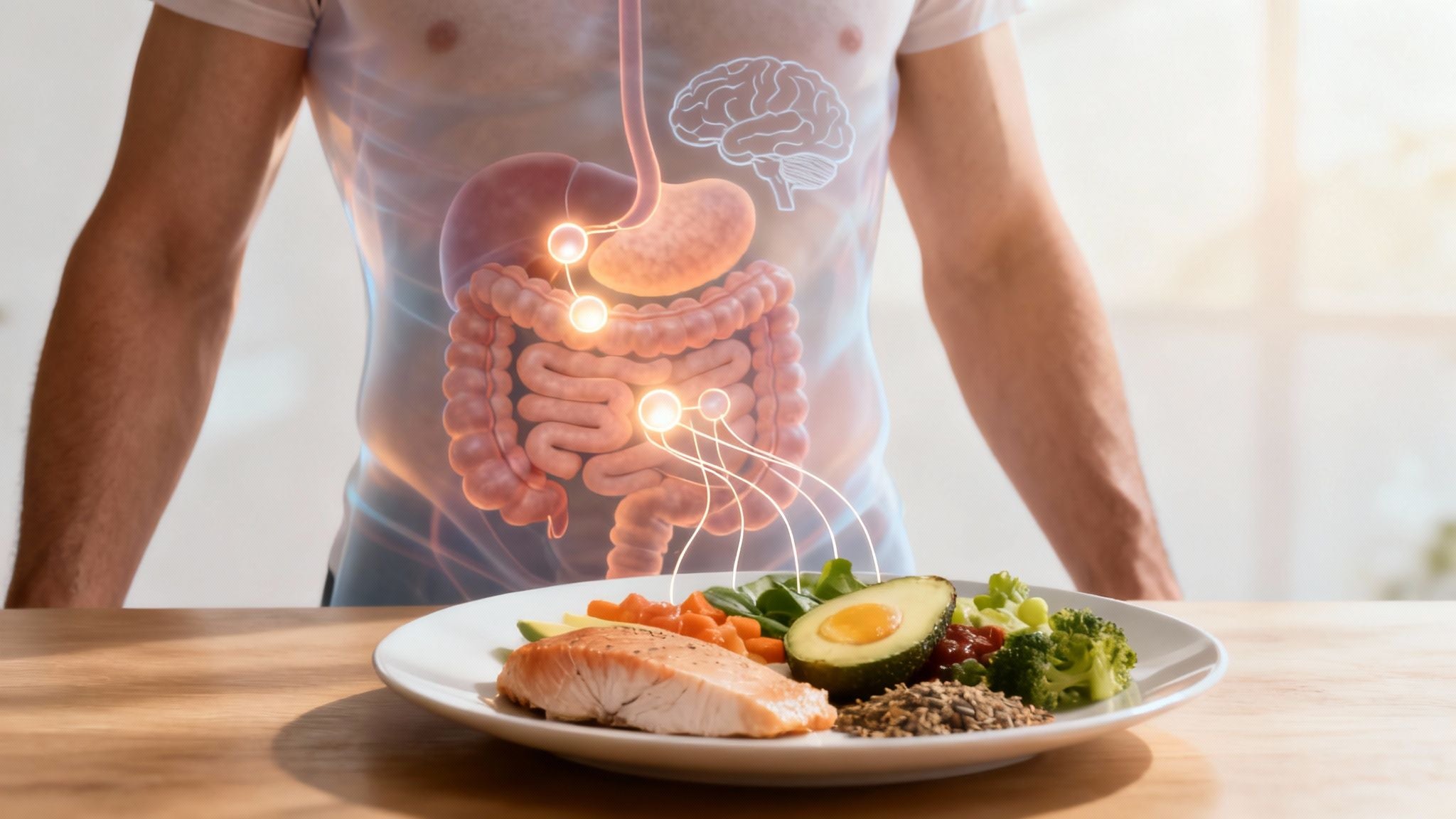
Understanding and intentionally regulating your sense of satiety
Imagine being able to simply eat until you feel comfortably full, without constantly counting calories—and still feel energized and completely comfortable. That's exactly what's possible when your sense of satiety is functioning properly. It is much more than the simple signal “I’m full.” It is your body's clever feedback system, telling you when you have taken in enough energy.
Why your sense of satiety is the key to your well-being

Your body is a communication genius. Every second, countless dialogues take place between cells, organs, and hormones to keep everything in balance. Your sense of satiety is one of the most important of these dialogues—a complex conversation between your stomach, intestines, hormones, and brain. When you learn to listen to these inner signals, you lay the foundation for a healthy relationship with food and a stable, comfortable weight.
But this system is finely tuned and vulnerable to disruption. Stress, too little sleep, the wrong foods, or even the speed at which you eat can throw these signals into disarray. Many of us know the result all too well: inexplicable cravings, the feeling of never being truly full, or the urge to wander back to the fridge shortly after a meal.
More than just a full stomach
People used to think satiety was a simple mechanical matter: the stomach expands, sends a signal to the brain, and that's it. Today, we know that the process is far more sophisticated. Your body analyzes exactly what you eat. Proteins, fiber, and healthy fats trigger completely different, much more lasting satiety responses than simple sugar. Your body therefore measures not only volume, but above all nutrient density.
Think of your sense of satiety as your personal nutritionist. It rewards you with satisfaction when you give it what it needs and signals hunger when energy or important building blocks are missing.
Internalizing this knowledge is a real game-changer. It frees you from rigid diet rules and obsessive calorie counting. Instead of fighting against your body, you begin working with it as a team. You learn to distinguish genuine hunger from emotional appetite and intuitively reach for the foods that keep you satisfied for longer.
The hidden power of your body
A well-regulated sense of satiety has an enormous impact that goes far beyond your weight. It directly affects:
- Your energy level: Stable satiety prevents your blood sugar levels from going on a roller coaster ride and therefore also prevents the dreaded afternoon slump.
- Your mood: A satisfied body supports a balanced mind. Cravings are often associated with stress and inner unrest—when that goes away, you feel clearer.
- Your concentration: When your body is optimally nourished and isn’t constantly crying out for more, your brain can focus fully on its tasks.
In this article, we’ll take you on a journey inside your body and uncover the secrets of your feeling of satiety. We’ll take a deep dive into the world of hormones such as leptin and ghrelin, explore the fascinating connection between your gut and your brain, and give you concrete, practical strategies for everyday life. You’ll see that listening to these inner signals is the crucial first step toward ending cravings and building a relaxed, intuitive relationship with food.
The most important hormones for hunger and satiety
Your feelings of hunger and satiety are not a coincidence. They are the result of a finely tuned hormonal orchestra in your body. Imagine that your body had two important managers who were constantly communicating with each other to ensure your energy supply. These two key players are the hormones ghrelin and leptin.
Ghrelin is, so to speak, the driving force—the “hunger hormone.” It is produced mainly in the stomach lining when your stomach is empty. Its job? To send a loud and clear signal to your brain: “Time for an energy boost!” The longer it has been since your last meal, the higher your ghrelin levels rise, and the louder not only your stomach growls, but also your craving for food.
Its counterpart is leptin, the “satiety hormone.” This hormone is produced by your fat cells. The more energy stored in your fat cells, the more leptin is released. It travels to the brain and delivers the message: “The stores are well stocked; you can stop eating.”
The duo of ghrelin and leptin
Ideally, this dynamic duo works perfectly together to maintain your energy balance.
- Before eating: Your stomach is empty, ghrelin levels rise, and leptin is low. You feel hungry.
- After eating: Your stomach is full, and your fat cells register the new energy. Ghrelin levels drop rapidly, while leptin levels slowly rise. You feel full and satisfied.
This rhythm ensures that you eat when you need energy and stop when you’ve had enough. A rather elegant system of self-regulation, wouldn’t you say?
If ghrelin is the loud alarm clock urging you to take action, leptin is the gentle voice telling you that everything is fine and you can relax.
But what happens when this communication is disrupted? What if your brain can no longer properly hear the signals that you are full?
When the fullness signal fades away: leptin resistance
This brings us to a crucial problem that affects many people: leptin resistance. In this condition, fat cells produce sufficient or even very large amounts of leptin, but the brain no longer responds to it properly. The signal of fullness essentially does not get through.
Imagine someone calling out something to you while you are wearing headphones playing loud music. You don't hear the message even though it is being sent. That is what happens to the brain with leptin resistance. Despite high leptin levels in the blood, it continues to receive the signal that the body is starving and needs more energy. This creates a vicious cycle: You keep eating even though your energy stores are already full, which only makes the problem worse.
Sleep and stress: the hidden saboteurs
In addition to diet, there are two other powerful factors that can massively influence this hormonal balance: sleep and stress. Their impact is often underestimated, yet they can throw the entire system out of balance.
Just one night of too little sleep can throw your hormonal balance into disarray. Studies show that sleep deprivation raises ghrelin levels and lowers leptin levels. The result: You wake up hungrier and feeling less full—and often have a stronger craving for high-energy, unhealthy foods.
Chronic stress also plays a harmful role. Ongoing stress causes the release of the stress hormone cortisol. Persistently elevated cortisol levels can not only intensify feelings of hunger but also promote leptin resistance. So you feel hungrier while also feeling less full. Learn more about the effects of stress and how you can measure your cortisol in our related article. Knowing your stress level directly can be an important first step toward regaining control over your feeling of fullness.
How your gut communicates with your brain
While hormones like leptin and ghrelin are the great conductors of your feeling of fullness, much of the crucial communication takes place in an often underestimated place: your digestive tract. Don't think of it merely as a processing station for food, but as a highly sophisticated command center. Through the so-called gut-brain axis, it communicates constantly with your brain.
This dialogue begins the moment you start eating. The first, very simple signal comes from your stomach.
The mechanics of satiety: your stomach speaks up
The mere mechanical stretching of your stomach is already a strong first signal for your brain. When you eat, your stomach fills and its walls stretch. Special sensors in the stomach wall immediately register this stretching and send a message via the vagus nerve—a direct data highway—to the brain.
The message is: “Attention, food is arriving—prepare for satiety.” This is exactly why drinking a large glass of water before a meal can actually help. It creates volume and triggers this first, mechanical satiety signal.
But that is only the beginning of the conversation. The real magic happens one level deeper, in your gut. This is where your very own ecosystem lives: the microbiome.
Your microbiome: the secret power broker
Trillions of microorganisms—bacteria, viruses, and fungi—live in your gut and together form your microbiome. These tiny inhabitants are far more than passive freeloaders. They are active metabolic factories and have a tremendous influence on your satiety, mood, and even your cravings.
When you eat, not only your own enzymes process the food—your gut bacteria do too. In particular, fiber that your body cannot digest serves as a feast for beneficial bacteria. As they ferment this fiber, they produce so-called short-chain fatty acids (SCFAs) as by-products, such as butyrate.
These SCFAs are true superstars when it comes to satiety and produce several positive effects at once:
- They stimulate the release of satiety hormones such as PYY and GLP-1 in the gut.
- They can cross the blood-brain barrier and curb appetite directly in the brain.
- They strengthen the gut barrier and reduce low-grade inflammation that can disrupt the satiety system.
A healthy and diverse microbiome is like a well-coordinated team that actively works to signal to your brain: You are full and satisfied. If this team is weakened, satiety signals become quieter and less clear.
The following infographic shows the two most important hormonal counterparts, whose balance is also influenced by the gut-brain axis.
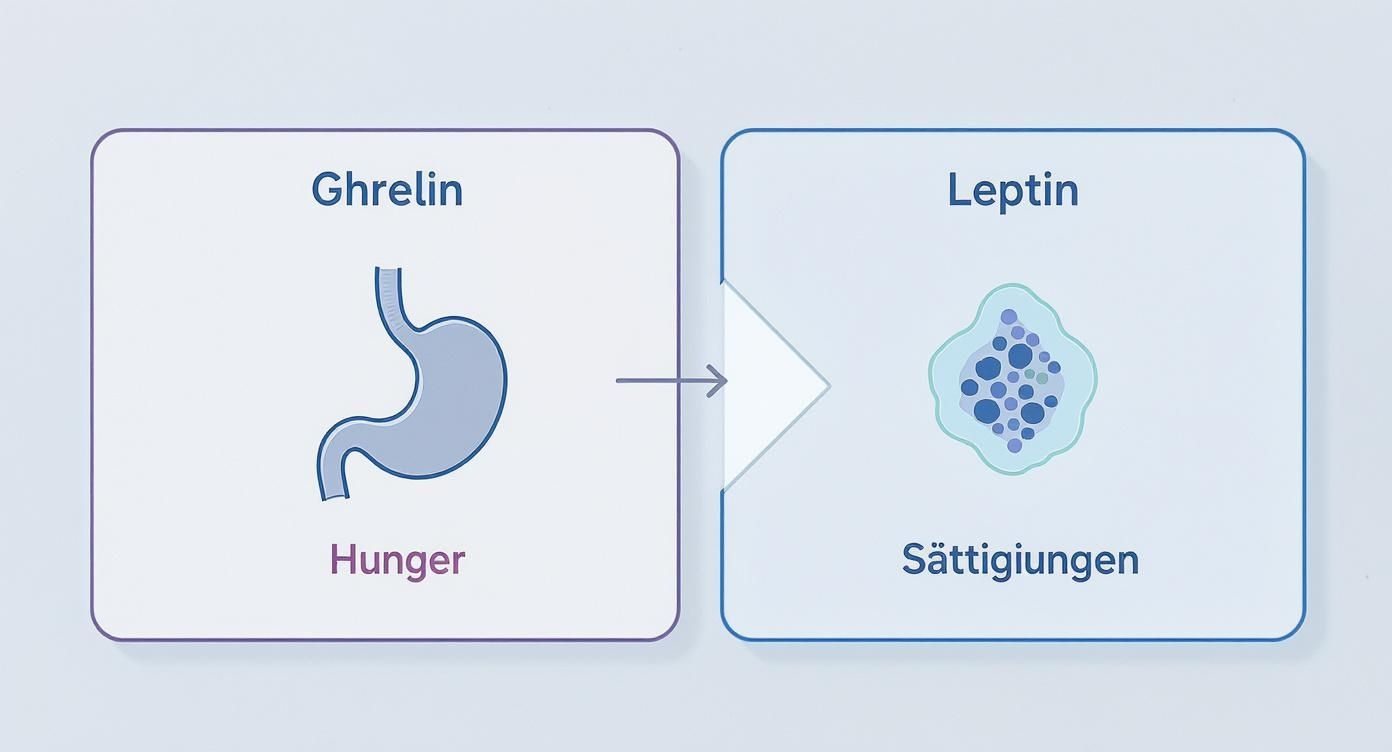
The balance between the hunger hormone ghrelin and the satiety hormone leptin is crucial. A healthy gut helps support this delicate balance.
The Gut-Brain Axis in Everyday Life
This direct connection between the gut and the brain explains much of what you may have already observed yourself. Why do you feel full for hours after a fiber-rich meal with plenty of vegetables and whole-grain products, while a sugary snack triggers new hunger after only a short time? It’s simple: The first meal feeds your microbiome and stimulates the production of satiety signals, while the second barely does so.
Caring for your gut flora is therefore one of the most effective strategies for positively influencing your eating habits. A first step may be to get to know the composition of your gut better. If you would like to understand the state of your personal gut flora, a microbiome test can provide valuable insights and show you where to start. After all, a healthy gut is the foundation for a properly functioning sense of satiety.
The Best Nutrients for Lasting Satiety
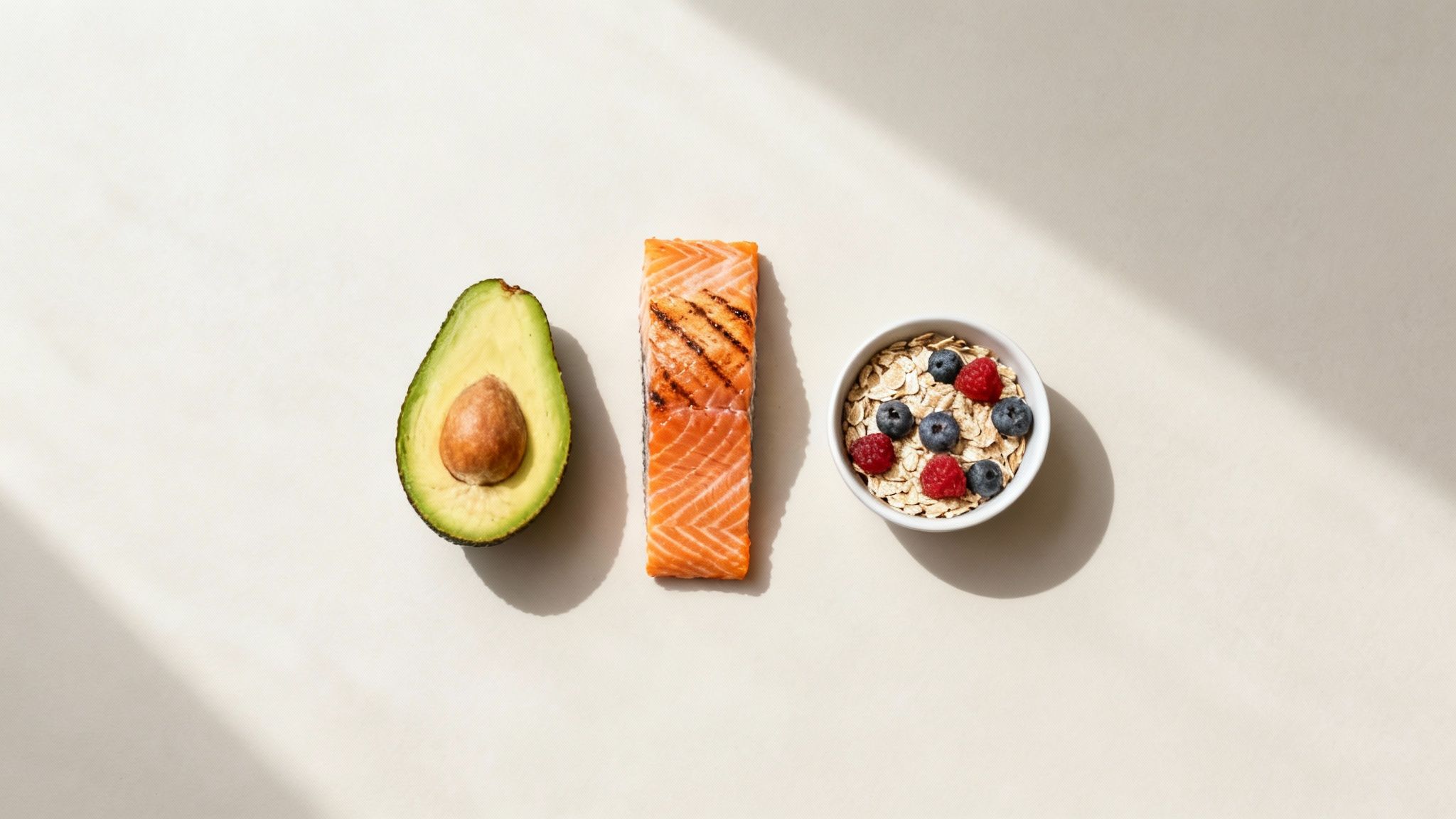
You now know that satiety is a clever conversation between the gut and the brain. But which “words” does your body understand best? Not every calorie sends the same message. There are three clear heroes that turn your meals into truly satisfying ones: protein, healthy fats, and fiber.
These three are far more than mere sources of energy. They interact directly with your hormonal system and digestive system to create a feeling of deep, long-lasting satisfaction. Once you understand how they work, you can put together your meals so that cravings don’t stand a chance and you feel energized for hours.
Protein: The Unrivaled Satiety Champion
When it comes to satiety, protein is at the top of the podium. A protein-rich meal keeps you noticeably fuller for longer than one consisting mainly of carbohydrates or fats. But why is that?
Protein plays to its strengths on several levels. For one, it communicates directly with your satiety hormones in the gut. It stimulates the production of messenger substances such as PYY and GLP-1, which tell your brain: “Everything’s fine, we’re nourished.” At the same time, it reduces the release of the hunger hormone ghrelin.
Secondly, your body uses more energy to digest and metabolize protein. This process, also known as the thermic effect of food, revs up your metabolism and additionally contributes to feelings of fullness.
Imagine the difference: A sugary donut gives you a brief boost, followed by a deep crash and renewed hunger. Scrambled eggs with vegetables, on the other hand, provide steady, satisfying energy that carries you confidently through the morning.
How much protein you personally need is a crucial building block for effective satiety management. In our guide, you'll learn how to calculate your individual daily protein requirement and cleverly incorporate it into your daily routine.
Healthy fats: Clever hormone boosters
Fats had a bad reputation for a long time—entirely undeserved. High-quality, unsaturated fats play a central role in maintaining a stable feeling of satiety. Their first trick: They slow gastric emptying. This means your meal stays in your stomach longer, and you feel pleasantly full for longer.
But their true superpower lies at the hormonal level. Fats stimulate the release of the hormone cholecystokinin (CCK), another powerful satiety signal sent directly from the gut to the brain.
Fiber: Hardworking helpers with a double effect
Fiber consists of the indigestible parts of plant-based foods—and is an absolute multitasker when it comes to satiety. It works in two ingenious ways that complement each other perfectly.
First, they provide pure volume. Soluble fiber, found in oats, beans, and apples, swells in the stomach and forms a gel-like mass. This gently stretches the stomach wall and, as we have learned, sends an early satiety signal to the brain.
Their second, perhaps even more important role takes place deeper in the gut. There, they are your beneficial gut bacteria's favorite food. Your microbiome ferments the fiber and produces short-chain fatty acids—small powerhouses that, in turn, stimulate the release of satiety hormones.
Here is a brief overview to help you choose the right foods for your meals.
The top foods for satiety at a glance
This table compares the satiating effects of the three main macronutrients and gives you specific examples of how to incorporate them into your daily routine.
| Nutrient | How they affect satiety | Examples of foods |
|---|---|---|
| Protein | Strongest hormonal satiety signals (PYY, GLP-1 ↑, ghrelin ↓), high thermic effect. | Lean meat, fish, eggs, Greek yogurt, lentils, chickpeas, tofu |
| Healthy fats | Slow gastric emptying and stimulate the satiety hormone CCK. | Avocado, nuts & seeds (almonds, walnuts, chia), olive oil, fatty fish (salmon) |
| Fiber | Increase the volume in the stomach (stomach distension), support the microbiome, and promote the production of satiety signals in the gut. | Whole-grain products, oats, legumes, vegetables (broccoli, carrots), fruit (apples, berries) |
So you see: By cleverly combining protein, healthy fats, and fiber, you are speaking your body’s language. You are not only filling your stomach, but also giving it exactly the signals it needs for stable, long-lasting satiety.
The role of lifestyle and mindfulness
Your sense of fullness does not arise solely from what is on your plate. Rather, it is closely intertwined with your overall lifestyle—with your habits, stress levels, and yes, even the quality of your sleep. These invisible influences are often exactly what throw your body’s delicate balance off track and sabotage your feeling of hunger.
You may know the feeling: You actually eat healthily, yet you are constantly hungry? The answer could be hidden in your everyday life. Your body is not a simple machine that only responds to calories. It is a complex system in which sleep, stress, and mental presence play a huge role.
Sleep: the underestimated foundation of satiety
Sleep is far more than just a break. It is the crucial time when your hormonal system is reset and recalibrated. Even a single night of too little or poor-quality sleep can seriously disrupt this delicate balance.
Studies make this very clear: When you are sleep-deprived, your body releases more of the hunger hormone ghrelin and, at the same time, less of the satiety hormone leptin. You feel the result immediately the next day: You are not only more tired, but also hungrier. Your craving for quick energy—that is, sugar and simple carbohydrates—increases, while your sense of fullness sets in much more weakly.
A good night’s sleep is therefore not a nice option, but an absolute necessity for a properly functioning sense of fullness. It is the foundation on which all other efforts can build.
So, if you want to improve your sense of fullness, start with your sleep hygiene. Often, even small adjustments make a tremendous difference.
Stress: the driver of emotional hunger
Chronic stress is another hidden saboteur of your sense of fullness. During stressful periods, your body releases more of the hormone cortisol. It was originally intended to provide energy quickly in dangerous situations—but today, it often leads us to reach for unhealthy foods.
A persistently elevated cortisol level can not only increase your feeling of hunger but also promote leptin resistance. This means your brain becomes virtually “deaf” to satiety signals. Stress therefore makes you feel hungrier while also making it harder to feel full—a vicious cycle. Here you can also find 10 tips for a healthy lifestyle that can help you reduce stress and find greater balance.
Mindfulness: the power of conscious eating
Have you ever polished off an entire meal in front of the television and then wondered where the food had gone? Distraction is one of the greatest enemies of feeling full. If your brain does not consciously register the meal, the satiety signals often do not get through properly either.
This is precisely where mindful eating comes in. It simply means giving your meal your full attention. It sounds simple, but it has a profound effect:
- Eat more slowly: It takes approximately 20 minutes for the first satiety hormones from your gut to reach your brain. Anyone who eats hurriedly easily outruns these signals and often eats far more than they actually need.
- Chew thoroughly: Chewing is the first step of digestion and signals to your body: Attention, food is coming! Chewing for longer gives your brain more time to register fullness.
- Enjoy with all your senses: Consciously noticing the smell, taste, and texture of your food increases satisfaction. This psychological component is enormously important for truly feeling full.
Current research also underscores the importance of psychology and enjoyment in this process. Studies show that enjoying a meal can influence feelings of fullness just as strongly as the nutrients themselves. Meals perceived as delicious significantly reduce hunger and improve mood, while poorly rated dishes can have the opposite effect. Learn more about these fascinating psychological connections on mpg.de.
How to find your very own path to feeling full
Okay, you now understand the bigger picture that controls your feeling of fullness—from hormonal messages and the gut-brain highway to your lifestyle. But the truly decisive point is this: Your body is not like everyone else’s. What makes you feel deeply and sustainably full may look completely different for the next person. So the next step is to apply this knowledge personally to you.
A one-size-fits-all diet completely ignores these fundamental differences in our biology. A nutrition strategy that truly works must take your individual predisposition into account. This is precisely where modern analyses come in, giving you insights into your body that you could never gain through trial and error alone.
Your genes and your microbiome have a say
Two of the most powerful directors in your satiety drama are your genetic predisposition and the unique community of bacteria in your gut. Your genes can determine, for example, how sensitive your cells are to satiety hormones such as leptin or how efficiently your body burns certain nutrients in the first place.
At the same time, the specific composition of your gut bacteria determines how well you can convert fiber into these super-satiating short-chain fatty acids. If you have too few of the “good guys,” the satiating effect of vegetables and whole-grain products simply fizzles out without reaching its full potential.
Imagine your DNA as the foundation of your house and your microbiome as the team of contractors working in it every day. Knowing both gives you an unfair advantage on your journey toward a weight that feels right for you.
Personalized insights instead of guesswork
This is precisely where personalized health comes in. Instead of groping in the dark and trying one diet after another, you can finally make informed decisions. Modern at-home tests now make it incredibly easy to look behind the scenes of your metabolism.
This is how you can finally individualize your path to satiety:
- Understand your gut flora: A microbiome test analyzes which microorganisms are in charge in your gut. The report shows you which bacterial strains dominate, whether important helpers are missing, and how you can specifically nourish your gut flora with the right foods (prebiotics) to get the production of satiety signals running at full speed.
- Know your genetic predisposition: A DNA test reveals how your body is genetically wired to respond to fats, proteins, and carbohydrates. Perhaps you respond particularly well to a high-protein diet when it comes to feeling full. Or your body may need more healthy fats than average to feel satisfied.
With this personal information in hand, you can develop a nutrition strategy tailored precisely to you. You’ll learn which foods are your own personal satiety boosters and can sustainably improve your well-being—without constantly fighting against your own body. This way, your feeling of fullness can finally become a reliable partner on your journey.
Frequently asked questions about feeling full
Here we've gathered the most frequently asked questions about satiety for you—answered briefly and clearly. They are intended to help you solve the small mysteries of your body in everyday life and find your way to a positive body awareness with greater confidence.
Why am I hungry again shortly after eating?
Everyone probably knows this frustrating feeling. Usually, the answer is right there on your plate: Did your meal contain too little protein, fiber, or healthy fats? Simple carbohydrates, such as those found in white bread or sugary snacks, send your blood sugar soaring and make it crash just as quickly. The result: intense cravings.
Another common reason is distracted eating. If you scroll, watch television, or work while eating, your brain doesn't properly register the meal. The satiety signals simply don't kick in.
Does drinking a lot really make you feel full?
Yes and no. A glass of water before a meal fills your stomach purely mechanically and can help you control your portion size. It's a clever trick, but not a sustainable solution. Since water provides no nutrients, it quickly leaves the stomach, and hunger returns.
True, long-lasting satiety always comes from the nutrients in your food, not from the volume of liquid. Use water as a smart aid, but don't confuse it with a nutrient-rich meal.
What is the difference between hunger and appetite?
This is one of the most important distinctions of all! Hunger is a purely physical signal. Your body is telling you: “I need energy!” You may feel it as a rumbling stomach, a queasy feeling, or difficulty concentrating. It is a genuine physiological need.
Appetite, on the other hand, is a psychological desire. It is often triggered from outside—by the aroma of fresh coffee, the sight of a pizza in an advertisement, or simply out of habit. Appetite can strike even when your body has long since had enough.
Knowing this difference is the first step toward distinguishing emotional eating from genuine energy needs. This is how you learn to interpret your body's signals correctly.
Do you want to stop merely guessing at your body's signals and truly understand them? At mybody® Lab GmbH, you'll find scientifically grounded analyses—from microbiome tests to DNA tests—that show you what your body really needs to feel full and satisfied. Discover your personal path to greater well-being at https://mybody-x.com.

Share now:
Understanding the VO2max value chart and improving it effectively
Matcha tea: How healthy is the green powder really?