
Understanding the VO2max Value Table and Improving It Strategically
You have probably come across the VO2max value on your fitness watch or in a health app. A VO2max value table can give you a quick indication of your aerobic fitness—from below average to excellent. But what exactly is behind this number, and why is it so important for your health and well-being?
In this guide, we explain in simple terms what the VO2max value indicates, how to assess it using tables, and above all, how you can improve it specifically. We will also look at why the right supply of nutrients—which you can check with a blood test from mybody-x.com—is the invisible foundation of your endurance.
What Your VO2max Value Really Says About Your Fitness
Think of your body simply as an engine. Every single movement, from a leisurely walk to an all-out sprint, requires energy. This energy is produced directly in your muscle cells, and the most important “fuel” for it is oxygen. The more oxygen your engine can take in and burn, the more performance it delivers.
That is exactly what the VO2max value describes. It is the gold standard for measuring your endurance capacity and shows you how many milliliters of oxygen your body can utilize per minute and per kilogram of body weight during maximum exertion (ml/min/kg). A high VO2max therefore simply means that your cardiovascular system is in excellent shape and your muscles are supplied with oxygen efficiently.
More Than Just a Number for Athletes
Sure, VO2max is a key metric in competitive sports. But it is relevant to everyone who cares about their health. That is because it is a strong indicator of your overall physical condition and even your longevity. A good value is directly linked to:
- A stronger heart: Your heart pumps more oxygen-rich blood through your body with each beat.
- More efficient lungs: Your lungs can filter and absorb more oxygen from the air.
- Better blood circulation: Your body creates more tiny blood vessels (capillaries) to deliver oxygen to every last muscle cell.
- Healthier cells: Your cells use the oxygen supplied more effectively to generate energy.
A higher VO2max value is not only a sign of physical fitness, but also an important marker of your cardiovascular health and overall well-being. It shows how well your body is able to supply itself with energy.
The foundation for performance and well-being
More and more health-conscious people are measuring their maximum oxygen uptake to keep track of their progress. As a rough guide, you can remember this: Untrained men often have a value of around 40 ml/min/kg, while untrained women achieve an average of about 35 ml/min/kg. If you want to explore the topic in more depth, Helios Gesundheit has more information about maximum oxygen uptake.
A good supply of oxygen is the foundation for every physical performance. But for your body to transport oxygen at all, it needs an important helper: iron. Iron is the core component of hemoglobin, the “oxygen taxi” in your red blood cells. If you are deficient in iron, not enough oxygen reaches your muscles—and your performance declines. In our article, you can learn more about what iron deficiency means for you.
A blood test from mybody-x.com, such as a nutrient test, gives you clarity about whether your supply of important nutrients is optimal. This helps ensure that you are giving your body the best conditions for improving your endurance and achieving your health goals.
VO2max value tables for men and women by age
Let's get straight to the point: How fit are you really? The number on your fitness watch is one thing, but what does it mean compared with other people your age and gender? That's exactly where VO2max tables come in. They are your personal compass for quickly and easily assessing your endurance.
Take a look at the values and find out where you stand—in the average range, the good range, or perhaps even at the top? This classification is the first step toward setting realistic goals and seeing your progress in black and white.
This infographic gives you a quick overview of the typical average values and the general differences between men and women.
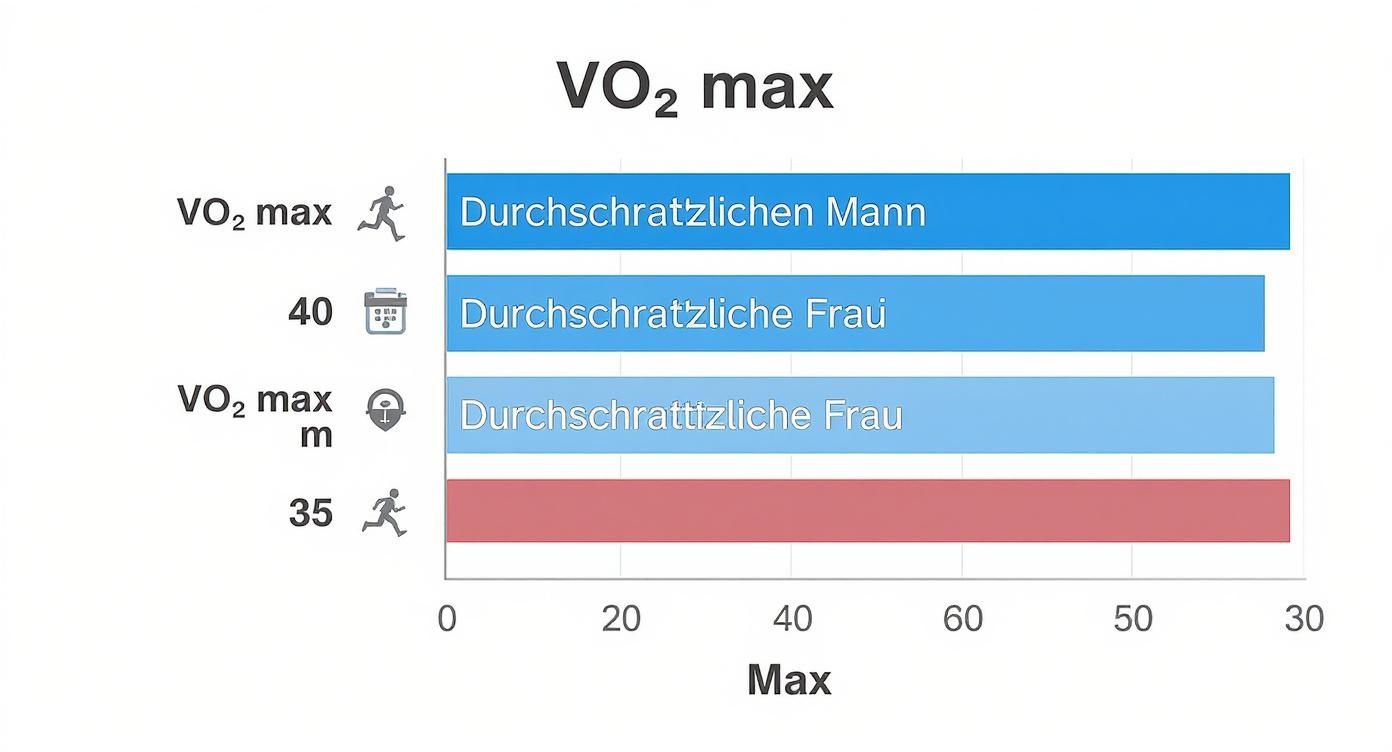
As you can see, men have a slightly higher average VO2 max value. This is not due to greater dedication to training, but has entirely natural, physiological reasons.
Why age and gender matter
Before you jump into the tables, let’s briefly clarify why we distinguish between age and gender in the first place. Men naturally tend to have more muscle mass, a larger heart, and more hemoglobin in their blood—all factors that promote oxygen transport in the body and thus lead to a higher VO2 max value.
At the same time, it is perfectly normal for maximum performance to gradually decline over the years. This is a biological process we all go through. But here’s the good news: you have the power to influence it! With regular training, you can not only slow this process down but also take your fitness to a new level.
VO2 max value table by age and gender
This table shows the average VO2 max values (in ml/min/kg) for men and women, divided into different age groups and fitness levels ranging from poor to excellent. This allows you to compare your value directly.
| Age group | Gender | Very poor | Poor | Average | Good | Excellent | Outstanding |
|---|---|---|---|---|---|---|---|
| 20–29 | Men | < 35 | 35–41 | 42–48 | 49–54 | 55–60 | > 60 |
| Women | < 29 | 29–33 | 34–39 | 40–45 | 46–51 | > 51 | |
| 30–39 | Men | < 33 | 33–39 | 40–45 | 46–51 | 52–57 | > 57 |
| Women | < 27 | 27–31 | 32–37 | 38–43 | 44–49 | > 49 | |
| 40–49 | Men | < 31 | 31–37 | 38–43 | 44–49 | 50–55 | > 55 |
| Women | < 25 | 25–29 | 30–35 | 36–41 | 42–47 | > 47 | |
| 50–59 | Men | < 29 | 29–35 | 36–41 | 42–47 | 48–53 | > 53 |
| Women | < 23 | 23–27 | 28–33 | 34–39 | 40–45 | > 45 | |
| 60+ | Men | < 27 | 27–33 | 34–39 | 40–45 | 46–51 | > 51 |
| Women | < 21 | 21–25 | 26–31 | 32–37 | 38–43 | > 43 |
Important: These tables are a great guide, but they are not a rigid rule. Your personal value also always depends on your training history and genetics.
These reference values are based on broad population data and provide a good average. Surveys, such as those conducted by the Robert Koch Institute (RKI), show that men between 20 and 29 often have values around 35–40 ml/min/kg, while women of the same age are typically at 27 to 30 ml/min/kg. After turning 30, the value often decreases by 5 to 10% per decade—if you do nothing to counteract it. If you want to explore the subject in greater depth, you can read more about the background of VO2 max values here.
What the tables primarily show is the enormous potential within you. Even if your value is only “average” today, you can improve significantly with the right training. In the next section, we’ll look at how to interpret your value correctly and what it means for you.
Interpreting your personal VO2 max value correctly
Reading a number on your watch is one thing. But what does that number really say about you and your fitness? That is the key point. Perhaps you saw in the VO2max Value Table that your value is considered “average.” But what does that mean in real life?
Your VO2max value is not a rigid label but a living indicator of your physical condition. It is influenced by so many factors. Don’t see it as a school grade, but as the starting point of your personal journey toward greater energy and health.
More Than Just Age and Gender
Of course, the tables provide an initial rough guide by breaking down the values by age and gender. But to truly understand your result, we need to dig deeper. Your personal value is made up of many individual components, like a mosaic.
These include, above all:
- Your genetics: Yes, your genes play a role. Some people naturally have a more efficient cardiovascular system.
- Your training level: Are you a seasoned athlete, or are you just getting started? A well-trained body is highly efficient at using oxygen.
- Your body weight: The value is given in milliliters per kilogram of body weight. Naturally, your weight plays a direct role here.
- Altitude: Do you live or train in the mountains? The thinner air there forces your body to adapt and use oxygen more efficiently.
Your VO2max value is not a verdict but a tool. It shows you where you stand and gives you the opportunity to decide where you want to go. Use it as motivation, not as a source of pressure.
What Your Value Means in Everyday Life
Let’s make it concrete. Suppose your value is “average.” That’s a great starting point! It means your cardiovascular system is fit for everyday life and you have a healthy foundation to build on. Climbing stairs or carrying your weekly groceries home? Probably no problem for you.
At the same time, an “average” value shows that there is still untapped potential. Imagine being able to chat comfortably with friends on your next walk without getting out of breath, or finishing your weekend bike ride with a smile. That freedom is exactly what an improved VO2max value can provide.
From Understanding to Action
Interpreting your value is the first step toward fully realizing your physical potential. It’s about recognizing your strengths and deliberately working on your weaknesses. Once you understand which levers you can adjust, you can really get started.
One factor is often overlooked: proper nutrient intake. Your training can be as perfect as possible—but if your body lacks the building blocks for oxygen transport and energy production, you’ll hit an invisible wall. We’ve also prepared detailed information on how to properly assess and improve your VO2 max value in a related article.
A nutrient test from mybody-x.com can provide valuable clarity here. It shows you clearly whether an unnoticed deficiency in iron or essential vitamins may be slowing your progress. This gives you the ideal foundation not only to keep your engine running, but to take it to an entirely new level.
How to reliably determine your VO2 max
Okay, now you know what the number on your watch or in your performance report means. But the key question is: How do you get a reliable value in the first place? There are several ways to determine your VO2 max—from highly accurate lab tests to simple methods you can carry out yourself.
The good news is that you don’t necessarily have to go to a lab. Every method has its advantages and disadvantages. We’ll introduce you to the most common ones so you can find the option that best suits your goals and budget.
The gold standard: spiroergometry in the lab
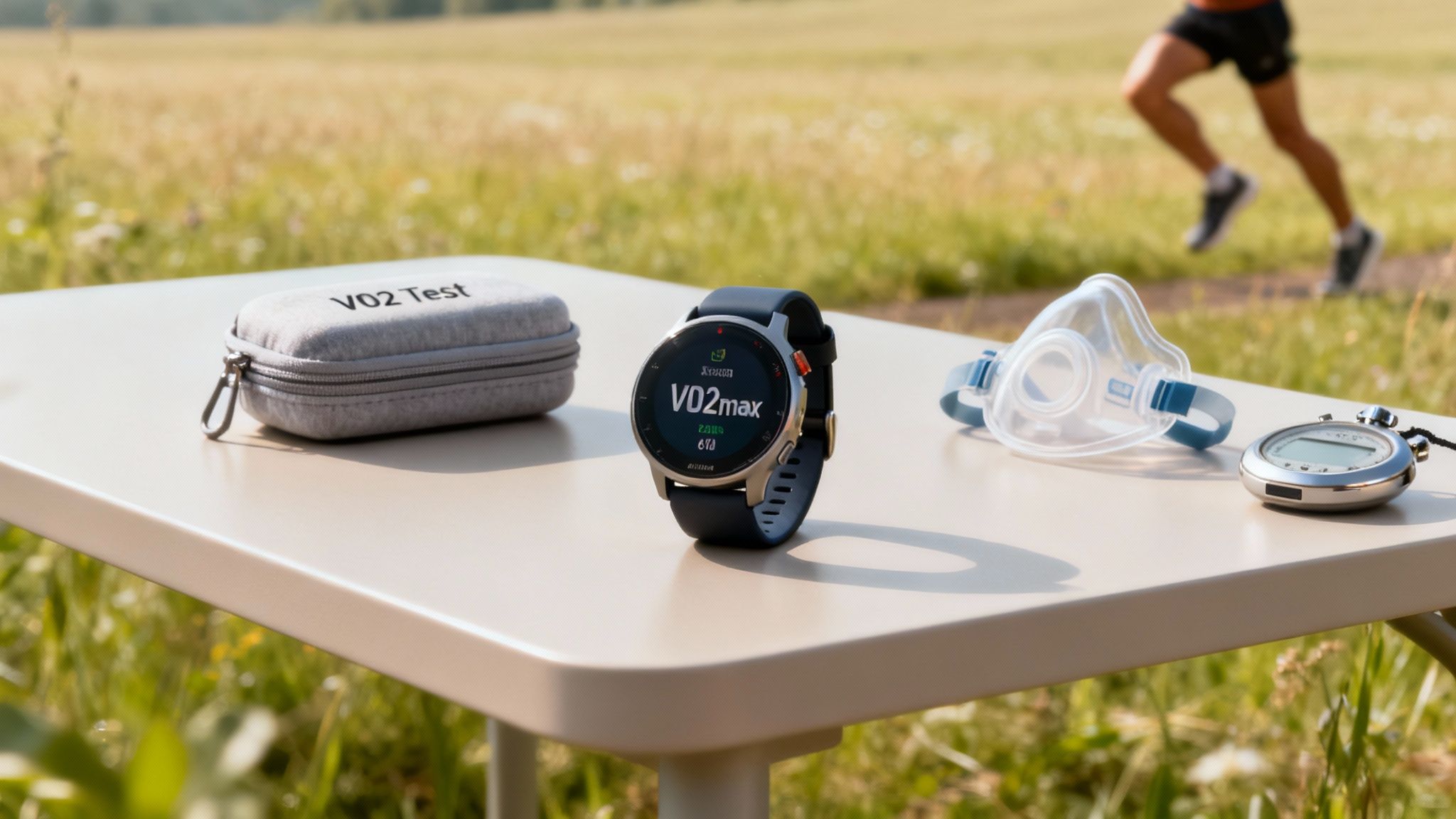
If you want to know exactly, there’s no getting around spiroergometry. It’s the gold standard of performance diagnostics, trusted by professional athletes too. You run or cycle while wearing a breathing mask as the intensity keeps increasing—until you really can’t go any further.
The mask measures exactly what your exhaled air is made up of. This makes it possible to determine precisely how much oxygen your body can absorb and use under maximum exertion.
- Advantage: It doesn’t get more precise than this. You get not only your VO2 max value, but also other extremely useful data such as your individual heart rate zones or your anaerobic threshold.
- Disadvantage: The effort involved is considerable and not exactly cheap. Expect costs of around 150–250 euros and an appointment at a sports medicine institute.
Convenient and close to the mark: the fitness watch
Modern sports watches from Garmin, Polar, and others are now surprisingly good at estimating your VO2 max. They use smart algorithms that process a whole range of data: your heart rate, heart rate variability, pace, and, of course, personal details such as age, sex, and weight.
Your smartwatch provides a good estimate of your VO2 max value, making it ideal for tracking trends and progress over time. However, the laboratory remains unmatched when it comes to absolute precision.
Of course, the accuracy cannot match that of a laboratory measurement. But for most recreational athletes and anyone who cares about their health, that is more than sufficient. The most important thing is consistency: The value primarily helps you track your progress over weeks and months. If your watch shows an increase from 42 to 45 ml/min/kg, that is a clear sign that your training is working.
The classic at-home option: field tests
You don't necessarily need expensive equipment to get a rough idea of your VO2 max. With so-called field tests, you can easily test your endurance yourself. The best-known of these is the Cooper Test.
The procedure is very simple:
- Warm up properly.
- Run on a flat, measured course (for example, a 400-meter track at a stadium) for exactly 12 minutes as fast as you can.
- Measure the exact distance you covered during this time.
You can then use a formula to calculate your estimated VO2 max value. Although tests like these are not as accurate as a watch or, indeed, a laboratory test, they give you a solid indication of your fitness.
Regardless of which method you choose, don't forget: A single value is always just a snapshot. Your daily condition, stress, or even the weather can influence the result. Much more important is to check your values regularly and keep an eye on your progress. To make sure your body is optimally prepared for this kind of exertion, it may be worthwhile to check important health markers. With the at-home health tests from mybody-x.com, you can make sure your nutrient supply is adequate and create the best conditions for reliable results.
Effective strategies for increasing your VO2 max
Okay, so now you know your VO2 max value. That is the first important step. But now the real work begins: targeted improvement. The good news is that your maximum oxygen uptake is not a number set in stone. With the right training, you can practically upgrade your cardiovascular system and take your endurance to an entirely new level.
We'll show you which training methods have proven most effective in practice for getting your inner engine really revving. But first, one thing: The best training is of little use if the invisible foundation is missing—the optimal supply of the right nutrients for your body.

Intensity is the key to success
To noticeably improve your VO2max, you need to challenge your cardiovascular system. You need to give it a reason to adapt and become stronger. The best way to do this is to train regularly at or near your performance limit. Two forms of training are absolute game changers here.
High-intensity interval training (HIIT) HIIT is essentially the turbo boost for your fitness. The principle is simple: You alternate between very intense exertion phases and short periods of active recovery. This method forces your heart to work at full capacity and pump the maximum amount of oxygen-rich blood to your muscles.
- For beginners: Run 4 to 6 repetitions of 400 meters at a fast pace. In between, walk 400 meters at an easy pace as a recovery break.
- For advanced athletes: Complete 5 repetitions of 4 minutes of running at 90–95% of your maximum heart rate, with 3 minutes of easy jogging between each.
Tempo runs With this method, you maintain a consistently high but still manageable pace for a longer period—say, 20 to 40 minutes. It feels strenuous, but you can just about keep going. Experts refer to this as training at the anaerobic threshold. It trains your body to use oxygen more efficiently and break down the lactate that accumulates more effectively.
Training provides the stimulus, but the actual improvement happens during the recovery phase. Give your body time to recover and the right nutrients to become stronger.
The effect of targeted endurance training is truly impressive. Studies show that significant improvements in VO2max of 10 to 30% are possible after just a few months of regular training. For example, an untrained adult can increase their value from around 35 ml/min/kg to 45–50 ml/min/kg within 3 to 6 months.
Don't forget the foundation: long, easy sessions
As important as intense sessions are, they are only the tip of the iceberg. You build the foundation of your endurance with long, easy runs or bike rides. These base-training sessions (at approximately 60–75 % of your maximum heart rate) improve the capillarization of your muscles. This means that more tiny blood vessels form, transporting oxygen even more effectively and deeper into the muscle cells.
Your body needs the right fuel
You can follow the smartest training program in the world—but if your body lacks the essential building blocks, you will keep running into an invisible barrier. Certain nutrients are absolutely essential for oxygen transport and energy production.
- Iron: Without iron, there is no hemoglobin in your red blood cells. If hemoglobin is lacking, oxygen cannot be delivered efficiently to the muscles. Your performance declines, no matter how hard you train.
- B vitamins (especially B12 and folic acid): These vitamins are essential not only for the formation of red blood cells but also play a central role in your cells’ energy metabolism.
- Magnesium: This mineral is involved in more than 300 metabolic processes that are important for muscle contraction and energy production.
A deficiency in these areas can sabotage your progress without you noticing it right away. You may simply feel tired and unfocused and wonder why your training is not producing the desired results. The cause could be a nutrient deficiency.
A nutrient test from mybody-x.com can provide clarity here. It precisely analyzes your blood values and shows you in black and white whether your nutrient levels are optimal or whether you should take targeted action. This gives you the perfect foundation to finally reap the rewards of your hard training.
And if you want to take it one step further: You can make your training even more personalized when you understand how your body responds genetically to different stimuli. In our article about the DNA-based training plan, you will learn how to tailor your training even more effectively to your needs.
Frequently asked questions about VO2max
You have now learned a great deal about VO2max, the tables, and the right training strategies. But as is often the case, a few questions still arise when you look at the details. Here, we debunk the most common myths and provide clear answers to eliminate your remaining uncertainties.
How quickly can I improve my VO2max?
This is one of the most fascinating questions, and the answer is a clear: It depends on where you start. Your current fitness level is the decisive factor.
As a beginner, you can look forward to quick and motivating results. Your body is not yet accustomed to the exertion and therefore responds extremely well to new training stimuli. Increasing your VO2max by 10 to 20% within the first three months is entirely realistic. After just a few weeks, you will already notice that climbing stairs or sprinting for the bus feels easier.
If, on the other hand, you are already a well-trained athlete, the improvements will naturally be smaller. Your system is already working very efficiently, and to get even better, you need to apply highly targeted stimuli. At this point, it is more about fine-tuning, for example by varying interval lengths or intensities. Progress comes more slowly, but is just as valuable.
Why is VO2max often lower in women?
This difference, which you can also see in any VO2max value chart, is purely biological. It says absolutely nothing about an individual woman’s performance or training status. It is important to understand these physiological differences in order to assess the values fairly.
The main reasons for this are:
- Body composition: Women naturally have a higher body-fat percentage and less muscle mass. Since VO2max is based on total body weight, this results in a lower value mathematically.
- Heart size: On average, men have larger hearts. This allows more oxygen-rich blood to be pumped into the circulatory system with each beat.
- Hemoglobin level: On average, men have a higher concentration of hemoglobin—the protein responsible for transporting oxygen. More “oxygen taxis” mean greater transport capacity.
It is crucial to emphasize that both sexes have an excellent ability to improve their VO2max through targeted training. The potential for relative improvement is entirely comparable.
What role do nutrients play in VO2max?
You can train as hard as you want—but if the engine doesn’t get the right fuel, it will never deliver its full performance. Your training is the stimulus, but your body needs the right building blocks to adapt and become stronger. Nutrients are the often-underestimated foundation here.
Iron is the prime example. It is the central component of hemoglobin. Iron deficiency inevitably leads to poorer oxygen supply to your muscles. The result: You feel sluggish, your performance stagnates or even declines.
But other micronutrients are also essential:
- B vitamins (e.g., B12, B9): They are essential for the formation of healthy red blood cells and play a key role in energy metabolism.
- Magnesium: This mineral is involved in hundreds of processes necessary for muscle contraction and energy production.
An unnoticed deficiency in these nutrients can sabotage your progress. A nutrient test from mybody-x.com can show you exactly whether such deficiencies are holding back your performance, helping you unlock your full potential.
Which sports improve VO2max the most?
The classic answer is running, and that is correct. But it is far from the only way to reach your goal. In general, all endurance sports that engage large muscle groups and get your cardiovascular system working hard are ideal.
The most effective sports include:
- Cycling: Especially uphill or during intense intervals, cycling is an excellent VO2max booster.
- Swimming: As a full-body sport, swimming challenges your entire system while being especially gentle on your joints.
- Rowing: Like swimming, rowing engages the arms, legs, and core while quickly raising your heart rate.
- Cross-country skiing: It is considered one of the most demanding endurance sports for good reason, with the highest measured VO2max values among top athletes.
The best approach is often a combination, also known as cross-training. This mix not only makes exercise more enjoyable but also reduces the risk of overuse injuries. It can even accelerate your performance gains.
Are you ready to remove the invisible brakes and give your body exactly what it needs for greater endurance and energy? At mybody-x.com, you’ll find scientifically backed blood tests that provide clarity about your nutrient levels. Find out with a simple at-home test whether your levels are optimal, and create the perfect foundation for your fitness goals. Discover the right blood tests now at mybody-x.com.



Share now:
Apple cider vinegar diet: What really works and what you should know
Matcha tea: How healthy is the green powder really?