

Gluten intolerance: Symptoms, causes, and your path to greater well-being
Do you often feel unwell after eating, struggle with digestive problems, or suffer from crushing fatigue? If you suspect that gluten might be the culprit, you’ve come to the right place. When faced with such symptoms, many people are quick to use the term “gluten intolerance,” but what is really behind it? It is crucial to understand the subtle but important differences, because not every reaction to wheat is the same.

Your body can react to gluten in very different ways. These reactions can be broadly divided into three categories. Although the symptoms often resemble one another, the causes and consequences are fundamentally different. To interpret your body’s signals correctly, we need to clearly distinguish these three forms:
- Celiac disease: A serious autoimmune disease in which the immune system attacks the person’s own small intestine.
- Non-celiac gluten sensitivity (NCGS): The actual “gluten intolerance,” in which symptoms occur without an autoimmune reaction or allergy.
- Wheat allergy: A classic immediate allergic reaction of the immune system to specific proteins in wheat.
The crucial difference: Celiac disease is not a simple intolerance
Celiac disease is the most severe form of reaction to gluten and clearly a chronic autoimmune disease. If you eat gluten while affected, something dramatic happens in your body: Your immune system sees gluten as an enemy and attacks not only it but also, mistakenly, the lining of your own small intestine.
This constant attack leads to chronic inflammation that damages the intestinal villi—tiny, finger-shaped projections responsible for nutrient absorption. Imagine sanding a fluffy carpet smooth. That is exactly what happens to the intestinal lining. The huge surface area available for nutrient absorption is drastically reduced, which can lead to deficiencies, weight loss, and a whole cascade of subsequent problems.
In Germany, about 1% of the population has celiac disease, with the risk for close family members being ten times higher.
Wheat allergy vs. wheat sensitivity: Immediate reaction or gradual symptoms?
Things are quite different with a wheat allergy. This is a typical food allergy, like those you know from nuts or shellfish. Here, the immune system reacts immediately and severely to wheat proteins by producing specific antibodies (IgE). Symptoms usually appear within minutes to hours and range from skin rashes and swelling to dangerous shortness of breath.
And then there is non-celiac gluten sensitivity (NCGS)—the “third way,” so to speak. Here, symptoms occur that resemble those of celiac disease, but blood tests reveal neither the typical antibodies associated with celiac disease nor those associated with a wheat allergy. The intestinal villi also remain intact. It is a diagnosis by exclusion: If celiac disease and wheat allergy have been ruled out, but symptoms clearly persist when consuming gluten, this is referred to as NCGS.
This means that although your body reacts to gluten, it does not harm itself as it does with an autoimmune disease. The symptoms are nevertheless real and often very distressing.
To clear up the confusion once and for all, here is a clear overview:
Overview of gluten-related disorders
This table provides an at-a-glance overview of the key differences between celiac disease, non-celiac gluten sensitivity, and wheat allergy.
| Characteristic | Celiac disease | Non-celiac gluten sensitivity (NCGS) | Wheat allergy |
|---|---|---|---|
| Type of reaction | Autoimmune disease | Intolerance reaction (mechanism unclear) | IgE-mediated allergy |
| Trigger | Gluten (in wheat, rye, barley, etc.) | Gluten and/or other wheat components | Wheat proteins |
| Onset of symptoms | Gradual or acute, often hours to days later | Hours to days later | Usually immediate (minutes to 2 hours) |
| Intestinal damage | Yes, villous atrophy (shrinkage of the intestinal villi) | No, the intestinal lining remains intact | No |
| Diagnosis | Antibody blood test & small intestine biopsy | Diagnosis by exclusion (after ruling out the other two) | Skin prick test & IgE blood test |
| Treatment | Lifelong, strictly gluten-free diet | Gluten-reduced or gluten-free diet, often individually adjustable | Strict avoidance of wheat |
As you can see, it is incredibly important to look closely. Self-diagnosis is not sufficient here. You can also find comprehensive information on this topic in our guide to food intolerances.
Common symptoms that may indicate gluten
The signs of gluten intolerance are often like a puzzle—the individual pieces do not always seem to fit together at first glance. Many people immediately think of the stomach when they hear about this topic, and that is a good place to start. But your body’s reactions can extend far beyond classic digestive problems.
You may know the feeling: After a meal with bread, pasta, or pizza, your stomach feels like an inflated balloon. This is one of the best-known signals. But the symptoms are far more varied and often not limited to the gut. Let’s put the puzzle pieces together so you can better understand your body’s often subtle signals.
The obvious signs in the digestive tract
The gut is usually the first place where a reaction to gluten becomes noticeable. Since gluten can trigger inflammatory processes or disrupt bowel movements in people with an intolerance, the effects are often felt directly. Your body is sending you very clear signals here.
The most common gastrointestinal symptoms include:
- Bloating and a feeling of fullness: Your abdomen feels uncomfortably full and distended, often shortly after eating.
- Abdominal pain or cramps: This can range from a mild twinge to severe, cramp-like pain.
- Diarrhea or constipation: In some people, the gut responds with accelerated digestion; in others, with the exact opposite. A constant alternation between the two is also typical.
- Nausea: An uneasy feeling in your stomach that can make you lose your appetite.
These symptoms aren’t merely bothersome—they can severely limit your quality of life. But the story is far from over.
When symptoms extend beyond the stomach
What many people don’t know is that gluten intolerance can manifest through a whole range of symptoms that you would never initially associate with your diet. These “extraintestinal”—meaning occurring outside the gut—symptoms are often why people affected spend years searching for the cause of their complaints.
Remember: Your gut is the center of your health. Chronic irritation there can trigger a chain reaction throughout the body, making itself felt in many different places.
Let’s take a closer look at these hidden clues.
Chronic fatigue and exhaustion
Do you constantly feel as though you’re operating on autopilot, even though you’re actually getting enough sleep? This leaden fatigue that simply refuses to go away is a very common symptom. Your body uses an enormous amount of energy to fight the constant irritation caused by gluten. This leaves you feeling weak and exhausted.
“Brain fog” and concentration problems
Do you sometimes feel as though your brain is working through a thick fog? Word-finding difficulties, forgetfulness, or trouble concentrating on a task are often described as “brain fog”. These cognitive impairments may be directly related to the inflammatory processes triggered by gluten.
Skin problems as a reflection of the gut
Your skin is often a reflection of what is going on inside you. Gluten intolerance can manifest through various skin changes:
- Eczema and skin rashes: Sudden, itchy, or scaly patches of skin.
- Acne or blemished skin: Particularly in adulthood, a deterioration in the appearance of the skin can be an indication.
- Dermatitis herpetiformis Duhring: A rare but specific skin condition that causes intensely itchy blisters and occurs almost exclusively in people with celiac disease.
Headaches and migraines
Do you suffer from recurring headaches or migraine attacks that seem to have no explanation? Studies suggest a link between gluten consumption and an increased frequency of headaches in sensitive individuals.
Unexplained joint and muscle pain
Pain in the joints and muscles that cannot be attributed to an injury or overexertion can also be a symptom. Inflammatory messengers released in the gut can spread throughout the body and cause discomfort there.
If you recognize several of these symptoms in yourself, it may be worth taking a closer look. Your body may be trying to tell you something important.
How to reliably determine whether you have gluten intolerance
Do you have a vague suspicion that gluten could be behind your symptoms? That is an important first step. But to gain real clarity and take the right steps for your health, you need certainty. This section is your practical guide, accompanying you from the first signs to a reliable diagnosis.
The thought of doctor’s appointments and tests may cause some discomfort, which is completely understandable. But it is the only reliable way to find out what is really going on in your body. A professional diagnosis is essential before you radically—and possibly unnecessarily—change your diet.
The first step: seeing a doctor
If you suspect that you have gluten intolerance, your first point of contact should always be a doctor, preferably a gastroenterologist. They will first have a detailed discussion with you (known as a medical history) to understand your symptoms, medical history, and any family predispositions.
The most important thing: Under no circumstances should you start a gluten-free diet on your own before the tests have been carried out! This is absolutely crucial, because the tests only provide meaningful results if your body is regularly exposed to gluten. Without gluten in your system, the body no longer produces detectable antibodies, and possible damage to the intestinal lining could heal. This would make the diagnosis considerably more difficult or even impossible.
A reliable diagnosis is only possible if you continue to eat a normal, gluten-containing diet before the tests. This is the only way the doctor can see how your body reacts to gluten.
Blood tests as important indicators
The next step is usually a blood test. Your blood is tested for specific antibodies produced by the immune system in response to celiac disease. The most important markers are:
- Transglutaminase IgA antibodies (tTG-IgA): This is the most sensitive and specific test for diagnosing celiac disease.
- Endomysial IgA antibodies (EMA-IgA): This test is also very accurate, but somewhat more complex to evaluate.
- Total IgA: This value is also measured to rule out a rare IgA deficiency that could distort the results of the other tests.
If these antibodies are elevated in your blood, the suspicion of celiac disease is already very high. This is a strong indication, but not yet definitive proof.
This infographic will help you better categorize your symptoms and understand the path to a diagnosis.

The decision tree shows how different symptoms—from digestive problems to headaches—can be a good reason to have a possible gluten intolerance investigated.
A small-intestinal biopsy provides definitive clarity
To confirm a celiac disease diagnosis beyond doubt, a gastroscopy with a small-intestinal biopsy is usually required after a positive blood test. It sounds worse than it is: a thin tube (endoscope) is guided through the mouth into the small intestine to take tiny tissue samples from the intestinal lining.
These samples are then examined under a microscope. A pathologist can determine whether the intestinal villi—the projections that are so important for nutrient absorption—are damaged or flattened. This is a clear sign of celiac disease.
What about self-tests for home use?
Self-tests can also be an option for an initial assessment. These tests often measure the same antibodies as a doctor’s test, but using only a small blood sample from the fingertip. They can provide a useful initial indication, but they can never replace a comprehensive medical diagnosis. If you’re looking for clarity, you can learn more about the options for a home celiac disease test in our dedicated guide.
The number of undiagnosed cases of celiac disease is particularly high. In the past, it was assumed that only about 1 in 1,000 people were affected. However, newer studies show that the prevalence is closer to 1 in 200 to 300. This means that up to 0.5% of the population could have often undiagnosed celiac disease, as the symptoms are frequently gradual or atypical. You can find more information about these findings at the German Allergy and Asthma Association.
Your practical roadmap to a gluten-free life
The diagnosis is in—and now what? You probably feel a mixture of relief at finally knowing what's going on and a fair amount of uncertainty about what comes next. First, take a deep breath: Living gluten-free is not a punishment. It's your chance to finally feel truly energized and comfortable in your own skin again.
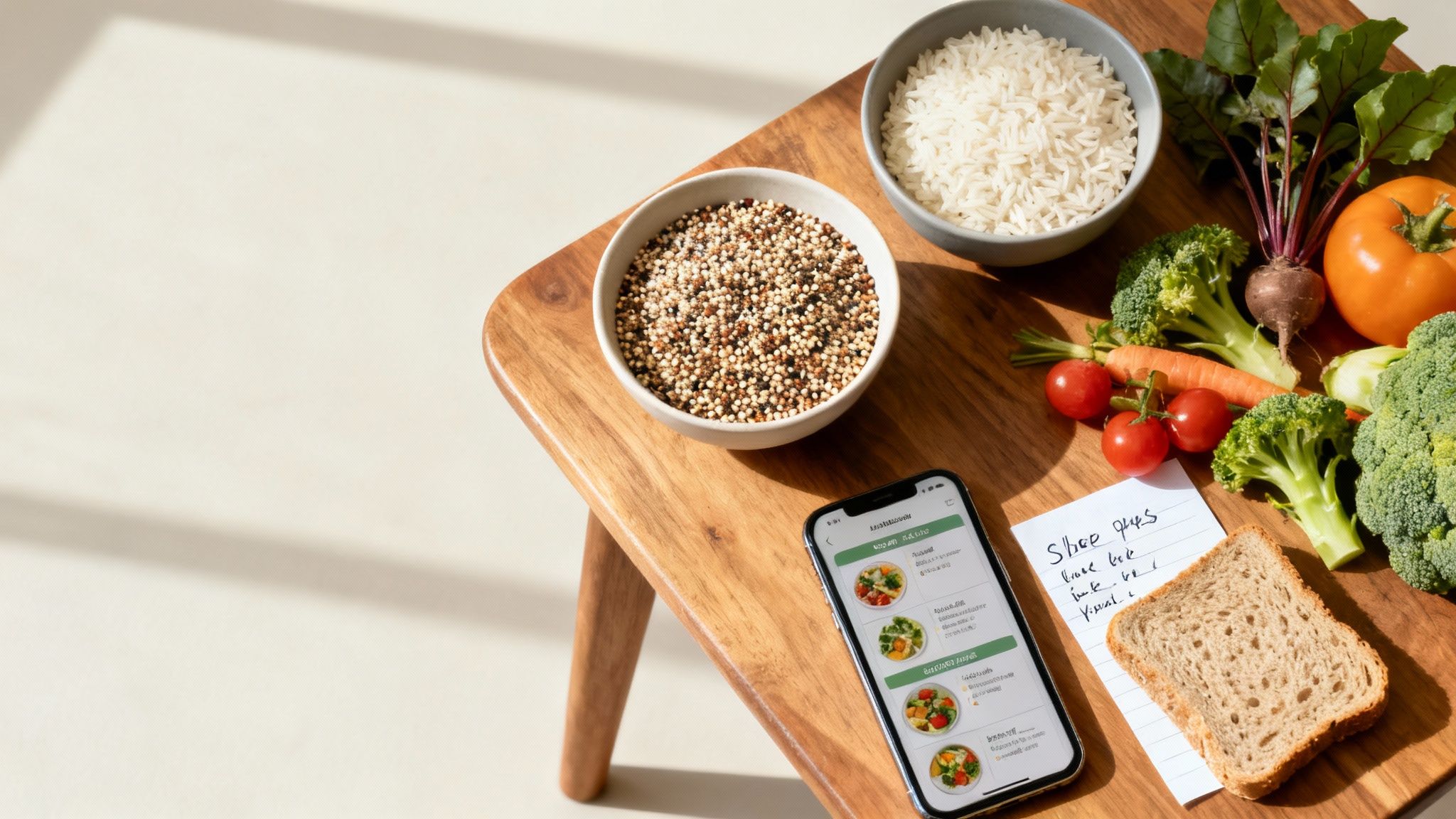
Switching to a gluten-free diet may feel like a huge mountain to climb at first. But don't worry—with a clear plan and the right knowledge, you can master it step by step. It's not about giving up everything, but about discovering a new, enjoyable way of eating that simply does your body good.
The basics of gluten-free cooking
The first and most important step is to understand which foods are naturally gluten-free. And there are far more than you might think! Instead of focusing on what you can no longer eat, direct your attention to the abundance of possibilities in front of you.
Your new shopping list could look something like this:
- Vegetables and fruit: Every fresh or frozen variety is your friend. They are packed with vitamins, minerals, and fiber.
- Legumes: Lentils, beans, chickpeas, and the like are true nutrient-rich powerhouses.
- Meat and fish: As long as they are unprocessed and free from marinades, you are always on the safe side.
- Eggs and dairy products: Plain yogurt, quark, cheese, and milk are naturally gluten-free.
- Nuts and seeds: Almonds, walnuts, flaxseeds, and chia seeds are perfect snacks and add the finishing touch to your dishes.
- Gluten-free grains & pseudograins: Rice, corn, millet, quinoa, buckwheat, and amaranth are fantastic alternatives.
With these ingredients alone, you can already create countless delicious dishes without any special substitute products. The diet for celiac disease and wheat sensitivity is based precisely on this variety of natural foods, which we examine in detail in a further article.
Beware of hidden gluten: The invisible enemy
The biggest challenge at the beginning is identifying products in which you would never suspect gluten. In the food industry, this sticky protein is highly popular as a binding agent, flavor carrier, or stabilizer.
Be especially vigilant at first and read the ingredients list of every single product. What may initially sound tedious will quickly become second nature.
Here are a few typical sources of hidden gluten lurking in the supermarket:
- Ready-made meals & sauces: Many sauces, dressings, and instant soups are thickened with gluten-containing starch.
- Spice blends: They often contain wheat starch as an anti-caking agent to prevent the spices from clumping.
- Sausage products: Breaded meat is obvious, but gluten is also hidden as a binding agent in many types of sausage and meat preparations.
- Sweets: Licorice, some types of chocolate, and even chips may contain barley malt extract.
- Medication & dietary supplements: Yes, gluten-containing starch can also be used as a filler here. If in doubt, always ask at the pharmacy!
Interestingly, the market for gluten-free products is growing steadily, even though not every buyer has a medical diagnosis. The number of people who regularly buy gluten-free foods rose to around 2.16 million, which corresponds to approximately 3% of the German population. By contrast, the number of people actually affected by celiac disease is around 1%. If you are interested in these figures in more detail, you can find further insights at Statista.
Confidently overcoming social hurdles
Changing your diet affects not only you personally but also your social life. A restaurant visit or an invitation to friends’ homes can suddenly become a real challenge. But here, too, there are simple strategies to help you stay completely relaxed.
Eating out without stress
- Do your research in advance: Many restaurants now have an allergen menu or even a separate gluten-free menu. A quick call beforehand can quickly provide clarity.
- Communicate clearly: Explain your situation to the service staff in a friendly but firm manner. A phrase such as: “I have a gluten intolerance and need to be very careful about what I eat” works wonders.
- Choose simple dishes: A grilled piece of fish or meat with baked potatoes and salad is usually a safe bet. Avoid dishes with complex sauces or breading if you are unsure.
Invitations from friends and family
Talk openly with your hosts. Most people are very understanding and would like to accommodate you, but often simply don’t know how. Offer to bring your own gluten-free side dish or dessert—that takes the pressure off the host, and you are guaranteed to have something delicious and safe to eat.
The transition to a gluten-free life is a process, not a sprint. Be patient with yourself, celebrate your small successes, and discover the joy of a diet that strengthens you and gives you new energy.
The important connection between gut health and gluten
Do you sometimes wonder why you react so sensitively to gluten while friends and family seem to enjoy pizza and pasta without any problems? You’ll often find the answer not in gluten alone, but in the state of your gut. It is the true center of your well-being and the key to understanding your intolerance.
To unravel this connection, we need to take a little excursion into the fascinating world of your microbiome. Don’t think of your gut simply as a digestive tube, but as a pulsating, living ecosystem. Trillions of microorganisms—bacteria, viruses, and fungi—live here, together forming your gut flora and having a huge influence on your health, immune system, and even your mood.
The concept of leaky gut syndrome
Normally, your intestinal lining is an extremely robust yet highly selective barrier. It acts like a strict bouncer: Only fully digested nutrients, vitamins, and minerals are allowed into your bloodstream. Everything else—such as undigested food particles, toxins, or harmful bacteria—is consistently rejected and safely escorted back out.
For some people, however, this protective wall becomes permeable. This is known as “leaky gut syndrome”, or a “leaky intestine.” The tight connections between intestinal cells, known as “tight junctions,” loosen. Suddenly, substances can enter the bloodstream that absolutely do not belong there—including incompletely digested gluten fragments.
Your immune system, which is about 80 % in the gut recognizes these intruders as foreign bodies immediately and raises the alarm. It triggers an immune response that leads to chronic, often unnoticed inflammation. This can spread throughout the body and cause exactly the wide range of symptoms you know as gluten intolerance.
A gluten-free diet is the first, absolutely logical step here. You’re essentially removing the ignition key from the lock to stop the constant irritation and give your immune system a break. But that still doesn’t solve the root of the problem.
Why Your Gut Flora Is Your Most Important Ally
A healthy and diverse gut flora is the key factor in maintaining a strong intestinal barrier. Certain “good” gut bacteria produce short-chain fatty acids such as butyrate—the main source of energy for your intestinal cells. Butyrate keeps the cells healthy and the connections between them tightly sealed.
But when this delicate balance is disrupted—experts refer to this as dysbiosis—it can have far-reaching consequences. An imbalanced gut flora can promote the development of leaky gut, opening the door wide to intolerances such as gluten intolerance.
So the long-term solution lies not only in eliminating certain foods, but in actively healing and strengthening your gut. It’s about rebuilding the foundation of your health from the ground up.
Here’s what you can actively do for your gut health:
- Promote diversity: Eat as many different plant-based foods as possible. Every type of fruit and vegetable feeds different beneficial bacterial strains in your gut.
- Choose probiotics: Fermented foods such as plain yogurt, kefir, sauerkraut, and kimchi provide live bacterial cultures that directly enrich your gut flora.
- Feed your little helpers with prebiotics: Fiber from leeks, onions, garlic, asparagus, and legumes is your beneficial gut bacteria’s absolute favorite food.
- Reduce stress: Chronic stress can negatively affect the composition of your gut flora and has been shown to weaken the intestinal barrier.
By addressing the causes and providing targeted support for your gut, you create the foundation for lasting improvement. A detailed analysis of your gut can help you understand its current state and make targeted adjustments in the right areas. If you would like to learn more about how to check the status of your gut bacteria, our article on the at-home microbiome test offers valuable insights.
Your next step toward greater well-being
Let’s sum up: You now have a fairly clear picture of what gluten intolerance is, how you might recognize it, and what options are available to finally gain clarity. But honestly, knowledge alone doesn’t change anything. The decisive part starts right now—when you take action and take your health into your own hands.
Your body may have been sending you signals for quite some time. Now is the time to really listen to it. A very simple but incredibly effective place to start is to record your observations. A food diary can reveal connections you would never have suspected and often provides the first crucial clues.
How to proceed now
The path to greater clarity and a better gut feeling doesn’t have to be complicated. Here are three practical steps you can take right away to get to the bottom of the causes of your symptoms:
- Observe mindfully: Keep a detailed diary for two to four weeks. Don’t just write down what you eat, but above all how you feel afterward—physically and mentally. The answers are often hidden in precisely these patterns.
- Seek professional advice: Take your suspicions and your diary to the doctor and speak openly about them. Professional medical evaluation is essential for obtaining a reliable diagnosis and ruling out other causes.
- Take the initiative: A reliable home self-test can be a great first point of reference. It can help substantiate your suspicion and prepare you optimally for your conversation with your doctor.
Think of this article as your personal map. You now have everything you need to set out on the path to a life with fewer symptoms. It’s up to you to take the first step and actively shape this journey.
Every step, no matter how small, counts and brings you a little closer to your goal. Use what you know now to finally initiate positive, lasting changes for yourself. It’s best to start today.
Frequently asked questions about gluten intolerance
Finally, let’s clarify a few questions that we keep receiving about gluten intolerance. They summarize the key points for you and give you the confidence you need for your next steps.
Especially at the beginning, there is often uncertainty about how strict and long-lasting the dietary change really needs to be. And this is one of the most important questions of all.
Do I have to avoid gluten forever?
That depends very much on your diagnosis. There is no one-size-fits-all answer here, because the cause determines the treatment. Professional medical evaluation is therefore essential to find the right path for you.
- With celiac disease: Yes, a lifelong and strict avoidance of gluten is necessary here. Since this is an autoimmune disease, even the smallest amount of gluten would repeatedly trigger the harmful immune reaction in the gut.
- With non-celiac gluten sensitivity (NCGS): The situation is often more flexible here. After an initial phase of strict avoidance and targeted gut restoration, the tolerance threshold may improve again for many people affected. It is quite possible that after some time you will tolerate small amounts of gluten again without experiencing symptoms.
Are gluten-free products automatically healthier?
A widespread misconception: The label “gluten-free” is automatically a guarantee that a product is healthy. Unfortunately, that is not the case. To replace the missing binding agent gluten, many of these substitute products often contain more sugar, fat, and various additives.
A mindful diet based on naturally gluten-free foods such as vegetables, fruit, legumes, rice, or quinoa is almost always the healthier and more nutrient-rich choice compared with highly processed substitute products.
How quickly will I notice an improvement?
The answer is as individual as you are. Your body needs time to recover, and this period can vary greatly. Some people notice a significant improvement in their symptoms after just a few days, such as bloating or fatigue.
For others, it can take several weeks or even months for the gut to fully recover and for the symptoms to subside sustainably. Be patient with your body. Consistency and a positive attitude are the keys to success on your journey toward greater well-being.
Would you like to gain clarity about your reactions to food and take control of your health? At mybody-x.com, you will find scientifically sound self-tests for use at home that help you better understand your body’s signals. Discover how precise analyses can help uncover the causes of your symptoms and optimize your diet in a targeted way. Find the right test for you now at https://mybody-x.com.


Share now:
Fat, carbohydrates, protein: your guide to the most important nutrients
What type of metabolism do I have? What a test really shows