
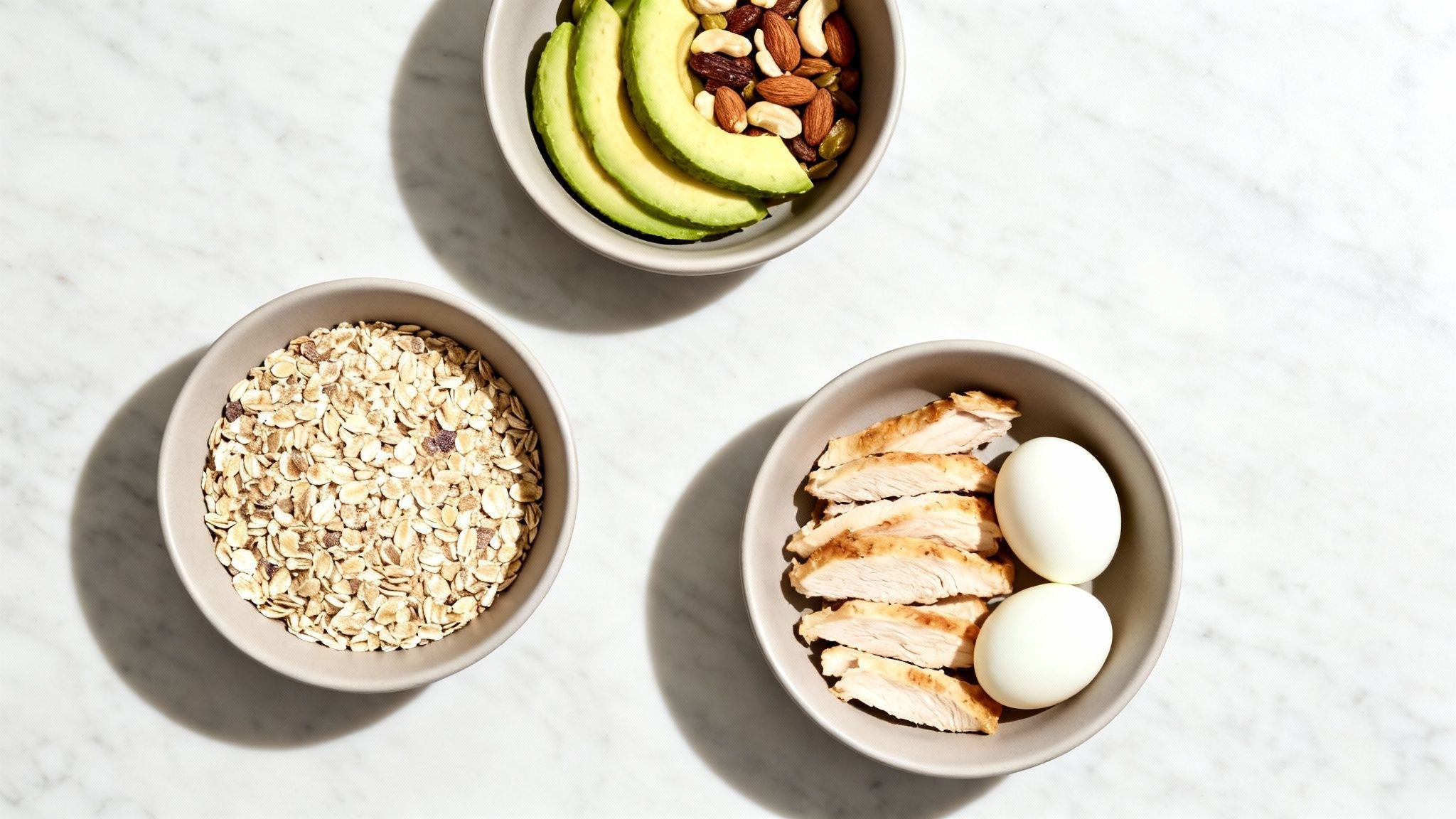
Fat, carbohydrates, protein: Your compass for the most important nutrients
Welcome to your personal guide to the cornerstones of your diet: fat, carbohydrates, and protein. These three building blocks, often also called macronutrients, are the foundation of your health and well-being. They provide the energy and building materials your body needs every single day.
What are macronutrients really?
You probably hear contradictory advice all the time—sometimes carbohydrates are the enemy, then it's fat again. We will shed light on the confusion and explain in simple terms why your body needs all three of these macronutrients. They are the foundation for everything that takes place in your body.
Simply think of them as your body's management team:
- Carbohydrates are the fast energy manager for immediate power.
- Protein is the diligent construction manager for your muscles and cells.
- Fat acts as a clever communications director and important protective shield.
This article is not a dry science lecture, but your practical guide. It is designed to help you better understand your body's signals and finally make mindful decisions about your diet.
If you want to start with the basics, our article explains exactly what a nutrient actually is. By the end of this guide, you will know exactly how to find the right balance that is perfect for you and your goals.
Carbohydrates as your primary energy provider
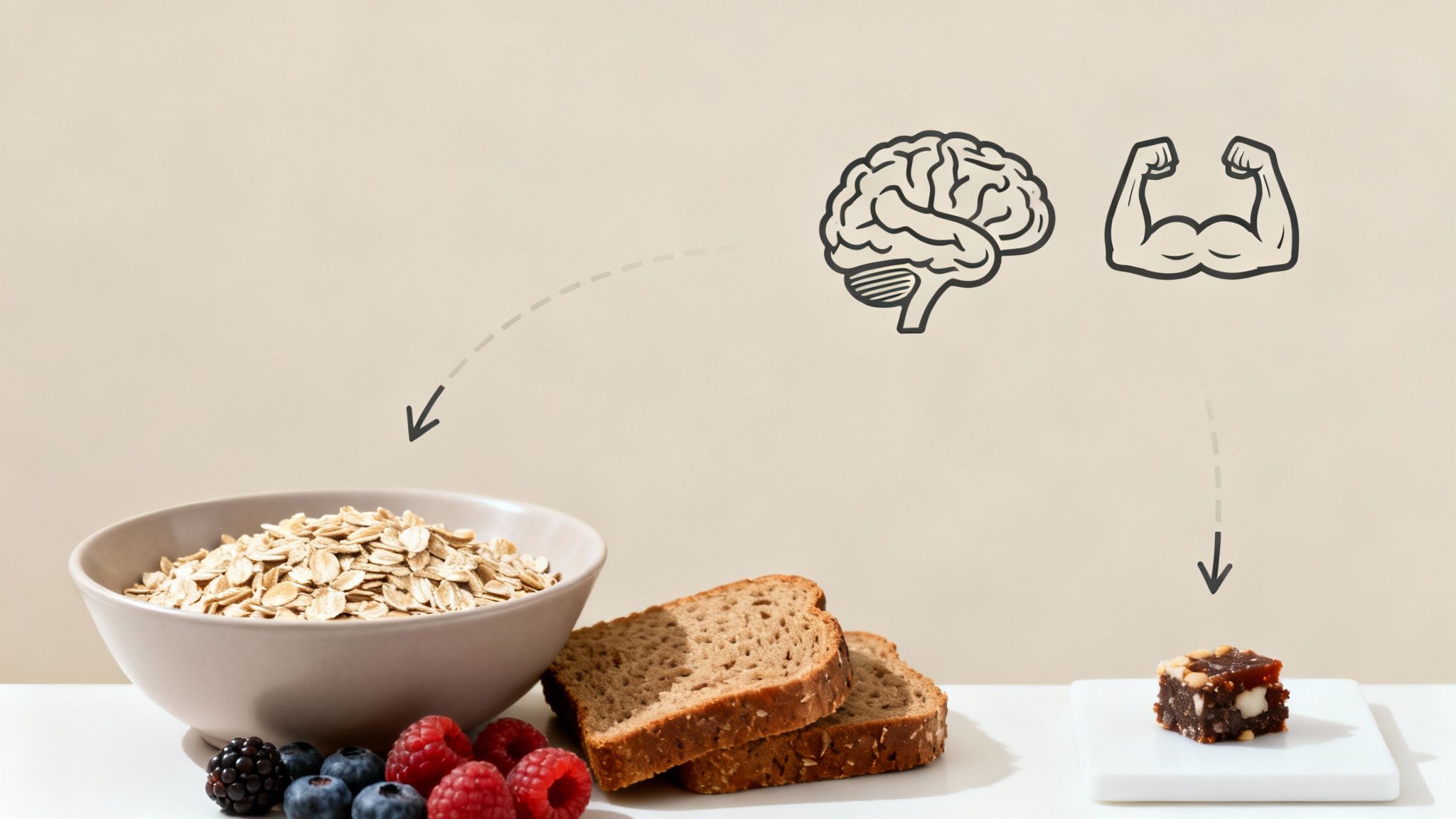
Carbohydrates are your body's ultimate turbo fuel. Think of your metabolism as an engine: fat, carbohydrates, and protein are all usable fuels, but carbohydrates ignite the fastest and provide immediate energy.
Your brain and muscles in particular depend on a constant supply to perform at their best. Without it, you quickly feel tired, unfocused, and lacking motivation. But beware: not all carbohydrates are the same. This is exactly where the key to a smart diet lies.
Simple vs. complex carbohydrates
The major difference lies in their structure and how quickly your body converts them into energy. You can think of it like building a fire:
- Simple carbohydrates: These are your kindling—paper and small twigs. They are found in sweets, white flour, and sugary drinks. They provide a quick, intense burst of energy, but it fades just as quickly. The result? The classic energy crash, followed shortly by cravings.
- Complex carbohydrates: These are the thick logs. You’ll find them in whole-grain products, oats, legumes, and vegetables. Your body first has to break them down slowly, which releases the energy steadily over several hours. This provides long-lasting satiety and a stable energy level.
The myth that carbohydrates automatically make you gain weight has long been debunked. It’s not the nutrient itself that matters, but its quality and quantity. By consciously choosing the right carbs, you ensure sustainable energy throughout the day.
How much energy do you really need?
In Germany, carbohydrates mainly come from grains and sugar. Nutrition experts recommend that adults consume around 250 grams of carbohydrates per day, as they are the most important source of energy for muscles and the brain. The German Nutrition Society (DGE) repeatedly emphasizes that whole-grain options rich in fiber are clearly the better choice for your health. For details, you can consult the DGE’s current dietary recommendations.
It’s not about demonizing carbohydrates, but about learning how to use them smartly to your advantage. They are the foundation of your physical and mental performance.
When you choose complex sources, you give your body not only energy but also valuable fiber, vitamins, and minerals. Want to dive deeper? Our guide explains exactly what makes carbohydrates truly healthy.
Protein as a building block of life

Now that we’ve established that carbohydrates are the fuel for your body, let’s move on to the building material: protein. Unlike fat and carbohydrates, protein is not primarily intended as a source of energy. Rather, it is the fundamental building block for pretty much everything that happens in your body.
Think of your body simply as a house. Protein provides the bricks, in the form of amino acids, that are necessary for construction and constant repair. Every cell, every muscle, your skin, your hair, and even hormones and enzymes—all consist of these tiny building blocks. Without an adequate intake, your body cannot function properly.
Why proteins are so important
A good protein supply is about much more than just feeding athletes’ muscles. It is the key to a robust and resilient body. Proteins are involved in countless processes.
Here is an overview of their most important functions:
- Muscle maintenance and growth: Protein is essential, especially if you are physically active or older, to protect and strengthen your muscle mass.
- Strong immune system: Antibodies that fight pathogens are nothing more than highly specialized proteins.
- Good satiety: Of all three macronutrients, protein keeps you feeling full the longest. This helps you get cravings under control and regulate your weight.
- Structure and repair: Proteins are responsible for tissue regeneration after injuries and ensure the strength of your skin, hair, and nails.
Your body is a master at recycling, but it cannot store proteins long-term like it stores fat or carbohydrates. That is why you depend on a regular intake through your diet to keep all vital structures intact.
Animal and plant-based protein sources
The good news: Protein is found in many foods. Basically, a distinction is made between animal and plant-based sources. Animal proteins from meat, fish, eggs, and dairy products are considered “complete” because they contain all nine essential amino acids—that is, those your body cannot produce itself.
Plant-based sources such as legumes, nuts, seeds, and grains are also fantastic sources of protein. The trick is to cleverly combine different plant-based sources throughout the day to cover the complete amino acid profile. A classic combination is lentils and rice or hummus with whole-grain bread.
In Germany, the average protein requirement is usually well covered. The German Nutrition Society (DGE) recommends an average of 48 grams for women and 57 grams for men for adults between 25 and 51 years of age. This corresponds to approximately 0.8 grams of protein per kilogram of body weight.
However, your personal requirements can vary significantly depending on your activity level, age, and goals. If you want to know more precisely, take a look at our article on calculating your daily protein requirements.
Fat as a shield for cells and hormones
Fat had a pretty bad reputation for a long time. Many people still see it as nothing more than something that makes you fat. But the truth is: fat is just as vital to your health as protein and carbohydrates. Think of it as your body’s communications director and head of security at the same time.
So it’s not about avoiding fat completely. Much more important is to consciously choose the right fats and understand why they are so incredibly valuable to us.
Imagine your body’s cells as small fortresses. Their walls—the cell membranes—need to be stable while also remaining flexible so they can let important nutrients in and waste products back out. High-quality fats are the building material for these strong, elastic walls. Bad fats, on the other hand, make the walls rigid and brittle, disrupting overall cell function.
Good fats and bad fats
As you can see, not all fat is the same. Quality is absolutely crucial to how it affects your body. The biggest differences lie in the chemical structure of the fatty acids, as this determines how your body ultimately processes them.
Here’s a simple rule of thumb:
- Unsaturated fatty acids (the “good” ones): These are the flexible building blocks. They keep your cell walls supple, support your cardiovascular system, and can even reduce inflammation. You can find plenty of them in avocados, nuts, olive oil, and fatty fish such as salmon.
- Saturated fatty acids (enjoy in moderation): These are found mainly in animal products such as butter, cheese, and fatty meat. In small amounts, they are perfectly harmless, but too much can negatively affect blood lipid levels.
- Trans fats (the “bad” ones): You should avoid these industrially hardened fats found in processed foods, fried dishes, and many baked goods as much as possible. They make cell walls rigid and fuel inflammatory processes in the body.
Fats are not just sources of energy. They are also essential for absorbing the fat-soluble vitamins A, D, E, and K. Without fat, your body cannot absorb and use these important vitamins from food in the first place.
Fat in practice
Fat is also the raw material for producing many important hormones, including sex hormones such as testosterone and estrogen. A balanced hormone system is fundamental to your mood, energy, and overall metabolism. A healthy fat metabolism ensures that all these processes run smoothly.
In Germany, average fat consumption is around 37 percent of daily energy intake—well above the recommended upper limit of 30 percent. What matters most is the quality of the fat. Studies clearly show that replacing saturated fatty acids with polyunsaturated fatty acids, such as those found in plant-based oils, has a positive effect on cholesterol levels and the cardiovascular system. You can find more information in the recommendations on fat consumption from the Federal Centre for Nutrition.
Instead of fearing fat, learn to use it as a valuable tool for your health. A handful of nuts as a snack, a drizzle of high-quality olive oil over your salad, or an avocado on whole-grain bread—these are simple ways to provide your body with what it really needs.
How to find the right macro balance for you
Okay, you now know the individual players—fat, carbohydrates, and protein. But how do you arrange them as a team so they deliver the best results for you and your goals? The bad news first: There is no one-size-fits-all formula. The good news: Your ideal balance is as individual as you are.
The perfect distribution of fat, carbohydrates, and protein depends directly on your personal goals. Do you want to lose weight, build muscle, or simply have more energy in everyday life? Your daily activity level and the way your metabolism works also play a decisive role.
Your goal determines the path
To find your personal macro distribution, you first need to clearly define your main goal. Depending on what you want to achieve, the proportions of the three major nutrient groups will shift.
Here are three common approaches that can serve as a guide:
- Balanced mixed diet (e.g., 40-30-30): This approach is perfect for maintaining general health and stable energy levels. About 40% of your calories come from carbohydrates, 30% from protein, and 30% from fat. This is a highly sustainable way to provide your body with everything it needs.
- Protein-focused diet (e.g., 30-40-30): Ideal if you want to build muscle or protect your hard-earned muscle mass while dieting. A higher protein intake of around 40% promotes greater satiety and boosts recovery. Carbohydrates and fats are reduced slightly to compensate.
- Low-carb approach (e.g., 20-40-40): This method is extremely popular for effectively reducing body fat. By limiting carbohydrates to around 20%, you essentially force your body to rely more heavily on fat as an energy source. Protein and fat play the leading roles here.
One thing always applies, regardless of which path you choose: The quality of your food is and remains the most important factor. High-quality, unprocessed sources are the key to success—regardless of the percentage distribution.
A practical guide to your nutrient distribution
To make getting started easier, we have put together a table. It is intended to show you what such a distribution might look like in everyday life and give you a sense of how to structure your meals flexibly and purposefully.
Example macronutrient distribution for different goals
This table shows example percentage distributions of carbohydrates, protein, and fat, along with specific food examples for different health and fitness goals.
| Goal | Carbohydrates (%) | Protein (%) | Fat (%) | Example foods |
|---|---|---|---|---|
| Balanced energy | 40 % | 30 % | 30 % | Oatmeal, quinoa, chicken, lentils, avocado, nuts |
| Muscle building | 30 % | 40 % | 30 % | Low-fat quark, eggs, fish, sweet potatoes, broccoli, olive oil |
| Weight loss | 20 % | 40 % | 40 % | Salmon, leafy greens, tofu, berries, almonds, chia seeds |
Treat these figures as a starting point, not rules set in stone.
This infographic also helps you quickly distinguish between good and less beneficial sources of fat.

The key message is clear: Plant-based fats from unprocessed sources are almost always the better choice for your health.
At the end of the day, what matters is how you feel. Experiment with these approaches and observe how your body responds. Do you feel energized and satisfied? Are you getting closer to your goals? Your diet is not a rigid concept; it can continue to evolve along with you.
Targeted nutritional support
Understanding the theory of fat, carbohydrates, and protein is the first important step. Of course. But the real art lies in applying this knowledge in stressful everyday life. And let’s be honest: Sometimes you simply need targeted support to ensure your body really gets everything it needs.
This is precisely where smart additions come into play. They are not a shortcut, and certainly not a substitute for a balanced diet, but rather an intelligent supplement to close small gaps in the system. Think of them as your personal helpers, always there when everyday life once again leaves you short on time.
Targeted support for your goals
Every body is different and has its own needs. You may find it difficult to get enough protein from your meals alone to protect or build muscle—it's a very common problem.
Here are two examples of how you can optimize your diet effectively:
- For your protein intake: When the day once again leaves no time for a balanced meal or you need something high-quality quickly after exercising, a pure protein powder is worth its weight in gold. It provides your body with readily available amino acids for recovery and growth without making you spend ages in the kitchen.
- For your healthy fat intake: Honestly, who eats fatty fish several times a week? To ensure you still get enough anti-inflammatory omega-3 fatty acids, high-quality omega-3 capsules are a highly practical and effective solution.
It's not about replacing real meals. Rather, the goal is to optimize your mindful, healthy diet where it truly matters, helping you reach your goals faster and more sustainably.
At mybody-x, we see ourselves as your partner on this journey. We offer pure, laboratory-tested products that support you in mastering the balance between fat, carbohydrates, and protein. Our products are designed to fit seamlessly into your healthy lifestyle and help you unlock your full potential.
Frequently asked questions about macronutrients
After all the information about fat, carbohydrates, and protein, there are often still practical everyday questions left. We've collected the most common ones and provide clear, easy-to-understand answers so you can make the right decisions with confidence.
Are carbohydrates in the evening really off-limits?
This is one of the most persistent myths of all. The short answer: No, eating carbohydrates in the evening doesn't automatically make you fat. What really matters is your total calorie balance throughout the day.
As long as you don't exceed your calorie target, your body won't simply store the energy from carbs as fat just because it gets dark. On the contrary: For some people, a small portion of complex carbohydrates in the evening may even improve sleep because it stimulates the production of the sleep hormone melatonin.
How much protein do I really need?
Your protein needs are highly individual—they depend on your age, weight, and above all, your activity level. As a general guideline, the German Nutrition Society (DGE) recommends around 0.8 grams of protein per kilogram of body weight for an average active adult.
However, if you’re very physically active, want to build muscle, or are focused on preserving muscle during a diet, your needs may increase significantly. In that case, values between 1.2 and 2.0 grams per kilogram of body weight are a good target range to optimally support your muscles.
A widespread misconception is that “more” protein is always helpful. While an increased intake makes sense for active people, more isn’t automatically better. An extremely high intake can strain the kidneys over time and provides no additional benefit for muscle growth.
Does fat inevitably make you fat?
No, that idea is outdated. Sure, fat is the most energy-dense nutrient, with nine calories per gram, but it doesn’t make you fat on its own. On the contrary: high-quality fats are absolutely essential for countless processes in the body.
They are building blocks for hormones, protect your cells, and help you absorb important vitamins. Healthy fats from avocados, nuts, or high-quality olive oil also keep you feeling full for longer and can help curb cravings. As with everything, the amount—and above all, the quality—makes the difference.
Do I need to track my macronutrients precisely?
To start with, it can be really helpful to track your intake of fat, carbohydrates, and protein for a few weeks. This gives you an invaluable sense of which foods provide what and where you might still need to make adjustments.
In the long term, however, most people don’t need to count every gram meticulously. Once you’ve developed a good understanding of balanced meals, you can increasingly rely on how your body feels. The goal is to find a sustainable and flexible way of eating that fits into your life—not the other way around.
Are you ready to delve even deeper into the world of your body and discover what’s really inside you? With the scientifically backed health analyses from mybody-x, you can understand your metabolism, nutrient status, and genetic predispositions in detail. Take control of your health with precision and confidence—find out now which test is right for you. Discover your personal health analysis at mybody-x.com.


Share now:
Metabolic disorder: Everything you need to know
Gluten intolerance: Symptoms, causes, and your path to greater well-being