

Maintaining weight after weight loss: what really helps
The key points at a glance
The difficult phase begins after weight loss. The Institute for Quality and Efficiency in Health Care puts it directly: Maintaining weight loss over the long term is usually more difficult than losing the weight itself (2022). The MSD Manual quantifies the scale of the problem and states that most people return to their pre-treatment weight within five years (2025).
The reason lies in the body, not in willpower. After a reduction in calorie intake, the body compensates, according to the same source, through increased appetite and lower energy expenditure at rest. Anyone who knows this plans the phase afterward differently than if they view it as a matter of discipline.
You will first read why maintenance is the real task. This is followed by the numbers on relapse, the five-percent threshold, a comparison of three approaches to the time afterward, the role of exercise and self-monitoring, and the question of which measurements actually show anything during this phase.
What to expect in this article
1. Why the phase afterward is the real task
2. What the sources say about maintenance
3. What the body does after weight loss
4. Relapse in numbers
5. Why five percent is considered the threshold
6. Which measurements matter during this phase
7. Three ways through the time afterward
8. Exercise as an anchor
9. Weighing yourself: the underestimated tool
10. Which measurements show something during this phase
11. Limitations: what this article does not answer
12. What to retain from maintenance
Frequently asked questions
Sources
Why the phase afterward is the real task
Almost every guide ends when the target weight is reached. According to the evidence, that is exactly where the more difficult part begins—and it lasts longer than the weight loss.
The imbalance is striking. For weight loss, guidelines cite periods of six to twelve months. For the time afterward, the MSD Manual describes a lifelong management program, similar to those for other chronic diseases.
Key point
Weight loss has an end; maintenance does not. Anyone who plans only the first phase is planning the shorter of the two.
Why this phase is so rarely described
Weight loss can be measured in weeks and shown with a before-and-after comparison. Maintenance, by contrast, looks like nothing: The scale stays still, and that is the success.
For a product or program, this is difficult to sell. For the person going through it, it is the decisive period. That is why this article focuses exclusively on it.
What the sources say about maintenance
IQWiG states the finding in a sentence that does not require technical language.
Documented source
“It is usually harder to avoid regaining weight permanently after losing weight than it is to lose it in the first place.”
Institute for Quality and Efficiency in Health Care (IQWiG)
Severe overweight (obesity), as of 2022
The same text also states what helps most: Those who continue to eat a balanced diet and get enough exercise after losing weight are most likely to maintain their weight over the long term or gain only a little.
The cautious wording is intentional
Two phrases in this sentence deserve attention. The first is “most likely,” and the second is “or gain only a little.” Both are deliberately cautious.
A program would guarantee success at this point. An institution instead describes a probability and factors in a slight increase. Those who begin this phase with that expectation measure themselves against a realistic standard.
What the body does after weight loss
The most important point of this article is physiological, not psychological. The MSD Manual describes how the body compensates for a reduction in calorie intake and identifies two pathways: increased appetite and a reduction in the calories burned at rest.
Both work in the same direction. On the intake side, pressure increases; on the expenditure side, the number decreases. If you eat as before after losing weight, you are therefore mathematically eating more than before.
The second mechanism
IQWiG names another reason for the decline in energy expenditure. Weight loss also reduces muscle mass, meaning the body needs less energy. Less body mass means lower basal energy expenditure, regardless of any adaptation.
We found no percentage figure for the size of this effect in the sources we reviewed. They describe the direction, not the extent, so we do not give a figure either.
The practical conclusion is therefore the most important point for the period afterward: The eating behavior that led to the old weight will return you to it more quickly after losing weight than it did before.
Why this is not a matter of discipline
The increased appetite described by the MSD Manual is a physical process, not a character trait. It operates regardless of how seriously someone takes their resolution.
This distinction is practically important during the maintenance phase. Those who interpret the increase as a personal failure look for the solution in greater strictness. Those who see it as the mechanism described look for it in a structure that holds even when attention wanes.
That is precisely the aim of the MSD Manual's recommendation to manage obesity like other chronic diseases with a long-term program. A chronic disease is not ended through effort, but managed through ongoing care.
Relapse in figures
Three figures help put the scale into perspective. All three come from the MSD Manual, in both the patient and professional editions.
What happens after the weight loss
5 years
Within this period, most people return to their pre-treatment weight
⅓–⅔
One-third to two-thirds of participants gained more than they had lost in a long-term analysis of low-calorie diets
lifelong
A long-term management program is recommended, similar to those used for other chronic diseases
Source: MSD Manual, patient edition and professional edition, chapter on obesity, fully reviewed October 2025
How to read these figures
The middle figure is the most uncomfortable. It describes not only weight returning, but also that, for a substantial proportion of people, it rises above the initial weight.
It refers to low-calorie diets. This is an indication of the type of approach, not a statement about every form of weight loss. We reproduce it here as it appears there, without generalizing it.
The three figures do not call for discouragement, but provide a basis for planning. Someone who knows that the critical period is measured in years will make different arrangements from someone who wants to put the matter behind them after three months.
Why five percent is considered the threshold
The S3 guideline on obesity identifies a threshold for success: at least five percent weight loss, maintained over the long term. The second half of the sentence is more important.
Under this wording, it is not the lowest weight reached that counts, but the weight maintained. The same guideline identifies clinically significant effects starting at three to five percent and cites a meta-analysis according to which intentional weight loss in people with obesity reduces overall mortality by 13 percent.
Chapter at a glance
Five percent, maintained over the long term, is considered the threshold for success in the S3 guideline. Clinically demonstrable effects begin at just three to five percent. In both cases, what matters is the duration, not the lowest value ever reached.
In practice, this shifts the benchmark considerably. Someone who has lost ten kilograms and regains three of them has still maintained a seven percent loss from an initial weight of 100 kilograms. Under this guideline, that is a success, not a failure.
Why the scale matters at all
A wrongly chosen benchmark costs more during this phase than a wrong method. Anyone who measures their own result against the lowest weight experiences every fluctuation as a setback and is more likely to give up.
The guideline applies the benchmark elsewhere. Measurement is taken against the starting weight before the loss, not against the lowest value ever reached. This reference point remains stable over the years and allows for fluctuations.
The size of the benefit is shown by the cited meta-analysis, which found a 13 percent reduction in all-cause mortality. The association applies to intentional weight loss in people with obesity and describes a correlation, not an individual trajectory.
Which measurements matter during this phase
Body weight is not the only measurement, and during the maintenance phase it is sometimes not the most informative. Two measurements are added.
The first is the body mass index, using the S3 guideline’s categories: normal weight from 18.5 to 24.9, overweight from 25.0 to 29.9, obesity class I from 30.0 to 34.9, class II from 35.0 to 39.9, and class III from 40 kilograms per square metre onward.
Waist circumference and why it belongs here
The second measurement is waist circumference. IQWiG cites thresholds above 102 centimetres for men and above 88 centimetres for women as an indication of substantial abdominal fat.
The S3 guideline explains why this figure is listed alongside weight: Increased waist circumference is closely associated with the development of a cardiovascular risk profile. Two people with the same BMI can differ considerably in this respect.
This is useful during the maintenance phase because waist size sometimes changes while weight remains stable. A tape measure costs nothing and provides a second perspective on the same question.
Three paths through the period that follows
After reaching the target weight, there are typically three patterns. The table compares them using the same criteria.
| Criterion | Return to old behaviour | Simply continue the diet | Permanently adapted behaviour |
|---|---|---|---|
| Fits the compensation described | No. Appetite increases, resting energy expenditure decreases, and old behaviour now has a stronger effect | Partly, but a permanent deficit is not described as a goal | Yes. This corresponds to what IQWiG describes as most likely to be successful |
| Prohibited foods | None, but no structure either | Usually yes, which contradicts the consumer advice centre’s criterion | None. According to the consumer advice centre, there should be no prohibited foods |
| Includes physical activity | Usually not | Depends on the programme | Yes. Sufficient physical activity is explicitly linked to weight maintenance |
| Sustainable for years | The question does not arise because no behaviour is maintained | According to the consumer advice centre, programmes under 1,000 kcal are hardly sustainable | The only one of the three paths designed to last |
The middle column is the one questioned least often. Continuing a diet indefinitely sounds consistent, but none of the sources reviewed presents it as a sustainable long-term state.
Exercise as an anchor
For the maintenance phase, exercise provides the most stable part of the balance because, unlike appetite, it can be planned.
Resting energy expenditure accounts for about 70 percent of average daily energy needs.
The figure comes from the IQWiG brochure and explains why exercise alone is not enough to maintain weight. Seven out of ten units go toward basic functioning. What exercise does is shift the remaining three, and that is enough to tip the balance.
Specific amounts from the sources
IQWiG recommends 30 to 45 minutes of mildly strenuous exercise, such as brisk walking, three to five times a week. The DGE considers 30 to 60 minutes of moderate physical activity per day beneficial for health and weight regulation.
We did not find a number of minutes specifically designated for the maintenance phase in the guidelines reviewed. The amounts given relate to health and weight in general, so we reproduce them without adding emphasis.
Why exercise works differently in this phase
During weight loss, exercise complements the deficit and contributes to part of it. In the maintenance phase, its role changes because no deficit is being pursued.
It then acts as a counterweight to what the MSD Manual describes: increased appetite combined with lower energy expenditure at rest. By maintaining their activity level, people keep part of the expenditure side stable—something the body reduces on its own.
There is also a practical advantage. Exercise can be scheduled; appetite cannot. In a phase when the intake side is harder to control than before, the predictable side is the more reliable one.
The WHO recommendation underpinning the RKI’s health reporting also calls for muscle-strengthening activities on at least two days per week. This part targets muscle mass, the loss of which IQWiG describes as a consequence of weight loss.
Weighing yourself: the underestimated tool
One of the most concrete recommendations for this phase is also the simplest. IQWiG states that weighing yourself regularly on a fixed day of the week can help maintain your weight.
The mechanism behind this is early feedback. Two kilograms are not noticeable in the mirror but show up immediately on the scale. Anyone who notices them can correct a small deviation instead of dealing with a major one later.
Why a fixed day of the week
Body weight fluctuates throughout the week, partly because of fluids and digestion. A fixed time makes the values comparable because it captures these fluctuations at the same point in the weekly rhythm.
Daily weighing, by contrast, produces a curve with a lot of noise. Those who react to it correct for fluctuations instead of trends. One number per week over twelve weeks is more meaningful than eighty individual values.
Regarding whether daily or weekly weighing works better, we found no comparative statement in the sources reviewed. IQWiG names a fixed day of the week, and we will leave it at that.
When the scale becomes a problem
Regular weighing is not a good tool for everyone. Anyone who has had a difficult relationship with numbers and their body in the past may lose more than they gain from weekly weighing.
In this case, waist circumference remains an alternative, measured at longer intervals. It provides the same type of feedback without the number that carries more emotional weight. Anyone who notices that measuring is distressing should discuss the issue with a doctor or psychotherapist rather than force it.
The consumer advice center's criteria catalog rejects a program that does not question the causes of excess weight. The same applies to the maintenance phase: If eating serves a function beyond nutrition, no weigh-in day addresses the cause.
Which values show something during this phase
Weight and waist circumference are the two measurements that work at home. There are also laboratory values that describe how the body handles its nutrient supply.
After an extended period of weight loss with reduced intake, whether the body is adequately supplied with vitamins and minerals is a legitimate question. A blood test answers it for the time of sampling, but it says nothing about weight.
mybody®x works with a certified medical laboratory in Germany, performs evaluations in compliance with the GDPR, and has been active since 2016, serving end customers since 2022.
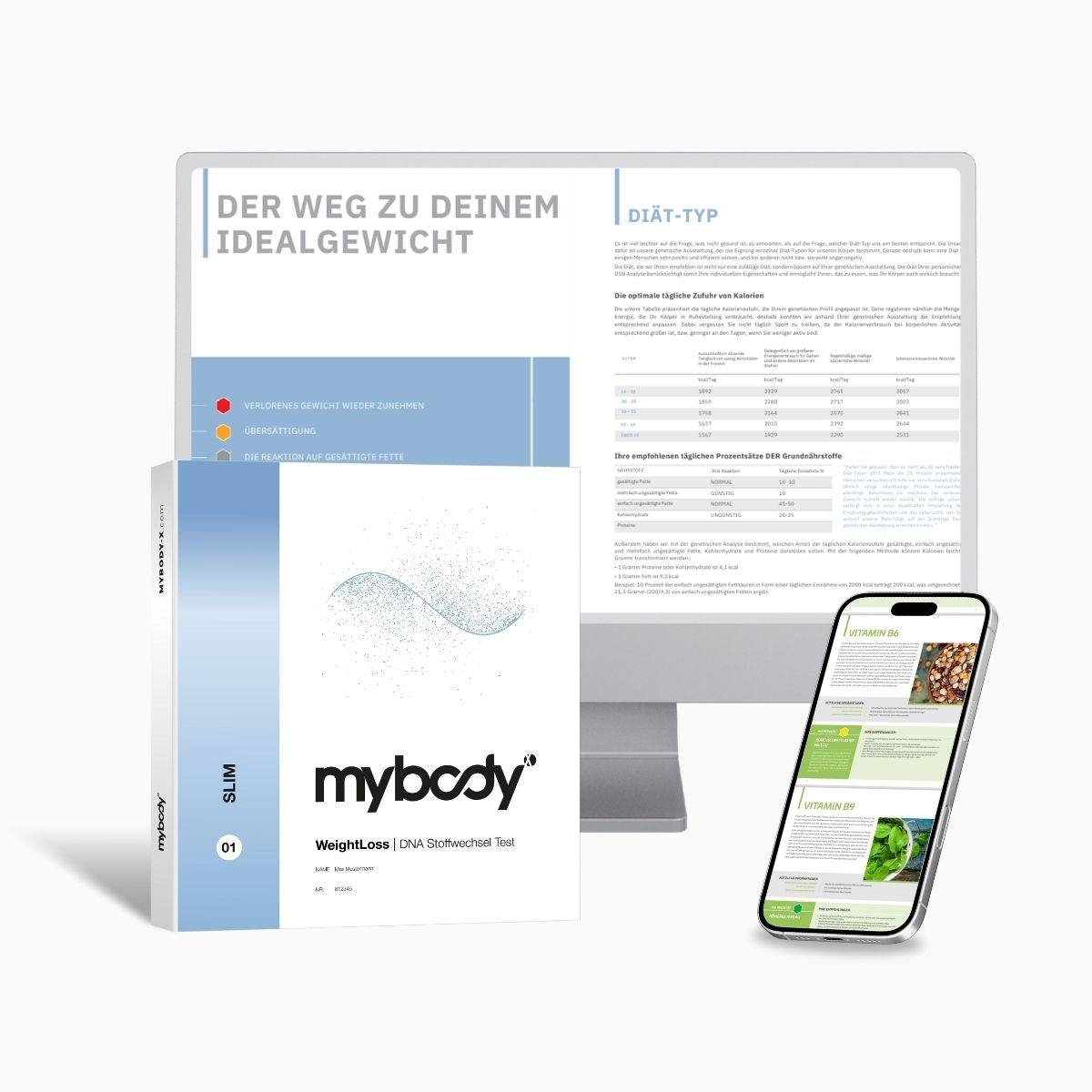
DNA test from saliva
WeightLoss | SLIM DNA Test
More than 80 genetic variations from a saliva sample, evaluated in 24 analysis reports. What the test does not do: It does not prevent renewed weight gain, predict how things will progress, or provide a diagnosis. No test eliminates the compensation through appetite and resting energy expenditure described in the MSD Manual.
Product page information, accessed 11 August 2026
The following four points summarize what can be derived from the sources for the maintenance phase.
Set a fixed weigh-in day
According to IQWiG, regular weighing on a fixed day of the week can support weight maintenance. One day per week is sufficient.
Set a correction threshold
Decide in advance at what deviation you will take corrective action. A small correction early is easier than a large one later.
Make exercise a fixed appointment
IQWiG recommends 30 to 45 minutes of mildly strenuous exercise three to five times a week. As a calendar entry, it lasts longer than a resolution.
Adjust the benchmark
Maintaining a five percent weight loss long term is considered a success in the S3 guideline. A slight regain is part of the expected pattern.
Limitations: what this article does not answer
We did not find a fixed minimum duration for the maintenance phase in months or years in the S3 guideline. It devotes a separate chapter to long-term weight stabilization but gives no timeframe in the sections available.
Nor was a percentage for the reduction in basal metabolic rate after weight loss verifiable. The MSD Manual describes reduced resting energy expenditure without quantifying it, and we therefore do not quantify it either.
A relapse rate specific to Germany is also unavailable. The figure of one-third to two-thirds comes from a long-term analysis of low-calorie diets in the MSD Manual and is not a figure for the population as a whole.
Finally, the caveat that takes precedence over everything else. Obesity is a disease, and care during the maintenance phase belongs in medical hands for anyone with a BMI over 30. This article describes general principles and does not replace professional advice.
What to retain about maintaining weight
If you take one habit from this article, make it a fixed weigh-in day. It is the only specific action explicitly linked to maintaining weight in the sources.
The reason is the size of the correction. Anyone who notices a deviation of two kilograms needs a few weeks of attention. Anyone who notices it only at eight kilograms is back at the beginning—with a body that burns fewer calories after the initial weight loss than before.
The starting question was how to lose weight permanently. The most honest answer shifts the question: losing it happens quickly enough, and what matters is the time afterward.
Frequently asked questions
Why do I regain weight after a diet?
The MSD Manual states that the body compensates for reduced calorie intake through increased appetite and lower resting energy expenditure (2025). The IQWiG adds that muscle mass also decreases with weight, causing the body to need less energy (2022). Both effects work in the same direction.
How many people maintain their weight?
The MSD Manual states that most people return to their pre-treatment weight within five years. In a long-term analysis of low-calorie diets, the same source found that between one-third and two-thirds of participants gained back more than they had originally lost (2025).
When is weight loss considered a success?
The S3 guideline on obesity defines successful weight loss as at least 5 percent, maintained long term, and describes clinically significant effects starting at 3 to 5 percent (2024). The IQWiG cites a loss of 5 to 10 percent within 6 to 12 months, depending on initial weight (2022).
How often should I weigh myself?
The IQWiG cites regular weighing on a fixed day of the week as support for maintaining weight (2022). We did not find a comparative statement in the sources reviewed on whether daily or weekly weighing is more effective.
What waist circumference is considered critical?
The IQWiG considers more than 102 centimeters for men and more than 88 centimeters for women to indicate a high amount of abdominal fat (2022). The S3 guideline describes an increased waist circumference as being closely associated with the occurrence of a cardiovascular risk profile (2024). The measurement complements BMI; it does not replace it.
Next step
An appointment in the calendar
Enter a fixed day for weighing yourself and decide in advance at what deviation you will take action. That is essentially all the maintenance phase requires. If you also want to see your genetic predispositions, you can find them in the WeightLoss DNA Test.
Go to the WeightLoss DNA Test Lose weight without giving anything upRead more
You might also be interested in
The question of prohibitions and sustainability before it is time to maintain the weight.
How to calculate your own energy needs instead of guessing them.
Sources
- Institute for Quality and Efficiency in Health Care (IQWiG): Severe overweight (obesity), as of 2022 – gesundheitsinformation.de
- Lewis JL III et al.: Obesity. MSD Manual, Patient and Professional Editions, fully reviewed October 2025 – msdmanuals.com
- German Obesity Society (DAG) and AWMF: S3 Guideline on the Prevention and Treatment of Obesity, registry number 050-001, as of 10/2024 – register.awmf.org
- Consumer Advice Centre: Weight-loss programs – what to consider when choosing one, as of 2025 – verbraucherzentrale.de
The verbatim quotation about maintaining weight, the statements about a balanced diet and exercise, the resting metabolic rate of approximately 70 percent, the fixed weighing day, waist circumferences of 102 and 88 centimeters, the exercise amounts of three to five sessions of 30 to 45 minutes, and the weight loss of 5 to 10 percent over 6 to 12 months are taken from source [1]. The five years until returning to the starting weight, the range from one third to two thirds, compensation through appetite and resting energy expenditure, and the lifelong management program are taken from [2]. The BMI categories, the 5 percent threshold, the effects starting at 3 to 5 percent, the 13 percent reduction in overall mortality, and the association between waist circumference and cardiovascular risk profile are taken from [3]. The note on prohibited foods and the lower limit of 1,000 kilocalories is taken from [4]. Additionally cited: 30 to 60 minutes of moderate physical activity per day, according to the German Nutrition Society. Information on price, scope, sample type, and laboratory comes from the mybody®x product page, accessed on 08/11/2026. All sources were accessed and reviewed on 08/11/2026.

mybody®x editorial & expert team
Laboratory diagnostics Nutritional science Blood analysis interpretation Nutrigenetics
This article was created by the mybody®x editorial and expert team. The team combines laboratory diagnostics, nutritional science, and the interpretation of blood analyses. Those who contribute to it are listed on the authors’ page.
Published on 05/02/2025 · Last updated on 08/11/2026
The content is intended for general information and does not replace medical advice, diagnosis, or treatment. Reference ranges depend on the laboratory, method, and age; the information on your report is always authoritative.




Share now:
Determine your metabolic type: what can and cannot be measured
Can a DNA test improve your diet?