
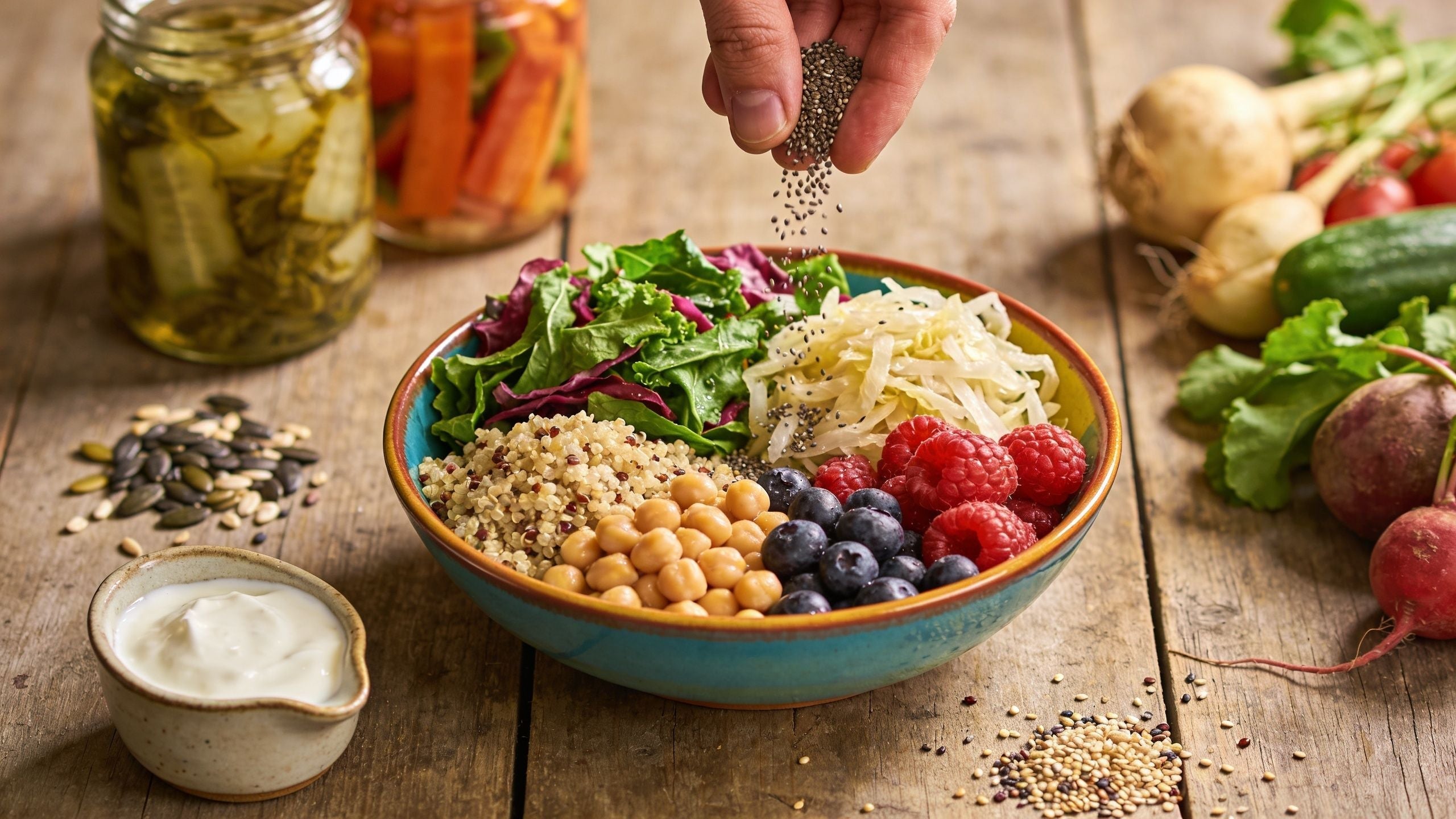
Eating for a healthy gut: Your guide to greater well-being
You’re making an effort. You buy yogurt, have a salad now and then, drink more water, and try to eat “lighter.” Yet your stomach still makes itself known. Sometimes through bloating, sometimes through fullness, sometimes through that vague tiredness after eating that makes you wonder what’s actually wrong.
This is exactly where the topic of eating for a healthy gut begins for many people. Not as a trend, but as a practical everyday question. What really benefits the gut, and what only sounds healthy but doesn’t suit you right now?
A healthy gut doesn’t require a perfect diet. It needs the right foundations, a little patience, and sometimes the courage to take a closer look. When you understand how fiber, plant diversity, and fermented foods work together, uncertainty quickly becomes a clear plan.
Your gut feeling is right Listen to it
Many people know this pattern. Everything is still fine in the morning, after lunch your stomach feels tight, your energy drops in the afternoon, and in the evening you feel somehow “out of balance.” This doesn’t automatically mean anything dramatic. But it’s also not something you should simply ignore indefinitely.
Your gut is more than a digestive tube. It processes food, communicates closely with your immune system, and noticeably affects how resilient you feel. When there is unrest there, it often shows up not only in the bathroom but also in your everyday life.

Typical signs that many people take seriously too late
Not every symptom immediately indicates a serious problem. But your body rarely works against you without a reason. Common signs include:
- Bloating after otherwise healthy meals. Especially when raw vegetables, legumes, or dairy products don’t sit well.
- Tiredness after eating. You’re full, but instead of feeling steady energy, you’d rather head straight to the sofa.
- Irregular digestion. Sometimes too sluggish, sometimes too fast, sometimes alternating between both.
- Vague uncertainty around food. You feel like you “can’t tolerate” many things, but you can’t say exactly what triggers it.
If this sounds familiar, it’s worth taking a look at typical signs that something is wrong with your gut.
Often, the problem isn’t your willpower but the lack of fit between your food, your pace, and your current digestion.
Why strict rules usually don’t help
Many people respond to symptoms by cutting things out. No more bread, no dairy, no fruit in the evening, no legumes, no spicy foods. This can provide relief in the short term. In the long term, it often makes the diet more restrictive and burdensome.
The better approach is usually simpler. Understand first, then make targeted changes. Your gut does not need daily dietary discipline under pressure, but nourishment that calms it while also strengthening it. That is where the next steps begin.
The foundation for your gut health
Your gut benefits most from a diet that regularly provides food for beneficial bacteria without constantly overwhelming digestion. In everyday life, this can be broken down into three building blocks: fiber, prebiotics, and probiotics.

Fiber is the foundation
Fiber consists of components of plant-based foods that are not fully digested in the small intestine. That is precisely what makes it so helpful. Fiber binds water, adds bulk to stool, and serves as food for gut bacteria in the large intestine.
The German Nutrition Society recommends that adults consume around 30 grams of fiber daily. The AOK article on gut health also makes it clear that fruit and vegetables still appear on many people's plates too infrequently in everyday life. In practice, this means the foundation is often lacking not because of ignorance, but because food needs to be quick, convenient, and easy to tolerate.
This is exactly where a realistic perspective is worthwhile. Raw vegetables are not automatically better than cooked vegetables. Whole grains are beneficial, but can cause bloating if too much is eaten at once by people with sensitive stomachs. Legumes are valuable, but many people need to introduce them gradually.
Good sources include:
- Whole-grain products such as whole-grain bread, oats, or wild rice
- Vegetables in the form you tolerate well—cooked, steamed, or raw
- Fruit as regularly as possible rather than only occasionally
- Legumes such as lentils, beans, or chickpeas
If you want to better understand what happens where in the digestive tract, the article on the structure of the intestine can help.
Prebiotics and probiotics are not the same thing
Many people lump the two together. But the difference matters in everyday life because prebiotics and probiotics work differently and are also tolerated differently.
| Term | What it is | What it is used for | Typical examples |
|---|---|---|---|
| Prebiotics | Specific dietary fibers | Food for beneficial gut bacteria | Inulin, oligofructose, plant foods |
| Probiotics | live microorganisms | support the balance of the gut microbiome | fermented foods |
Prebiotics are found, for example, in onions, leeks, chicory, oats, and legumes. Probiotics generally come from plain yogurt, kefir, sauerkraut, or kimchi.
Both can be helpful. Both can also cause discomfort at first if you eat too much of them too quickly.
Everyday rule: A sensitive gut often responds better to small, regular amounts than to a radical change from one day to the next.
What really works in everyday life
Nutrition knowledge is of little use if breakfast is rushed, lunch is skipped, and everything is eaten at once in the evening. That is why a simple sequence is more worthwhile than a perfection plan.
Start with one meal a day that reliably contains more fiber. Oatmeal with fruit and plain yogurt is often easy to manage. Once that is well established, add the next change, such as choosing whole grains more often as a side dish or eating two set portions of vegetables a day.
These small steps usually work better:
- Upgrade breakfast. Oatmeal, chia seeds, berries, or a kiwi can turn a quick meal into one that is much more gut-friendly.
- Choose side dishes mindfully. Potatoes, brown rice, or legumes often offer more than expensive specialty products.
- Make vegetables easy to access. Frozen vegetables, soups, and roasted vegetables are often more reliable in a stressful everyday routine than good intentions.
- Introduce fermented foods slowly. Start with a few forkfuls of sauerkraut or a small cup of kefir. Then observe how your stomach reacts.
This creates, step by step, a diet that not only calms your gut in the short term but also builds it up over the long term.
These foods are loved by your gut bacteria
The simplest mistake when eating for gut health is to focus only on prohibitions. Less sugar, less fast food, fewer processed foods. That can be helpful. But for your gut, what you add is often more important.
A healthy microbiome thrives on diversity. Different plants provide different fibers and plant compounds. This exact combination makes a big difference in everyday life.
Diversity beats perfection
Research from the American Gut Project involving more than 10,000 participants showed that gut microbiome diversity is greatest when at least 30 different plant foods are eaten per week. According to the article on the 30-Plant Challenge, this not only supports digestion but also strengthens the immune system and may help regulate appetite.
This does not mean you have to eat huge bowls of salad every day. Even small portions count. Herbs, nuts, seeds, beans, berries, vegetable sides, and whole-grain varieties all add up.
What Can Actually Go in the Shopping Cart
Instead of working through a rigid list, think in groups. That automatically makes the week more varied.
- Vegetables such as broccoli, carrots, fennel, zucchini, spinach, bell peppers, and beetroot
- Fruit such as apples, pears, berries, kiwis, or oranges
- Legumes such as lentils, chickpeas, and white beans
- Whole grains and seeds such as oats, whole-grain bread, wild rice, and flaxseeds
- Nuts such as walnuts or almonds
- Fermented foods such as plain yogurt, sauerkraut, kimchi, or kefir
If you want to better understand fermented dairy products, read the article about kefir and why it is interesting to many people.
A gut-friendly plate is rarely spectacular. It is colorful, regular, and easy on your stomach.
How to Eat 30 Plants Without Stress
The challenge sounds like a lot at first. In everyday life, it is surprisingly manageable.
An example of a typical day: oats, flaxseeds, apple, blueberries, lentils, carrots, spinach, tomatoes, onions, brown rice, broccoli, herbs, and a handful of nuts. That already gives you an impressive variety without complicated cooking.
These tricks are especially helpful:
- Count herbs and spices too. Parsley, basil, or sesame add variety with little effort.
- Use mixes. Frozen vegetables, salad mixes, and legume salads make the week easier.
- Rotate side dishes. Oats one day, rice the next, then potatoes, then lentils.
- Don't eat everything raw. Cooked vegetables are often easier on sensitive stomachs.
Your 1-week meal plan for a happy gut
A good plan has to work in everyday life. Not expensive, not complicated, and not so healthy that you lose interest after two days. The meals below focus on fiber, plant diversity, and well-tolerated combinations.
If you are very sensitive, reduce the amounts of raw vegetables, legumes, and fermented foods slightly at first. The plan is a guide, not a rigid system.
Gut-friendly 1-week meal plan
| Day | Breakfast | Lunch | Dinner |
|---|---|---|---|
| Monday | Oatmeal with plain yogurt, apple, and flaxseeds | Lentil soup with carrots and celery, served with whole-grain bread | Roasted vegetables with hummus and a little sauerkraut |
| Tuesday | Whole-grain bread with avocado and cucumber, plus a kiwi | Wild rice with broccoli, bell pepper, and chickpeas | Potatoes with herb quark and steamed spinach |
| Wednesday | Plain yogurt with berries, oats, and walnuts | Vegetable stir-fry with zucchini, carrots, and brown rice | Omelet with mushrooms, tomatoes, and a small green salad |
| Thursday | Porridge with pear, cinnamon, and chopped almonds | Quinoa salad with lentils, cucumber, parsley, and carrots | Pumpkin soup with whole-grain toast and plain yogurt |
| Friday | Kefir with oats, banana, and chia seeds | Whole-grain wraps with beans, salad, and avocado | Steamed fish or tofu with fennel and potatoes |
| Saturday | Whole-grain bread with nut butter and berries | Vegetable stew with white beans | Rice with stir-fried vegetables and a little kimchi, if well tolerated |
| Sunday | Scrambled eggs with tomatoes and whole-grain bread, plus fruit | Baked potatoes with herb quark and salad | Mild vegetable soup with lentils and fresh herbs |
How to use the plan effectively
You do not have to copy it exactly. What matters more is the principle behind it.
- A substantial breakfast. A combination of fiber, protein, and some fat keeps you full longer and often helps keep your blood sugar steady throughout the day.
- Neither too light nor too heavy at lunch. A meal consisting entirely of raw vegetables is not automatically gut-friendly. Cooked components are often easier to digest.
- Eat more simply in the evening. Many people sleep better when dinner is not too fatty or too heavy.
A small shopping list to get started
For this week, you mainly need foods that you can use to make several different things:
- Staples such as oats, whole-grain bread, wild rice, potatoes
- Plant-based variety with carrots, broccoli, spinach, zucchini, tomatoes, cucumbers, berries, apples
- Protein sources such as plain yogurt, kefir, eggs, tofu, or fish
- Legumes such as lentils, chickpeas, beans
- Extras such as flaxseeds, walnuts, herbs, sauerkraut
If you prepare meals in advance, eating healthily for your gut becomes much easier. A pot of soup, cooked rice, and chopped vegetables eliminate many spontaneous poor choices during the week.
Help with bloating and discomfort
Many people think a gut-friendly diet should feel easy right away. In practice, the opposite is often true. If you suddenly eat more fiber, legumes, or fermented foods, you may initially notice more activity in your abdomen.
That is not automatically a warning sign. Your gut needs to get used to new amounts and new textures, especially if your previous diet was rather low in fiber.
Why things get bumpy at first
More fiber means more work for your gut bacteria. This is fundamentally desirable. However, gases are also produced in the process, especially if you change too much too quickly.
Typical triggers at the beginning include:
- Jumps that are too big. Going from very few vegetables straight to several very high-fiber meals per day.
- Too many raw vegetables at once. Healthy, but not immediately comfortable for every gut.
- Not drinking enough. Fiber needs fluids; otherwise, it can feel more constipating than helpful.
- Too many “healthy” extras at once. Chia seeds, flaxseeds, beans, sauerkraut, and smoothies all in one day are often too much for sensitive guts.
Symptoms at the beginning often do not mean that the foods are wrong. Frequently, the pace is simply too fast.
What usually works better
If your gut protests, you do not have to stop everything. You should simply proceed more strategically.
-
Halve the portions
Eat smaller portions of legumes, cabbage, or fermented foods and increase them slowly. -
Prefer cooked foods
Steamed or cooked vegetables are often much easier to tolerate than large portions of raw vegetables. -
Drink regularly
Water and mild herbal teas help your gut cope better with more fiber. -
One new element at a time
Do not introduce five changes at once. Otherwise, you will not know in the end what is helping you and what is not.
When you should take a closer look
Normal adjustment feels temporary. However, if symptoms persist, become significantly worse, or you repeatedly react to similar foods, it is worth seeking a more individualized assessment.
Then it may no longer simply be a matter of “changing too quickly,” but perhaps an intolerance, an unfavorable food choice for your current microbiome, or an eating pattern that sounds good but does not suit your body.
When general advice is no longer enough
There comes a point when standard advice reaches its limits. You eat more mindfully, try fiber, reduce highly processed foods, add fermented foods, and your gut is still difficult. Then discipline is not the problem. Often, information is missing.
Every gut reacts individually. Some people quickly benefit from eating more legumes, while others initially experience pressure and bloating as a result. Some tolerate plain yogurt well, while others notice that certain foods repeatedly trigger discomfort. General recommendations are a good starting point, but they do not replace a personalized perspective.

What a personalized analysis can achieve
Modern gut microbiome analyses combine sequencing with metabolic analyses, providing deeper insights as a result. According to the article on the personalized food method, personalized recommendations based on such omics data show a 3-4x higher success rate in improving symptoms than generic dietary advice.
This is important in practice. Instead of simply being told to eat “more fiber,” it is possible to assess in greater detail how your gut is currently doing and which dietary steps are more appropriate than others.
When tests become worthwhile
Not everyone needs an analysis immediately. But there are clear situations in which it makes sense:
- Symptoms persist despite changing your diet. You are doing many things right, but hardly feel more stable.
- You react uncertainly to many foods. A systematic approach is then more helpful than further guesswork.
- You want to act strategically rather than broadly. This often saves time, frustration, and unnecessary restrictions.
In such cases, an offering like mybody x Gesundheit can be useful. It provides at-home health self-tests, including blood tests, intolerance tests, and gut microbiome analyses, creating a more individualized basis for nutrition and lifestyle choices.
The less clear your reactions are, the less another general nutrition tip will help. What matters then is what is specifically happening in your body.
The difference between guessing and understanding
Many people switch between elimination and starting over for years. First gluten-free, then dairy-free, then low-carb, and then back to “just eat clean.” The problem is not motivation, but a lack of precision.
If you have already implemented the basics and still cannot make progress, personalization is not a luxury. It is the sensible next step. That is precisely when the desire to eat in a gut-healthy way becomes a plan that truly suits you.
If you no longer want to guess when dealing with recurring digestive issues, suspected intolerances, or the desire for a more individualized nutrition strategy, you can find suitable at-home self-tests at mybody x Gesundheit. This allows you to combine general recommendations with concrete insights into your body and make more informed decisions about what is genuinely good for you.


Share now:
Vegan diet deficiency: recognize and prevent symptoms
Identify, understand, and specifically prevent vitamin deficiencies