
Vitamin B12 deficiency test: your practical guide for home use
Do you often feel tired, unfocused, or forgetful? If such signs become persistent, there may be more to it than everyday stress. They could be the first indications of a vitamin B12 deficiency—a nutrient deficiency that often develops gradually and remains unnoticed for a long time. A simple vitamin B12 deficiency test can quickly give you clarity.
Why you should take the signs of a vitamin B12 deficiency seriously

Does this sound familiar? You have actually had enough sleep, but still feel as though you are constantly running on reserve. This persistent exhaustion is one of the most common symptoms of a vitamin B12 deficiency. But why is this one vitamin so crucial to your well-being?
Vitamin B12, also known as cobalamin, is a true multitasker in your body. Think of it as the ignition key for energy production in every single cell. Without B12, your cells cannot work efficiently—the result: you feel tired and drained.
At the same time, it is essential for the production of red blood cells, which transport vital oxygen throughout your body. A deficiency can lead to a specific form of anemia known as megaloblastic anemia, which leaves you pale and weak.
More than just fatigue: the far-reaching consequences
A vitamin B12 deficiency does not just drain your physical energy; it also affects your nervous system and mental acuity. The vitamin is essential for protecting the myelin sheaths that surround your nerves like an insulating layer. If this protective layer is damaged, it can lead to serious neurological problems:
- Tingling or numbness, usually in the hands and feet
- Memory problems and difficulty concentrating
- Mood swings, which can range from low moods to depression
- Problems with coordination and balance
The insidious thing is that these symptoms develop gradually. They are often mistakenly attributed to aging or simply to stress.
An undetected vitamin B12 deficiency can persist for years and, in the worst case, lead to irreversible nerve damage. Early detection is therefore crucial to prevent long-term health problems.
Who belongs to the risk group?
It is a widespread misconception that only vegans and vegetarians are affected by B12 deficiency. Although the vitamin is found almost exclusively in animal-based foods, the causes of inadequate levels are far more varied.
Risk groups also include:
- People over 60, as stomach acid production often decreases with age, making it harder to absorb B12 from food.
- People with gastrointestinal conditions such as Crohn’s disease, celiac disease, or chronic gastritis.
- Women who use hormonal contraception, as the pill is known to deplete nutrients.
- People who regularly take acid blockers (PPIs).
Given these diverse risk factors and often vague symptoms, you shouldn’t guess—you should seek certainty. A convenient vitamin B12 deficiency test for home use, such as the one from mybody®x, puts you back in control. It gives you a reliable basis for taking targeted steps to support your health.
What B12 testing methods are available and what really matters

When you choose a vitamin B12 deficiency test, you face an important question: Which value will really give you the most accurate result? There are various ways to check your B12 status, but they are far from equally informative. Let’s shed some light on the laboratory jungle.
The conventional test, which many general practitioners still routinely order, measures total vitamin B12 in the blood serum. That may sound logical at first, but it has one major drawback: This value lumps everything together—both the active form of B12 that your cells can use directly and huge amounts of inactive B12 that merely circulates in the blood bound to transport proteins, without your body being able to do anything with it.
The problem? A serum level like this can give you a false sense of security. It may be within the normal range while your cells have long been undersupplied and a gradual deficiency has already begun.
Holo-TC: the gold standard for early detection
This is exactly where the holotranscobalamin test (Holo-TC) makes the crucial difference. This marker is also called “active B12,” and today it is rightly considered the gold standard for detecting a deficiency at an early stage.
Why is that? It’s quite simple: Holo-TC measures exclusively the form of vitamin B12 that is bound to the transport protein transcobalamin II. Only in this specific combination can the vitamin be absorbed and utilized by your body’s cells at all.
A low Holo-TC value is the first reliable warning signal that your B12 stores are being depleted. This often occurs long before the total B12 value in serum becomes abnormal or you notice your first symptoms.
Modern at-home tests, such as the mybody®x nutrient test, therefore specifically use this precise marker. This gives you a much more accurate and, above all, earlier picture of your actual B12 status.
What methylmalonic acid (MMA) reveals
Another important piece of the puzzle is methylmalonic acid (MMA), which can be measured in the blood or urine. Think of MMA as a type of metabolic waste that builds up in the body when vitamin B12 is missing for an important process.
- With good B12 status: Vitamin B12 ensures that MMA is converted smoothly. Everything runs normally.
- With a B12 deficiency: This conversion process slows down. The result: MMA levels rise.
An elevated MMA value is therefore a strong indication that a functional deficiency already exists at the cellular level—the vitamin is no longer reaching where it is needed. This test is particularly helpful when Holo-TC values are unclear and further evaluation is required.
Incidentally, which sample is best suited for each value depends heavily on the respective marker. You can learn more in our guide to the difference between blood and saliva tests.
Comparison of common vitamin B12 testing methods
A direct comparison of the B12 markers shows which test provides the clearest information about your B12 status.
| Test marker | What is measured? | Significance | Ideal for |
|---|---|---|---|
| Total B12 (serum) | Total B12 in the blood (active & inactive) | Low, may miss a deficiency | Only as a rough initial indication |
| Holotranscobalamin (Holo-TC) | Only active, cell-available B12 | Very high, detects deficiency at an early stage | Precise early detection and status check |
| Methylmalonic acid (MMA) | Metabolic product that increases in the event of a deficiency | High, indicates a functional deficiency | Confirmation when Holo-TC values are unclear |
As you can see, there are several ways to diagnose a deficiency, but not all are equally reliable.
In summary, while the total B12 value provides only a rough indication, the Holo-TC test is the key to a precise and, above all, early assessment of your vitamin B12 status. It gives you the chance to take corrective action in time—long before a deficiency makes itself felt through unpleasant symptoms.
Your at-home vitamin B12 test – explained simply and clearly
The mere thought of a crowded waiting room and having blood drawn stops many people from having their vitamin B12 level checked. Fortunately, those days are over. With modern at-home tests, you can easily and discreetly determine your level at home—without any medical expertise.
The whole process is surprisingly straightforward. Instead of waiting for a doctor's appointment, you only need a few minutes for a small, barely noticeable prick in your fingertip. Let's take a look at how relaxed the whole process is.
Collecting the sample is this easy
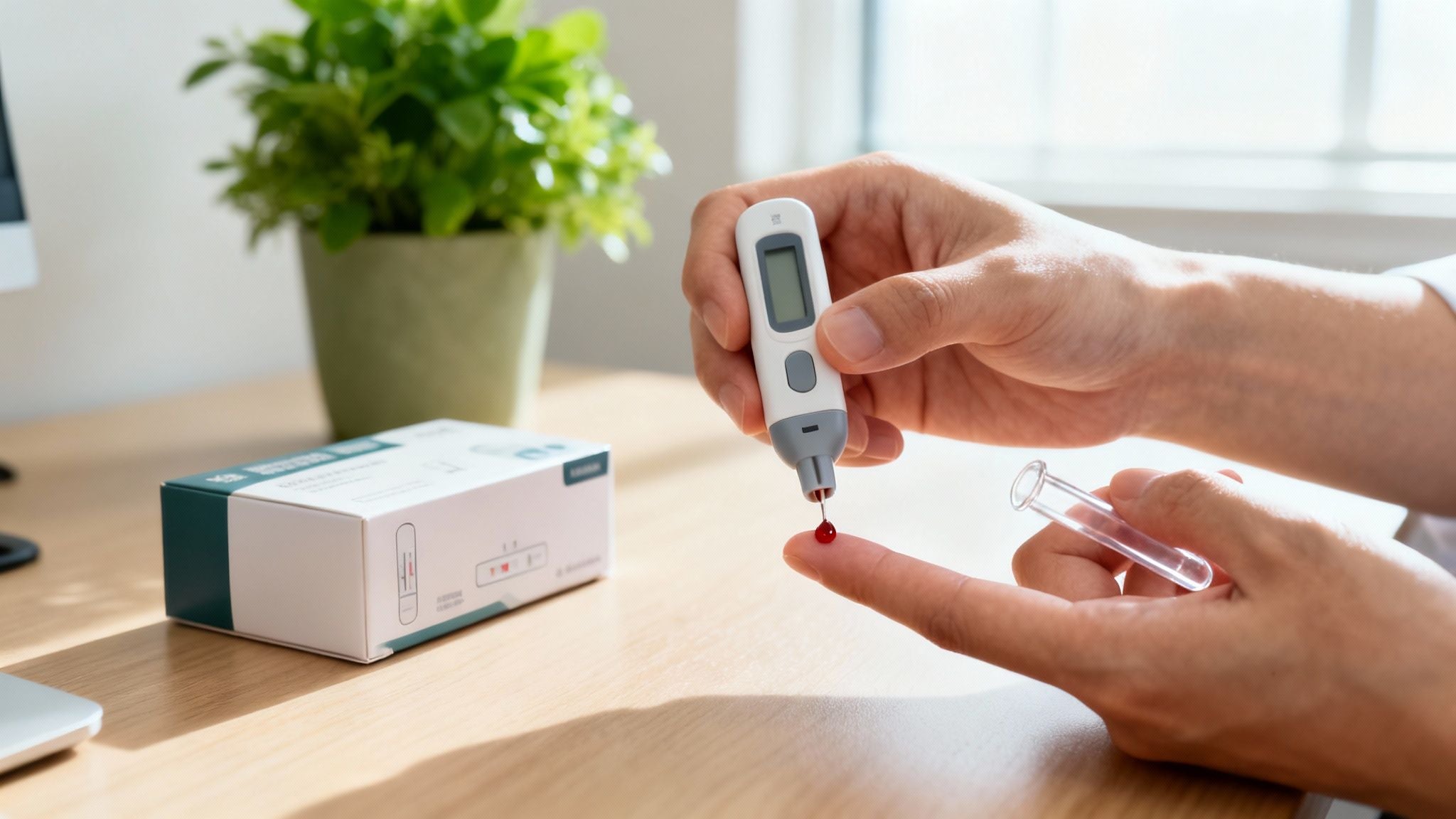
The core of the test kit is a tiny lancet that makes a precise puncture in the fingertip. Many people find this brief prick considerably more comfortable than a traditional blood draw from a vein. Your goal is simply to collect a few drops of blood in the sample tube—that is all.
So that you can collect the blood comfortably, we have a few simple practical tips for you:
- Warm your hands: Hold your hands under warm water for a moment or massage them vigorously. Warmth stimulates circulation and helps the blood flow much more easily.
- Rotate your arms: Swing the arm you want to draw blood from a few times like a windmill. This helps the blood reach your fingertips.
- Drink enough: A glass of water shortly before collecting the sample can further support blood circulation.
You do not have to be a professional to take charge of your health. The mybody®x nutrient test is designed so that every step is self-explanatory and you can feel completely confident.
This simple method gives you the freedom to collect important health data whenever it suits you best.
From your fingertip directly to a German specialist laboratory
Once you have collected your sample, simply place it in the enclosed return envelope. From there, it goes directly to a certified German specialist laboratory. Experts analyze your sample here using the same high standards that apply in medical practices and clinics.
So you can be sure: your results are precise and absolutely reliable. It is the straightforward way to obtain well-founded data about your vitamin B12 status, without the usual hurdles.
If you are still unsure, you can find a detailed, illustrated description of the process in our capillary blood test instructions.
Why an at-home test may be the better choice
The greatest advantage of an at-home test is not just convenience. It gives you the opportunity to take a proactive approach to your health instead of only reacting once clear symptoms have already appeared.
| Feature | Home test (finger prick) | Doctor's office (venous blood draw) |
|---|---|---|
| Effort | Low; completed in just a few minutes | Appointments, travel, and waiting time |
| Pain sensation | Minimal, just a small prick | Often uncomfortable; requires venipuncture |
| Flexibility | Possible anytime, anywhere | Bound by opening hours and appointments |
| Discretion | 100 % Private and anonymous | Takes place in a public setting |
With a Vitamin B12 Deficiency Test for home use, you take control yourself. You don't just receive a result, but an understandable basis for making the right decisions for your well-being.
Interpreting your test results correctly: Your guide to the next steps
At last, the time has come: You are holding your Vitamin B12 Deficiency Test report in your hands. But what do you do with all those numbers and charts now? Don't worry, we won't leave you on your own. Here you'll learn what your results really mean and which steps make sense now.
Your results report clearly shows where your vitamin B12 level falls compared with scientifically established reference ranges. These are usually divided into three zones: optimal, borderline, and deficient. This lets you see at a glance whether everything is fine or whether you should take action.
To give you some initial guidance, this simple decision tree can help. It shows when a test makes sense and what may follow from the result.
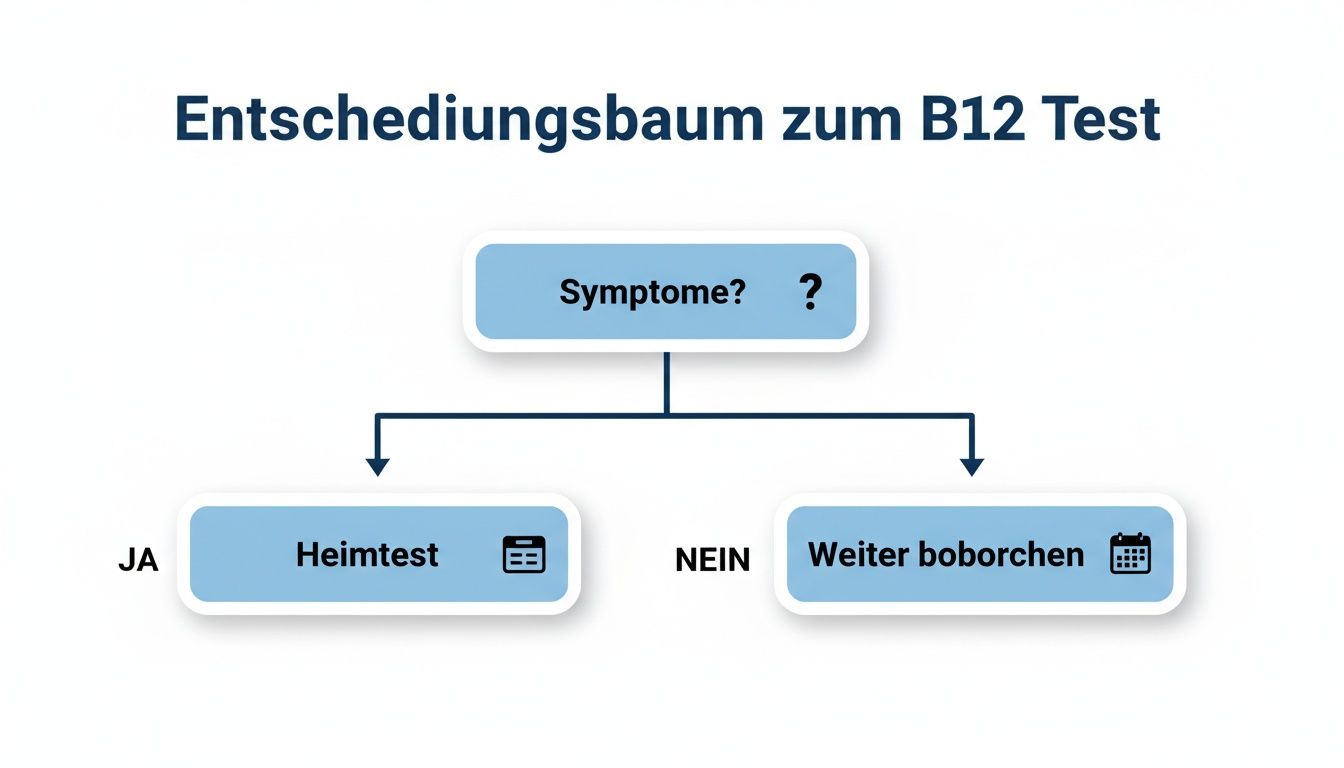
The graphic sums it up: If you have specific symptoms, a home test will quickly provide clarity. If you feel well, it is usually enough to continue paying close attention to your body.
Your value is in the optimal range
Great, a value in the green range is wonderful news to start with! This means your supply of active vitamin B12 is currently adequate. So you don't need to change anything immediately, but you should still keep an eye on the issue—especially if you belong to a risk group (e.g., if you follow a vegan diet or are over 60).
- Our recommendation: Keep it up! Maintain your healthy lifestyle and focus on a nutrient-rich diet. It wouldn't hurt to have another check in one to two years to make sure everything stays on track.
What a borderline value means for you
A borderline or low-normal value is a clear warning sign. It tells you that your stores are no longer fully replenished and that a true deficiency may develop if you do not take action. Your body is not yet suffering from a functional deficiency, but your reserves are running low.
Right now is the perfect time to take a proactive approach. Often, small dietary adjustments or taking a low-dose supplement is enough to bring your level back into the green range. Sometimes, a more comprehensive blood nutrient analysis is also worthwhile to identify other possible deficiencies.
Taking action in the case of a confirmed deficiency
If your level is in the red range, meaning a deficiency is present, it’s time to take action. However, there is no reason to panic, as a deficiency can generally be treated effectively. What matters now is not only treating the symptom—the depleted stores—but also getting to the root of the cause.
A diagnosed deficiency should always be a wake-up call to find the cause. Is it due to your diet? A malabsorption disorder in the intestines? Or certain medications? Only those who know the root of the problem can resolve it permanently.
Your specific next steps could look like this:
- Start supplementation: In the case of a clear deficiency, taking high-dose vitamin B12 is the fastest way to replenish your stores. Your mybody®x report provides specific recommendations for this.
- Adjust your diet: Consciously incorporate more B12-rich foods into your everyday life if your diet is the cause. If you follow a vegan or vegetarian diet, you cannot avoid long-term supplementation.
- Seek medical clarification: A conversation with your doctor or therapist is particularly important now. Discuss your results and possible causes, such as undiagnosed gastritis or other gastrointestinal problems.
Your test result is not a verdict, but your personal starting point for better health. It gives you back control and enables you to make the right decisions for your well-being in an informed and confident way.
Hidden causes of vitamin B12 deficiency
Your Vitamin B12 Deficiency Test shows low levels, and you’re wondering: What’s the cause? Many people immediately blame a vegan or vegetarian diet. But the real reasons are often much more complex and hidden deeper—usually directly in our digestive system.
The problem is often not that we consume too little B12, but that our body cannot use it. Chronic inflammation in the stomach or intestines, such as with gastritis or Crohn’s disease, can attack the mucous membranes so severely that B12 absorption is blocked. The valuable vitamin then simply passes through the body unused, no matter how rich in B12 your diet is.
The stomach as a key player
Stomach acid is a crucial factor. Without it, vitamin B12 cannot be released from food or prepared for further absorption in the first place. If acid production decreases, whether due to age or the long-term use of acid blockers (PPIs), this initial, critical step is already impaired.
Medications such as metformin for diabetes and the stomach-protective tablets mentioned above are particularly well-known “B12 thieves.” They interfere directly with this sensitive mechanism and can gradually deplete the body’s stores without being noticed.
But there is another helper in the stomach: the so-called Intrinsic Factor. Think of it as a taxi. This special protein picks up the released B12 and safely transports it through the small intestine to the point where it enters the bloodstream. Without this taxi, for example due to an autoimmune disease (pernicious anemia), B12 absorption is virtually impossible. If you want to learn more, read our article on the causes of vitamin B12 deficiency.
Why women should be especially attentive
The figures tell a clear story: Women are significantly more likely to be affected by B12 deficiency. According to the National Nutrition Survey II (NVS II) conducted by the German Nutrition Society (DGE), one in four women in Germany does not reach the recommended daily intake. Among young women aged 14 to 24, the figure is as high as 33 percent. You can also watch a video about these findings on B12 levels in Germany.
The reasons are varied: Hormonal contraceptives, pregnancy, and breastfeeding significantly increase the body’s needs. An undetected deficiency can quickly become a serious problem.
When you know the true reasons behind your symptoms, you can finally tackle the problem at its root. A test gives you the clarity you need to do more than just treat the symptoms and address the underlying cause directly.
Why B12 status is especially important as we age

The older we get, the more our body changes. One of these often unnoticed changes affects our ability to absorb vital nutrients such as vitamin B12 from food. That is precisely why a vitamin B12 deficiency test is such an important tool for preventive healthcare as we age.
This declining nutrient absorption is not a personal failure but a completely normal biological process. Many older people produce less stomach acid—and it is essential for releasing vitamin B12 from food and making it available to the body at all.
The most common cause: an undetected stomach problem
One of the main reasons for this problem is so-called atrophic gastritis, an age-related shrinking of the stomach lining. It means that the body produces not only less stomach acid but also less of the important “intrinsic factor.” Both are essential for the absorption of B12.
The insidious thing is that this condition often goes completely unnoticed. However, the consequences can be serious, because B12 deficiency causes symptoms that are all too easily dismissed as typical signs of aging:
- Forgetfulness and difficulty concentrating, which are mistakenly interpreted as the onset of dementia.
- Unsteady gait and dizziness, which massively increase the risk of falls.
- Depressive moods and lack of motivation, which are often considered normal mood swings in old age.
An undetected vitamin B12 deficiency can cause lasting damage to nerve health. If the symptoms are ignored, irreversible neurological damage may occur in the worst case, severely limiting quality of life.
Why testing is so crucial in old age
The figures speak for themselves: Older people are considered a high-risk group in Germany. While around 5 to 7 percent of the overall population is affected, the proportion rises to around 25 percent among those over 60. Among people over 85, almost one in two (nearly 40 percent) suffers from a deficiency. The main cause is usually the aforementioned atrophic gastritis, which affects 20 to 50 percent of older adults. You can read more about the background to B12 deficiency in old age here.
Regularly monitoring your B12 status is therefore not a luxury. It is an essential building block for maintaining mental fitness, mobility, and a high quality of life well into old age. A simple test gives you the reassurance that your nerves and brain are optimally supplied and helps you take timely, targeted action if necessary.
Are you ready to take control of your nutrient intake and proactively shape your health? With the blood tests from mybody®x, you can quickly and easily gain clarity about your vitamin B12 status. Discover the right tests for you now at https://mybody-x.com.



Share now:
Fasting for a blood test: Is coffee really off-limits?
Too Many White Blood Cells: Causes Explained Clearly