

Find your Hormone Balance for greater well-being in autumn
A stable Hormone Balance is essentially the key to everything: your well-being, your energy, and your mood. Imagine it as the finely tuned clockwork inside you. When all the gears mesh perfectly, you feel balanced, clear-headed, and capable. But when this sensitive system gets out of sync, your entire body feels it. Especially in autumn, when the days grow shorter and energy levels decline, it is particularly important to understand your hormonal balance and restore it.
Why autumn is the ideal time to bring your hormones into balance

The days get shorter, the light fades, and temperatures drop—the autumn is here. Do you know that feeling? Suddenly, a heavy fatigue sets in, your mood hits rock bottom, your sleep is no longer as restorative, and you lack motivation. Far too often, this is simply dismissed as the “autumn blues.” But there may be much more behind it than just a seasonal mood—namely, a genuine hormonal imbalance.
This change of seasons is a real adjustment for your body and puts your inner balance to the test. Your body reacts extremely sensitively to the changed conditions—and this has a direct impact on your hormones.
The effects of less daylight
The most obvious factor in autumn is the lack of sunlight. Your skin needs sunlight to produce the essential vitamin D. But this vitamin is far more than just a bone-strengthener; it plays a central role in hormone production and in maintaining a strong immune system.
A deficiency often quickly becomes noticeable through constant fatigue and increased susceptibility to infections. You can also learn more about how to recognize and treat a vitamin D deficiency in our magazine.
At the same time, the fading light throws two important messengers that control your sleep-wake rhythm and emotional well-being out of sync:
- Serotonin: Your “happiness hormone” is stimulated by daylight. Less light often leads to less serotonin, which can manifest as low mood, cravings for sweets, and a general lack of motivation.
- Melatonin: Your “sleep hormone” is released in the dark and makes you tired. Since it gets dark earlier, your body also starts producing melatonin earlier. This explains the typical autumn fatigue that can overcome you as early as the afternoon.
This hormonal shift is not a personal failure, but a completely natural response from your body. It is a clear signal that your system could use some support now.
Make autumn your opportunity
Instead of simply shrugging off these symptoms, you can view autumn as a wake-up call. It’s the perfect time to take a closer look and take action. When you take your body’s signals seriously, you give yourself the chance to take charge of your health again.
A hormone test for women or a hormone test for men from mybody-x.com is the first and perhaps most important step. It provides clear, data-based facts about your current hormone status. Instead of wondering why you feel tired, unbalanced, or down, you get solid information. With this knowledge, you can uncover imbalances and take targeted measures to restore your Hormone Balance and get through the dark season full of energy.
How your inner hormonal orchestra works

Imagine your body as a large, perfectly synchronized orchestra. Your hormones? They’re the musicians. Each hormone has its own instrument and plays a very specific role in the grand symphony of your well-being. As long as everyone plays in harmony, everything sounds harmonious—you feel energized, balanced, and simply good.
But what happens when even a single instrument falls out of rhythm? The violin suddenly plays far too loudly, or the trumpet comes in at exactly the wrong moment. Bam—the whole melody sounds off-key. That’s exactly what happens when your Hormone Balance is disrupted. Even the tiniest imbalance can be enough to throw your mood, energy levels, and entire body into disarray.
Understanding this complex interplay is the first and most important step toward regaining control. You don’t have to be a medical professional. Simply knowing the key players and their roles is enough to finally interpret your body’s signals correctly.
The most important instruments in your hormonal orchestra
Although there are hundreds of hormones, some are the true conductors of your well-being. They set the rhythm and influence countless processes in your body, from your metabolism and sleep to your mood.
Let’s take a closer look at the key players:
-
Estrogen: Often dismissed as “the female hormone,” it does so much more than regulate the menstrual cycle. It is essential for healthy skin, strong bones, and even good brain function. When it gets out of balance, irregular cycles, mood swings, or hot flashes are often the result.
-
Progesterone: This is basically your calming "feel-good hormone". It counteracts the stimulating effect of estrogen, promotes good sleep, and acts like a natural anti-anxiety remedy. A deficiency often manifests as inner restlessness, sleep problems, and nasty PMS symptoms.
-
Testosterone: Although it is known as the "male hormone", it is also essential for you as a woman. It gives you energy, supports libido and muscle strength, and provides the drive you need in everyday life. Do you often feel weak and tired? A testosterone deficiency could be behind it.
-
Cortisol: This hormone is the boss of your stress response. In short bursts, it is vital for survival because it mobilizes energy. But constant stress leads to permanently elevated cortisol levels, which disrupt sleep, slow down the metabolism, and completely drain you. If you want to learn more about the topic, read our article about what cortisol is and how it affects your body.
When the orchestra gets out of tune
The delicate balance of this orchestra can quickly be disrupted. Stress at work, an unbalanced diet, too little sleep, or even seasonal changes such as those in autumn—all of these can cause individual hormones to gain the upper hand or suddenly fall silent. The result: hormonal chaos that you can feel directly in your own body.
A hormonal imbalance is not imaginary. It is the logical consequence when communication between your body's messengers no longer works smoothly.
Menopause is a perfect example. In Germany, around 9 million women are currently affected by this natural, but often very challenging, stage of life. Hormonal changes often begin gradually, years before the final period, vividly demonstrating how strongly fluctuating hormone levels can turn our well-being upside down.
This basic knowledge about your inner orchestra is worth its weight in gold. It helps you understand that symptoms such as constant fatigue or low moods often have a tangible biological cause. And the best part is: With a hormone test from mybody-x.com, you can find out which instruments in your body are out of tune so that you can restore harmony in a targeted way.
How can I recognize a hormonal imbalance?
Do you know this feeling? Do you often feel exhausted for no apparent reason, even though you have actually slept enough? Are you struggling with stubborn extra pounds, even though you have barely changed your diet? Or are sudden mood swings and skin problems that seem to come out of nowhere making your life difficult?
These are not imagined or simply “bad days.” Rather, they are often the first, subtle cries for help from your body, pointing to a hormonal imbalance. Think of it this way: Your inner orchestra is playing out of tune, and the symptoms are the discordant notes you hear.
Ignoring these signals would mean leaving the underlying cause in the dark. They are the most important indication that your body needs support to regain its natural Hormone Balance.
Typical warning signs in women
The female body is a masterpiece of hormonal fine-tuning, constantly changing through the monthly cycle, pregnancies, or menopause. When this sensitive system falls out of balance, we often feel it very clearly.
Signs you should look out for as a woman include:
- Irregular cycle: Your period comes whenever it wants or stops altogether. Extremely heavy or unusually light bleeding can also indicate a disrupted balance between estrogen and progesterone.
- Severe premenstrual syndrome (PMS): When the days before your period become unbearable—with extreme irritability, breast tenderness, cravings, or depressive moods—a progesterone deficiency is often behind it.
- Unexplained weight gain: Are you gaining weight, especially around your abdomen, hips, or thighs? This may be related to excess estrogen or chronically elevated cortisol levels.
- Persistent fatigue and lack of energy: Do you constantly feel as though you are going through the day with the handbrake on? Weakening thyroid hormones or low testosterone levels could be behind it.
- Skin problems such as acne: Adult acne, especially when it appears on the chin and along the jawline, is a classic sign of hormonal imbalance, often caused by excessive androgens (male hormones).
- Hot flashes and sleep disturbances: These typical companions of perimenopause and menopause are a direct consequence of declining estrogen levels.
It is important to understand that you do not simply have to accept these symptoms as “normal” or “age-related.” They are measurable signals from your body that you can respond to.
Specific signs in men
As a man, you are by no means immune to hormonal turbulence. Chronic stress, an unhealthy lifestyle, or the natural decline in testosterone levels starting at age 30 can seriously disrupt your hormonal system.
In men, an imbalance often manifests differently:
- Decreased libido and erectile problems: A noticeably lower sex drive is one of the most common and earliest signs of declining testosterone levels.
- Muscle loss and reduced strength: Do you notice that you are losing muscle mass despite training regularly or are no longer performing as well as you used to at the gym? This can also indicate a testosterone deficiency.
- Increase in abdominal fat: The so-called “spare tire” is not always caused only by beer and unhealthy food. It is often a clear sign of an unfavorable testosterone-to-estrogen ratio.
- Lack of motivation and low mood: Testosterone deficiency directly affects motivation, self-confidence, and overall mood.
- Fatigue and concentration problems: Do you often feel exhausted and have difficulty focusing? An imbalance of the stress hormone cortisol or low testosterone levels could be the cause.
This graphic gives you an idea of the ranges in which the most important hormones should ideally fall.
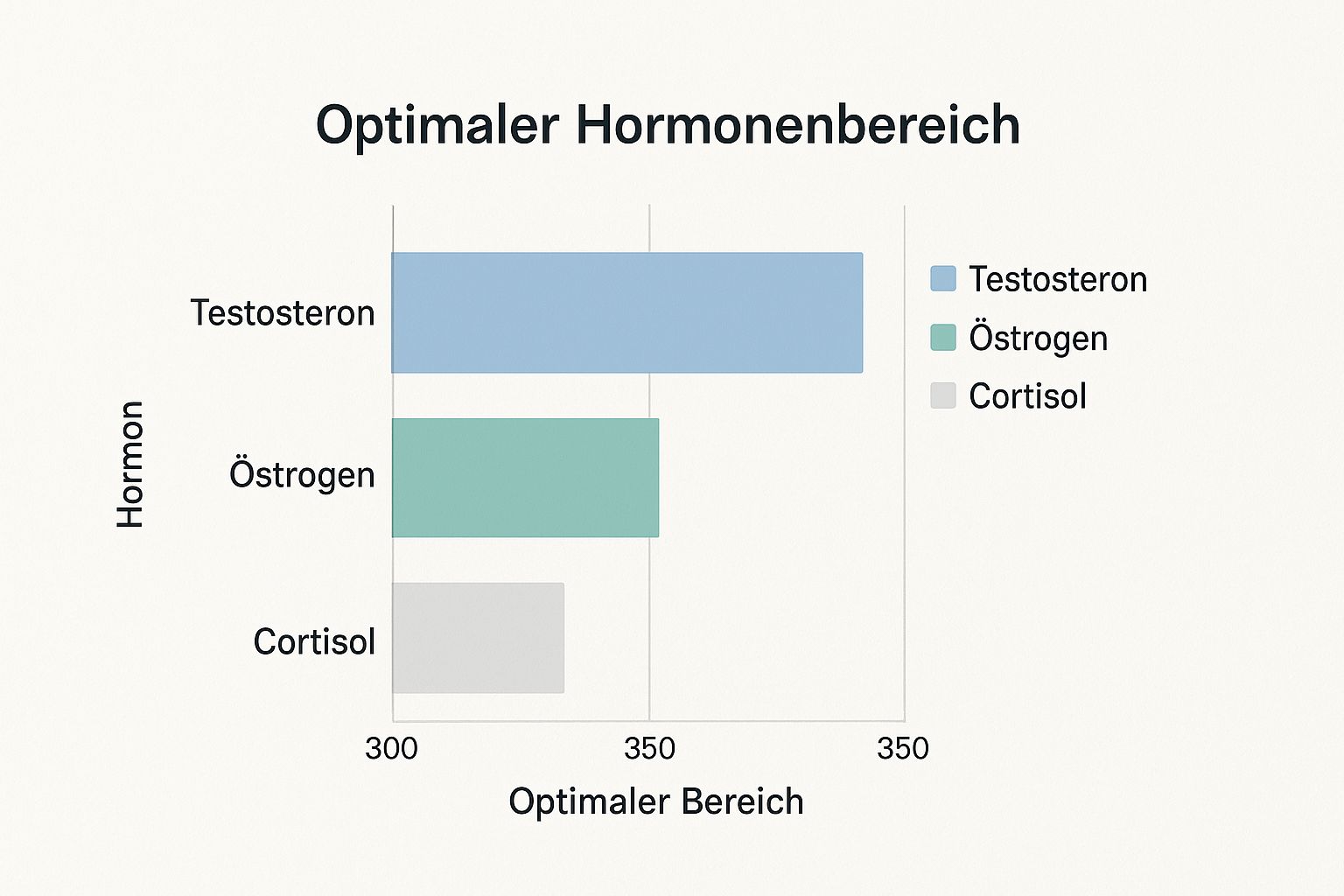
This clearly shows how different the concentrations of individual hormones in the body are—for example, testosterone is present in much higher quantities than estrogen or cortisol.
What your symptoms could mean
To give you a clearer overview, we have summarized the most common symptoms and their possible hormonal causes here. Think of this table as a kind of guide to help you better interpret your body's signals—but of course, it does not replace a medical diagnosis.
Symptoms and possible hormonal causes
This table shows common symptoms of hormonal imbalance and assigns them to the potentially affected hormones in women and men.
| Symptom | Possible hormonal cause (women) | Possible hormonal cause (men) |
|---|---|---|
| Persistent fatigue | Hypothyroidism, cortisol imbalance, low testosterone levels | Low testosterone levels, cortisol imbalance, thyroid problems |
| Weight gain (abdominal) | High cortisol, estrogen dominance, insulin resistance | Low testosterone levels, high cortisol, insulin resistance |
| Mood swings | Fluctuating estrogen, low progesterone levels | Fluctuating testosterone levels, high cortisol |
| Sleep disorders | Low progesterone levels, low melatonin, high cortisol | High cortisol, low testosterone levels, low melatonin |
| Low libido | Low testosterone levels, low estrogen | Low testosterone levels |
This overview makes it clear how closely your symptoms may be linked to specific hormonal changes. The crucial next step is now to replace these assumptions with solid data.
A hormone test for women or a hormone test for men from mybody-x.com gives you exactly the clarity you need to move from simply guessing at symptoms to taking targeted action.
How a hormone test finally brings clarity
If you recognize yourself in the symptoms of a hormonal imbalance, you are standing at a crossroads. You could continue as before: guess, try different diets, or simply blame the constant fatigue on autumn. Or you can take the only path that replaces vague assumptions with hard facts – through a targeted hormone test.
No more guesswork. A test is like an exclusive look behind the scenes of your body. It shows you in black and white which hormones in your inner orchestra may have fallen out of sync. This clarity is the decisive turning point at which you stop merely reacting and start actively shaping your well-being.
The invaluable value of data instead of assumptions
Imagine sitting in front of a huge puzzle, but missing the picture on the box. That’s exactly how it feels when you try to restore your hormone balance without solid data. You try one herb, then another dietary change – but whether you’re really turning the right knob remains pure guesswork.
A hormone test from mybody-x.com finally gives you the missing piece of your puzzle. It provides precise measurements of your most important hormones, transforming vague symptoms into concrete, tangible starting points.
A test result is so much more than just numbers on a sheet of paper. It is your very own roadmap to better health, showing you the direct path to well-being.
With this knowledge in hand, you can finally take targeted action. You no longer waste your energy on generic advice, but invest it in strategies tailored precisely to your individual needs.
How an at-home hormone test works
For many people, getting their hormone levels checked sounds complicated. Fortunately, the days of long waits for doctor’s appointments and cumbersome laboratory visits are over. With mybody-x.com hormone tests, you can easily bring the lab to your home.
The entire process is designed to be as simple and discreet as possible:
- Order the test: Choose the right test for you – the hormone test for women or the hormone test for men – and have the complete kit conveniently delivered to your home.
- Collect the sample: With easy-to-follow instructions, you take a tiny blood sample from your fingertip yourself. It’s quick and virtually painless.
- Send the sample: Send the sample in the enclosed return envelope directly to our certified medical laboratory in Germany.
- Receive results: After a short time, you will find a detailed and, above all, easy-to-understand report in your secure online account. You will see not only your results but also receive specific, personalized recommendations for action right away.
This is how easy it is to finally gain clarity. If you want to learn more about the process and its benefits, take a look at the article in our magazine about how you can test your hormone balance.
A concrete example from practice
Let's illustrate this with an example. Anna, 42 years old, she has felt completely exhausted for months, sleeps poorly, and is often stressed for no apparent reason. She blames it on the autumn blues and normal everyday stress.
But then she decides to take the mybody-x.com hormone test for women. The result is a real eye-opener: Her progesterone level is unusually low, while her cortisol level is close to the upper limit. Suddenly, everything makes sense.
Her low progesterone level explains her sleep problems and inner restlessness, as progesterone naturally has a calming effect. Her high cortisol level confirms that her body is under constant strain, completely exhausting her energy reserves.
With this insight, Anna can finally take targeted action. Instead of doing relaxation exercises at random, she focuses on techniques proven to lower cortisol levels. At the same time, she adjusts her diet to stimulate natural progesterone production. Anna's story perfectly illustrates how a single piece of information can change everything. The test not only gave her a diagnosis—it also gave her control over her health back.
The importance of an accurate diagnosis
The importance of making a data-driven decision is also illustrated by looking at the history of hormone replacement therapy (HRT). Following a critical study in 2002, the number of prescriptions in Germany fell dramatically by around two thirds. Analyses showed that use among women aged between 40 and 79 steadily declined—a clear sign of increased awareness of the importance of individual consideration. This underscores how crucial an accurate diagnosis is before making far-reaching health decisions. You can find further insights in the analyses by the Robert Koch Institute.
A hormone test is your personal fact check—the essential first step toward making informed and safe decisions for your well-being.
Your path to hormonal balance with simple everyday tips
Okay, your test results are here. At last, you have in black and white which instruments in your hormone orchestra have fallen out of tune. But this isn’t the end point—it’s the powerful starting signal for your journey back to balance. With this knowledge, you stop guessing and start taking targeted action.
This isn’t about turning your entire life upside down overnight. It’s the small but consistent changes in your everyday life that have a huge impact and help you sustainably restore your hormonal balance. Let’s take a closer look at the four key areas of your well-being.
1. The right diet for your hormones
What ends up on your plate is the most direct form of communication with your body. Some foods provide the building blocks your hormones urgently need to function, while others can further throw your sensitive system off balance.
The key is to keep your blood sugar level as stable as possible. Every blood sugar roller coaster caused by sugar or simple carbohydrates forces your body to release insulin and stress hormones—an actual disruptor of your hormonal balance.
- Choose complex carbohydrates: Reach for whole grains, legumes, quinoa, and plenty of vegetables. They make your blood sugar rise slowly and provide you with long-lasting energy.
- Include healthy fats: Avocados, nuts, seeds, and good olive oil are essential for producing important hormones such as estrogen and testosterone.
- Make sure you get enough protein: Every meal should contain a high-quality source of protein, such as fish, eggs, or lentils. Protein keeps you full for a long time and stabilizes your blood sugar.
These simple adjustments form the basis for stable hormone production and help you get cravings and nasty energy slumps under control.
2. Exercise in the right amount
Exercise is a real miracle cure for reducing stress hormones and improving your cells’ sensitivity to hormones such as insulin. But here’s the catch: more isn’t always better.
Especially when your body is already stressed by a hormonal imbalance, too much of a good thing can actually make the problem worse. A brutally intense workout drives up cortisol levels and can further deplete your system instead of strengthening it. It's about finding the right balance for you.
Your goal should not be complete exhaustion, but regeneration and renewed energy. Exercise should work for your body, not against it.
A good mix of moderate endurance training, such as brisk walking or cycling, and targeted strength training to build muscle is ideal. Gentle forms of exercise such as yoga or stretching are just as important for calming your nervous system and actively reducing stress.
3. Active Stress Management for Everyday Life
In our hectic world, stress is practically everywhere. Constantly elevated levels of the stress hormone cortisol are one of the greatest enemies of your hormonal balance. It acts like interference over your feel-good hormones, blocking progesterone, for example, and throwing your entire metabolism into disarray.
That's why active stress management is not a luxury but an absolute necessity. You need to regularly signal to your body that it is allowed to relax. Just a few minutes a day can make a tremendous difference.
Here are a few simple techniques you can try right away:
- Mindful Breathing Exercises: Take 5 minutes three times a day to breathe deeply into your abdomen. Especially long exhales activate the parasympathetic nervous system, your body's rest-and-digest system.
- Short Break in Nature: A 15-minute walk in nature has been shown to lower cortisol levels.
- Digital Detox Before Bed: Put your phone and tablet away at least one hour before going to bed. The blue light interferes with the production of the important sleep hormone melatonin.
If you want to delve even deeper into the topic, you'll find more valuable tips in our magazine on how to regulate your hormonal balance and find greater inner peace.
4. The Priceless Power of Sleep
Sleep is the time when your body tidies up, repairs itself, and readjusts its hormones. Chronic sleep deprivation throws this sophisticated system completely out of balance and is one of the most common triggers of hormonal problems.
While you sleep, your body regulates vital hormones such as cortisol, melatonin, and growth hormones. Good sleep hygiene is therefore absolutely non-negotiable if you want to bring your hormones back into balance.
Improve your sleep with these simple routines:
- Set regular sleep times: Try to go to bed and get up at roughly the same time every day—even on weekends.
- Create a cool, dark oasis: Your bedroom should be a place of tranquility. Invest in good blackout curtains and keep the temperature pleasantly cool.
- Develop an evening ritual: A warm bath, a few pages of a book, or soft music signals to your body that it’s time to wind down.
By incorporating these four areas into your daily life step by step, you’re giving your body exactly the support it needs to find its natural harmony again. Start small, be patient with yourself, and celebrate every little bit of progress along the way.
Frequently asked questions about hormone balance
We’ve now delved deeply into the world of hormone balance, from the symptoms to the first steps toward improvement. Still, questions often remain. That’s completely understandable—hormones are a complex matter, after all, and every body works differently. Here, we want to answer the most common questions so you feel confident on your journey.
There is a lot of half-knowledge circulating, especially on health topics. Our goal is to give you clarity so you can confidently make the right decisions for yourself and your body.
How long does it take for my hormones to settle back into balance?
This is probably the question burning on everyone’s mind. The honest answer: It depends entirely on you. How long your body needs depends on where the cause of the imbalance lies, how fit you are overall, and how consistently you stick with it.
You may notice the first positive changes after just a few weeks when you adjust your lifestyle—whether by eating in a more hormone-friendly way or managing stress better. Suddenly, you have more energy or sleep more deeply. With more persistent imbalances, however, it can take several months to find a stable new balance.
Patience is your best friend on this journey. Your body may have been out of balance for years—give it the time it needs to find its natural rhythm again.
Is changing my diet enough to get my hormones under control?
Your diet is without question one of the most effective tools for stable hormone balance. Nutritious food that doesn’t send your blood sugar on a roller coaster ride can work wonders. It provides the building blocks for your hormones and helps reduce inflammation in your body.
But—and this is important—diet is usually only one piece of the puzzle. Chronic stress, the quality of your sleep, how much you exercise, and even environmental toxins can also interfere with your hormonal system. The key to success is therefore a holistic approach that takes all these areas into account.
When is a hormone test really worthwhile?
A hormone test is always a good idea when you have been struggling for some time with symptoms that have no simple explanation. Think of constant fatigue, unexplained weight gain, mood swings that even surprise you, sleep problems, or an irregular cycle. Especially in autumn, when such symptoms are often dismissed as “normal,” a test can show you whether a genuine hormonal imbalance is behind them.
Instead of stumbling around in the dark, a test gives you concrete data. You stop blindly trying out random strategies and can instead take targeted measures that actually make a difference. It is the first step toward moving from passively enduring things to actively shaping your well-being.
Are at-home hormone tests just as good as those performed by a doctor?
Yes, absolutely. High-quality at-home self-tests, such as those from mybody-x.com, provide equally reliable results. The reason is simple: We send your sample to the same certified medical laboratories trusted by doctors and clinics.
Collecting the sample—for example, with a small prick to the fingertip—is designed to be so simple and safe that you can easily do it yourself. Your result is therefore just as accurate as one from a doctor’s office, only more convenient and discreet from the comfort of your home.
The debate surrounding hormone therapies is often highly charged. In this context, a US study involving 10 million women is particularly interesting: it showed that every form of hormone therapy was associated with a lower risk of death than using none at all. In Germany, it is estimated that only 11% of women receive hormone therapy, highlighting the importance of individual, data-based decisions. Read more in the summary of these study findings on hormone therapy.
Are you ready to stop guessing and finally gain clarity about your hormones? With a test from mybody-x.com, you’ll gain precise insights into your body and specific recommendations to support your hormonal balance. Take the first step toward more energy and well-being and discover the right at-home health self-tests on mybody-x.com.



Share now:
Iron deficiency test – This is how to reliably find out whether your iron level is too low
Vitamin B6 deficiency: which symptoms indicate it and which do not