

Identifying nutrient deficiencies: How to test for your deficiencies in autumn
As the days grow shorter and the leaves change color, many people experience the typical autumn fatigue. But often there's more to it than just the changing seasons. Especially now, when our immune system is under particular strain and sunlight is less intense, nutrient deficiencies that previously went unnoticed can become apparent. A blood test is the best way to get clarity.
Are you often tired, unfocused, or more prone to colds? These could be early signs that your body is lacking important vitamins and minerals. Instead of guessing and taking supplements on a hunch, you can have a nutrient deficiency specifically identified and tested. This will give you a clear picture of what your body really needs to stay fit and resilient throughout the autumn.
In this article, we present six proven methods for checking your current nutrient status. We explain the advantages and disadvantages of each option step by step, from the classic blood test at the doctor's office to convenient at-home self-tests. We'll show you why a blood test to identify nutrient deficiencies is particularly useful in autumn and how the home tests from mybody-x.com can help you take control of your health. Find out which method is right for you.
1. Blood test at the doctor's office or laboratory
A blood test performed by a doctor or in a specialized laboratory is the gold standard if you want to test for a nutrient deficiency. This method offers the highest accuracy and most comprehensive analysis of your nutrient status. Unlike rapid tests, your blood is professionally drawn and analyzed under controlled conditions, ensuring precise and reliable results.
This is how medical nutrient analysis works
During this examination, a small amount of blood is drawn, usually from a vein in your arm. This sample is then sent to a laboratory, where experts analyze your blood serum or whole blood for specific values. These values can include vitamins such as B12 and D, minerals such as iron and magnesium, and important trace elements such as zinc and selenium. This method is particularly useful if you experience specific symptoms such as chronic fatigue, hair loss, or increased susceptibility to infections.
Typical examples of a medical blood test are:
- Vitamin D measurement: Particularly relevant in the darker autumn and winter months, when the body's own production decreases due to lack of sunlight.
- Iron status testing: Recommended in cases of persistent fatigue or paleness, common in women of childbearing age.
- Vitamin B12 test: A must for vegans and vegetarians, as vitamin B12 is found almost exclusively in animal products.
- Folic acid test: Important for women who want to have children, to prevent developmental disorders in the fetus.
Your path to success: A clear process
The process for a professional blood test is straightforward and standardized to ensure the highest quality. The following infographic illustrates the three key steps, from preparation to discussing your results.
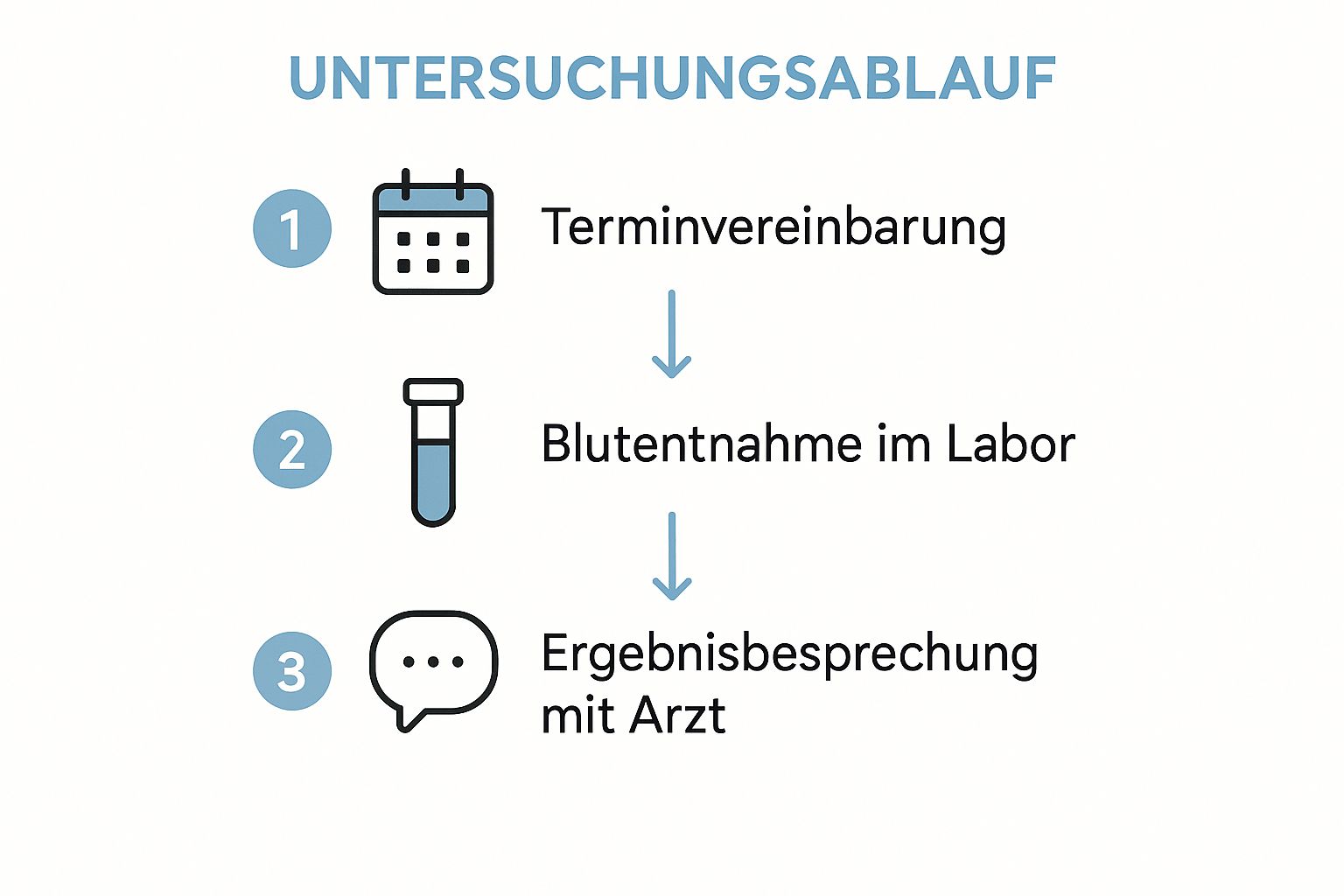
As you can see, the process from scheduling your appointment to the final discussion of your results is clearly structured and aims to give you a sound basis for your health decisions.
Tips for a meaningful result
To ensure that your blood test results are not distorted, you should keep a few things in mind:
- Arrive fasting: It's best to come to your blood test on an empty stomach. Certain nutrients from food can temporarily affect the results.
- Pause supplements: Stop taking dietary supplements a few days before the test.
- Combined tests: If possible, have several values determined simultaneously. This saves time and provides a more comprehensive picture.
- Medical consultation: Always discuss the results with your doctor to correctly interpret the values and derive the appropriate measures.
Are you interested in the potential costs of such an examination? Learn more about the cost of a comprehensive blood test at mybody-x.com .
2. Home self-tests (dried blood)
At-home self-tests, like those offered by mybody-x.com, are a modern and convenient alternative to a doctor's examination for testing for nutrient deficiencies. With these home test kits, you can determine key nutrient levels using a small blood sample that you take yourself from your fingertip. The sample is placed on a special test card, dried, and then sent postage-free to a certified laboratory. This method has gained significant popularity in recent years due to its combination of discretion, convenience, and rapid results.
This is how the dried blood spot tests from mybody-x.com work.
Performing this test is straightforward. You order the test kit online, which contains all the necessary materials such as lancets, a disinfectant wipe, and a dried blood spot card. After pricking your finger and applying a few drops of blood to the card, you let it dry. The dried sample is stable and can be safely sent by mail to the partner laboratory. There, it is professionally analyzed, and you usually receive your results digitally within a few days.
Popular examples of home tests based on the dried blood spot method:
- Vitamin D test: Ideal for the autumn and winter months to prevent a deficiency that can occur due to less sun exposure.
- Mineral analysis: Measures important minerals such as zinc, selenium and magnesium, which are crucial for the immune system and energy metabolism.
- myHealth & Nutrition Test: A comprehensive test that covers a wide range of vitamins and minerals and provides a holistic picture of your nutritional status.
- Omega-3 test: Determines the ratio of omega-6 to omega-3 fatty acids, an important indicator of inflammatory processes in the body.
Your path to results: Simple and discreet
The process from ordering to receiving your results is designed to offer you maximum control and flexibility. You decide when and where you take the test and receive a detailed analysis directly on your smartphone or via email. The results are presented clearly at mybody-x.com and supplemented with specific recommendations for nutrition and lifestyle.
Tips for a reliable test result
For your home test to deliver meaningful results, correct execution is crucial. Therefore, please note the following points:
- Follow the instructions carefully: Read the enclosed instructions carefully before you begin taking the sample.
- Prepare your hands: Wash your hands thoroughly with warm water to stimulate blood circulation and avoid contaminating the sample.
- Take in the morning: It is best to perform the test in the morning on an empty stomach to minimize daily fluctuations in the values.
- Sufficient blood: Make sure the circles marked on the map are completely filled with blood so that the laboratory has enough material for analysis.
3. Urine analysis
In addition to blood tests, urine analysis offers a valuable, non-invasive method for testing for nutrient deficiencies. This analysis is particularly well-suited for assessing the status of water-soluble vitamins and the excretion of minerals. Since the body excretes excess water-soluble nutrients through urine, their concentration provides information about how well your body is currently supplied or whether there might be an excessive burden.
This is how nutrient analysis via urine works
During a urinalysis, you provide a urine sample, which is then analyzed in a specialized laboratory. This method is completely painless and can be conveniently performed at home before the sample is sent to a lab such as Ganzimmun or Genova Diagnostics. In the lab, specific metabolites, vitamins, and minerals are measured to draw conclusions about your nutrient levels or levels. This test is particularly informative if you want to understand how your body metabolizes and eliminates nutrients.
Typical examples of urinalysis include:
- B vitamin profile: Since B vitamins are water-soluble, their excretion in urine can be easily measured to determine a deficiency or excess.
- Iodine excretion: An important test for assessing iodine supply, which is essential for healthy thyroid function.
- Mineral and heavy metal exposure: Urine can indicate whether the body is losing essential minerals at an increased rate or is burdened with heavy metals.
- Vitamin C status: The concentration in urine provides an indication of how well your body is saturated with this important antioxidant.
Your path to results: A simple process
The process of a urinalysis is straightforward and discreet. The sample is collected in the comfort of your own home, which is a significant advantage for many people. First, the sample is collected, often as morning urine, since this is the most concentrated. The sample is then securely packaged and sent to the laboratory. There, it undergoes a precise analysis, and you receive a detailed report that helps you better understand your nutritional status.
Tips for a meaningful result
To ensure the accuracy of your urinalysis, you should consider a few simple but important points:
- Use morning urine: For most standard tests, the first urine after waking up is best, as it is the most concentrated.
- Correct collection technique: In a 24-hour urine collection, the first morning sample is discarded, and only then is the sample collected over a 24-hour period.
- Cool storage: Keep the sample in a cool, dark place until shipping to protect the ingredients.
- List medications: Document all medications and supplements you are taking, as they may affect the results.
Urine analysis is also a key component for gaining deeper insights into gut health. Learn more about how you can test your microbiome at mybody-x.com .
4. Saliva test
The saliva test is a modern and non-invasive method for testing for nutrient deficiencies or hormonal imbalances. Unlike blood tests, it is completely painless and can be conveniently performed at home. This method is particularly well-suited for determining hormones such as cortisol, which strongly influence nutrient balance, as well as for certain fat-soluble vitamins. Since the concentration of these substances in saliva reflects their freely available, biologically active form in the body, the test provides valuable insights into your current metabolic state.
This is how nutrient analysis via saliva works
For a saliva test, you collect a small amount of your saliva in a special sample tube, following the instructions. You then send this sample to a certified laboratory for analysis. This method is particularly informative for substances whose concentrations fluctuate throughout the day, such as the stress hormone cortisol. A saliva test allows you to easily collect several samples at different times, thus creating a precise daily profile.
Typical examples of analysis using a saliva test are:
- Cortisol day profile: Ideal for investigating chronic stress, fatigue or sleep disorders that increase nutritional needs.
- Melatonin testing: Helps to analyze the sleep-wake rhythm and find causes for difficulty falling asleep.
- Vitamin D metabolites: Although less common than the blood test, saliva can also be used to determine vitamin D status.
- DHEA measurement: DHEA is an important precursor hormone and provides information about the body's ability to adapt to stress.
Your path to results: A simple process
The saliva test procedure is designed so that you can perform it without assistance. The process is straightforward yet provides you with precise laboratory results. From sample collection at home to expert analysis, every step is clearly defined to offer you a reliable basis for assessing your health. Its ease of use makes it simple to integrate the test into your daily routine and gain valuable insights into your body.
Tips for a meaningful result
Proper preparation is crucial for your saliva sample to provide accurate results. Please note the following points:
- Fasting from food and drink: Do not eat or drink anything except water for about 30 minutes before taking the sample.
- No dental care immediately beforehand: Do not brush your teeth immediately before taking the sample to avoid contamination of the sample.
- Pay attention to the daily profile: If several samples are needed throughout the day, adhere precisely to the specified times.
- Avoid stress: Perform the sample collection in a calm and relaxed situation, as stress can strongly affect hormone levels.
Do you want to find out how stress affects your body? A stress test (cortisol daily profile) can provide you with clear answers.
5. Smartphone apps with food diary
A modern and accessible method for testing for potential nutrient deficiencies is the use of smartphone apps that keep a detailed food diary. These digital tools allow you to log and analyze your daily food intake. Instead of directly measuring nutrient levels in the body, they provide a well-founded estimate of your nutrient intake by comparing your entries with extensive food databases. This gives you valuable insights into whether your diet meets your individual needs.

This is how nutrient analysis via app works
The way it works is incredibly simple: You enter everything you eat and drink into the app. Many apps make this easier with barcode scanners, recipe calculators, and huge databases. The app then calculates not only calories but also your intake of macro- and micronutrients such as vitamins, minerals, and trace elements. These values are then compared with general or customizable reference values to identify any potential nutritional deficiencies.
Popular apps for nutrient analysis include:
- Cronometer: Known for its highly detailed breakdown of micronutrients and the scientific accuracy of its database.
- MyFitnessPal: One of the best-known apps with a huge community and food database, whose premium version also enables nutrient tracking.
- Yazio: The premium version offers a clear overview of vitamin and mineral intake.
- Nutrients – Nutrition Facts: Focuses strongly on a scientifically sound and detailed nutritional analysis.
Your path to a digital nutrient overview
The process of using an app to get an overview of your nutrient intake is straightforward and motivating. You start by entering your data and receive an analysis of your eating habits almost immediately. This method is particularly useful for raising awareness of your own diet and recognizing connections between certain foods and your well-being. Tracking can also be very insightful for specific dietary needs, such as those recommended for hypothyroidism.
Tips for a meaningful evaluation
To ensure your analysis is as precise as possible, you should consider a few points:
- Record your food intake for a sufficient amount of time: Track your diet for at least seven to 14 days to get a realistic picture.
- Accuracy is crucial: Weigh your portions instead of just estimating them. This is the only way to calculate the nutritional values correctly.
- Don't forget anything: Include small snacks, drinks, oils for frying and sauces, as these also provide important nutrients (or calories).
- Record regularly: Make it a habit to log your meals immediately after eating them, so you don't forget anything.
If you would like to learn more about how nutrition plays a role in certain health conditions, you can find insightful information in our article on nutrition for hypothyroidism on mybody-x.com .
6. Physical Symptom Checklist
Your body often sends clear signals long before a nutrient deficiency reaches critical levels. A systematic assessment of physical and mental symptoms is a simple, free, and readily available method for obtaining initial indications of potential deficiencies. This form of self-monitoring is based on established medical connections between specific deficiency symptoms and particular nutrients.
This is how symptom analysis works
With this method, you observe yourself over a longer period and document recurring symptoms. Instead of looking at individual symptoms in isolation, you search for patterns that could indicate a deficiency of a specific vitamin or mineral. This approach sharpens your awareness of your body's needs and serves as a valuable basis for taking targeted further steps, such as a blood test.
Typical symptom clusters that may indicate a deficiency include:
- Iron deficiency: Persistent fatigue, pale skin, brittle nails and noticeable hair loss are classic signs.
- Vitamin B12 deficiency: Tingling in the hands or feet, memory problems and unexplained fatigue can indicate a deficiency.
- Vitamin D deficiency: Frequent infections, bone or joint pain and a depressed mood, especially in autumn, are typical symptoms.
- Magnesium deficiency: Nighttime leg cramps, muscle twitching, inner restlessness and sleep disturbances can indicate a deficiency.
Your path to assessment: A clear process
Systematic self-observation is not a substitute for a medical diagnosis, but it is a crucial first step. It helps you to define your symptoms more precisely and provides valuable information for a conversation with a doctor or therapist. This allows you to investigate the causes more effectively and avoids guesswork.
As you can see, this process is an important building block for better understanding your body. It enables you to act proactively and provides the basis for testing for a specific nutrient deficiency in the next step and verifying the assumptions.
Tips for meaningful observation
To use the symptom checklist effectively and avoid incorrect conclusions, you should proceed in a structured manner:
- Observation period: Document your symptoms for at least two to four weeks to rule out random fluctuations.
- Accuracy: Note not only the symptom, but also its frequency, intensity, and the exact time of day it occurs.
- Think holistically: Keep in mind that symptoms like fatigue can also be caused by stress or lack of sleep. Try to rule out other causes.
- Use as a supplement: A symptom checklist only provides clues. Use it as a basis to carry out targeted lab tests and gain certainty.
Want to learn more about the physical signs that indicate specific deficiencies? Discover a detailed overview of the most common nutrient deficiency symptoms at mybody-x.com .
Comparison of nutrient deficiency testing methods
| method | 🔄 Implementation complexity | ⚡ Resource requirements | 📊 Expected results | 💡 Ideal use cases | ⭐ Main advantages |
|---|---|---|---|---|---|
| Blood test at the doctor's office or laboratory | High (appointment, blood draw, lab) | High (costs, skilled personnel) | Very precise, comprehensive | Diagnostics in case of suspected deficiencies, follow-up examinations | Highest accuracy, medically recognized |
| Self-tests for home use (dried blood) | Means (follow instructions, delivery) | Means (test kit, laboratory) | Affordable and quick orientation | Home screening, regular check-ups | Convenient and more cost-effective than a doctor's visit |
| Urine analysis | Low to medium (sample in laboratory) | Low (little material) | Limited, excretion-related | Monitoring of water-soluble vitamins | Non-invasive, cost-effective |
| Saliva test | Low (easy sampling) | Low to medium (test kits) | Specifically for hormone- and fat-soluble nutrients | Stress and hormone levels, children | Painless, easy to use |
| Smartphone apps with food diary | Low (app usage) | Low (Smartphone, Time) | Estimation of nutrient intake | Prevention, nutritional monitoring | Immediate results, motivating |
| Physical symptom checklist | Very low (questionnaire) | Very low (no material) | Qualitative, indicative | Initial self-assessment, supplement to other methods | Free, simple, quick orientation |
Your next step: From knowledge to action with mybody-x.com
This article has provided you with a comprehensive overview of the various methods for identifying potential nutrient deficiencies. From simple symptom checklists and nutrition apps to medical blood tests – each method has its merits. However, while subjective assessments and general analyses can offer valuable initial clues, they often lack the crucial precision you need for targeted health optimization.
Especially in autumn, when the days grow shorter and our immune system faces new challenges, it's crucial to know exactly which nutrients your body truly needs. An insufficient supply of vitamin D, iron, or zinc can be particularly noticeable during this time and negatively impact your energy and well-being. Instead of remaining uncertain or coordinating time-consuming appointments, you can now take control yourself.
Your key findings summarized:
- Symptoms are just the beginning: fatigue, difficulty concentrating, or increased susceptibility to infections can indicate a deficiency, but are often nonspecific. They should serve as a prompt to take a closer look.
- Apps provide estimates, not facts: Food diaries are useful for identifying habits. However, they only show what you eat, not what your body actually absorbs and utilizes.
- Blood tests provide reliable data: Only a blood analysis can give you precise, measurable values about your nutritional status. It is the gold standard for testing for nutrient deficiencies and making informed decisions.
From knowledge to concrete action
The crucial step now is to move from simply having information to actively implementing it. It's about replacing assumptions with facts. A precise test not only gives you clarity but also the motivation to make targeted changes, whether through an adjusted diet or the right supplementation. With the at-home nutrient tests from mybody-x.com, we've made this process as simple and accessible as possible for you.
Instead of waiting for a doctor's appointment, you can conveniently collect your blood samples from home. Our tests are based on the proven dried blood spot method, which is analyzed in ISO-certified German laboratories. You'll receive not only your raw lab results, but also an easy-to-understand report with personalized recommendations. This transforms complex data into a clear roadmap for your health. Take this opportunity to proactively care for your well-being and get through the cold season feeling stronger.
Are you ready to leave the guesswork behind and gain clarity about your nutrient levels? The mybody x blood test offers you a simple, scientifically sound way to test for nutrient deficiencies from the comfort of your own home and receive personalized health recommendations. Discover the right test for your needs now at mybody x Blood Test and take control of your well-being.



Share:
Iron deficiency test – How to reliably find out if your iron level is too low
Find your hormonal balance for greater well-being in autumn